Specific Heat Capacity
 Call Kai
 Learn
Learn Practice Test
 Spaced Repetition
 Match
Match Flashcards
 Knowt Play
1/17

There's no tags or description
Looks like no tags are added yet.
Name | Mastery | Learn | Test | Matching | Spaced | Call with Kai | Chat |
|---|
No analytics yet
Send a link to your students to track their progress
18 Terms
True or False: The specific heat capacity represents the amount of energy needed to raise the temperature of 1kg of material by 1K.
True
True or False: The temperature of the ocean varies little because water has a high specific heat capacity.
True
Which of the following is not present in the following equation: ΔQ=mcΔT?
a) Specific heat capacity.
b) Time.
c) Change in temperature.
d) Mass
b
True or False: In the Fahrenheit scale, 32°F is the melting point of water and 212°F is the boiling point of water.
It takes more energy to raise the temperature of 1 gram of water by 1°F than by 1°C.
False
The specific heat capacities of brass and gold are 380 and 130 J kg−1 K−1 respectively.
Which would require more energy to heat up?
a) Gold
b) Brass
c) Neither
d) Not enough energy
b
True or False: The specific heat capacity of a material is constant at all temperatures.
False
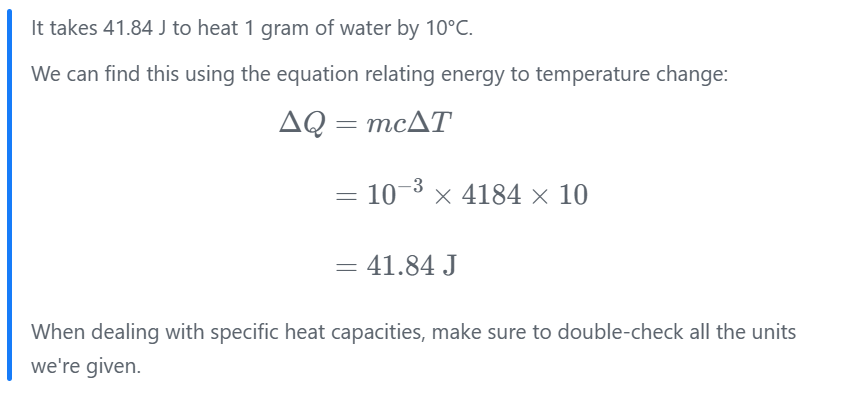
The specific heat capacity of water is 4184 J kg−1 K−1.
How much energy does it take to heat 1 gram of water by 10°C?
41.84J
True or False: Good conductors of heat typically have large specific heat capacities.
False
What are the SI units of the specific heat capacity?
Jkg-1K-1
It takes 300 J to heat 50 g of an unknown material by 7°C.
What is the specific heat capacity of this material, to 3 significant figures?
857Jkj-1K-1
Complete the sentence: The specific heat capacity is the amount of energy required to raise…
1kg of substance by 1K.
True or False: We can only experimentally measure the specific heat capacity for liquids.
False
What quantity do we nit need when calculating the energy used by an electric heater?
a) Voltage.
b) Temperature.
c) Time.
d) Current.
b
Which formula can we use to calculate the energy used by an electric heater?
E = VIt
An experiment involves heating 1 kg of fluid and timing the increase in temperature to get the specific heat capacity.
Which of these tools is NOT required for this experiment?
a) Thermometer
b) Ruler
c) Heater
d) Stopwatch
b
True or False: An experiment involves heating 1 kg of fluid and timing the increase in temperature to get the specific heat capacity.
To get the most accurate value, we should time how long it takes for the temperature to increase by exactly 1°C.
False
True or False: An experiment involves heating 1 kg of fluid and timing the increase in temperature to get the specific heat capacity.
The experimentally determined specific heat capacity will usually be higher than the theoretical value.
True
An experiment involves heating 1 kg of fluid and timing the increase in temperature to get the specific heat capacity.
What change can we make to the experiment to get a result for the specific heat capacity that's closer to the theoretical value?
a) Heat a larger volume of fluid.
b) Insulate the container that the fluid is in.
c) Perform the experiment outdoors.
d) Use a more powerful heater.
b