homeostasis in humans y3 biology 2026
 Call Kai
 Learn
Learn Practice Test
 Spaced Repetition
 Match
Match Flashcards
 Knowt Play
1/15

There's no tags or description
Looks like no tags are added yet.
Name | Mastery | Learn | Test | Matching | Spaced | Call with Kai | Chat |
|---|
No analytics yet
Send a link to your students to track their progress
16 Terms
Define homeostasis and why it is important for organisms
Homeostasis is the maintenance of a constant internal environment despite large fluctuations in the external environment.
Homeostasis allows environments to be independent from changes in external environment + blood and interstitial fluid that surround the cells constitute the INTERNAL environment are maintained within narrow limits called a steady state/set point to provide body cells with optimum conditions to carry out metabolic processes
What are the internal conditions set point/normal range? Why must these conditions be kept constant
Body temp: 36.5°C-37.5°C, changes to body temperature may result in inactivation or denaturation of enzymes within the cells
Blood pH: 7.35-7.45, enzymes activities in cells are pH sensitive
Blood water potential: isotonic (equal concentration of solutes inside and outside the cells), affects the flow of water into and out of the cells via osmosis
Blood glucose concentration: 4.4-6.1 mmol/L, affects the availability of glucose as a substrate for cellular respiration
Describe the process of negative feedback
Stimulus produces change in variable, detected by receptors,information sent along afferent pathway to the control center and compared to the set point, control center sends out information to the effectors allowing efferent pathway, effectors carries out corrective mechanisms to reverse the effect of the stimulus and sets condition back to set point
Define osmoregulation
Osmoregulation is the control of water potential and solute concentrations in the blood to maintain a constant water potential in the body
Why is osmoregulation important?
If the blood plasma becomes too diluted (blood water potential>set point), water will enter the cells by osmosis, causing body cells and tissue cells to swell and burst.
If the blood plasma becomes too concentrated (blood water potential < set point), water will move out of the cells by osmosis, causing body cells and tissue cells to be dehydrated and shrink and be unable to carry out metabolism properly
Describe osmoregulation when blood water potential < set point
When blood water potential < set point, osmoreceptors in the hypothalamus detect the decrease in water potential of the blood, pituitary gland releases more antidiuretic hormone into the blood, transported to the kidneys to cause the walls of the collecting ducts to be more permeable to water so more water is reabsorbed from glomerular filtrate into the blood capillaries/blood stream, producing a smaller volume of concentrated urine, blood water potential returns to set point/normal.
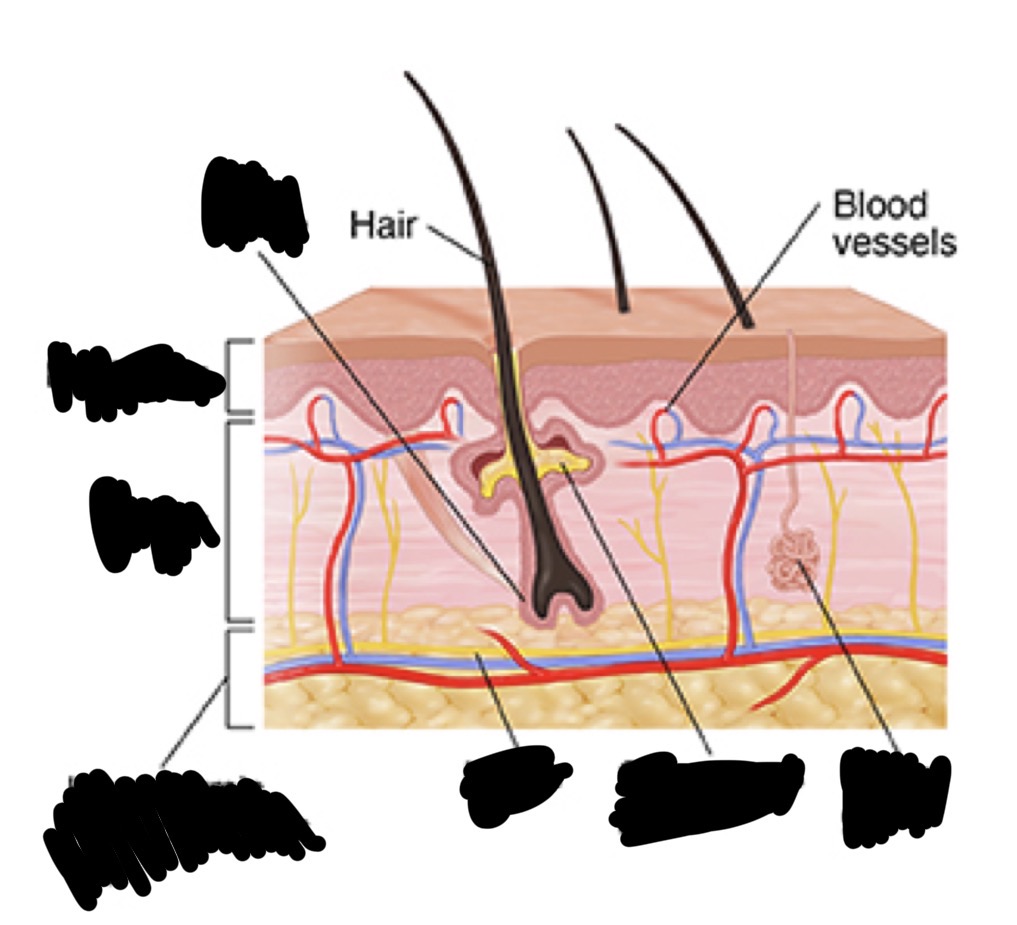
Name the covered then describe characteristics of them
Epidermis is the outermost layer and provides a protective barrier from invasion of substances into the body
The dermis has rich supply of nerves and blood vessels
Fats are stored in adipose cells found in subcutaneous layer (hypodermis) and acts as an insulating layer, helps in reducing heat loss

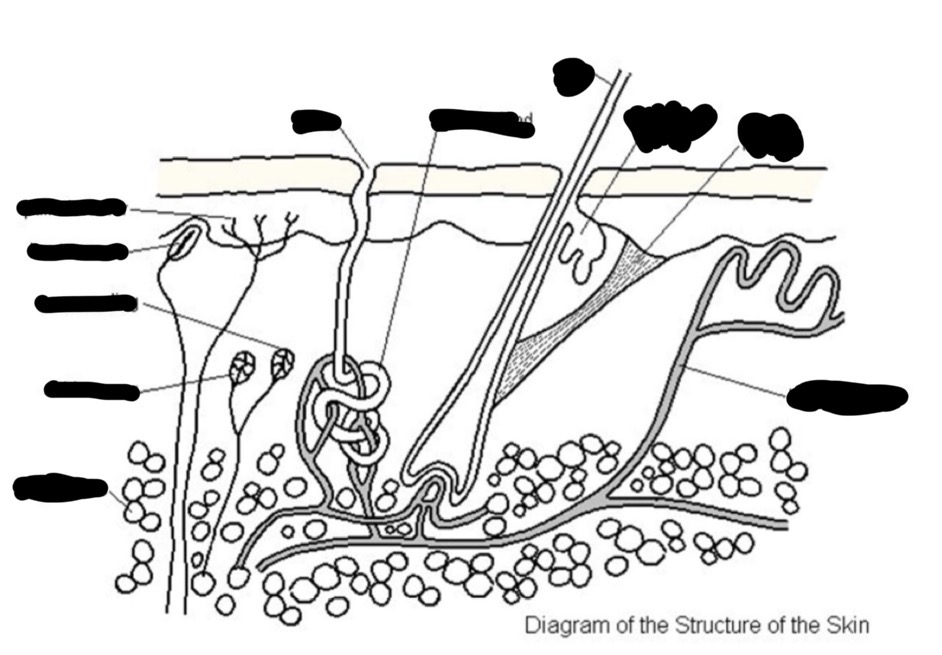
Identify the coveredd

Describe how different temperatures causes blood vessels under the skin surface to do what
skin Arterioles change diameter when SMOOTH MUSCLES contract or relax
When body temperature is high, skin Arterioles dilate (vasodilation)m more warm blood is sent to the blood capillaries under the skin surface, more heat is lost to the environment through the epidermis/skin by conduction, convection and radiation and skin appears red
When body temperature is low, skin Arterioles constrict (vasoconstriction), so less warm blood is sent to blood capillaries under the skin surface, less heat lost to the environment by conduction , convection and radiation sand skin appears pale
Describe the sweat glands in the skin and how it carries out its function when it’s too hot and told cold
A sweat gland is a coiled tube surrounded by blood capillaries and nerves. Sweat flows through a sweat duct to a sweat pore on the skin surface
Sweat consists of mostly water, dissolved salts, small amount of urea because THE SKIN IS AN EXCRETORY ORGAN
when body temperature rises above normal, sweat glands more active, more sweat is produced, more water in the more sweat on our skin evaporates. As evaporation of water requires latent heat of vaporisation which is taken from our warm skin, the skin is cooled at a faster rate as the sweat evaporates
When body temperature falls below normal, sweat glands become less, active, less sweat is produces, less water in the less sweat on our skin evaporates, less latent heat is removed from our warm skin for evaporation of the water so the skin is cooled at a slower rate.
Describe the role of sensory receptors and the types of sensory receptors (3)
Sensory receptors detect changes in the environment
Thermoreceptors found in the hypothalamus in the brain detect changes in: cold receptors, warm receptors
Mechanoreceptors detect pressure changes
Nociceptors detect pain
How does shivering help thermoregulation in cold environments
Shivering is an involuntary response to produce heat in cold environments, characterised by the rapid contraction of the skeletal muscles, releasing heat as a by-product of doing work. Mitochondria in brown adipose tissue can generate heat through non-shivering thermogenesis
How do hairs reduce heat loss in cold environments?
Each hair grows inside a hair follicle. When hair erector muscles contract, hair stands on end, skin around hair is raised causing goose pimples and hair traps a layer of still air which is a poor conductor of heat, reducing heat loss although this effect is insignificant in humans
How does the body gain and lose heat
Heat gain(internal): exithermic metabolic rxns eg cellular respiration, muscles during vigorous exercise and liver are the main organs of heat generation, heat is distributed to the rest of the body via the blood
Heat gain (external): consume hot food, stay in warm environment
Heat is loss: through the skin by conduction, convection, radiation and by evaporation of water in sweat, in faeces and urine, in exhaled air
Role of the hypothalamus in thermoregulation
The hypothalamus is the control centre which receives information from thermoreceptors in the skin to detect external temperature (peripheral/secondary) + thermorereceptors in the hypothalamus itself which detects blood temperature (central/primary)
It monitors body temperature and sends nerve impulses to effectors to bring about changes (corrective mechanisms) that promote heat production/conservation depending on the stimulus
Define thermoregulation and the processes which regulate it.
Thermoregulation is the process by which animals maintain an internal temperature within a tolerable range/set-point
Constriction or dilation of Skin Arterioles, change in sweat glands activity, skeletal muscles in shivering , relaxation or contraction of hair erector muscles, rate of metabolic processes