9 Biotechnology
 Call Kai
 Learn
Learn Practice Test
 Spaced Repetition
 Match
Match Flashcards
 Knowt Play
1/16

There's no tags or description
Looks like no tags are added yet.
Name | Mastery | Learn | Test | Matching | Spaced | Call with Kai | Chat |
|---|
No analytics yet
Send a link to your students to track their progress
17 Terms
biotechnology
The use of microbiological (microbes and microorganisms) and biochemical techniques (enzymes) to solve practical problems and produce product
→ creates protein sources that are reliably available and less expensive than traditional sources
→ genetic engineering of organisms (GMOs) using recombinant DNA techniques: methods used to manipulate DNA and genetically alter organisms
Genetically modified organisms
GMOs. Organisms that have been genetically engineered to confer useful traits
Restriction enzymes
Enzymes naturally occurring in organisms that have the ability to recognize palindromes: specific sequences in the DNA that are mirror inversions of each other, and cut them
→ palindromes are consistent throughout all of the sequences the enzymes cut
» generate restriction fragments: DNA that can be joined to other DNA pieces cut with the same restriction enzyme cut / “digest”
→ enables them to base-pair / “anneal” (DNA ligase solidifies their bond) and form recombinant DNA molecules
eg.
alul
BamHi*
EcoRI*
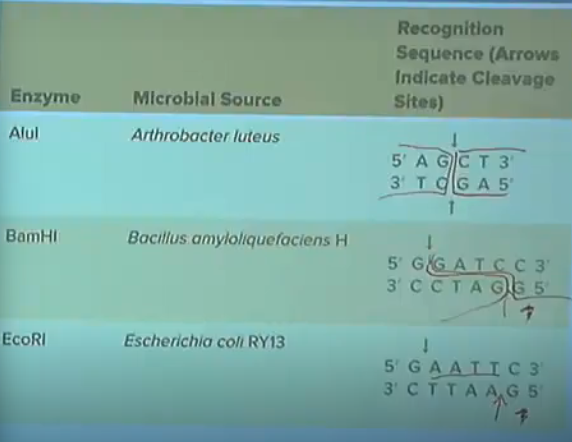
* has “sticky ends” which refers to how their sequences overhang post-cut
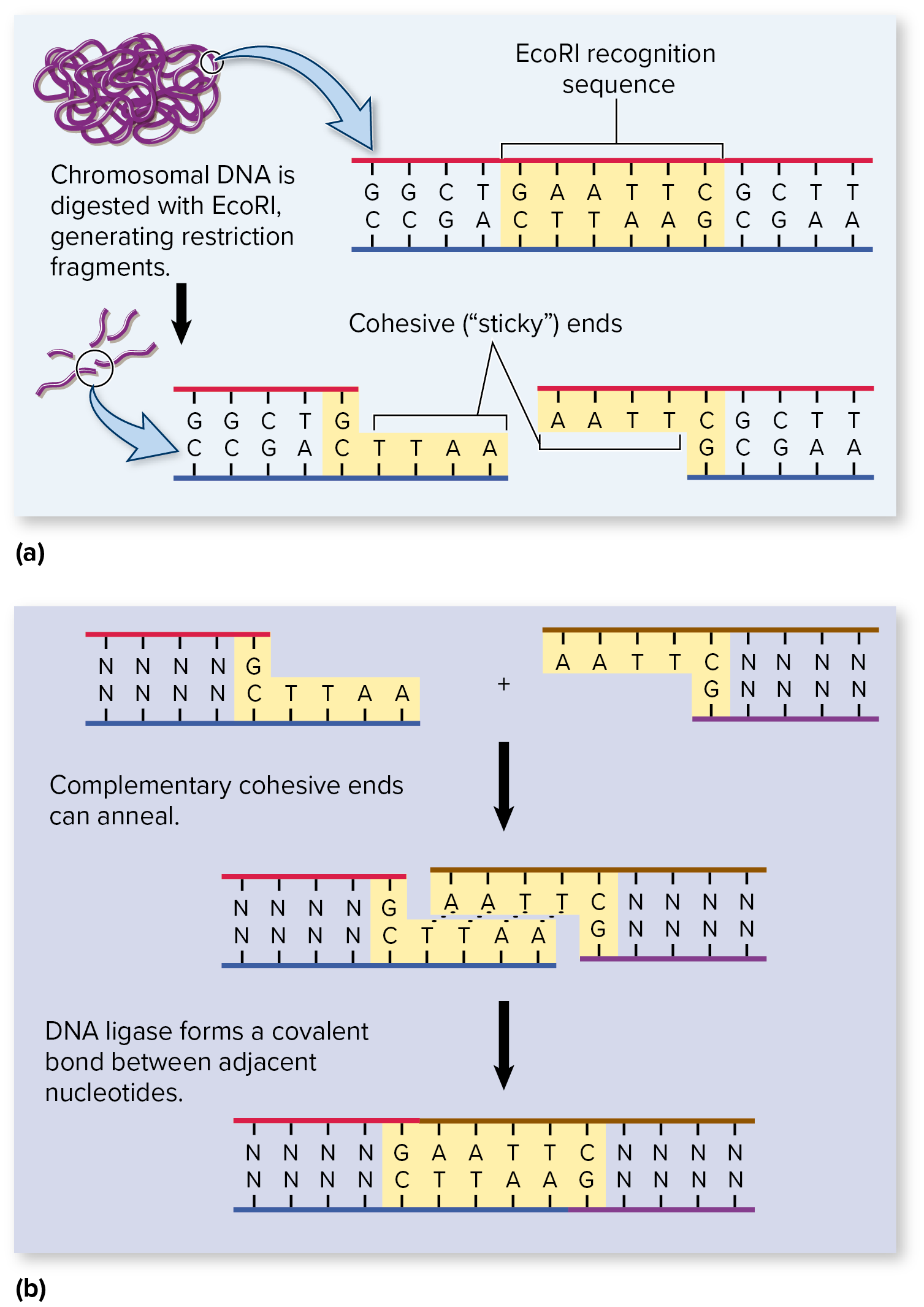
recombinant DNA molecules
DNA molecule formed by splicing together DNA cuttings from one specific restriction enzyme
→ can have DNA from humans and bacteria
DNA molecules that contain DNA from more than one organism
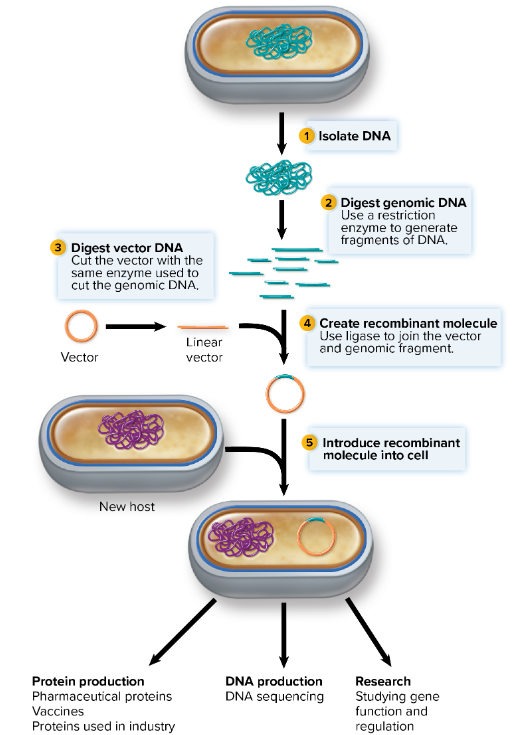
DNA cloning
Making more copies of the DNA
Procedure used to introduce altered/foreign DNA into a recipient cell that will be replicated and passed unto the cell progeny
process involves:
isolation of insert (DNA fragment) from chromosome, cut by restriction enzymes
cutting a vector: plasmid that will carry desired DNA fragment into the recipient cell
must be cut with the same restriction enzyme
joining the insert with the vector → recombinant DNA molecule
introducing the plasmid to a host cell where DNA will replicate
vector
Plasmid or bacteriophage.
Has many features that make it invaluable for cloning, such as:
origin of replication » enables plasmid to make more copies of itself independent of the chromosome (can be in thousands)
multiple-cloning sites » sites that contains multiple restriction sites: recognition sequences of a restriction enzyme
gets cut and desired DNA for cloning (inserts) gets inserted here
selectable marker » gene that enables researchers to eliminate cells that have not taken up molecules containing the [__] sequences
provides the cell immunity to be grow on selective media that are typically anti-microbial » kills cells that don’t have it otherwise
eg. ampicillin » NA-Ampicillin is the most common culture media
selective environment ensures only bacteria with the [__] grow
second marker » helps distinguish cells with successful recombinant plasmid (has the blue insert), from what would be just an intact vector (just red)
![<p>Plasmid or bacteriophage.</p><p><u>Has many features that make it invaluable for cloning, such as:</u></p><ul><li><p><mark data-color="#f4eeee" style="background-color: rgb(244, 238, 238); color: inherit;">origin of replication</mark> » enables plasmid to make more copies of itself independent of the chromosome (can be in thousands)</p></li></ul><div data-type="horizontalRule"><hr></div><ul><li><p><mark data-color="#f4eeee" style="background-color: rgb(244, 238, 238); color: inherit;">multiple-cloning sites</mark> » <mark data-color="yellow" style="background-color: yellow; color: inherit;">sites that contains multiple </mark><strong><mark data-color="purple" style="background-color: purple; color: inherit;">restriction sites</mark></strong><mark data-color="yellow" style="background-color: yellow; color: inherit;">: recognition sequences of a restriction enzyme</mark></p><ul><li><p>gets cut and <mark data-color="yellow" style="background-color: yellow; color: inherit;">desired DNA for cloning</mark> (<strong><mark data-color="purple" style="background-color: purple; color: inherit;">inserts</mark></strong>) gets inserted here</p></li></ul></li></ul><div data-type="horizontalRule"><hr></div><ul><li><p><mark data-color="#f4eeee" style="background-color: rgb(244, 238, 238); color: inherit;">selectable marker</mark> » gene that enables researchers to eliminate cells that have not taken up molecules containing the [__] sequences</p><ul><li><p>provides the cell immunity to be grow on selective media that are typically anti-microbial » kills cells that don’t have it otherwise</p><ul><li><p><u>eg.</u> <strong>ampicillin </strong>» <strong><mark data-color="blue" style="background-color: blue; color: inherit;">NA-Ampicillin</mark></strong> is the most common culture media</p></li></ul></li><li><p><mark data-color="yellow" style="background-color: yellow; color: inherit;">selective environment ensures only bacteria with the [__] grow</mark></p></li></ul></li></ul><div data-type="horizontalRule"><hr></div><ul><li><p><mark data-color="#f4eeee" style="background-color: rgb(244, 238, 238); color: inherit;">second marker</mark> » <mark data-color="yellow" style="background-color: yellow; color: inherit;">helps distinguish cells with successful recombinant plasmid</mark> (has the blue insert), <mark data-color="yellow" style="background-color: yellow; color: inherit;">from what would be just an intact vector</mark> (just red)</p></li></ul><img src="https://assets.knowt.com/user-attachments/fc32c261-42ec-485f-ad3f-d9214051dc0b.png" data-width="100%" data-align="center"><p></p>](https://assets.knowt.com/user-attachments/d05c1d70-3397-4a12-ad99-05342fc3f0c8.png)
Vector pUC18
One of the most common recombinant DNA
selectable marker » ampicillin resistance
grown on an NA-Ampicillin culture media
second genetic marker » lac’Z gene
produces Beta-galactosidase, which interacts with the color-less substrate X-gal added to the media
→ cleaves it to produce a blue compound
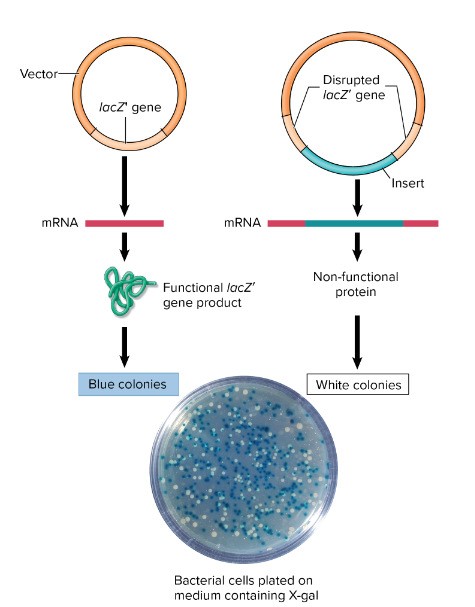
intact vector (no recombinant) » intact lac’Z → blue
broken vector (HAS recombinant) » white
transgenic
Uses for GMOs and DNA cloning:
DNA production » study genes, identify organisms
Protein production » human insulin, vaccines, chymosin (rennin) for cheese production via coagulation
Genetically altered plants » pest-resistant, herbicide-resistant, improved nutrient value, edible vaccines
another word for GMO’s like these are [__] organisms
reverse transcriptase
Enzyme produced by retroviruses
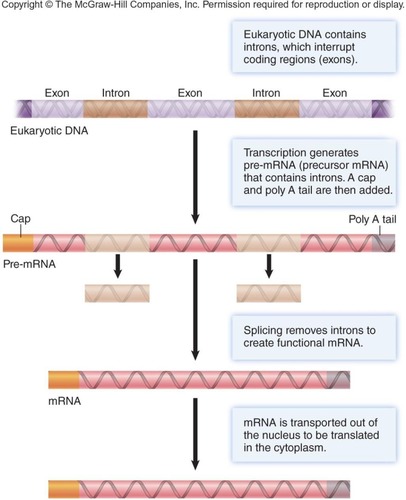
reverse transcription: uses RNA as template to make DNA → cDNA » complementary DNA
useful for:
generating eukaryotic libraries that are intron-free copies of eukaryotic genes
introns = noncoding regions, removed in transcription of DNA to mRNA. plasmids in bacteria lack this mechanism
if plasmids were given the original DNA, its proteins produced would have faulty proteins produced by introns
as mRNA only contains exons, it can be used to reverse engineer to an accurate form of DNA that can be replicated in bacteria
gene expression studies
electrophoresis
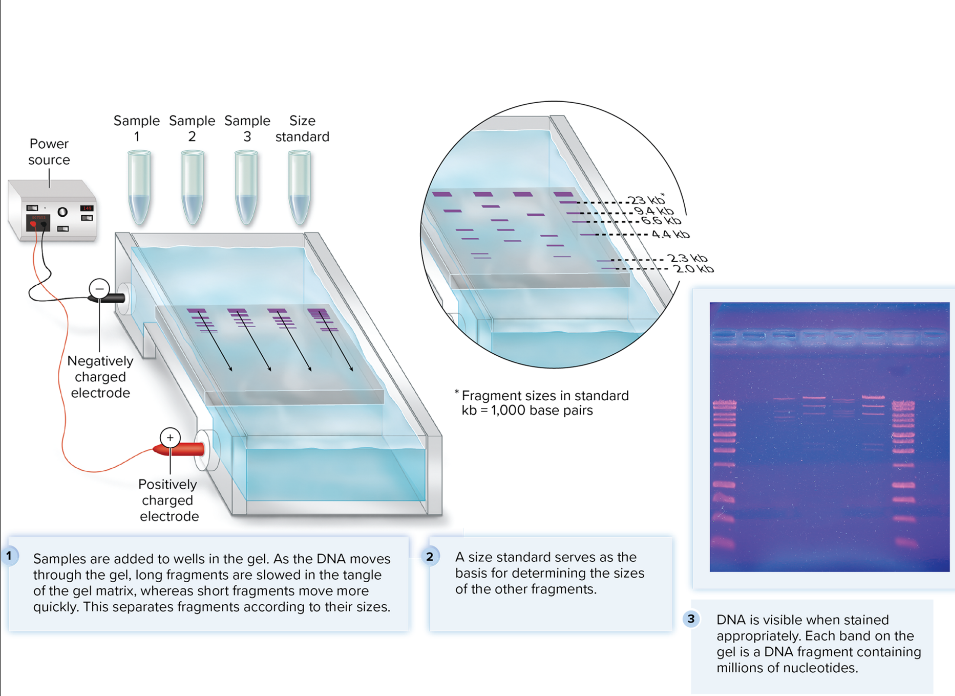
Technique that separates DNA, RNA, and proteins according to their size
Set up:
DNA is put into wells in gel
gel subjected to electric current (two polar charged electrodes at ends)
Result:
DNA migrates towards the (+) electrode as it is negatively charged; smaller fragments migrate faster and closer to the buffer solution. Usually have markers to indicate size
DNA are stained for viewing.
DNA and RNA sequencing
Process of determining the order of nucleotides in DNA and RNA
Next-generation sequencing » much quicker and cheaper
as low as $70, takes a few hours
Sequencing projects:
Human Genome (1990) » wanted to sequence whole genome of humans
Human microbiome (2007) » wanted to sequence microbes found on human body
Earth BioGenome (2018) » effort to sequence genome of all known animals, plants, protozoan, and fungal species
applications
[___] of DNA sequencing can:
help identify genetic alterations that may result in disease
Sickle cell anemia » single base-pair change in gene → point mutation (substitution)
Cystic fibrosis » 3 base-pair deletion
Breast cancer » mutation in BRCA1 or BRCA2 gene
Detect and trace infectious diseases by the CDC
eg. foodborne illnesses » sequence genome of organism and place it into cloud and track if other people encountered the same gene
Assist in studying evolutionary relatedness of organisms
polymerase chain reaction
Allows exponential amplification of DNA → creation of over a billion copies of a given region of DNA in hours. Exponential (multiplies by 2 per cycle) Can do without culturing.
Reaction requirements:
Target DNA » serves as template
Primers: short, synthetic DNA sequences that are complementary to and mark starting point for DNA synthesis
determines region of target DNA to amplify
Taq polymerase: heat-stable, DNA polymerase. assembles new DNA strand by adding nucleotides to primers
Deoxynucleotides: building blocks used by the enzyme to construct new DNA strands
dATP, dGTP, dCTP, dTTP
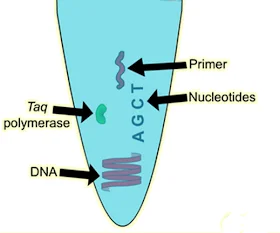
primers
Short, single-stranded DNA fragments that bind to the complementary sequences in target DNA for replication
defines target sequence to be amplified and determines length of PCR product
repeatedly cleaves longer DNA into shorter ones, and using the shorter ones as a template
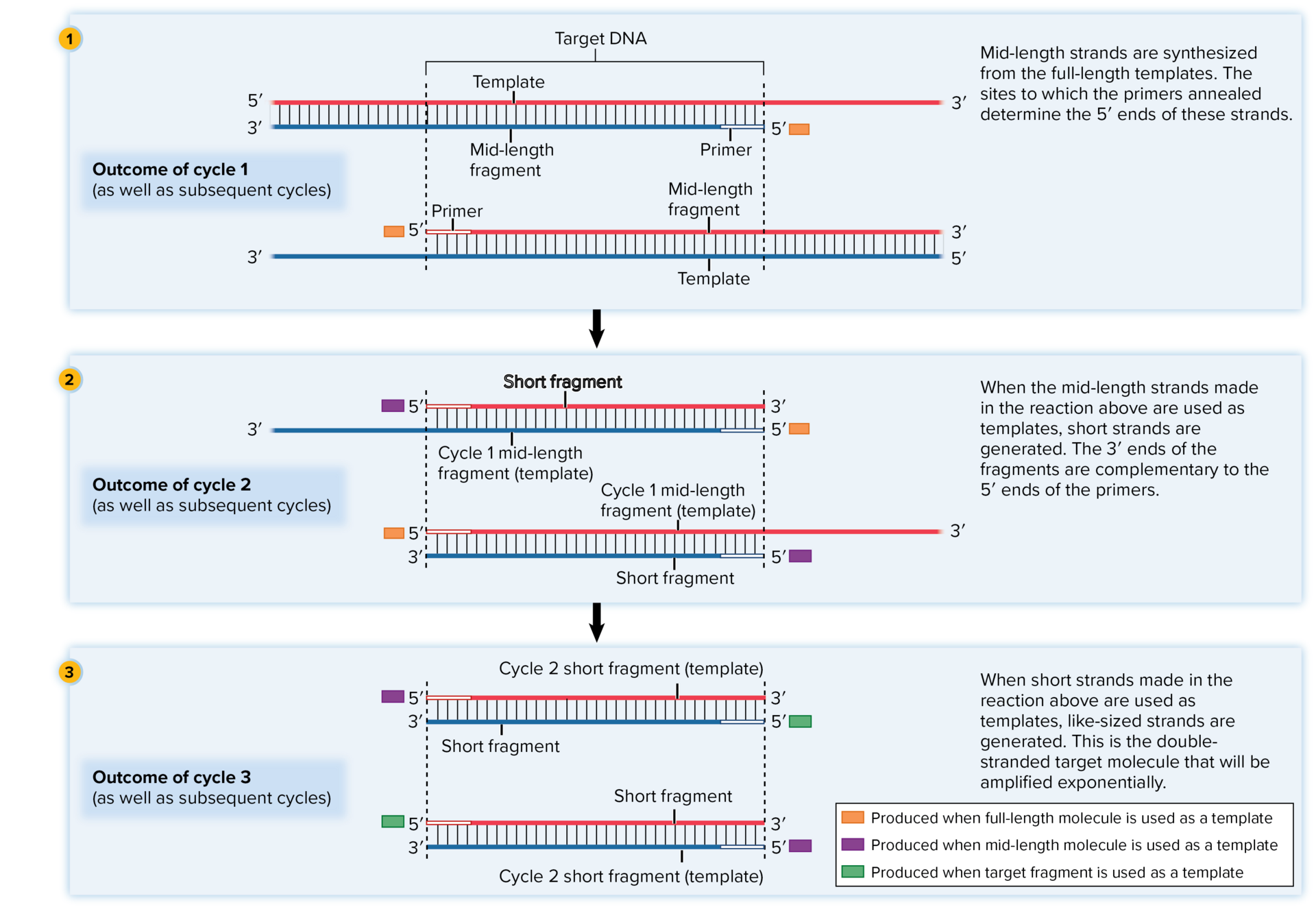
denaturation
The Three Step Amplification Cycle of PCR:
[___]: DNA strands split by heat (~95 C)
Annealing: primers anneal/bind to target DNA sequence (~50-60 C)
Extension: DNA synthesis by Taq polymerase (~68-72 C)
![<p><u>The Three Step Amplification Cycle of PCR:</u></p><ol><li><p><mark data-color="purple" style="background-color: purple; color: inherit;">[___]</mark>: DNA strands split by heat (~95 C)</p></li><li><p><mark data-color="purple" style="background-color: purple; color: inherit;">Annealing</mark>: primers anneal/bind to target DNA sequence (~50-60 C)</p></li><li><p><mark data-color="purple" style="background-color: purple; color: inherit;">Extension</mark>: DNA synthesis by Taq polymerase (~68-72 C)</p></li></ol><p></p>](https://assets.knowt.com/user-attachments/f257299f-2bd0-4ae5-801d-b9ef143df0b5.png)
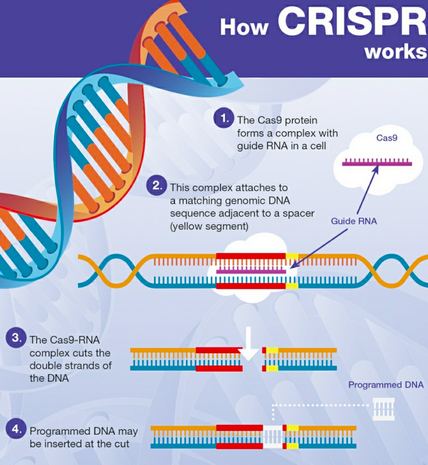
CRISPR-Cas
[___] technology are gene editing tools that can:
» locate, cut out, replace, or add targeted changes to nucleotide sequence of living cell genome
uses
Cas9: enzyme that makes double-stranded cut of DNA at a specific location so a new sequence can be inserted
Guide RNA: pre-designed RNA sequence that recognizes desired DNA sequence
placed in Cas9 alongside the insert/DNA fragment that will be inserted
guides Cas9 to target sequence
![<p>[___] technology are <mark data-color="yellow" style="background-color: yellow; color: inherit;">gene editing tools that can:</mark></p><p><mark data-color="yellow" style="background-color: yellow; color: inherit;">» locate, cut out, replace, or add targeted changes to nucleotide sequence of living cell genome</mark></p><p></p><p><u>uses</u></p><ul><li><p><mark data-color="purple" style="background-color: purple; color: inherit;">Cas9</mark>: <mark data-color="yellow" style="background-color: yellow; color: inherit;">enzyme that makes double-stranded cut of DNA at a specific location so a new sequence can be inserted</mark></p></li><li><p><mark data-color="purple" style="background-color: purple; color: inherit;">Guide RNA</mark>: pre-designed RNA sequence that recognizes desired DNA sequence</p><ul><li><p><mark data-color="yellow" style="background-color: yellow; color: inherit;">placed in Cas9 alongside the insert/DNA fragment that will be inserted</mark></p></li><li><p><mark data-color="yellow" style="background-color: yellow; color: inherit;">guides Cas9 to target sequence</mark></p></li></ul></li></ul><p></p>](https://assets.knowt.com/user-attachments/0d1d8ae9-ad95-4973-9e50-35bb26be68fa.png)
gene therapy
Use of genetic engineering technologies to manipulate DNA in humans to treat genetic diseases
clinical trials are assessing usage of Cas9 in [__]
eg. hemophilia has been cured using Cas9