BIO 201 Chapter 4: Cell Junctions
 Call Kai
 Learn
Learn Practice Test
 Spaced Repetition
 Match
Match Flashcards
 Knowt Play
1/6

There's no tags or description
Looks like no tags are added yet.
Name | Mastery | Learn | Test | Matching | Spaced | Call with Kai | Chat |
|---|
No analytics yet
Send a link to your students to track their progress
7 Terms
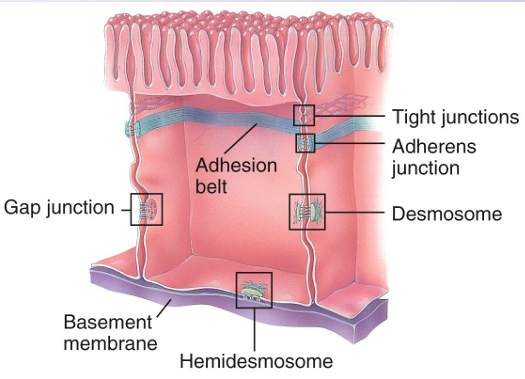
Cell junctions
contact points between plasma membranes of adjacent tissue cells
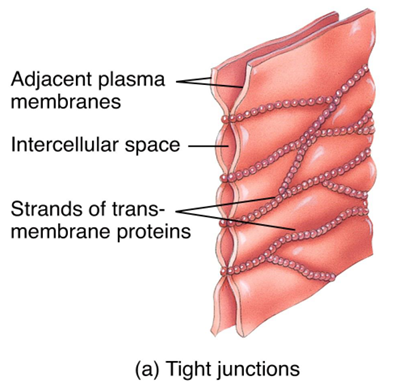
Tight junctions
Consists of weblike strands of transmembrane proteins that fuse together the outer surfaces of adjacent plasma membranes to seal off passageways between adjacent cells
Prevents contents of organs from leaking into blood or surrounding tissue
Ex. lining of intestines, stomach, bladder

Adhering junctions
Contain plaque which attaches to membrane proteins and microfilaments of the cytoskeleton
Help prevent epithelial surfaces from separating during contractile activities, involved in dynamic cell interactions
Ex. food moving through intestines
Cadherin
transmembrane glycoproteins that insert into plaque from opposite the plasma membrane, connecting to cadherins of the adjacent cell; along with microfilaments (actin filaments), forms adhesion belt
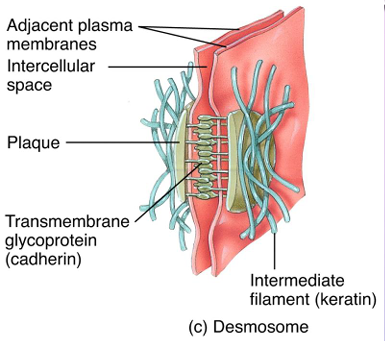
Desmosomes
Contain plaque and cadherins; however, they instead connect to intermediate filaments
Spot weld-like junctions
Prevent epithelial cells from separating under tension and cardiac cells separating during contraction
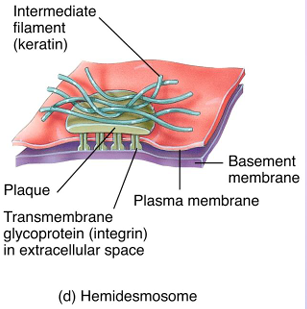
Hemidesmosomes
Integrins attach to intermediate filaments made of keratin
Anchor cells not to each other but to basement membrane

Gap junctions
Connexin proteins form tunnels (connexons) that connect neighboring cells
Allow diffusion of ions (nutrients) from cytosol of one cell to another
Ex. developing embryo, nerve communication with contractile muscles