Post-E1: CH. 35
 Call Kai
 Learn
Learn Practice Test
 Spaced Repetition
 Match
Match Flashcards
 Knowt Play
1/74

There's no tags or description
Looks like no tags are added yet.
Name | Mastery | Learn | Test | Matching | Spaced | Call with Kai | Chat |
|---|
No analytics yet
Send a link to your students to track their progress
75 Terms
If you cut a stem with scissors, the xylem sap will
not leak out, because it is under negative pressure
If you cut a stem with scissors, the phloem sap will
leak out because it is under positive pressure
Sugars move…
from source to sink!
sugars in phloem sap can move both up or down, unlike xylem which only moves up!
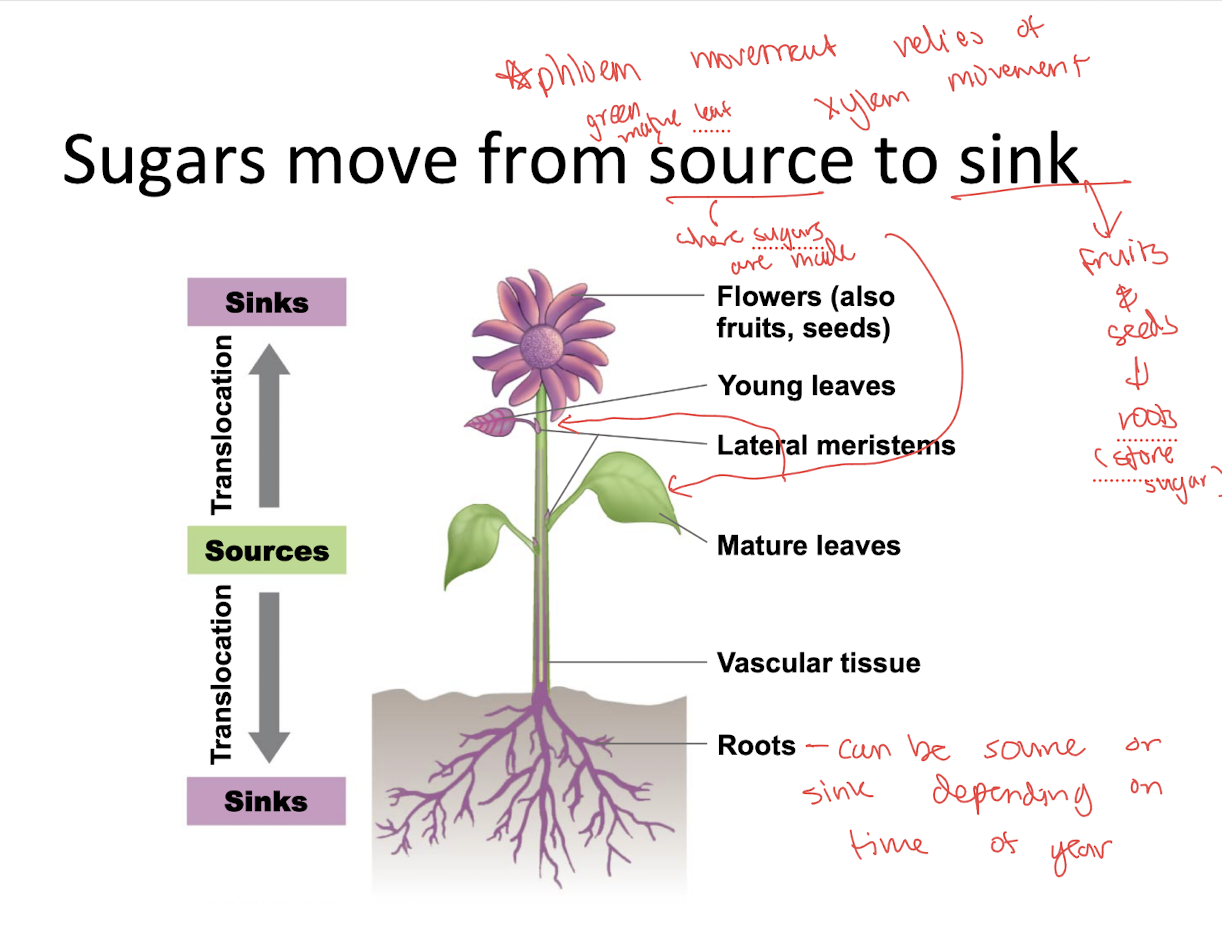
What is translocation?
The movement of sugars (mainly sucrose) through the phloem from sources to sinks by bulk flow.
What is a source?
A tissue where sugar enters the phloem because it produces or releases more sugar than it uses.
where sugars are made
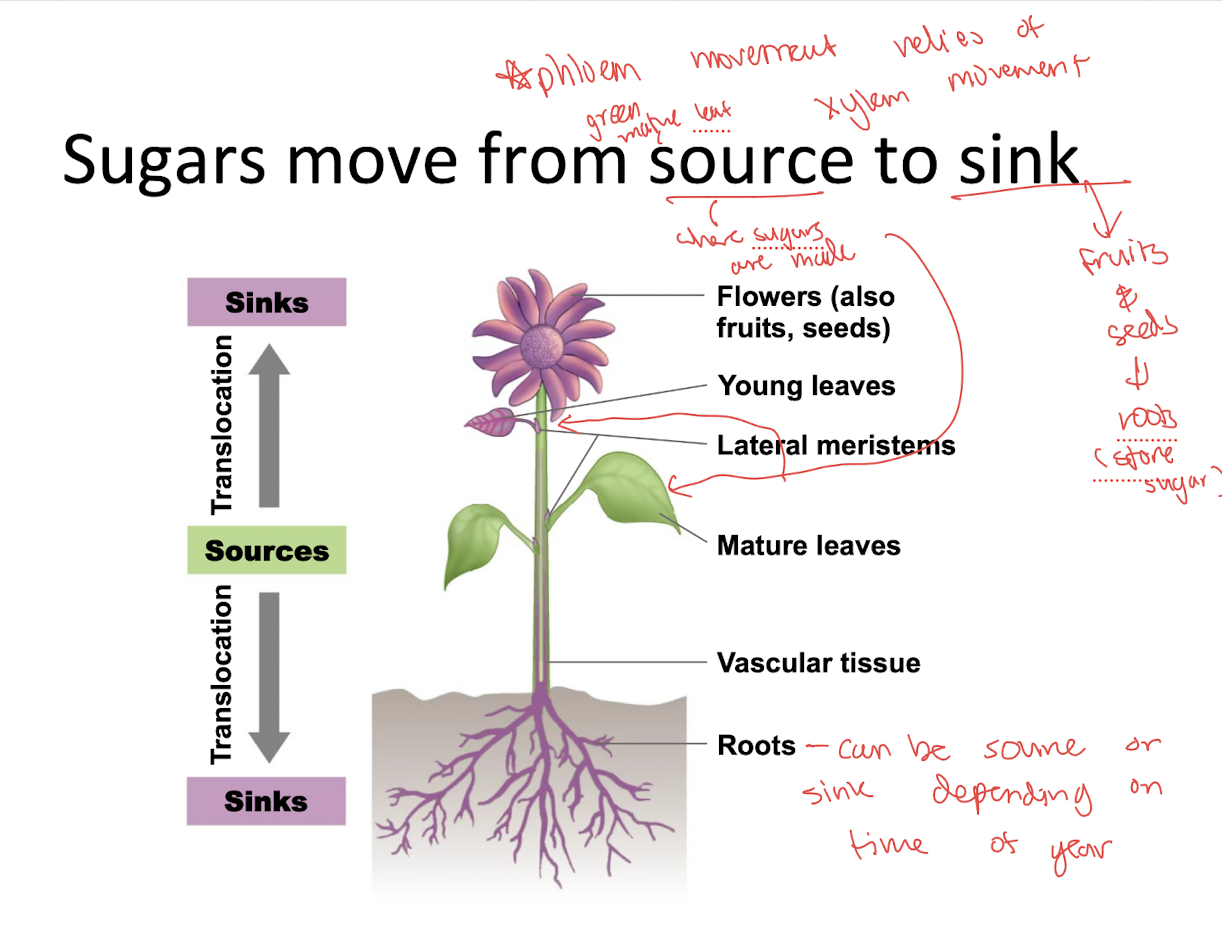
What is a sink?
A tissue where sugar leaves the phloem because it uses or stores more sugar than it produces.
where sugar is stored or used
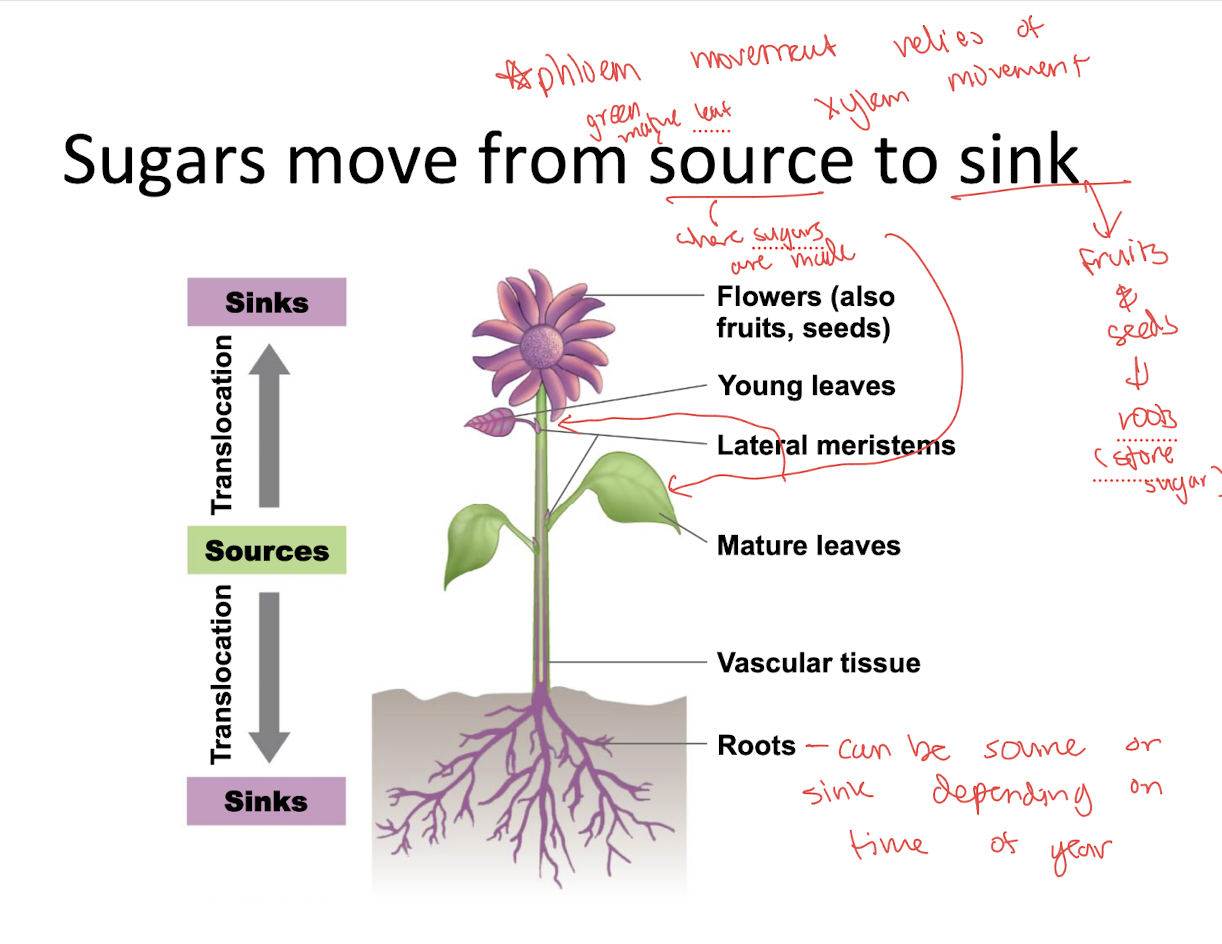
Which tissues are sources during the growing season?
Mature photosynthetic leaves
Mature green stems
Any tissue actively producing excess sugar
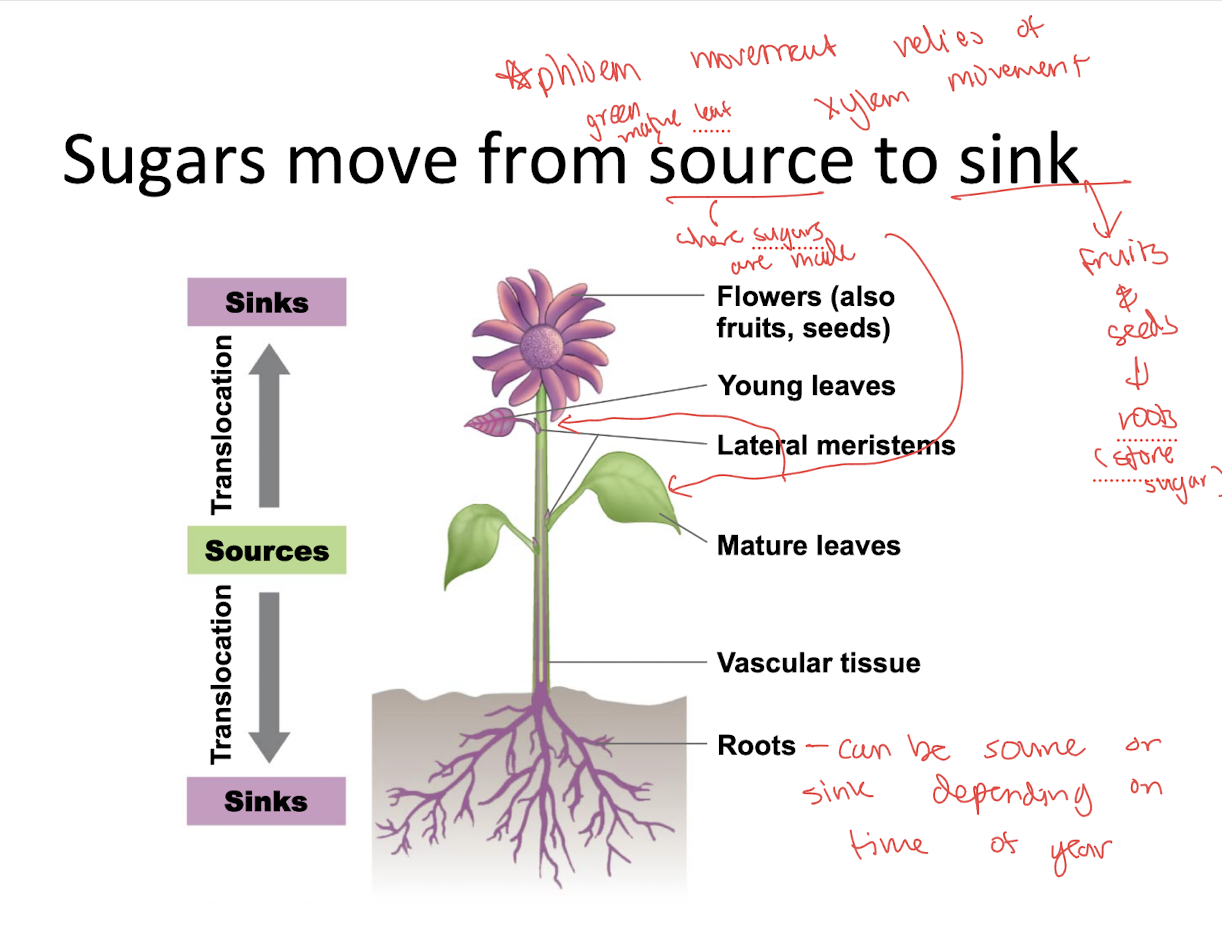
Which tissues are sinks during the growing season?
Roots (storage)
Flowers
Fruits
Seeds
Young/developing leaves
Apical meristems
Lateral meristems
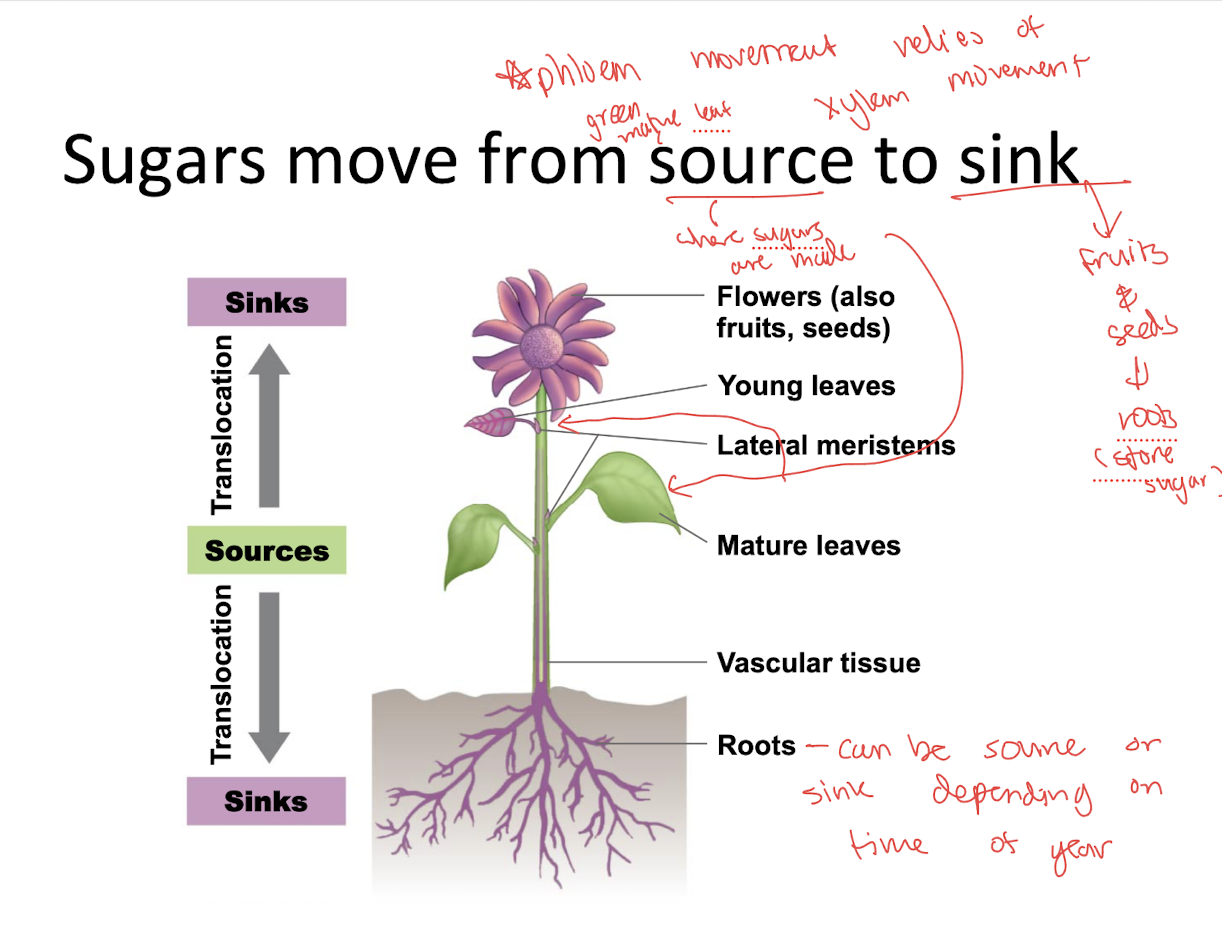
Why are young leaves sinks instead of sources?
They have not yet developed enough photosynthetic capacity, so they import sugar for growth.
Why are roots sinks during the growing season?
They store excess carbohydrates produced by photosynthesis.
Can plant tissues switch between being sources and sinks?
Yes. Their role depends on the season and developmental stage.
What happens during early spring when growth resumes?
Stored sugars in roots/stems become sources.
Developing shoots and leaves become sinks.
Why do roots become sources in early spring?
Stored sugars are transported upward to nourish new shoot and leaf growth before photosynthesis begins.
Does phloem transport occur in only one direction?
No. Overall transport can occur in either direction depending on where sources and sinks are located, although within an individual sieve tube at a given time, flow is one-way (source → sink).
What does xylem transport?
Water and dissolved minerals.
What does phloem transport?
Primarily sucrose, along with amino acids, hormones, minerals, and signaling molecules.
Are xylem cells alive or dead at maturity?
Dead
Why can xylem cells be dead?
Water moves passively through hollow tubes, so living cytoplasm is unnecessary.
Which xylem cells conduct water?
Vessel elements (angiosperms)
Tracheids
Which plants have only tracheids?
Gymnosperms
Which plants have both vessel elements and tracheids?
Angiosperms
What are pits in xylem?
Thin regions of the cell wall that allow lateral movement of water between adjacent xylem cells.
in both tracheids & vessel elements
Which phloem cells transport sugars long distances?
Sieve-tube elements.
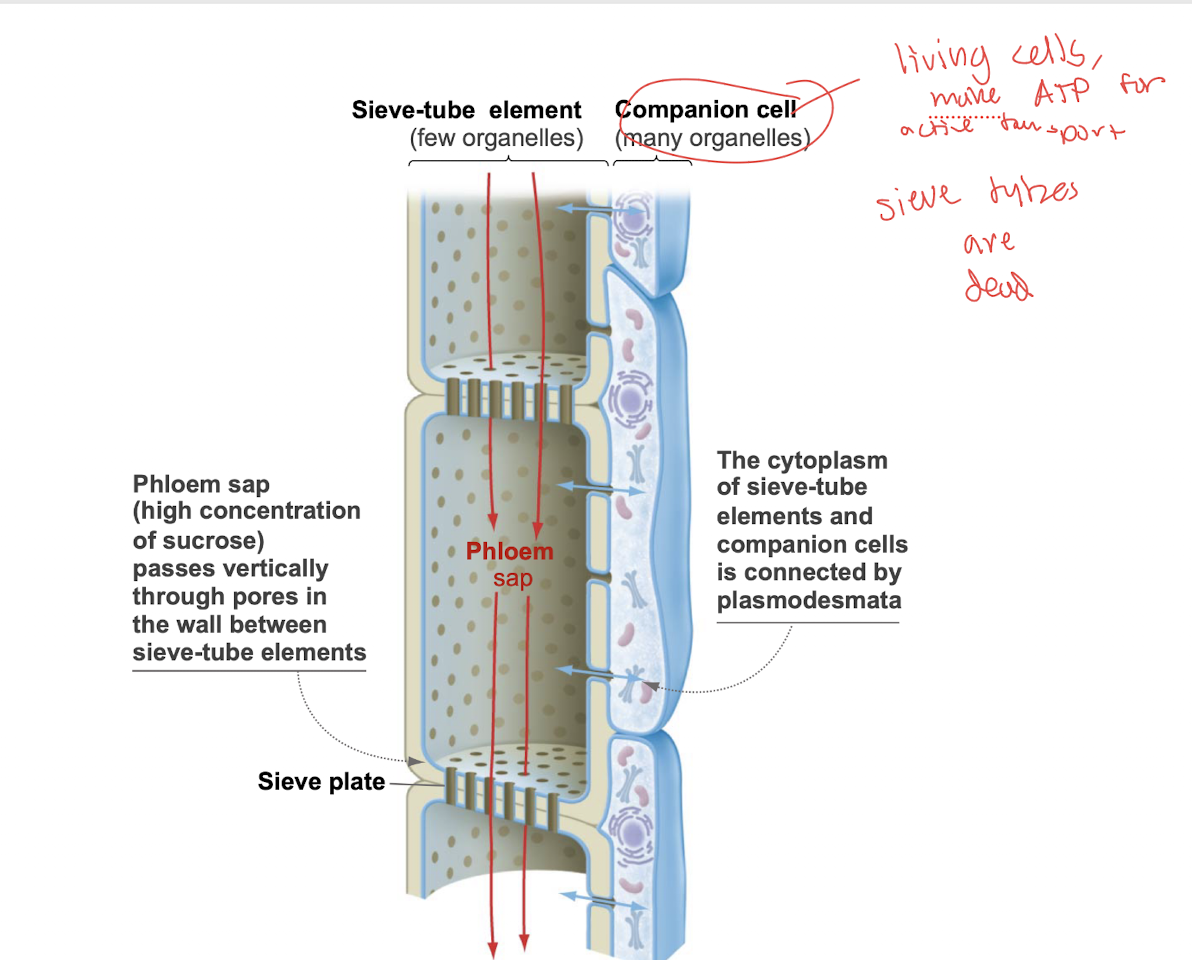
What are sieve plates?
Perforated end walls between sieve-tube elements
Sieve plates are enlarged pores between adjacent sieve-tube elements
openings represent regions with no cell wall → phloem sap can easily move between cells
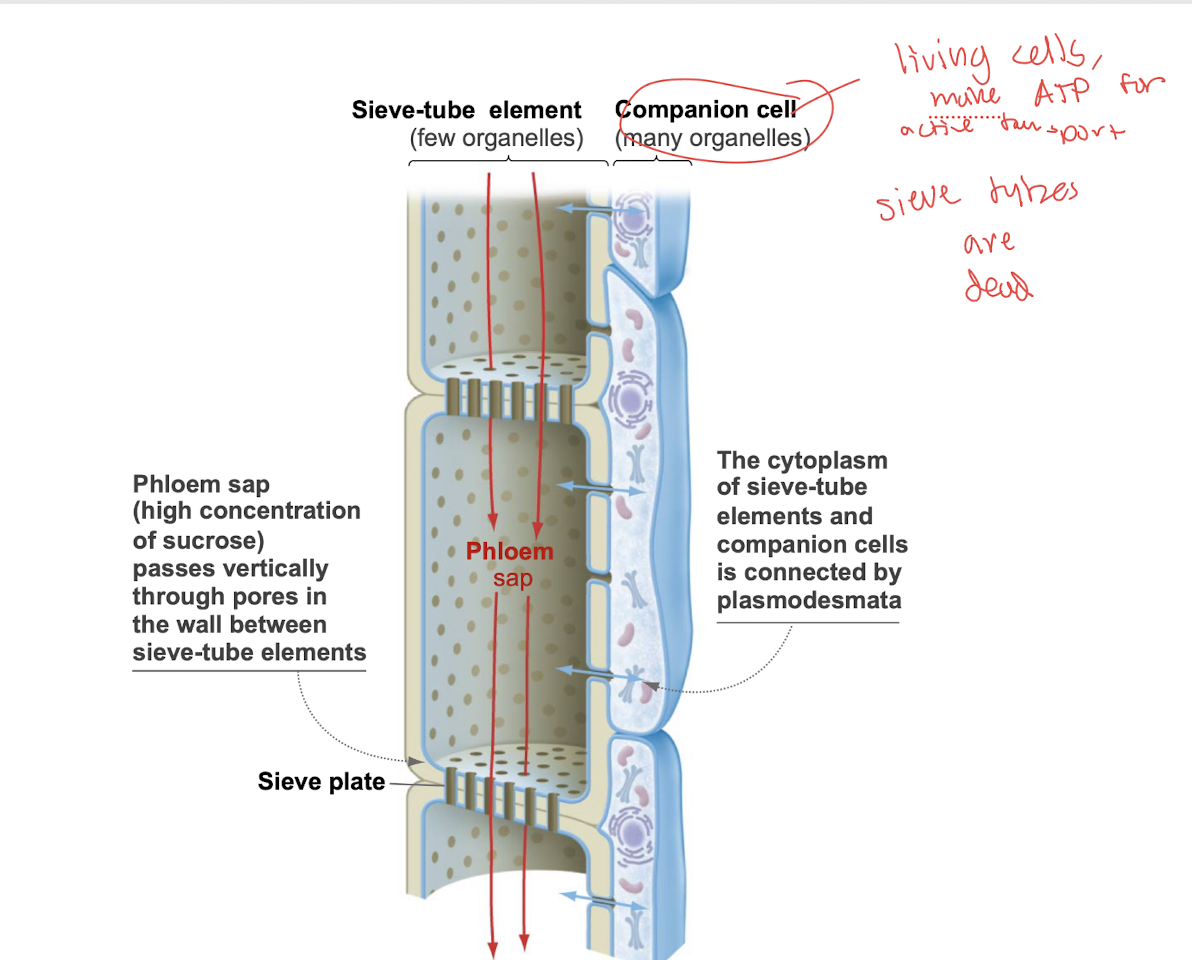
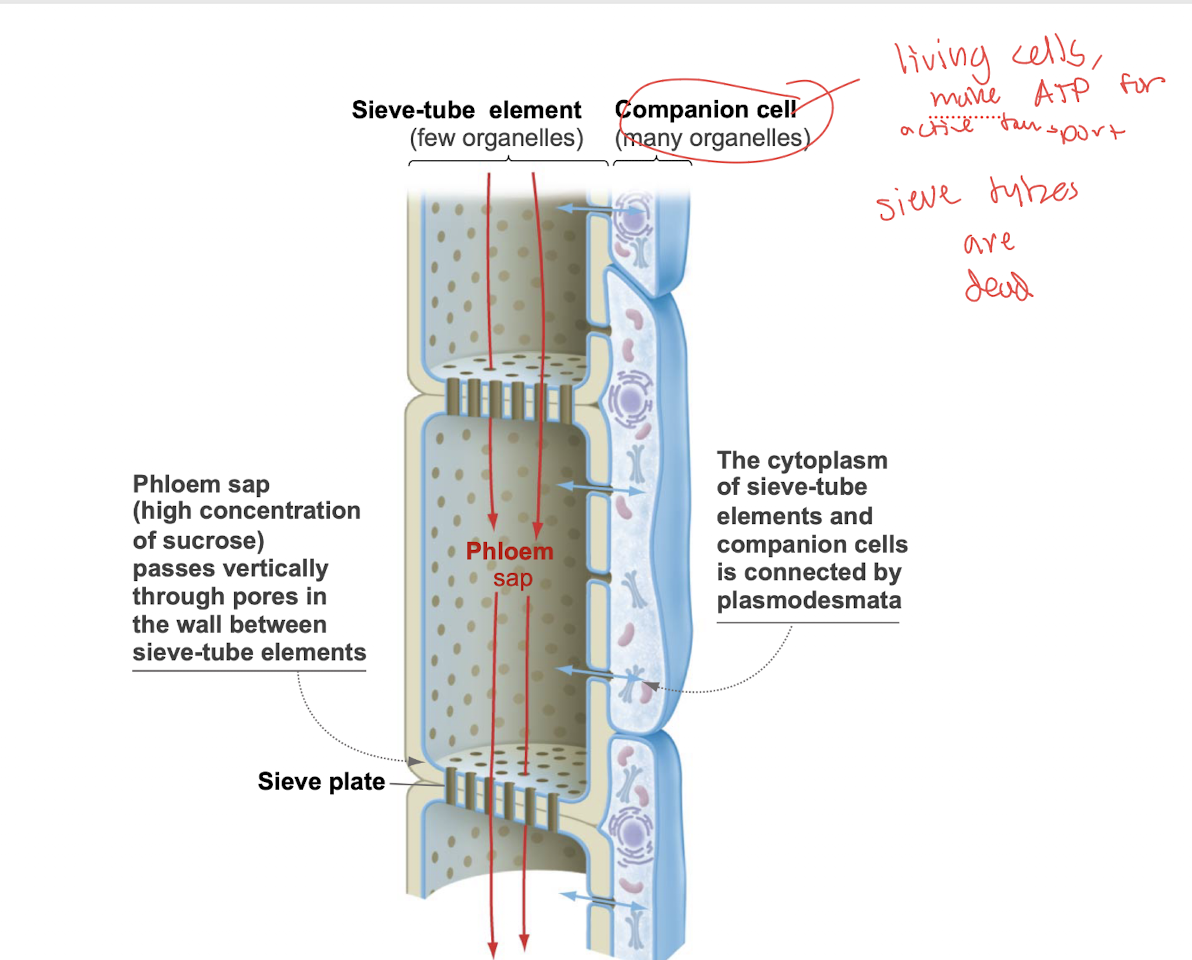
What organelles do sieve-tube elements lack?
They lack a nucleus and most organelles.
Why are companion cells necessary?
They perform metabolic functions and provide ATP, proteins, and transport support for sieve-tube elements.
How are companion cells connected to sieve-tube elements?
By plasmodesmata.
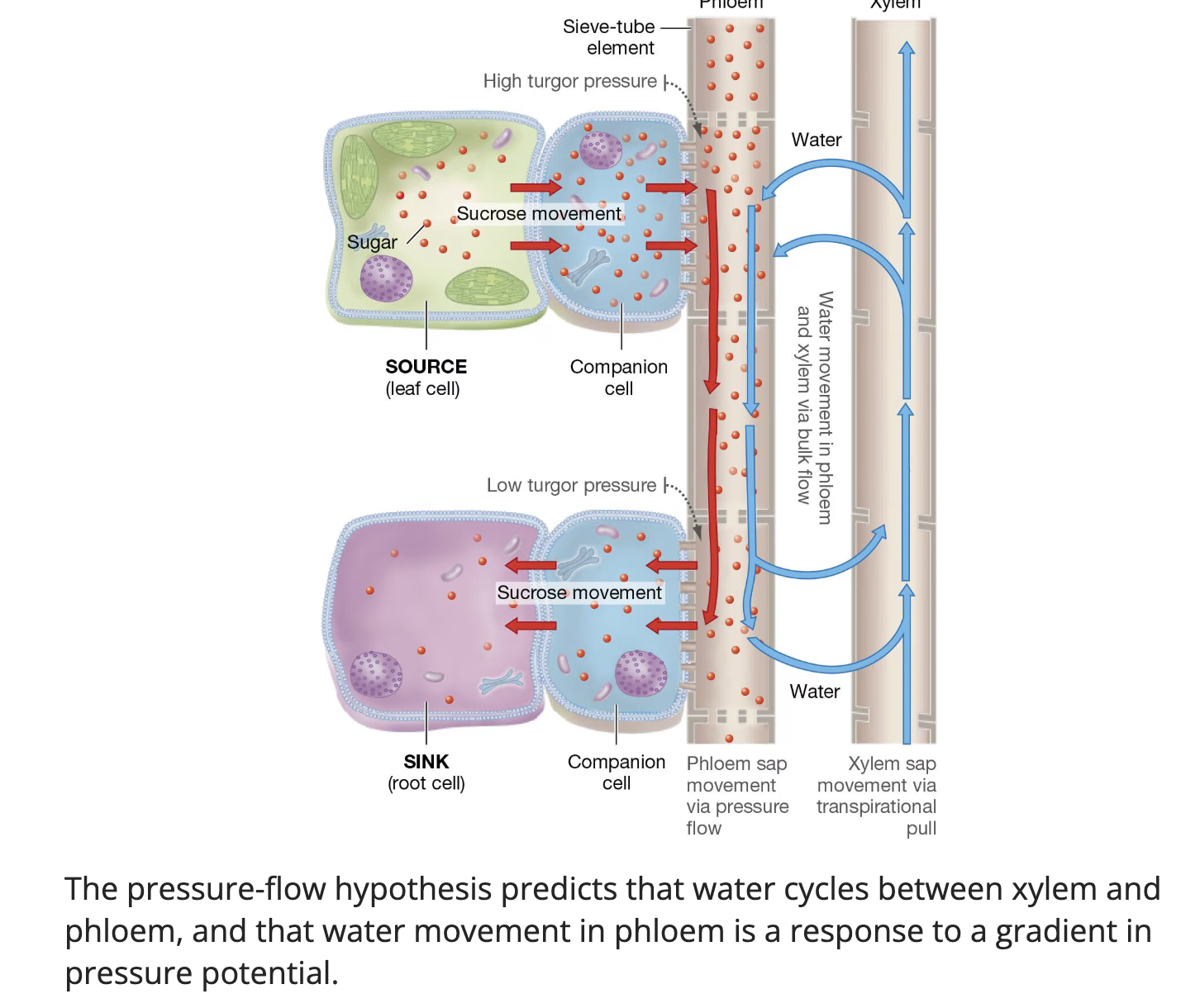
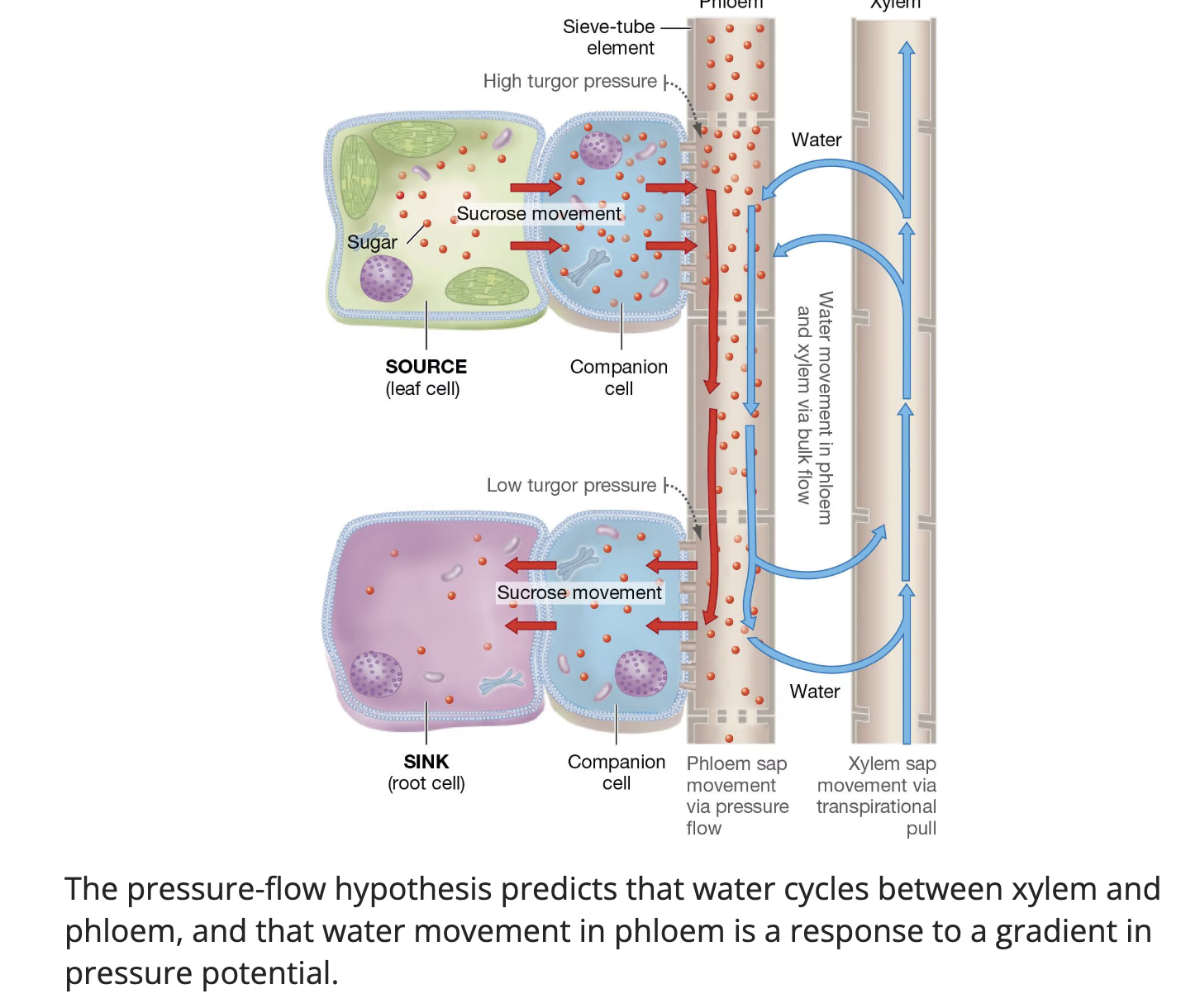
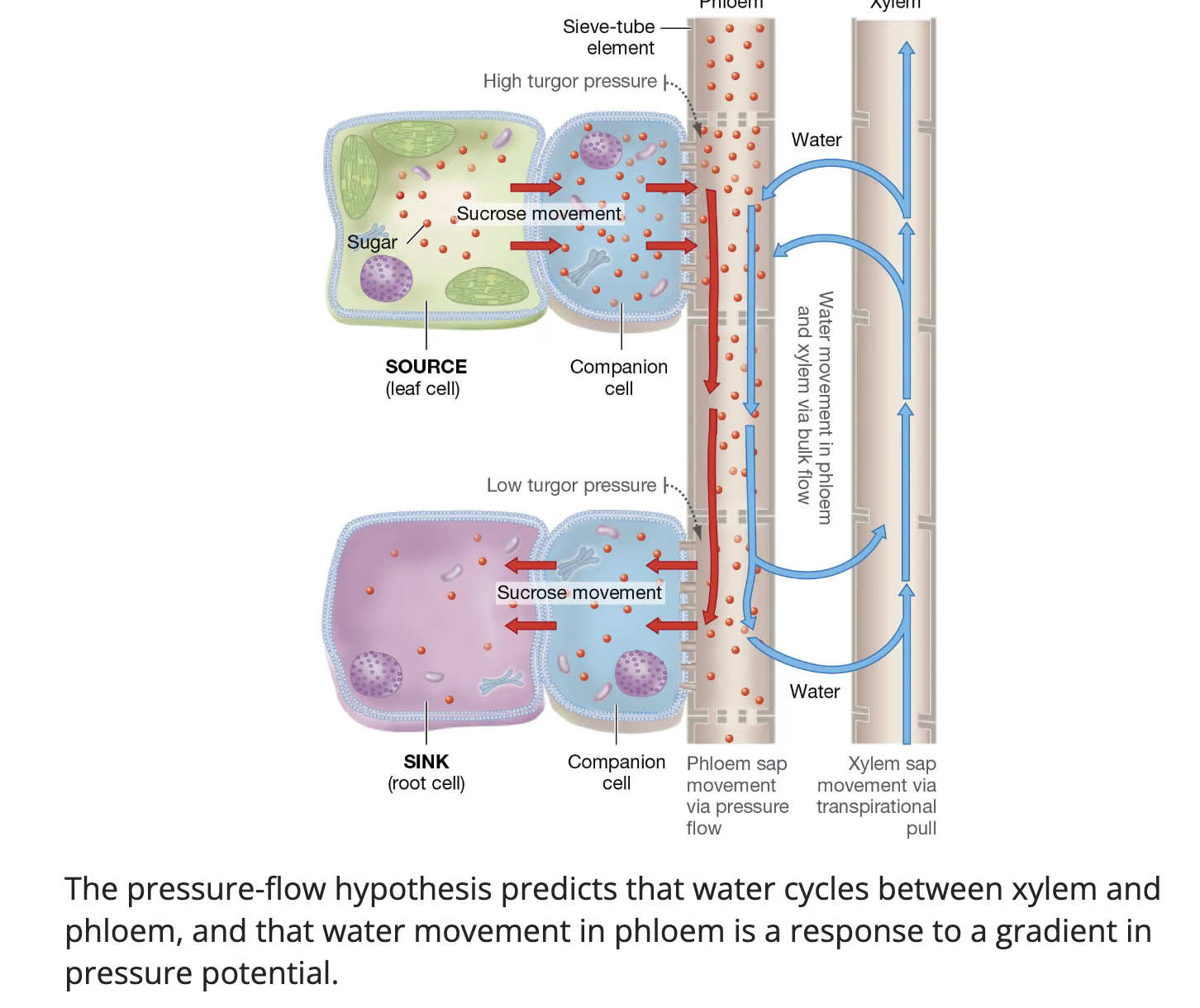
Pressure-Flow Hypothesis
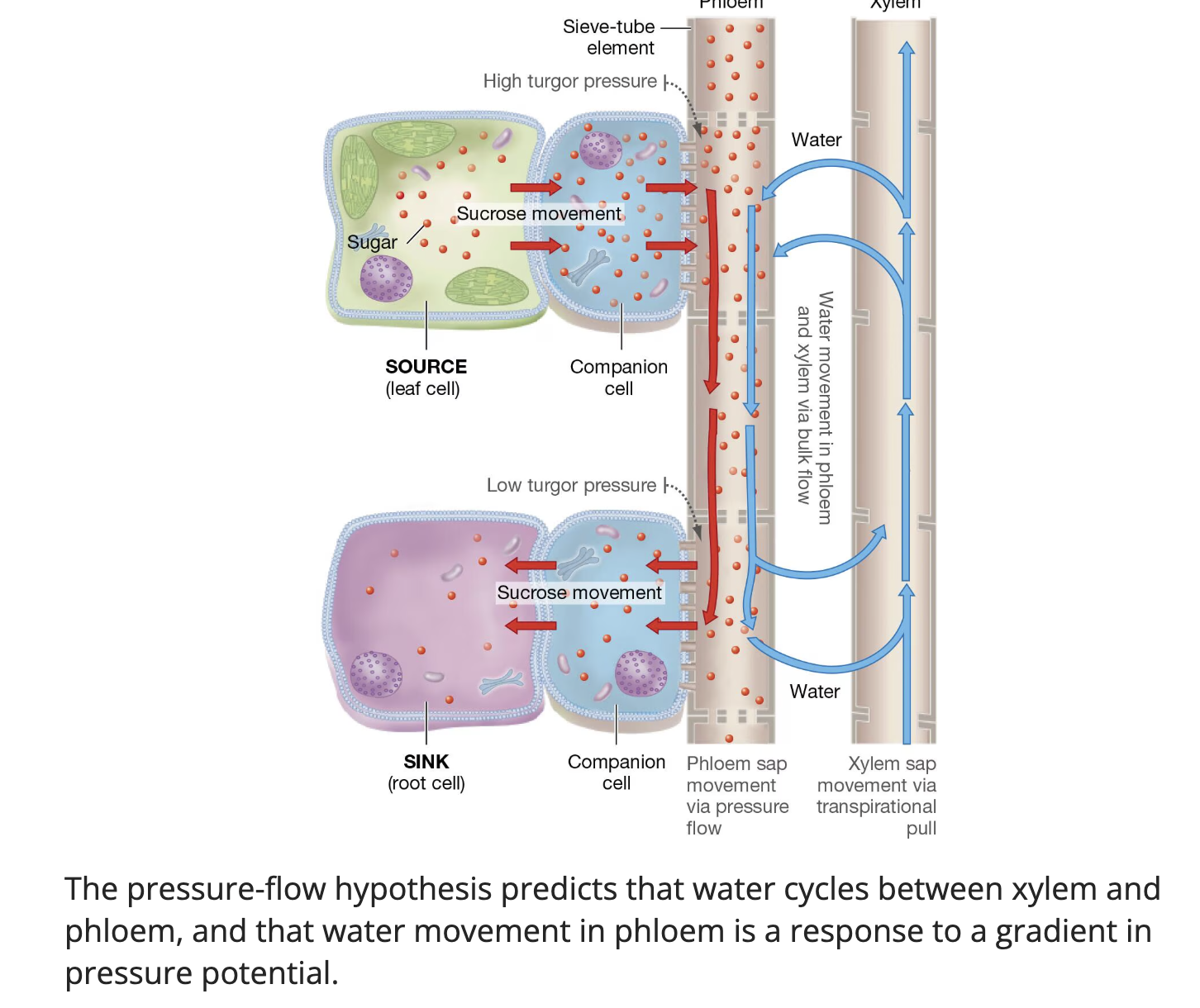
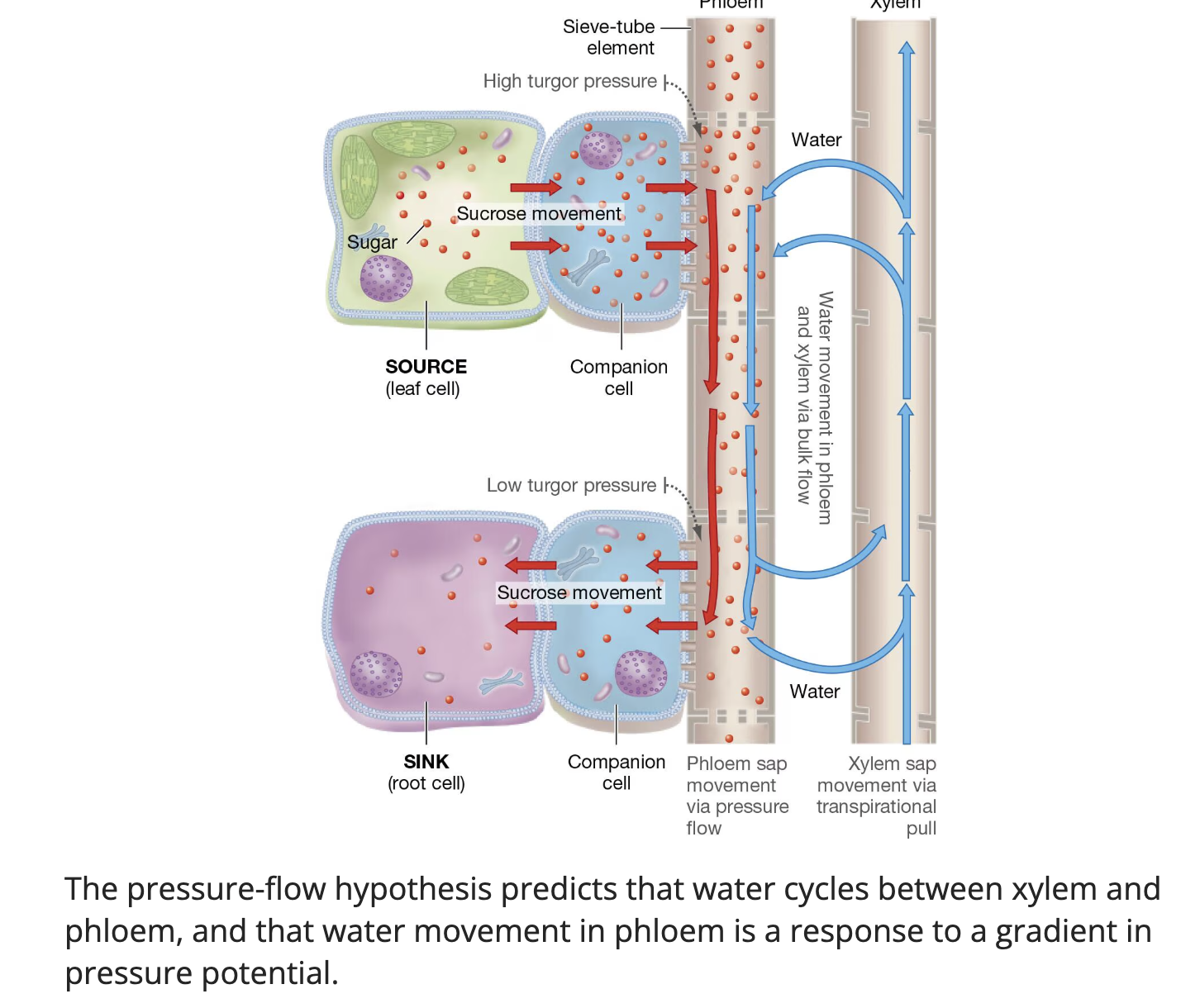
Events at source & sink tissues create a pressure potential gradient in phloem
→ drives movement of phloem sap (from source to sink)
Aphids feed on phloem sap….
insert a syringe-like mouthpart, called a stylet, into sieve-tube elements.
pressure on the fluid in these cells forces it through the stylet and into the aphid’s digestive tract. Excess water and sucrose that the aphid does not need is excreted out its anus as droplets of “honeydew”
such positive pressure that phloem sap shoots through stomach & even through butt!
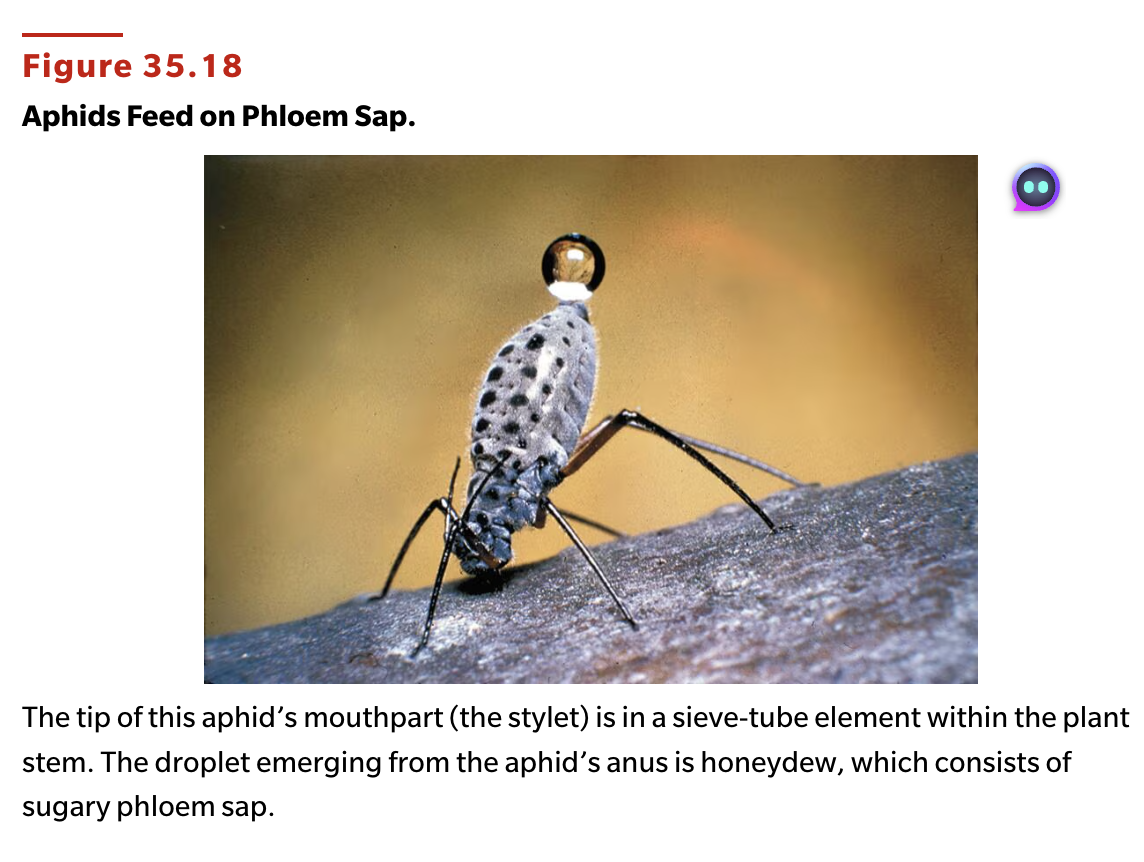
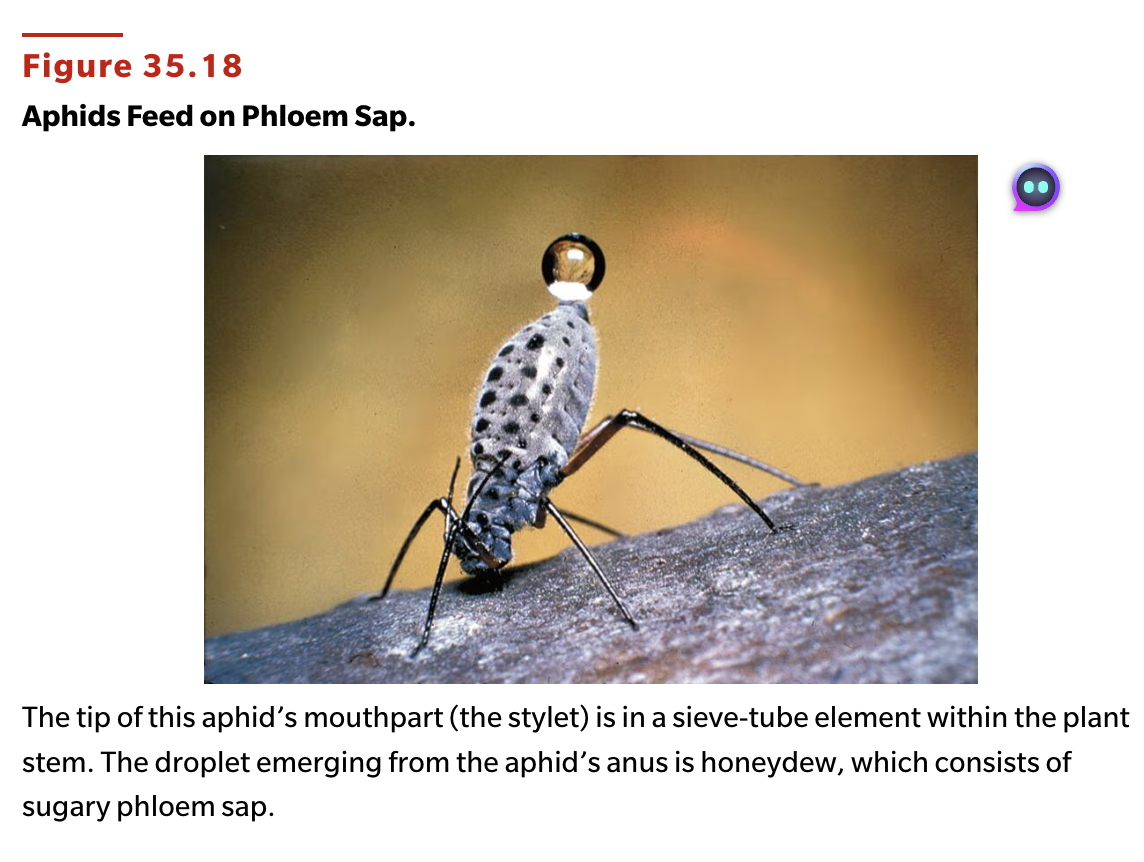
What if aphids were severed from their stylets?
sap continues to flow out through
aphids do not actively suck the fluid.
As predicted by the pressure-flow model, phloem sap is indeed under positive pressure, which forces it to enter the aphid.
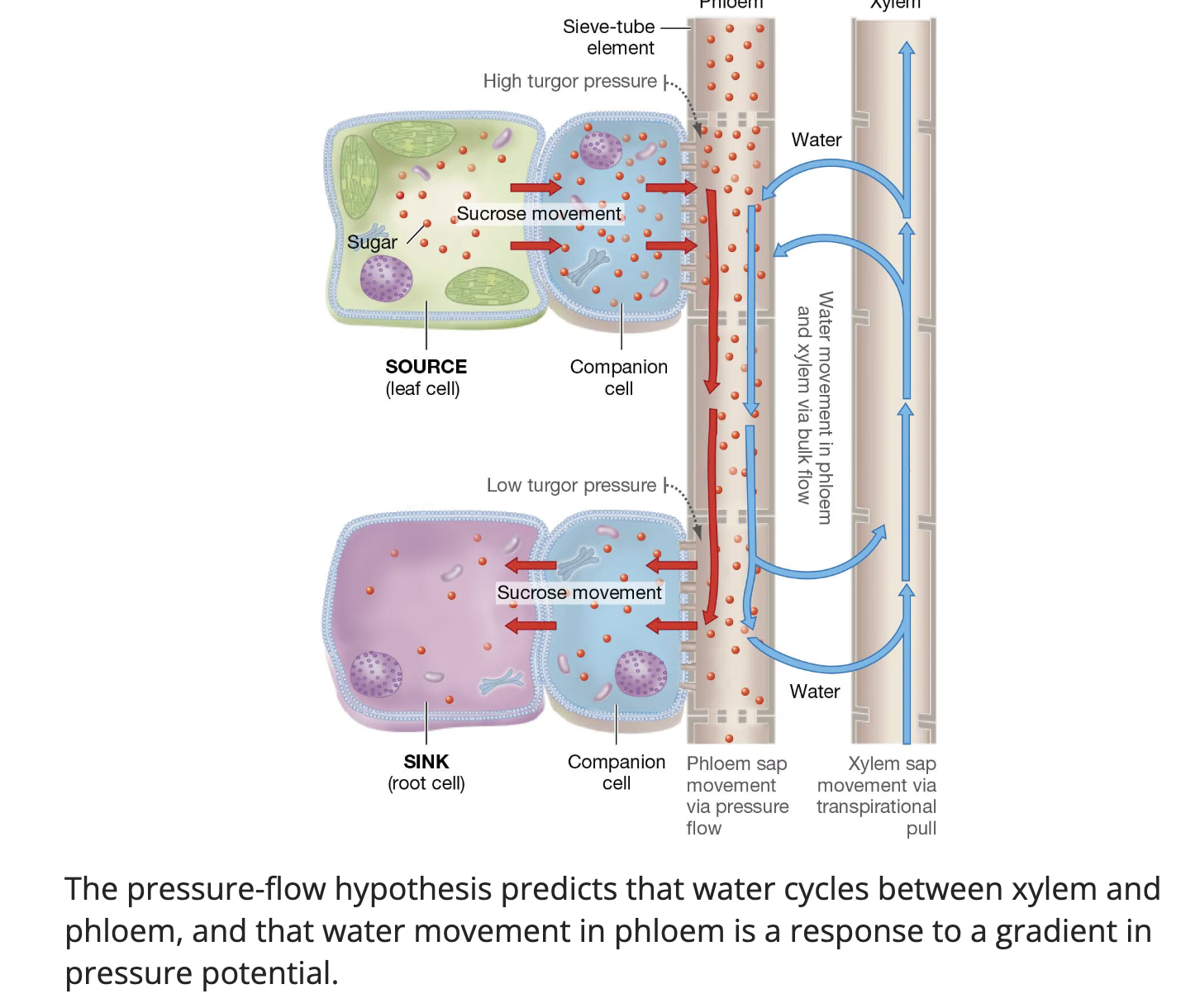
Why must sucrose become concentrated in sieve-tube elements at the source?
To lower water potential of phloem and create high turgor pressure that drives pressure flow.
water enters the sieve tube from the adjacent xylem by osmosis. This increases turgor pressure (Ψp), which drives pressure flow toward the sink.
What cell first receives sucrose during phloem loading?
Companion cell.
Which membrane protein uses ATP directly during phloem loading?
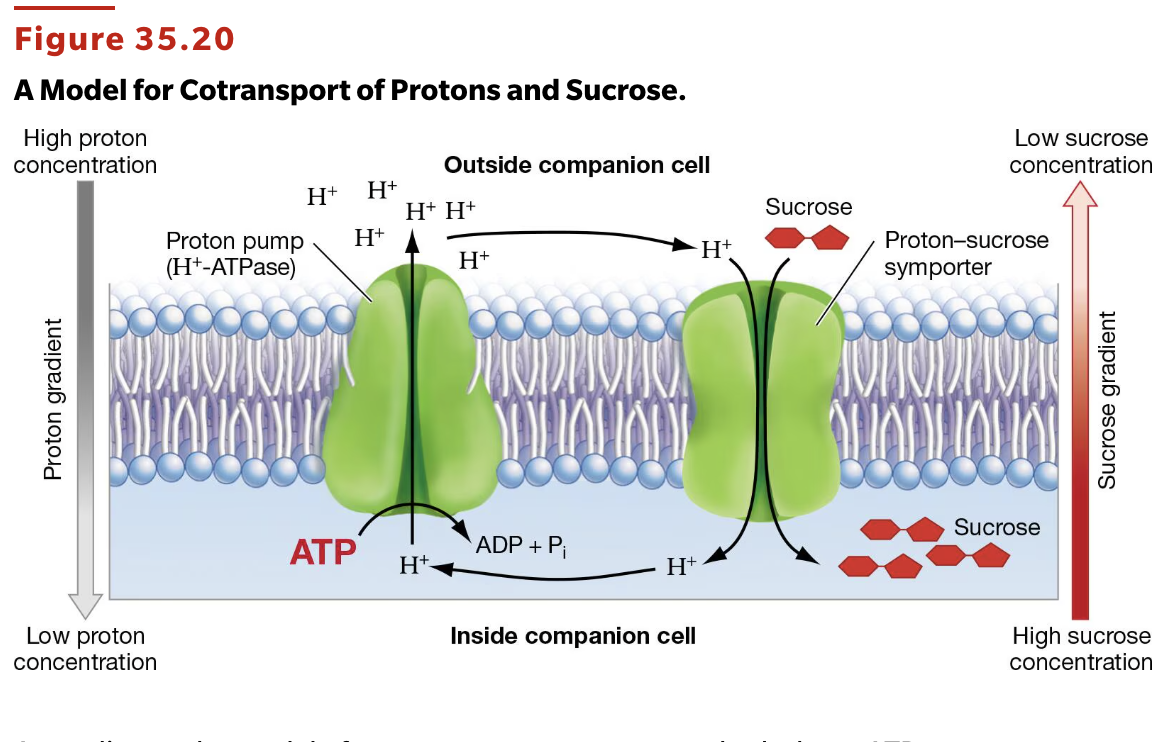
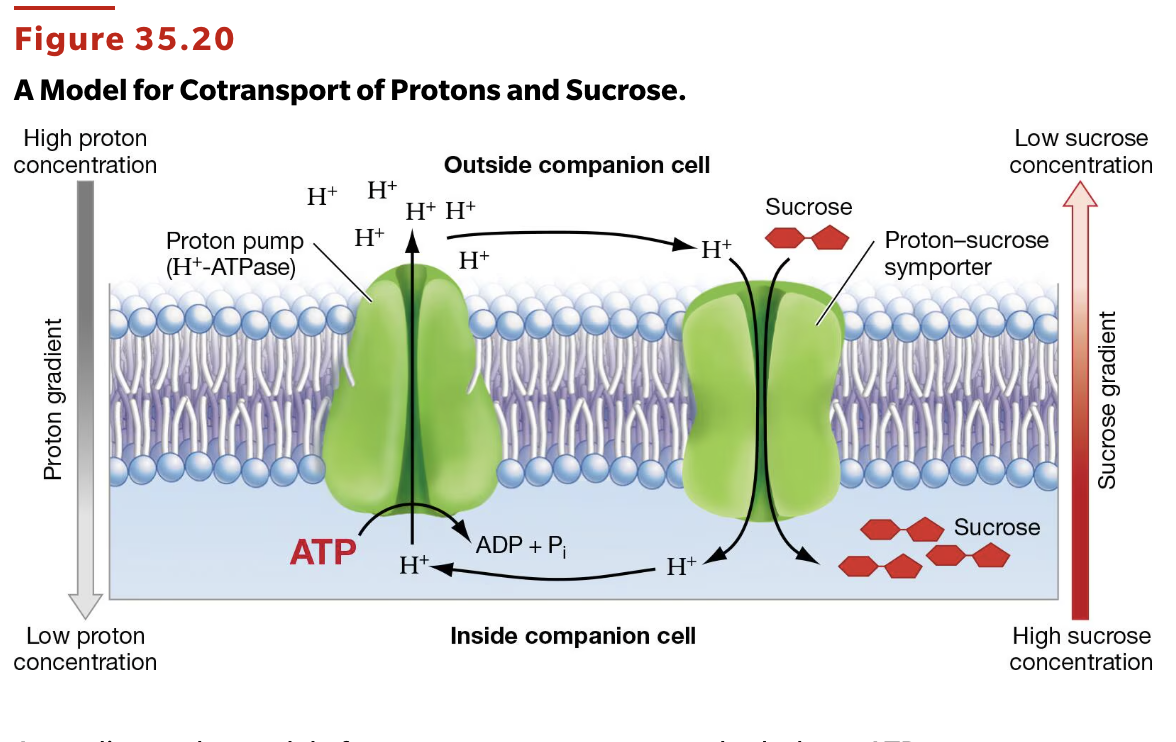
H⁺-ATPase (proton pump).
What does the H⁺-ATPase do?
Pumps H⁺ ions out of the companion cell using ATP.
creates a proton electrochemical gradient.
primary active transport
Which transport protein brings sucrose into the companion cell?
H⁺/sucrose symporter.
secondary active transport (cotransport)
ATP is used indirectly—the proton gradient created by the H⁺ pump powers sucrose transport
When is phloem loading active instead of passive?
Active loading occurs when sucrose must be concentrated in the companion cell against its concentration gradient. ATP powers an H⁺-ATPase, creating a proton gradient that an H⁺/sucrose symporter uses to bring sucrose into the companion cell (secondary active transport).
When is phloem loading passive instead of active ?
Passive loading occurs when sucrose concentration is already very high in the source cell, allowing sucrose to diffuse through plasmodesmata into the companion cell and sieve-tube element without ATP.
After entering the companion cell, how does sucrose reach the sieve-tube element?
Through plasmodesmata.
Can phloem loading ever occur without ATP?
Yes. If sucrose concentration is already very high in source cells, sucrose may diffuse passively through plasmodesmata.
What is phloem loading?
The movement of sucrose from source cells into sieve-tube elements.
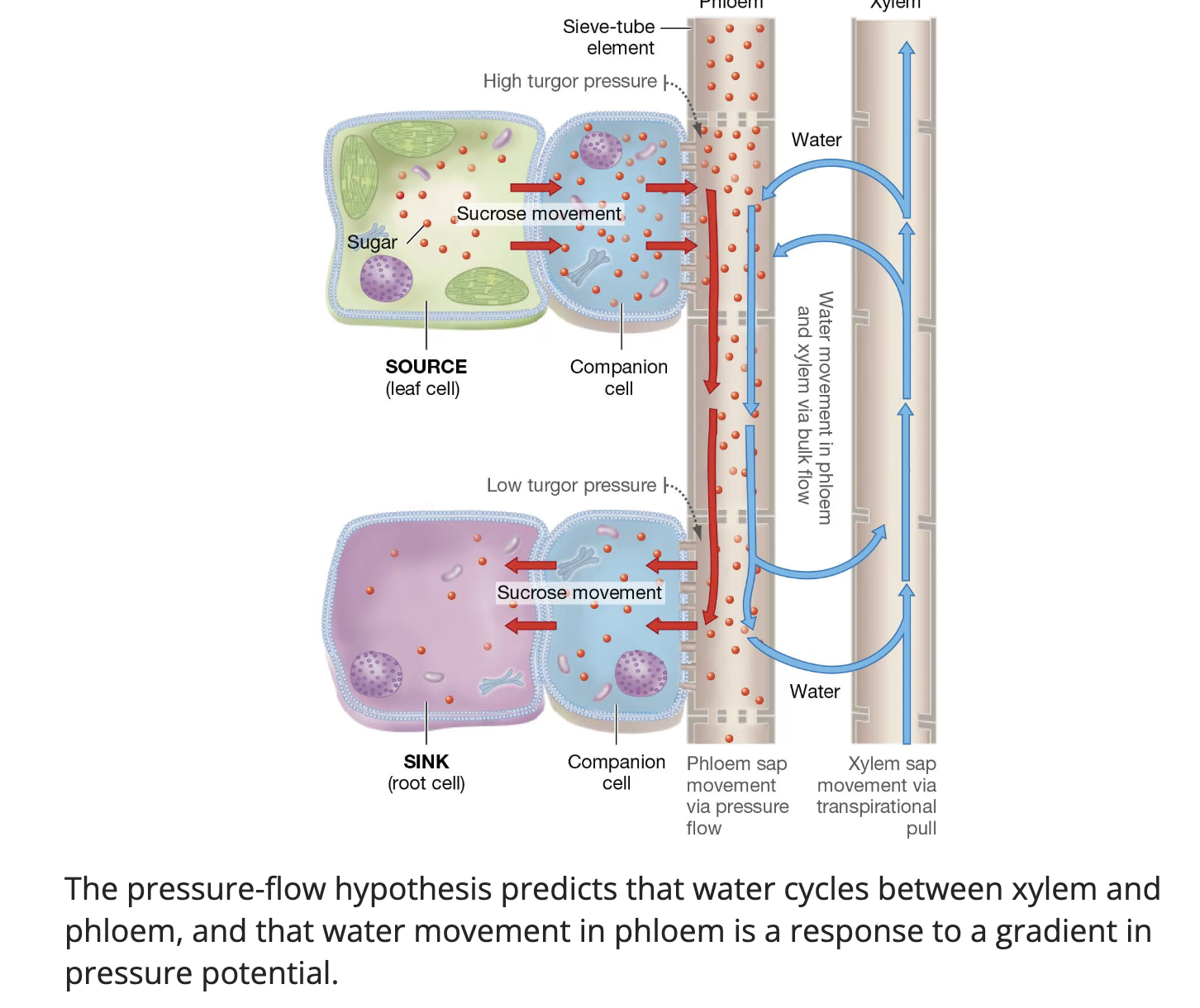
What drives phloem transport?
A pressure (turgor pressure) gradient between source and sink.
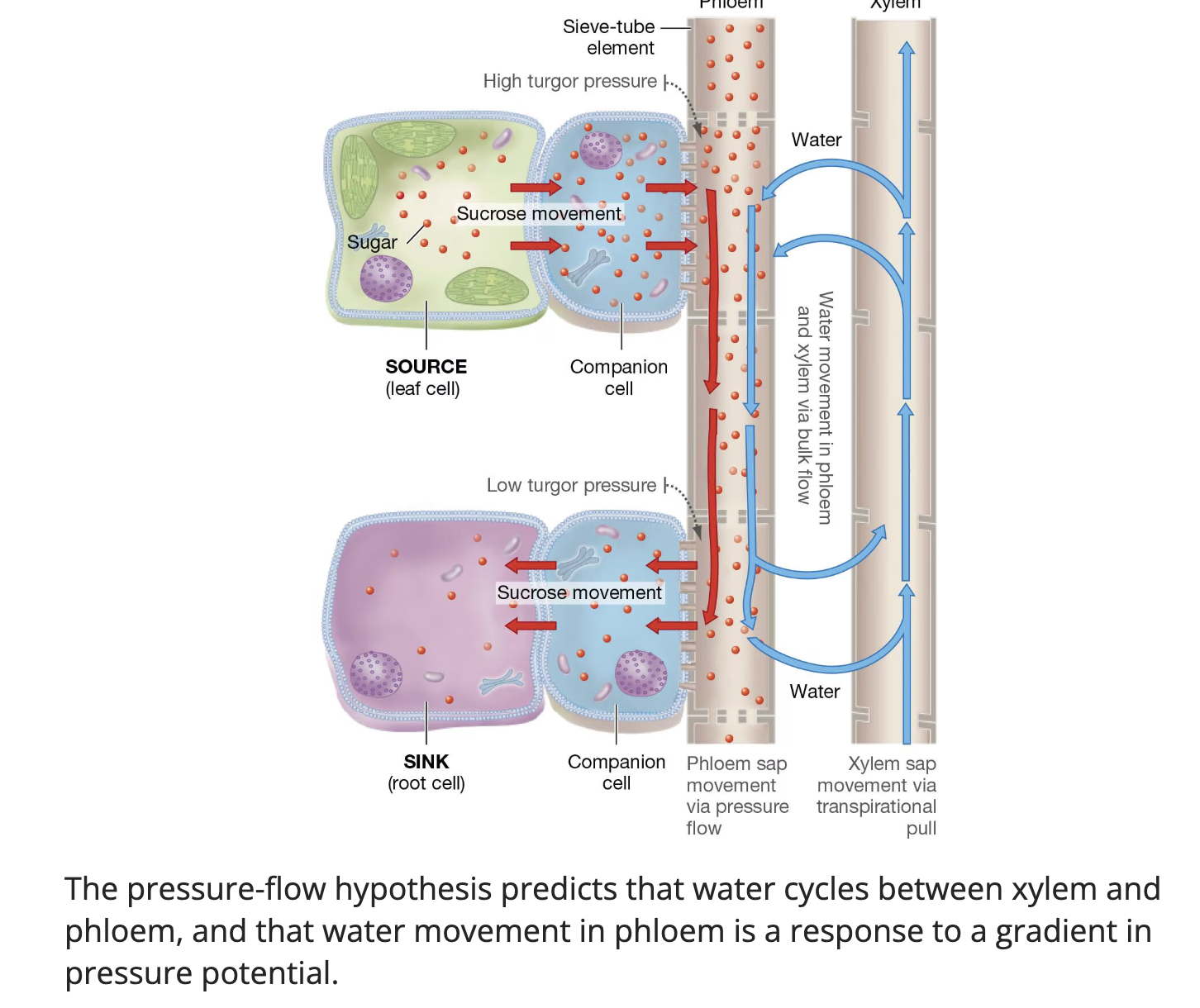
What creates high pressure at the source?
Sucrose loading lowers Ψs (more negative)
Water enters from xylem by osmosis.
Pressure potential (Ψp) increases.
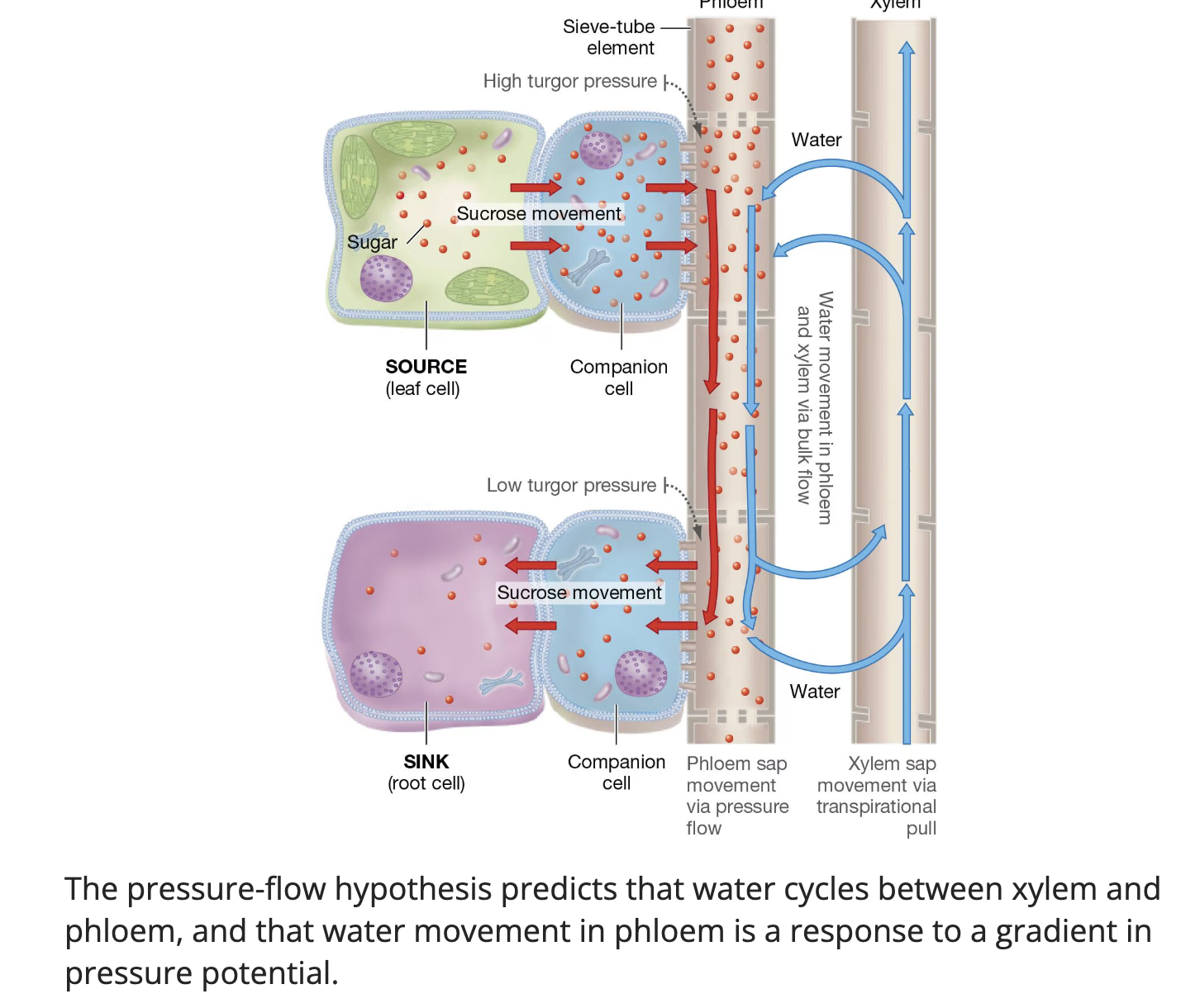
What creates low pressure at the sink?
Sucrose is unloaded.
Ψs becomes less negative.
Water leaves phloem for xylem.
Pressure decreases.
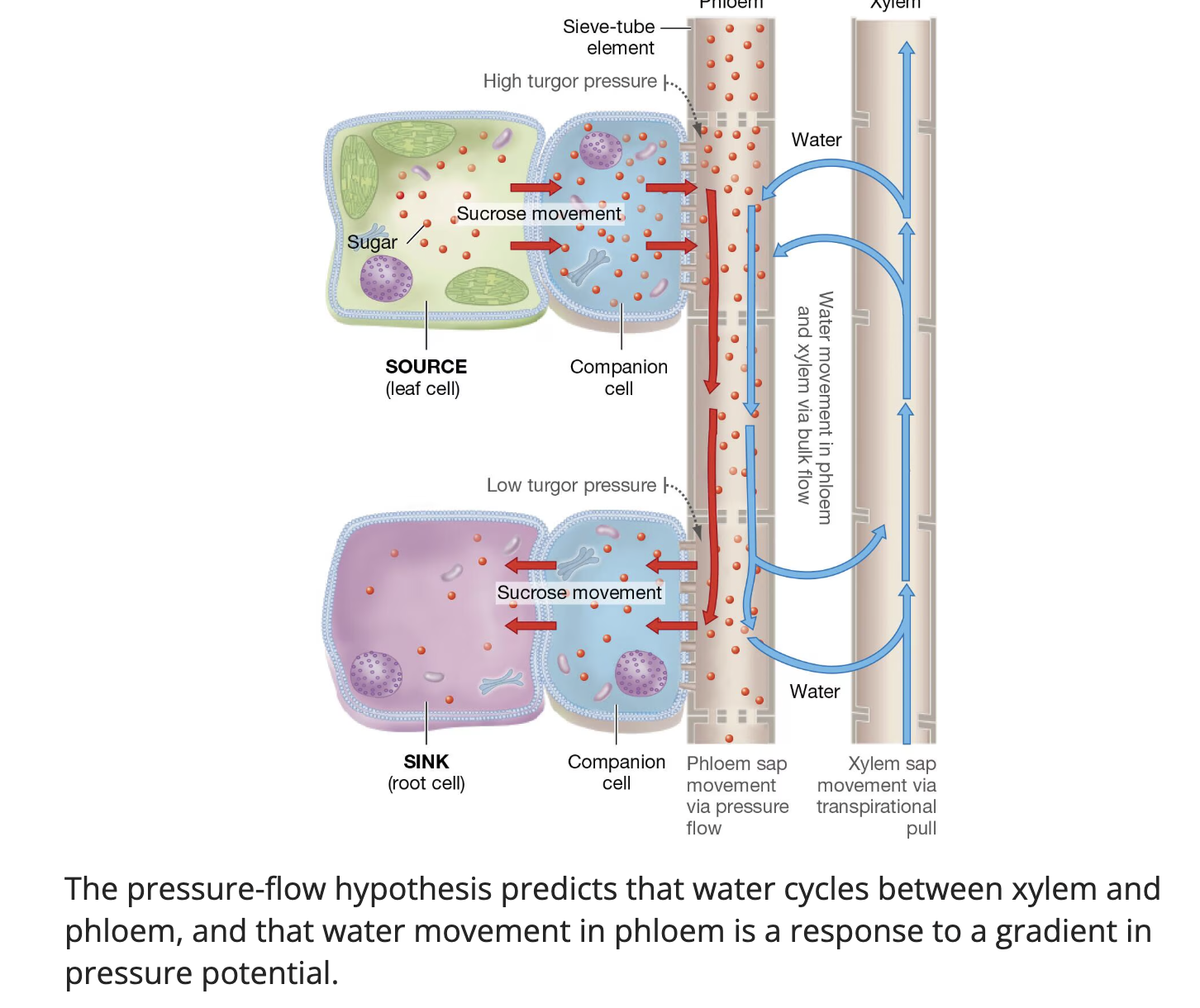
Why does water move into phloem at the source?
Loading sucrose lowers water potential (Ψ), so water enters from adjacent xylem by osmosis.
remember high water potential to low water potential
Why does water leave phloem at the sink?
Removing sucrose raises water potential, causing water to move back into xylem.
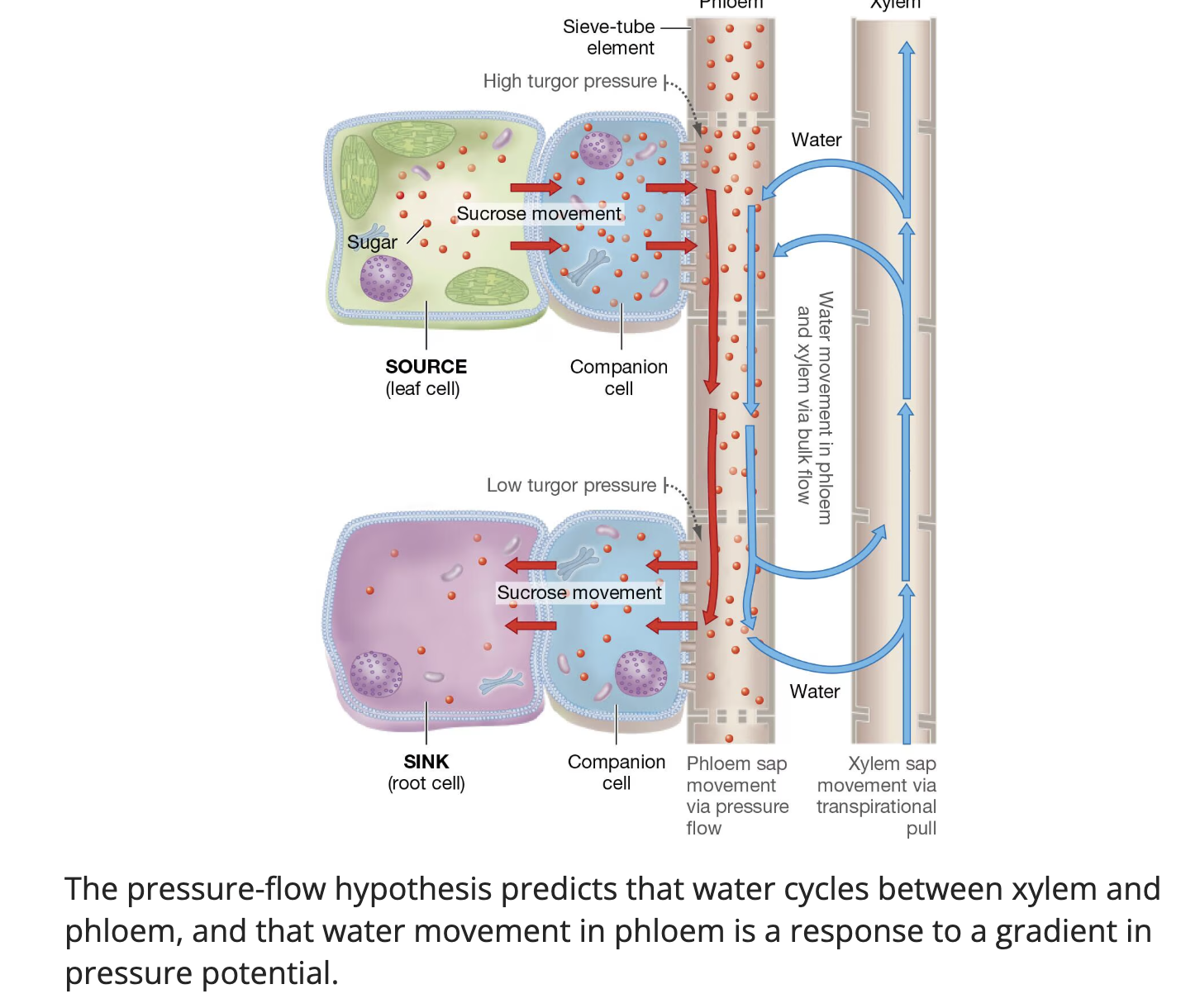
What happens to sucrose after pressure builds at the source?
It is carried by bulk flow through the sieve tubes toward the sink.
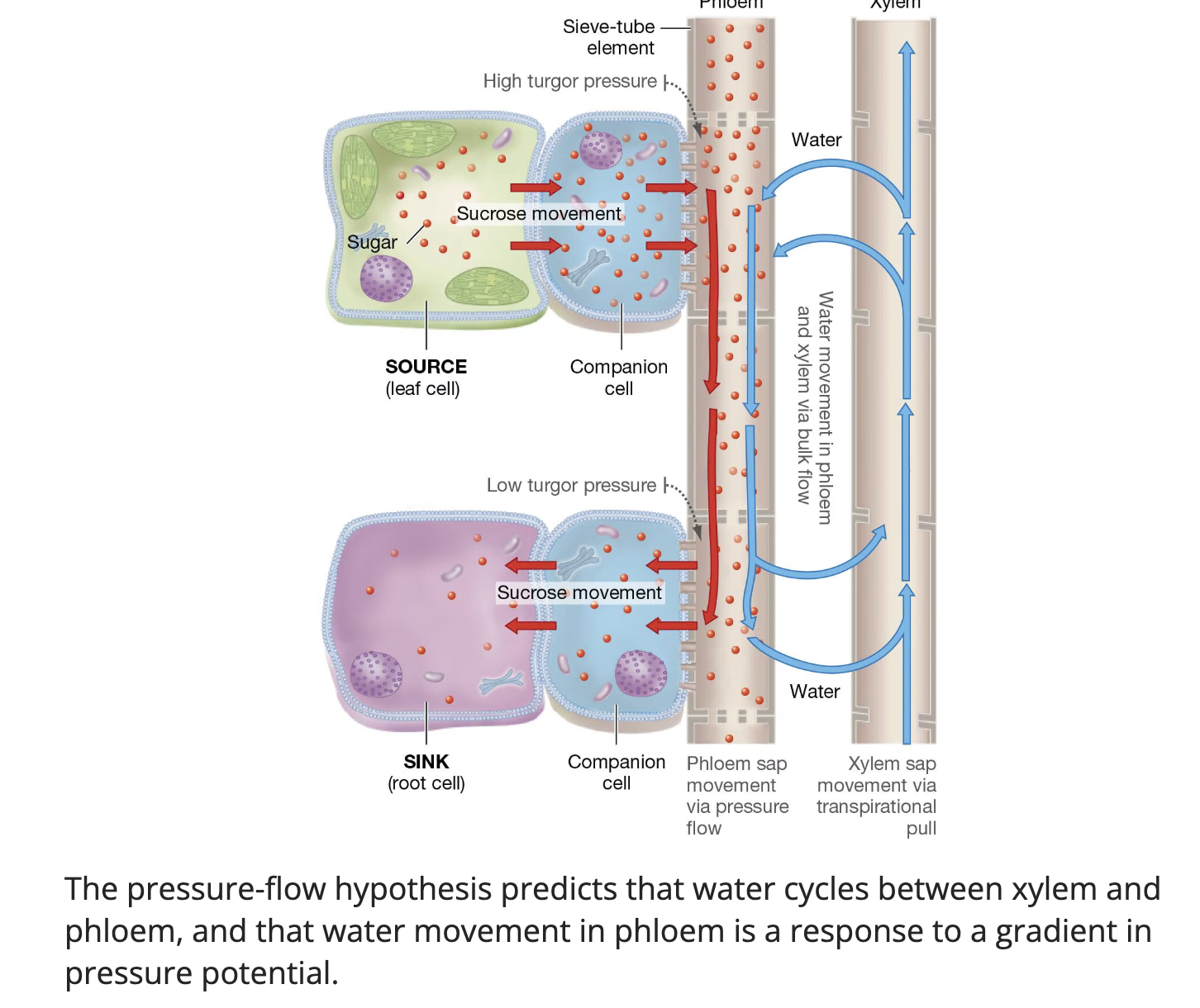
What returns water from the sink back to the source?
Xylem transport via transpiration pull.
What is phloem unloading?
The movement of sucrose from the sieve-tube elements into sink tissues.
often active transport
Can phloem unloading be passive or active?
Yes. The mechanism depends on the type of sink tissue and the plant species.
How does sucrose unload into actively growing leaves (e.g., sugar beet)?
By passive diffusion down its concentration gradient because sucrose is rapidly used for cellular respiration and biosynthesis, keeping intracellular sucrose concentrations low.
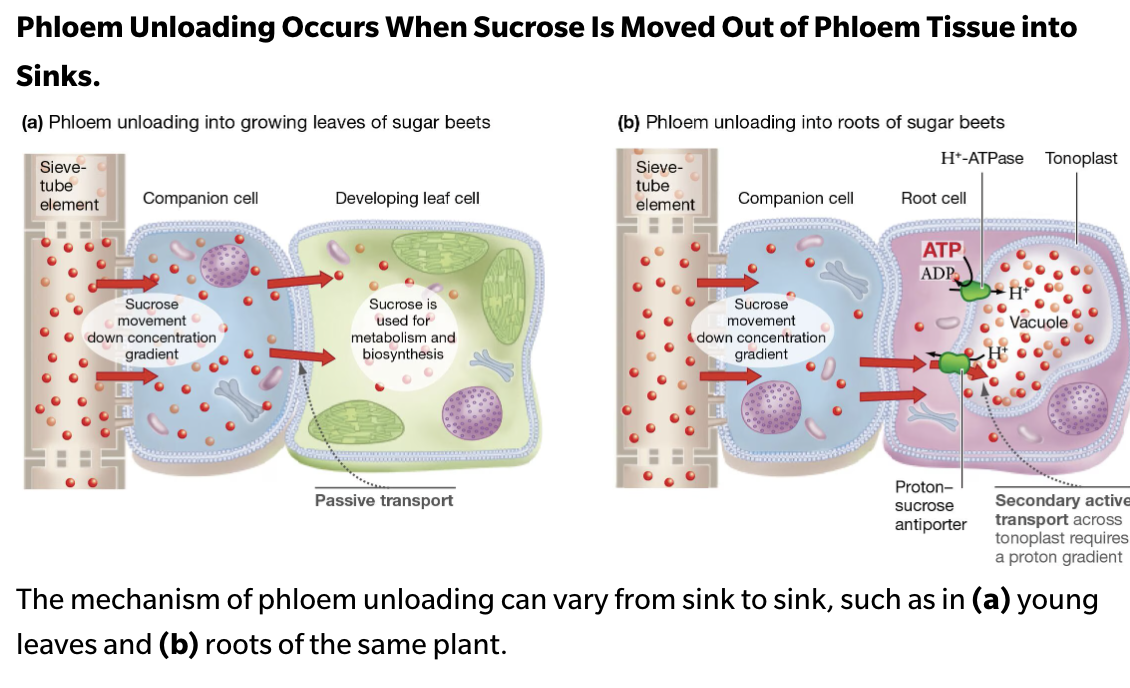
How does sucrose unload into storage roots (e.g., sugar beet)?
By secondary active transport into the vacuole. ATP powers an H⁺-ATPase that creates a proton gradient across the tonoplast, and a proton-sucrose antiporter uses that gradient to move sucrose into the vacuole against its concentration gradient.
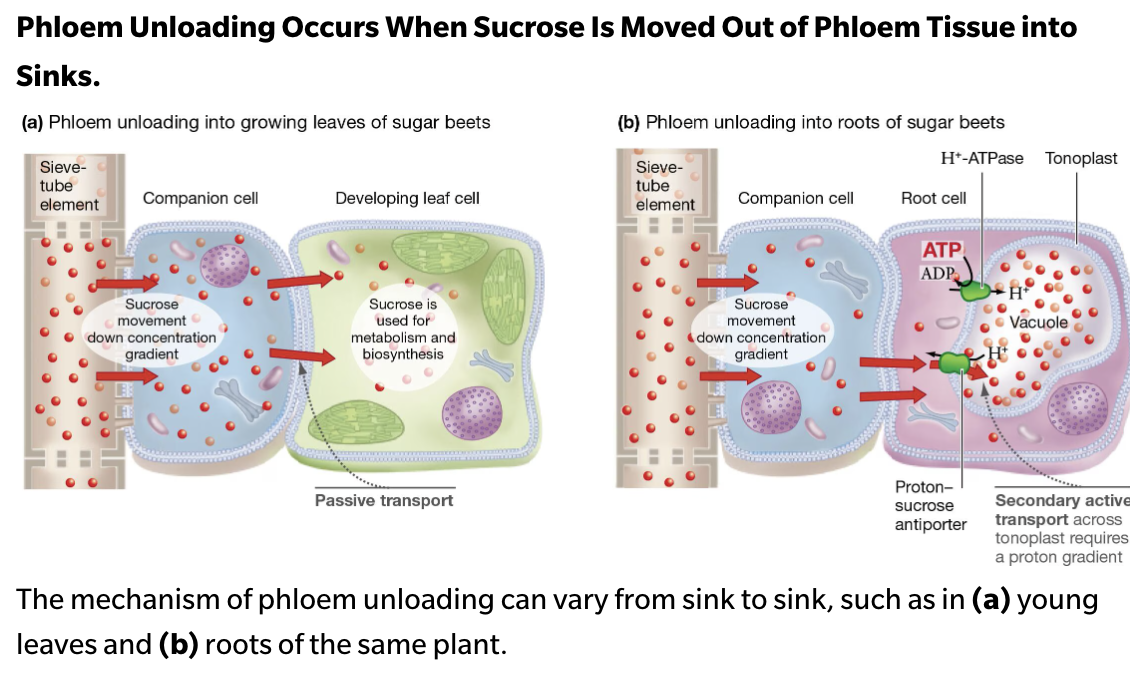
What happens to water potential and pressure during phloem unloading?
Removing sucrose makes the phloem's solute potential (Ψs) less negative, increasing overall water potential (Ψ). Water then moves from the phloem into the adjacent xylem, decreasing turgor pressure (Ψp) at the sink.
Why is phloem unloading essential for pressure-flow?
It lowers sucrose concentration and turgor pressure at the sink, maintaining the pressure gradient that drives bulk flow from source to sink.
What is bulk flow?
The movement of fluid and dissolved substances together due to a pressure gradient.
Does transpiration directly power phloem transport?
No. Phloem transport is driven by pressure differences created by sucrose loading and unloading.
Describe water potential at a sink.
Lower sucrose concentration
Less negative Ψs
Water exits
Low Ψp (low turgor)
In which tissue is turgor pressure highest?
Source phloem.
after sucrose is loaded & water comes in, pressure potential increases so overall water potential increases
In which tissue is turgor pressure lowest?
Sink phloem.
Why must sieve-tube elements remain alive?
They need functional plasma membranes to carry out active transport during phloem loading and unloading.
Why is ATP required for phloem transport?
ATP powers proton pumps that establish the proton gradient needed for sucrose loading (and in some sinks, unloading).
but not always active loading!
Why would phloem transport stop if sieve-tube elements died?
Active transport would cease, sucrose could not be loaded/unloaded, the pressure gradient would disappear, and bulk flow would stop.
Why doesn't xylem require living cells?
Water movement is passive and driven by transpiration and cohesion-tension, so metabolism is unnecessary.
What would happen if proton pumps were inhibited?
The proton gradient would collapse, sucrose loading would decrease, pressure would not build at the source, and translocation would slow or stop.
Water moving out of the sieve tube member near the source causes:
a. Ψ in the sieve tube member to increase because Ψp increases
b. Ψ in the sieve tube member to decrease because Ψp decreases
c. Ψ in the sieve tube member to increase because Ψs increases
d. Ψ in the sieve tube member to decrease because Ψs decreases
a. Ψ in the sieve tube member to increase because Ψp increases
Water moving out of the sieve tube member near the sink causes:
a. Ψ in the sieve tube member to increase because Ψp increases
b. Ψ in the sieve tube member to decrease because Ψp decreases
c. Ψ in the sieve tube member to increase because Ψs increases
d. Ψ in the sieve tube member to decrease because Ψs decreases
b. Ψ in the sieve tube member to decrease because Ψp decreases
Why can't pressure-flow occur without cell walls?
Cell walls resist the high turgor pressure created when water enters the phloem. Without rigid cell walls, the sieve-tube elements would swell and burst instead of building the pressure needed to drive bulk flow.
Why does phloem transport require living sieve-tube elements, even though bulk flow is passive?
Bulk flow itself is passive & occurs down a pressure gradient. BUT living sieve-tube elements (with help from companion cells) are needed to establish and maintain that pressure gradient through phloem loading and unloading
often require ATP-dependent membrane transport
Without living cells, sucrose could not be properly loaded or unloaded = pressure gradient & therefore bulk flow would cease
What is the primary force that moves water from the soil into plant roots?
Negative pressure (tension) created by transpiration from the leaves, which pulls a continuous column of water upward through the xylem.
What role does root cell solute concentration play in water uptake?
It lowers the water potential of root cells, allowing water to enter by osmosis, but it is not the primary force moving water through the entire plant.
What is the transpiration ratio?
The amount of water transpired divided by the amount of CO₂ fixed during photosynthesis.
What does a high transpiration ratio indicate?
The plant loses more water for each CO₂ molecule fixed, making it less water-use efficient.
What does a low transpiration ratio indicate?
The plant loses less water for each CO₂ molecule fixed, making it more water-use efficient.
Why do CAM and C4 plants have lower transpiration ratios than C3 plants?
They reduce photorespiration, allowing stomata to remain closed more often. As a result, they lose less water while fixing the same amount of CO₂.
A typical C3 plant has a transpiration ratio of 500. Would you expect CAM and C4 plants to have a higher or lower transpiration ratio?
Lower, because they use water more efficiently.
ratio of about 50–250, because CAM and C4 plants lose less water per unit of CO₂ fixed
plant cell has Ψs = -1 MPa and Ψp = +2 MPa. The soil has Ψ = -1 MPa. Why is the correct answer "water moves out of the cell, and the cell is turgid" rather than "water moves out of the cell, and the cell is flaccid"?
Water movement describes what will happen next, while pressure potential describes the cell's current condition. Since Ψp = +2 MPa, the cell is currently turgid, even though water is beginning to move out. The cell would only become flaccid after losing enough water to reduce its pressure potential to zero.