Developmental: Lecture 1 + chapter 2
0.0(0)
Studied by 1 person Call Kai
 Learn
Learn Practice Test
 Spaced Repetition
 Match
Match Flashcards
 Knowt Play
Card Sorting
1/62

Earn XP
Description and Tags
1. Introduction to the course 2. Theories and issues in child development 3. Introduction to psychological assessment
Last updated 9:21 PM on 1/31/23
Name | Mastery | Learn | Test | Matching | Spaced | Call with Kai | Chat |
|---|
No analytics yet
Send a link to your students to track their progress
63 Terms
1
New cards
theory
**a coherent set of ideas, hypotheses and explanations**
2
New cards
Nature/endogenous
Knowledge is innate and gets expressed during the course of development
3
New cards
**Nurture/exogenous**
Only learning mechanisms are innate, all the rest of development is determined by the environment
4
New cards
Continuous
Development is gradual; children are not qualitatively different from adults; children lack experience
5
New cards
Stages
Development occurs in transitions; children are qualitatively different from adults
6
New cards
Passive
Child plays a passive role; development occurs automatically
7
New cards
Active
Child plays an active role in its own development; constructs its own knowledge
8
New cards
**Maturational theory of Gesell (1924)**
biologically directed maturation; the same developmental patterns independent of environmental input
9
New cards
Cephalocaudal
From head to foot
10
New cards
Proximodistal
from centre of body to periphery
11
New cards
Key points of **Maturational theory of Gesell (1924)**
* Maturation of central nervous system determines the development of the child, behavioral development follows
* Cephalocaudal trend = from head to foot
* Proximodistal trend = from centre of body to periphery
* Differences in child’s temperament play important role in pace of development
* Role of parents is to provide the right environment (when the child is ready; no pushing)
* Cephalocaudal trend = from head to foot
* Proximodistal trend = from centre of body to periphery
* Differences in child’s temperament play important role in pace of development
* Role of parents is to provide the right environment (when the child is ready; no pushing)
12
New cards
Criticism to **Maturational theory of Gesell (1924)**
• Not all children follow the same pattern (e.g., backward crawling and butt sliding)
• Does not necessarily generalize to all cultures \n • Environment can play guiding role
• Does not necessarily generalize to all cultures \n • Environment can play guiding role
13
New cards
**McGraw (1945)**
enviroment can shape motor development (Twin study with Jimmy and Johnny Woods)
14
New cards
Dynamic systems theory
Development is a complex interaction between properties of the system and environment
15
New cards
Fundamental attribution error
The tendency of others to overestimate the influence of dispositions (traits) and to underestimate the influence of situational factors (states, reaction to situation)
16
New cards
Salience effect
Giving more weight to striking information than non-striking information when drawing conclusions
17
New cards
Contrast error
General tendency to judge others in a manner opposite from the way in which one perceives themselves due to a perceived difference between self and others
18
New cards
Illusory correlation
Perceiving links between tests and own conclusion, which do not exist empirically
19
New cards
Blind spot bias
The tendency to see oneself as less biased than other people and to be less able to recognize biases in oneself than in others
20
New cards
Psychoanalysis
the theoretical view, first developed by Sigmund Freud, that much of our behaviour is determined by unconscious factors.
21
New cards
assimilation
the process through which children incorporate new experiences into their preexisting *schemes*
22
New cards
accommodation
the cognitive process through which children adapt to new experiences by modifying their preexisting *schemes*
23
New cards
schemes
mental structures in the child’s thinking that provide representations and plans for enacting behaviours.
24
New cards
functional invariance
processes that do not change during development, such as *accommodation* and *assimilation* in Piaget’s theory.
25
New cards
sensorimotor stae
first stage of *cognitive development*
* thought is based primarily on perception
* action and internalised thinking is largely absent.
* development of *thought in action*
* learn object permanence
* from birth to about 2 years old.
* thought is based primarily on perception
* action and internalised thinking is largely absent.
* development of *thought in action*
* learn object permanence
* from birth to about 2 years old.
26
New cards
pre operational stage
second stage
* 2-7 years
* **egocentric**
* **animism**
* thinking tends to be illogical
* magical (believe in Santa Claus)
* **centration**
* 2-7 years
* **egocentric**
* **animism**
* thinking tends to be illogical
* magical (believe in Santa Claus)
* **centration**
27
New cards
concrete operations stage
third stage
* 7-11 years
* pass the conservation task (no more centration)
* reasoning becomes more logical, systematic and rational in its application to concrete objects.
* 7-11 years
* pass the conservation task (no more centration)
* reasoning becomes more logical, systematic and rational in its application to concrete objects.
28
New cards
formal operations stage
fourth and final stage
* from 11 years
* individual acquires the capacity for abstract scientific thought. This includes the ability to theorise about impossible events and items.
* from 11 years
* individual acquires the capacity for abstract scientific thought. This includes the ability to theorise about impossible events and items.
29
New cards
egocentric
someone who finds it difficult to see things from another person’s point of view.
30
New cards
animism
children in the preoperational stage tend to attribute life and life-like qualities to inanimate objects, particularly those that move and are active.
31
New cards
centration
the focusing or centring of attention on one aspect of a situation to the exclusion of others.
32
New cards
conservation tasks
tasks that examine children’s ability to understand that physical attributes of objects, such as their mass and weight, do not vary when the object changes shape.
33
New cards
information processes
the view that cognitive processes are explained in terms of inputs and outputs and that the human mind is a system through which information flows.
34
New cards
constructivism
Piaget’s theoretical view that infants are not born with knowledge about the world, but instead gradually construct knowledge and the ability to represent reality mentally.
* bottom-up
* bottom-up
35
New cards
bottom-up vs. top-down
Bottom-up:
* allowing the stimulus itself to shape our perception, without any preconceived ideas.
Top-down:
* using our background knowledge and expectations to interpret what we see.
* allowing the stimulus itself to shape our perception, without any preconceived ideas.
Top-down:
* using our background knowledge and expectations to interpret what we see.
36
New cards
object unity of infants
younger infants perceive the components but not the wholes – they perceive the parts of a partly hidden object but do not see it as a single unit
37
New cards
**connectionism**
a modern theoretical approach that developed from *information processing* accounts in which computers are programmed to simulate the action of the brain and nerve cells (*neurons*).
38
New cards
zone of proximal development
the distance between the actual developmental level and the level of potential development
* determined by independent problem solving vs. with adults or more able peers
* determined by independent problem solving vs. with adults or more able peers
39
New cards
**introspectionism**
an approach to psychology common in the \n 19th century in which observers were asked
to reflect on their thoughts, feelings and perceptions.
to reflect on their thoughts, feelings and perceptions.
40
New cards
law of effect
Thorndike: the likelihood of an action being repeated is increased if it leads to a pleasant outcome, and decreased if it leads to an unpleasant outcome.
41
New cards
social learning theory
Albert Bandura. The application of *behaviourism* to \n social and cognitive learning that emphasises the importance of *observational learning*
42
New cards
observational learning
situation in which people (especially children) learn by observing others and then copying (imitating) the observed acts.
43
New cards
social cognitive theory
a theory that emphasises social factors in cognitive development.
44
New cards
primary drives
basic needs which include hunger, thirst and the need for warmth. attachment is argued as a primary drive as well (Bowlby)
45
New cards
secondary drive
an object that acquires reinforcing properties by being associated with the satisfaction of an individual’s *primary drives.*
46
New cards
monotropy
the view that the infant has a basic need to form an attachment with one significant person (usually mother)
47
New cards
id
* present in newborns
* consists of impulses, emotions and desires.
* demands instant gratification of all its wishes and needs
* consists of impulses, emotions and desires.
* demands instant gratification of all its wishes and needs
48
New cards
ego
rational thought that evolved to control the urges of the *id* in order to meet the demands of reality and maintain social approval and esteem.
49
New cards
superego
* sense of duty and responsibility
* conscience
* in conflict with id
* conscience
* in conflict with id
50
New cards
oral stage
* birth to 1 year
* Greatest satisfaction: stimulation of the lips, tongue and mouth.
* Sucking
* Greatest satisfaction: stimulation of the lips, tongue and mouth.
* Sucking
51
New cards
anal stage
\
* 1-3 years
* potty training
* pleasure: exercising control over the anus and by retaining and eliminating faeces.
* 1-3 years
* potty training
* pleasure: exercising control over the anus and by retaining and eliminating faeces.
52
New cards
phallic stage
* 3-6 years
* pleasure: stimulating genitals
* boys: Oedipus complex → castration complex
* girls: Electra complex
* pleasure: stimulating genitals
* boys: Oedipus complex → castration complex
* girls: Electra complex
53
New cards
latency and genital stages
* 6 years - adolescence
* latency: rest period (6 years until puberty and adolescence)
* genital stage: at adolescence, sexual feelings become more apparent and urgent
* latency: rest period (6 years until puberty and adolescence)
* genital stage: at adolescence, sexual feelings become more apparent and urgent
54
New cards
Oedipus complex
young boy develops sexual feelings toward his mother but realises that his father is a major competitor for her (sexual) affections.
55
New cards
castration complex
young boy fears castration at the hands of his father
* resolved: he adopts the ideals of his father and the superego develops.
* resolved: he adopts the ideals of his father and the superego develops.
56
New cards
Electra complex
little girls develop feelings towards their father and fear retribution at the hands of their mother.
* resolved: empathising with their mother, adopting the ideals she offers, superego develops.
* resolved: empathising with their mother, adopting the ideals she offers, superego develops.
57
New cards
Problems with Freudian theory
* unconscious processes cannot be measured; based on beliefs rather than evidence.
* Freud’s views are almost impossible to test. →**reaction formation** →impossible to predict the child’s development + unfalsifiable
* Freud’s views are almost impossible to test. →**reaction formation** →impossible to predict the child’s development + unfalsifiable
58
New cards
reaction formation
The individual may react, often unconsciously, to negative aspects of their personality and react against it (opposite as predicted) (*psychoanalytic theory*)
59
New cards
psychosocial stages
Erik Erikson.
The child goes from the stage of ‘basic trust’ in early infancy to the final stage in adult life of maturity with a sense of integrity and self-worth.
The child goes from the stage of ‘basic trust’ in early infancy to the final stage in adult life of maturity with a sense of integrity and self-worth.
60
New cards
humanistic theory
theory which emphasises that humans have free will and are motivated to fulfil their potential.
61
New cards
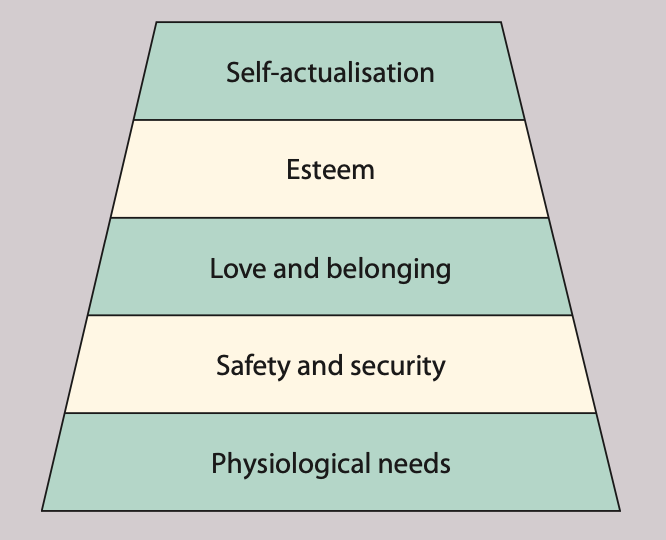
self-actualization
fulfilment of needs beyond those deemed necessary for survival (humanistic theory)
62
New cards
hierarchy of needs
stages of needs or desires in Abraham Maslow’s *humanistic theory* which go from the basic physiological needs for food and water to the ultimate desire for *self-actualisation* or the desire to fulfil one’s potential.
63
New cards
gender constancy
the awareness, in early childhood, that one is either a boy or a girl, and that this is unchangeable