Ecology Exam 1
 Call Kai
 Learn
Learn Practice Test
 Spaced Repetition
 Match
Match Flashcards
 Knowt Play
1/77

There's no tags or description
Looks like no tags are added yet.
Name | Mastery | Learn | Test | Matching | Spaced | Call with Kai | Chat |
|---|
No analytics yet
Send a link to your students to track their progress
78 Terms
ecology
study of how organisms live, and interact with each other and their environment. Studies all the relationships in nature. The most complex scientific discipline
how to calculate whether a population meets HW
first calculate the observed allele frequencies (number of that kind of allele/total alleles), then use those frequencies as p and q and determine expected genotypic frequencies via HW, then multiply by the population size. If those genotype numbers match what was given in the problem, it meets assumptions.
remember to add new notes and do practice problems
two examples of a relationship
predator-pray, male competition (relationships can be positive or negative)
abiotic factors
minerals, temp, gravity, rain, sunlight
biotic factors
living organisms: animals, plants, fungi, etc.
is a pile of dirt biotic or abiotic
both: has bugs, mircroorganisms, but also organic matter and minerals
is a carcas biotic or abiotic
abiotic
what is the difference between natural history and ecology
natural history is about observing habits and interactions in nature. Ecology involves math, utilizing the scientific method, and predicting relationships and habits in nature, NOT observation
how is multivariate calc involved in ecology?
used to predict how the population of one organism affects another
what are the different scopes/levels of ecology
individual→population→community→ecosystems→biosphere
(a relationship can have an effect on each level)
population
a group of interacting individuals of the same species that generally occupy the same space at the same time
what level of ecology does natural selection happen at
population level
evolution happens within what kind of group
within populations, not an entire species. A species in one population can evolve differently than the same species in a different population
evolution
change in the genetic frequency of a population through successive generations. Typically the genes that promote fitness become more abundant in a population
community
multiple species of things living in the same place at the same time and all interact with eachother
ecosystem
communities of species interacting with each other and abiotic components of the environment (but you can look at abiotic impacts on lower levels too). Can be anything from a cubic inch of water to an entire continent
biome
large scale groups of ecosystems into distinct ecological regions. (land based, the ocean is not sorted into ecosystems)
biosphere
the earth/combination of all ecosystems
evolution vs ecology
evolution observes the environment on a long time scale/over time, where ecology looks at the environment how it is/on a short time scale
mechanisms of evolution (8)
natural selection: concerns fitness, individuals with heritable traits that improve survival tend to leave more offspring, causing those traits to become more common over generations
gene flow: movement of alleles between populations when individuals migrate and reproduce in a new population. Alleles become more or less common randomly
genetic drift: does not concern fitness, allele frequencies in a population change over generations due to random chance rather than natural selection
mutations: changes in DNA sequences that can create new alleles. Mutations are the ultimate source of new genetic variation.
artificial selection: concerns fitness, humans choose which organisms reproduce based on desired traits, causing those traits to become more common over generations
recombination: The reshuffling of genetic material during meiosis that creates new combinations of alleles in offspring.
genetic inheritance: The passing of genes/alleles from parents to offspring through reproduction
symbiosis: A close, long-term interaction between two different species. It includes mutualism (+/+), commensalism (+/0), and parasitism (+/−)
allele
form of a gene
genotypic frequency
percent of genotypes in a population
ex. 20% TT, 70% Tt, 10% tt
phenotypic frequency
% of a phenotype in a population
allele frequency
% of specific alleles in a population, has nothing to do with the individuals or how they combine
p, and its equation
the frequency of the dominant allele within a population
number of dominant alleles/number of total alleles
q, and its equation
the frequency of the recessive allele within a population
(number of recessive alleles/number of total alleles)
Hardy Weinberg equation and its assumptions
p2 + 2pq + q2 = 1
p + q = 1
gives the expected genotypic frequency in 2 alleles that are equally fit
a null model, requires a population that is isolated, no immigration or emigration ocuring, and a large population
allele frequency in a single generation is…
fixed
true or false: 2 alleles can have the same level of fitness
true
what does it mean if a population is not at equilibrium?
the null and observed values for genotypic frequencies are different, and that shows the population is evolving
do populations ever acheive/stay at equilibrium?
they don’t stay at equilibrium for long, since some mechanism of evolution is always at play
are larger or smaller populations more at risk for genetic drift?
smaller, since random events have a larger impact. If a few individuals die by chance, unique genes can sharply decrease or even disappear completely. For example 5/20 individuals has a greater effect than 5/100.
Genetic bottleneck
occurs in a population that is so small, usually because of a disaster event, alleles have been lost via genetic drift. Even if the population increases again, there will be less diversity.
FORM OF GENETIC DRIFT
founder effect
a new population has less genetic diversity than its parent group because they migrated and started with small numbers, and is therefore prone to genetic drift
TPYE OF GENETIC DRIFT
all individuals have the same chance of mating when…
genotypes have no difference in fitness
do recessive alleles increase or decrease fitness
can do both, but typically reduce
equation for frequency of dominant allele after 1 generation
p’ = p / (1-sq2)
p’= freq of dominant allele after 1 generation
p= freq of dominant allele
s= selection coefficient, shows % decrease in fitness of recessive phenotype relative to dominant
q= freq of recessive allele
1= fitness of dominant allele
1-s= fitness of the recessive allele
fitness
success of a genotype at contributing alleles to the population (more about parents passing to offspring, a DIRECT way of passing alleles)
evolutionary stable strategy
a strategy that allows a genotype to be optimally fit so that it is not replaced by other genotypes in the population. Fitness will usually increase over generations as it is passed through reproduction until almost all members have the genotype that codes for this strategy, and then it is said to be stable.
the strategies are not intentional, just coded by the genes
will not be replaced by another alternative strategy because this one is the most fit and effective for survival and repoduction
altruistic behavior
enhances the fitness of a genotype at contributing its alleles or copies of them to the population, at the expense of the individual performing the behavior
inclusive fitness
sucess of a genotype at contributing its alleles or copies of them to the population (more about parents passing to offspring AS WELL AS other relatives passing copies of alleles to offspring, so direct AND indirect)
ex. horn bills: aunts and uncles help raise offspring. Even though they aren’t having direct offspring themselves, they are still aiding in contributing their own genotypes to the population (r=.25)
coefficient of relationship (r), and how it relates to altruistic allele equation
the average proportion of genes shared by 2 individuals
parent/child: .5
siblings: .5
cousins: .125
all altruistic allele will increase in fitness if k > 1/r
k= inclusive fitness gained/inclusive fitness lost
physical resource
physical abiotic components that must be assimilated for survival
ex. O2, CO2, light, water, nutrients, minerals
not every organism needs every single one of these
physical factors
environmental CONDITION that affect where an organism can live.
Ex. temp, pH, light (don’t necessarily have to be assimilated)
limiting resource
a resource that isnt abundant enough for an organism to survive (ex. not enough calcium for crayfish)
limiting factor
a environmental condition that is beyond an organisms range of survival (for example extreme heat that causes a plant to shrivel)
what does low temp do to the body, in mild and extreme cold?
slows metabolism, and in extreme cold it freezes the body and cellular fluids
homeothermic
an organism whose metabolic rate is high enough to keep a constant body temperature regardless of the external environment. These organisms are called endothermic, or informally, “warm blooded”
ex. humans, polar bear, whale, duck
ectothermic and example
organisms that have a metabolism too slow to have a constant body temp, instead it is controlled by the external environment. Informally, “cold blooded” or poikilothermic
ex. lizards, frogs
Q10 rule
math function that described the increase in an organisms metabolism as ambient/environment temp increases by 10C
Humans is usually 2, meaning our metabolic rate doubles for every increase in 10 degrees
Q10 trap
the issue of the activity of ectothermic organisms being dependent on ambient temp, so they are very sensitive to temperature changes
strategies for Q10 trap/increasing metabolism in cold ambient temperatures: sunlight positioning, huddling, insulation, and counter current heat exchange
do endotherms eat more or less as it gets colder
more, to increase their body temperature to maintain a constant internal temp
do ectootherms eat more or less as it gets colder
less, since their metabolism is slower so they need less food
sunlight positioning
positioning body in the sun to absorb UV rays that raise body temp and metabolism above ambient temp, utilized by many ectotherms
huddling
grouping together to maintain body heat, decreases surface area relative to volume
insulation and examples
specialized tissue to hold in body heat, very important for homeotherms/endotherms
ex: fur on a wolf, blubber on a walrus, duck down
counter-current heat exchange
used in tuna, basically makes themselves from an ectotherm to endotherm
they swim to create friction in their muscles, which creates heat. Therefore, warm blood travels out of and away from muscles, while cold blood comes out of heart into muscles. These blood vessels carrying warm and cold blood run countercurrent to eachother. The warm blood heats the cold blood as it enters the muscles, to keep muscles receiving warm blood.
Heat gets recycled back to muscles, warming core temp above ambient temp
torpor
breif lowering of metabolism during the coldest part of the day. Utilized when it is so cold that Q10 strategies don’t work, but makes organisms more vulnerable to predators.
preserves energy by dropping metabolism and body temp
ex. hummingbirds and chickadees
hibernation and example
lowering of metabolism during the coldest part of the season (ex. hedgehogs and dormice)
lowers caloric need
bears are not true hibernators, they give birth and nurse in the winter
supercooling and example species
lowering body temp below the freezing point without freezing body fluids and endangering life, utilizes “antifreeze” like glycerol and alcohols to prevent blood from freezing and maintain a metabolism that is still low yet active. NOT a kind of hibernation because it helps them keep functioning in extreme cold rather than reach a full dormant state, like what would happen in hibernation
ex. arctic ground squirrels, snow fleas
extracellular freezing and example
a kind of hibernation, freezing all body fluids except those in the cells, adds a nucleating agent outside of cells for ice to form around outside of the cell (NOT inside). The goal is to get water outside of the cell to make the cell itself harder to freeze. Metabolism is as low as possible for the organisms to stay alive, the animal literally does nothing
ex. wood frog
life history strategy
an organism's overall “strategy” for surviving and reproducing
for example, K and R selected species (“slow” vs “fast”)
metamorphisis, why it is effective
great change of the body form during the maturation process.
juveniles and adults may not be recognizable as the same species
ex. tadpoles and frogs, caterpillars and butterflies
intraspecific competition: effective because there is little intraspecific competition, since juveniles and adults fill different specific niches so that resources are better partitioned (ex. caterpilar is on the ground and eats all day, butterflies fly around for mates food and travel farther
habitat exploitation: also beneficial because juvenilles can better exploit their temporary habitat, since adults don’t occupy the exact habitat in the exact same way
diapause
prolonged dormancy including lowering of metabolic rate and supression of protein synthesis
hibernation is a specific type of diapause to avoid cold
but overall diapause can be used to avoid unfavorable conditions in general, not just extreme cold
R and K selection, draw the population graphs of each.
two theoretical extremes in reproductive and ecological factors, but many species have elements of both
both graphs initially grow exponentially to the carrying capacity, but then K levels out and only goes slightly above or below. It is stable. Whereas R tends to overshoot then experience exponential decline, then shoots back up again when resources replenish.
R selected species
have a high reproductive rate, mate early in their lifespan (reach sexual maturity quickly), mate often, have a lot of offspring with little to no parental care
often undergo large fluctuations in population and have an exponential growth rate
have a Generalist niche, can live in many types of environments (however in a stable environment often outcompeted by species with a specialist niche)
short lifespan (hours to months)
examples: dandelions, mosquitoes, frogs, bunnies
K selected species and example
low reproductive rate, mate when older, mate rarely but regularly, have less offspring at a time, live longer
take great care of offspring, they are less likely to die
K= carrying capacity, how much the environment can sustain
populations remain fairly stable since mortality rate is lower, so long as the environment is stable they have specific niches that make them very successful in their environments
live in more specific types of environments and eat more specific types of diets than R selected→they are specialists
ex. koalas: specialists in eating eucalyptus leaves, almost no other organisms do so they have very little competition, helps them be successful and maintain stable population
what happens if a niche a K selected species specializes in is lost? provide an example
the population will decline and may go extinct
ex. spotted owl, specialized in old woody forests but many populations were lost in California as these forests were utilized for resources
is it better to be R or K selected
depends on the environment. If its stable, then K, because the environment is able to support the specific niches of the K selected species. Their population will remain fairly stable because of lower birth rates and lower offspring mortality. If not, then R, because they are more adaptable and generalists, and are able to utilize a variety of resources rather than relying on a specific one or few. They can rapidly colonize an environment due to high reproduction and offspring per birth.
population demography
quantitative descriptions of a population
ex. size, density, age structure, dispersion (how they are organized), sex ratio, birth rate, death rate
population growth
rate at which a population is growing or shrinking
carrying capacity
K →number of individuals of a species that can be supported indefinitely by a habitat. Can go over K, but not long term sustainable
exponential growth (draw a graph)
growth in which the rate of growth increases as size increases
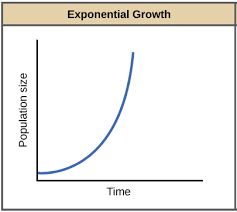
common in R selected species
population overshoot
when a population grows larger than the carrying capacity of its environment, so its resources become depleted, usually followed by exponential decline
exponential decline occurs when
resources become depleted, especially because the population continues to reproduce. Common in R selected species after exponential growth
therefore the high reproductive rate of R selected species is both good and bad
exponential growth model
Nt = N0e^rt
Nt→pop size at a defined time
N0→beginning size of population
r→rate of growth
t→time
r= birth rate - death rate
(if you get a negative number, its negative growth)
deme
singe genetically distinct population characterized by random mating within it, it is at equilibrium
basically organisms within a population who are closer to each other and therefore more likely to mate, so kind of like a sub population