AP BIO SUMMER PACKET
 Call Kai
 Learn
Learn Practice Test
 Spaced Repetition
 Match
Match Flashcards
 Knowt Play
1/246

There's no tags or description
Looks like no tags are added yet.
Name | Mastery | Learn | Test | Matching | Spaced | Call with Kai | Chat |
|---|
No analytics yet
Send a link to your students to track their progress
247 Terms
What is the most common ion/charge formed by carbon?
Carbon usually forms covalent bonds rather than a common simple ion; it has 4 valence electrons and typically forms four covalent bonds.
What is the most common ion/charge formed by hydrogen?
Hydrogen commonly forms H+ with a +1 charge.
What is the most common ion/charge formed by oxygen?
Oxygen commonly forms O2− with a −2 charge.
What is the most common ion/charge formed by nitrogen?
Nitrogen commonly forms N3− with a −3 charge, although in biological molecules it most often forms covalent bonds.
What is the most common ion/charge formed by phosphorus?
Phosphorus commonly forms phosphate-containing ions such as PO4^3− and commonly has a −3 oxidation state in simple ionic compounds.
What is the most common ion/charge formed by sulfur?
Sulfur commonly forms S2− with a −2 charge and is also found in covalent biological molecules.
What is an isotope?
An isotope is an atom of the same element that has the same number of protons but a different number of neutrons.
What makes radioactive isotopes special?
Radioactive isotopes have unstable nuclei that spontaneously decay and release radiation.
How can radioactive isotopes be useful in biology?
They can be used as tracers to follow molecules or biological processes and can also be used in medical diagnosis and treatment.
What determines how atoms interact with one another?
The number and arrangement of their electrons, especially their valence electrons, determine how atoms interact and bond.
What are valence electrons?
Valence electrons are the electrons in an atom's outermost energy level.
Why are valence electrons important?
Valence electrons determine how an atom bonds and interacts with other atoms.
What is a covalent bond?
A covalent bond is a bond in which atoms share electrons.
What is a nonpolar covalent bond?
A nonpolar covalent bond is a covalent bond in which electrons are shared relatively equally between atoms.
What is a polar covalent bond?
A polar covalent bond is a covalent bond in which electrons are shared unequally because one atom attracts the electrons more strongly.
What is an ionic bond?
An ionic bond is the electrostatic attraction between oppositely charged ions that form after electrons are transferred from one atom to another.
What is a hydrogen bond?
A hydrogen bond is a weak attraction between a partially positive hydrogen atom and an electronegative atom, usually oxygen or nitrogen, in another molecule or another part of the same molecule.
How strong are hydrogen bonds compared with covalent bonds?
Hydrogen bonds are much weaker than covalent bonds.
How do ionic bonds and covalent bonds differ?
Covalent bonds involve sharing electrons, while ionic bonding results from attraction between oppositely charged ions after electron transfer.
How do polar and nonpolar covalent bonds differ?
Polar covalent bonds share electrons unequally, while nonpolar covalent bonds share electrons more equally.
Which type of bond holds the atoms together within a water molecule?
Polar covalent bonds hold the oxygen and hydrogen atoms together within a water molecule.
Which type of bond forms between separate water molecules?
Hydrogen bonds form between separate water molecules.
What is the difference between a molecular formula and a structural formula?
A molecular formula shows the number and type of atoms in a molecule, while a structural formula shows how the atoms are connected and bonded.
What is the molecular formula of oxygen gas?
O2.
What is the molecular formula of carbon dioxide?
CO2.
What is the structural formula of carbon dioxide?
O=C=O.
What is the molecular formula of glucose?
C6H12O6.
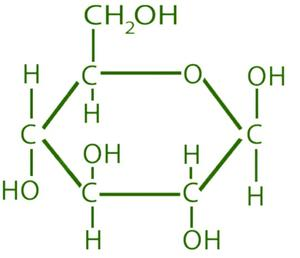
What is the structural formula of glucose?
Glucose is commonly represented as a six-carbon structure with multiple -OH groups and an aldehyde group in its open-chain form; in cells it commonly exists as a ring.
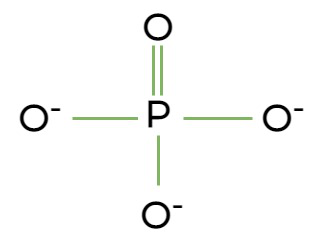
What is the molecular formula of phosphate?
PO4^3− is the formula for the phosphate ion.
What is the structural representation of a phosphate group?
A phosphorus atom is bonded to oxygen atoms, with one oxygen connecting the phosphate group to the carbon skeleton of an organic molecule.
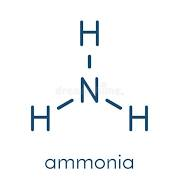
What is the molecular formula of ammonia?
NH3.
What is the structural formula of ammonia?
NH3 with nitrogen covalently bonded to three hydrogen atoms.
What is the molecular formula of water?
H2O.
What is the structural formula of water?
H-O-H, with polar covalent bonds between oxygen and hydrogen.
Why is water considered a polar molecule?
Oxygen is more electronegative than hydrogen, so electrons are shared unequally, giving oxygen a partial negative charge and hydrogen a partial positive charge.
What does it mean that water has an uneven distribution of electrons?
The shared electrons spend more time near oxygen than hydrogen, creating partial charges within the molecule.
What is cohesion?
Cohesion is the attraction between molecules of the same substance.
Why does water have cohesion?
Water molecules are attracted to one another through hydrogen bonding.
What is an example of cohesion?
Water forming rounded droplets or beads is an example of cohesion.
What is adhesion?
Adhesion is the attraction between molecules of different substances.
What is an example of adhesion?
Water sticking to the sides of a graduated cylinder is an example of adhesion.
What is surface tension?
Surface tension is the resistance of a liquid's surface to being stretched or broken.
How does cohesion cause surface tension?
Hydrogen bonding between water molecules creates a cohesive surface that resists being broken.
Why can some insects walk on water?
Cohesion between water molecules creates surface tension that can support the insects.
Why is water's high specific heat important to organisms?
It helps organisms and environments resist sudden temperature changes and maintain stable temperatures.
What is evaporative cooling?
Evaporative cooling occurs when evaporation removes high-energy molecules and thermal energy from a surface, causing the surface to cool.
What is water's role as a solvent?
Water dissolves many polar and ionic substances because its partial charges interact with charged and polar particles.
Why does salt dissolve in water?
NaCl is ionic, so polar water molecules surround and separate its Na+ and Cl− ions.
Why does sucrose dissolve in water?
Sucrose contains many polar hydroxyl groups that can form interactions with water molecules.
Why do nonpolar substances generally not dissolve in water?
Nonpolar substances cannot form favorable interactions with polar water molecules.
How do cohesion and adhesion work together in capillary action?
Adhesion causes water to stick to a surface while cohesion causes water molecules to stick to one another, allowing water to move through narrow spaces.
How does capillary action help plants?
It helps water move through narrow plant tissues from roots toward stems and leaves.
What property explains a meniscus in a graduated cylinder?
Adhesion between water and the glass combined with cohesion between water molecules produces the curved meniscus.
Which property of water allows salt and sucrose to dissolve?
Water's polarity and its role as a solvent.
Many substances such as NaCl and sucrose dissolve quickly in water. What property explains this?
Water's polarity allows it to dissolve ionic substances such as NaCl and polar substances such as sucrose.
What is molarity?
Molarity is the number of moles of solute per liter of solution.
What pH is neutral?
A pH of 7 is neutral at 25°C.
What is the relationship between pH and H+ concentration?
pH = -log[H+].
How do you calculate H+ concentration from pH?
Use [H+] = 10^(-pH).
How do you calculate pH from H+ concentration?
Use pH = -log[H+].
What is pOH?
pOH is a measure of hydroxide ion concentration and is calculated as pOH = -log[OH−].
How do you calculate OH− concentration from pOH?
Use [OH−] = 10^(-pOH).
How do you calculate pOH from OH− concentration?
Use pOH = -log[OH−].
What is the relationship between pH and pOH at 25°C?
pH + pOH = 14.
How do you calculate pOH if you know pH at 25°C?
Subtract the pH from 14: pOH = 14 − pH.
How do you calculate pH if you know pOH at 25°C?
Subtract the pOH from 14: pH = 14 − pOH.
What is the relationship between H+ and OH− concentrations at 25°C?
[H+][OH−] = 1.0 × 10^−14 M².
How do you calculate OH− concentration if H+ concentration is known?
Use [OH−] = 1.0 × 10^−14 ÷ [H+].
How do you calculate H+ concentration if OH− concentration is known?
Use [H+] = 1.0 × 10^−14 ÷ [OH−].
What is the H+ concentration of a solution with pH 7?
1.0 × 10^−7 M.
What is the OH− concentration of a neutral solution at 25°C?
1.0 × 10^−7 M.
What is the H+ concentration of human blood at pH 7.40?
[H+] = 10^−7.40 = approximately 3.98 × 10^−8 M.
What is the pOH of human blood at pH 7.40?
pOH = 14 − 7.40 = 6.60.
What is the OH− concentration of human blood at pH 7.40?
[OH−] = 10^−6.60 = approximately 2.51 × 10^−7 M.
A solution has an H+ concentration of 1.3 M. What is its pH?
pH = −log(1.3) = approximately −0.11.
A solution has an H+ concentration of 1.3 M. What is its OH− concentration at 25°C?
[OH−] = 1.0 × 10^−14 ÷ 1.3 = approximately 7.69 × 10^−15 M.
A solution has a pH of 3. What is its H+ concentration?
[H+] = 10^−3 = 1.0 × 10^−3 M.
A solution has a pH of 3. What is its pOH?
pOH = 14 − 3 = 11.
A solution has a pOH of 4. What is its pH?
pH = 14 − 4 = 10.
A solution has a pOH of 4. What is its OH− concentration?
[OH−] = 10^−4 = 1.0 × 10^−4 M.
If the H+ concentration increases by a factor of 10, what happens to pH?
The pH decreases by 1 unit.
If the H+ concentration decreases by a factor of 100, what happens to pH?
The pH increases by 2 units.
Why are small changes in pH important in biology?
pH affects the shape and function of proteins and enzymes and therefore can change the rates of biological reactions.
Why must cells maintain a stable pH?
Cells require a specific pH range for enzymes and other molecules to function properly.
What is a buffer?
A buffer is a weak acid or weak base system that resists sudden changes in pH.
How does a buffer respond when H+ concentration increases?
The buffer accepts excess H+ ions, reducing the change in pH.
How does a buffer respond when H+ concentration decreases?
The buffer can release H+ ions, helping prevent the pH from rising too much.
Why are buffers important in living organisms?
They help maintain the stable pH required for normal cellular processes.
What is an example of an important biological buffer system?
The carbonic acid-bicarbonate buffer system helps maintain blood pH.
How does the carbonic acid-bicarbonate buffer system help maintain blood pH?
Carbonic acid and bicarbonate can accept or release H+ ions to resist changes in blood pH.
What is an organic compound?
An organic compound is a carbon-containing compound, with some carbon-containing compounds such as CO2, CO, and carbonates classified as inorganic.
Why is carbon the central element in the chemistry of life?
Carbon has four valence electrons and can form four covalent bonds, allowing it to create stable chains, rings, and complex molecules.
Why can carbon form such a wide variety of biological molecules?
Carbon can bond to itself and many other elements, creating chains, branches, rings, and diverse three-dimensional structures.
What is dehydration synthesis?
Dehydration synthesis is a reaction that joins molecules together by removing a molecule of water.
What is another name for dehydration synthesis?
Condensation reaction.
What happens to the number of molecules during dehydration synthesis?
Smaller molecules are joined to form a larger molecule while water is removed.
How can glucose and fructose form sucrose?
Glucose and fructose undergo dehydration synthesis, forming sucrose and releasing one molecule of water.
What is the overall reaction for forming sucrose from glucose and fructose?
Glucose + fructose → sucrose + H2O.
What is hydrolysis?
Hydrolysis is a reaction that breaks a larger molecule into smaller molecules by adding water.
How can sucrose be broken down by hydrolysis?
Water is added to break the bond between glucose and fructose, producing glucose and fructose.