Types of Joints
 Call Kai
 Learn
Learn Practice Test
 Spaced Repetition
 Match
Match Flashcards
 Knowt Play
1/20

There's no tags or description
Looks like no tags are added yet.
Name | Mastery | Learn | Test | Matching | Spaced | Call with Kai | Chat |
|---|
No analytics yet
Send a link to your students to track their progress
21 Terms
Uniaxial joints
Hinge
Pivot
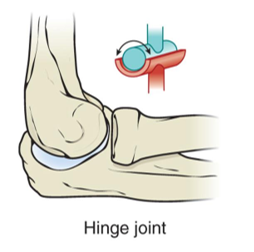
Hinge Joint
Ex. IP (fingers), elbow, and knees
Perform motions of flexion and extension (saggital)
Uni-axial
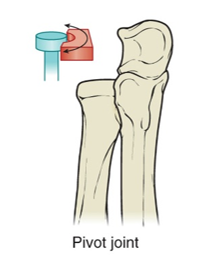
Pivot Joint
Ex. Radioulnar joint
Performs supination and pronation (transverse)
Uni-axial
Biaxial Joints
Condyloid
Ellipsoid
Saddle
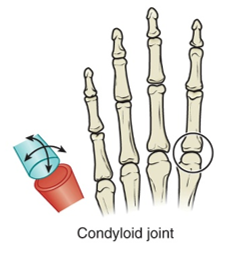
Condyloid Joint
Spherical convex surface with a concave surface
Ex. MCP in hands and MTP in feet
Performs flexion/extension and abduction/adduction
Bi-axial
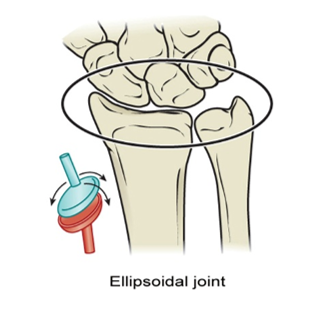
Ellipsoid Joint
Flattened convex surface with deep concave surface
Ex. Radiocarpal joint
Permits flexion/extension and abduction/adduction
Bi-axial
Saddle Joint
Concave and convex surface oriented perpendicular to each other
Ex. CMC of the thumb
Bi-axial

Triaxial
only Ball & Socket
Ex. Hips and Glenohumeral Joint
Flexion/Extension, abduction/adduction, rotation
Spherical covex surface with a concave surface
Condyloid

Flattened convex surface with deep concave surface
Ellipsoid

Concave and convex surface oriented perpendicular to each other
Saddle
CMC of the thumb

Synarthrodial Joints
Skull sutures, for example
No movement
fibrous structure offers stability
fit between bony segments (very tight, very congruent)
Amphiarthrodial Joints
Intervertebral (spine) joints, for example
Slight movement
provides great stability and limited mobility
fibrous and hyaline (articular) cartilage
Diarthrodial (synovial) Joints
Shoulder, Hip, Knee, for example
Free movement
most common joint in body
Stratus fibrosum (thicker)
Stratum synovium (produces synovial fluid)
either ovoid (egg) or sellar shaped (saddle)
Rolling joint motion
Rotary or angular motion
Sliding (gliding)
Translatory or linear motion amongst parallel surface
Spinning
rotary/angular motion where 1 point of contact remains constant
Distraction
pulling apart at joint
Compression
joints coming together
Closed-packed Position
The joint surfaces are maximally fitted together and the surrounding tissues are tight
maximum stability, which is useful during activities such as weight-bearing.
Open-packed position (or loose-packed)
The joint is in a position where the capsule and ligaments are relatively relaxed, allowing more joint play.
typically used for joint mobilizations