Business Studies Prelim
 Call Kai
 Learn
Learn Practice Test
 Spaced Repetition
 Match
Match Flashcards
 Knowt Play
1/109

There's no tags or description
Looks like no tags are added yet.
Name | Mastery | Learn | Test | Matching | Spaced | Call with Kai | Chat |
|---|
No analytics yet
Send a link to your students to track their progress
110 Terms
Profit
Revenue - Expenses
Income
Money earned by employees. Usually in the form of salary or wages.
Innovation
Occurs when businesses create a new way of doing things, or produce novel products
Risk
Possibility of financial loss
Entrepreneurship
Occurs when a person creates business wealth by focusing on a vision and bringing together all of the inputs required to realise that vision.
Qualities of entrepreneurs
- Energy
- Determination
- Creativity
- Communication skills
Wealth
The value of assets owned
Business (enterprise)
Are engaged in activities involving the provision of goods and services
SMEs (small to medium enterprises)
- Businesses with less than 200 employees
- Turnover under 2mil
Small businesses
- Businesses of less than 20 employees
- Turnover under 200k (400k agriculture)
Large businesses
- Employ over 200 employees
- Turnover greater than 2mil
Primary industry
Use of resources in their most basic, natural and unrefined form. (BHP)
Secondary industry
Sometimes called value adding sector, as conversion involves adding value to raw materials as they are changed into products. Include energy utilities- water, gas, electricity. (Holden)
Tertiary industry
Concerned with retail and provision of services. Includes logistics and transportation. (Coles)
Quaternary industry
Businesses involved with the transfer and processing of information and knowledge. (CBA, SMH)
Quinary industry
Involved with the provision of home-based services. Includes businesses that replace home based activities with servies that do those activities for a fee. (Jims Mowing)
Sole trader
A person who is the exclusive owner of a business, entitled to keep all profits after tax has been paid but liable for all losses.
Partnership
A business owned and run by two or people. Partners are individually responsible for debts incurred. All partners have agency (Contracts or agreements entered by one partner has binding effect on all partners).
Private company
- 1 to 50 shareholders
- Legal structure is seperate from owners, limits personal liability.
- Must have a director
- 'Pty Ltd'
Public company
- Unlimited shareholders
- Minimum of three directors
- Are listed on the ASX
- Must publish an annual report each year
- 'Ltd'
Government enterprise
- Businesses run by the government, but treated like a company in private sector with profit motive
- Purpose is to increase product and efficiency
Incorporation
The process of establishing a business as a separate legal identity that allows it to benefit from limited liability
Internal Influences on business
- Products
- Location
- Resources
- Management
- Business Culture
Stakeholder
Anyone who is interested in and affected by the business.
Internal stakeholders
Owners, managers, other employees
External stakeholders
- Government
- Customers
- Suppliers
- Society
- Competitors
- Environment
- Financers
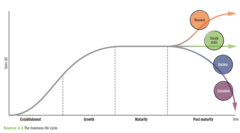
Business Life Cycle
1. Establishment
2. Growth
3. Maturity
4. Post-maturity
Establishment
First stage of the business lifecycle, occurs when business launches into the market.
- Create awareness of business and loyal customers
- Penetration pricing strategy
Growth
Second stage of a business lifecycle and occurs when a business starts to sustainably increase its sales and turnover in the market
- Minor product variations in response to customer feedback
- Employ more staff, increase scale of production
Maturity
Third stage of business cycle and occurs when business has achieved a stable market share. Point that management decisions become more important to future survival of business.
- Find ways to reduce costs to maintain profitability (cheaper suppliers, investment in capital)
- Take over smaller businesses within market
Post maturity
Fourth (last) stage of the business cycle. Stage where business will either decline or find new opportunities, regrow and increase in scale.
regrow (post maturity)
- Rebrand old products
- Improve existing products
- Enter new markets (increase in customer base)
- Make new product lines
cease trading (post maturity)
- Stop making/selling new items
- Sell of all stock, complete existing contracts
- Reduce prices to generate cash
- Honour all financial obligations (staff, suppliers etc)
Challenges in establishment phase
- Financial challenge: Manage high cash outflow and the very low cash inflow after launch
- Operations challenge: Ensure there is enough reliable supply to manage the early need for product
- Marketing challenge: Increase brand-awareness whilst keeping costs low
Challenges in growth phase
- Financial challenge: Manage high cash inflow and high cash outflow that occur with rapid sales.
- Operations challenge: Ensure there is enough reliable supply to manage the high demand for the product
- Marketing challenge: Increase brand awareness and product quality
- Human resources challenge: Find skilled staff
Challenges in maturity phase
- Financial challenge: Reduce cash outflow and maintain profitability through value adding and emphasis on rewarding customer loyalty
- Operations challenge: Reduce supply costs
- Marketing challenge: Maintain brand awareness in competitive market
- Human resources challenge: Keep staff motivated to innovate and create difference when sales are steady
Challenges in renewal phase
- Financial challenge: Manage high cash outflow and the cost of entering new markets, rebranding, or experiencing rapid sales
- Operations challenge: Ensure there is enough reliable supply to manage high demand for product
- Marketing challenge: Maintain product quality, and differentiate to satify new markets.
- Human resources challenge: Attract skilled staff to manage change and regrowth
Challenges in cessation phase
- Financial challenge: Manage high cash outflow and low cash inflow (arising from sales, financial discipline must be maintained to pay off debts)
- Operations challenge: Close supply lines and manage the sale of old stock
- Marketing challenge: Manage dissapoitment that consumers may experience due to loss of brand
- Human resource challenge: Manage career transition of staff
Factors that lead to business decline
- Loss of interest by owners/management who may be seeking new challenges, achieved goals, or transitioning into retirement
- Loss of demand from market due to change in consumer preferences
- Emergence of new competition that provides better products
Liquidation
Occurs when the firms assets are sold off to generate or realise cash. This cash is used to pay off creditors and others who have an entitlement payment from the business.
Voluntary cessation
- The owners decide to close the enterprise. Sell of business assets, pay all debts and close business
- Shareholders can elect to close business through selling of assets, repaying debts, then close by notifying ASIC. Directors may choose to call in an administrator (reciever).
Involuntary cessation
- Business cannot pay of debt, a creditor will apply to court demanding payment. The assets of a business, even personal assets of owners will be sold.
- Business appoints administrator (reciever) who will try to trade the business into a position of strength. May sell off assets in order to relieve debt. If this is not possible the business will be liquidated, and all assets sold.
Effective management skills
- Interpersonal: Able to relate to employees
- Communication
- Strategic thinking: Able to keep big picture in mind when making decisions
- Vision: clear vision, 'mission statement', communicated to emplyees
- Probem solving and decison making: Identify most appropiate response
- Flexible, adapt to change: Proactive not reactive
- Reoncile conflicting interests of stakeholders
Internal growth
Increase sales, expand product range, employ more staff, increase capital, increase number of stores/locations business has
External growth
Merging or acquiring another business
Business goals
- Maximised profits
- Improved market share
- Growth
- Social goals
- Environmental goals
External influences on business
- Economic
- Financial
- Social
- Legal
- Political
- Institutional
- Technology
Classical approach
Workers focused on performing specific tasks in the most efficient and effective way (repetition of tasks). Management focused on increasing output by increasing worker effort and saving time (repetitive task -> maximum efficiency)Behaviour.
- Heirarchial organisational structure
- Autocratic leadership style
Strategic planning
Long term planning for a business as a whole developed by senior management
Tactical planning
Medium-term planning, one or two years ahead. Devised by middle management.
Operational planning
Plans for the day-to-day running of a business, using input from supervisors.
Heirarchial organisational structure
- People are grouped according to the function they need to perform
- Chain of command
- Rigid lines of communication
- Bureaucratic (most important decisions made by higher up)
Division of labour
Each task divided into small steps in the production process, each worker is assigned to a task. Evident in classical approach.
Autocratic leadership style
- Authoritarian (enforce strict obiedience to authority, less personal freedom)
- Make decisions with little input from others (centeralised)
- Very little opportunity for input from those at bottom of chain
Management approaches
- Classical
- Behaviourial
- Contingency
Behavioural approach
Focused on the human element of business, employees wellbeing is most important in terms of maximising production. Autonomous employees, easier problem solving and identify issues faster.
- Flat structure (teams)
- Participative/Democratic leadership style
Team structure
- Teamwork
- Management as facilitators, providing teams with resources
- Supervisor to lead teams
- Improved commication channels, more flexible, decisions are made and implemented faster, improved morale and productivity
Participative (democratic) leadersip style
- Employees encouraged to share their opinions
- Management consider views of others before making decision
Contingency approach
- Use a combination of classical and behavioural.
- Management make decisions based on current circumstances, adapting style and approach accordingly
Role of management classical approach
- Planning (setting goals)
- Organising (what will be done, who will do it, how it will be done)
- Controlling (compare, corrective action)
Role of management behavioural approach
- Leading
- Motivating
- Communicating
Key business functions
- Operations
- Marketing
- Finance
- Human resources
Goods
Physical, tangible items. Can be simply transformed manufactured goods (STM, used by other businesses as input) or eleborately manufactured goods (ETM, undergone a number of processes prior)
Quality control
Reactive. Involves conducting checks at various points in the production proces to ensure quality is met.
Quality assurance
Proactive. Involves implementing a set of procedures and processes that will prevent defects from occuring.
Total quality management
A philosophy that involves everyone in an organisation in a continual effort to improve quality and achieve customer satisfaction.
Leads to reduced costs, increased efficiency, improved price competitiveness, improved business name and reputation
Marketing
The process of planning and executing the conception, pricing, promotion, and distribution of ideas, goods, and services to create exchanges that satisfy individual and organizational objectives
Market segmentation
Division of the target market into smaller segments based on the similar or common characteristics of a customer group.
- Demographic
- Geographic
- Lifetyle
- Behavioural
Marketing mix
The process of developing a product that meets the needs of consumers and implementing the four ps that will encourage customers to purchase the product
Four Ps
Product, Price, Place, Promotion
Product (4 Ps)
- The product itself
- Packaging
- Branding/Logo
- Positioning
- Guarantee
Price (4 Ps)
- Cost plus margin
- Market price
- Competitors price
- Discount price
Promotion (4 Ps)
- Personal selling
- Sales promotions
- Advertising
- Publicity
Place (4 Ps)
- Channels of distribution
- Intensive, selective, exclusive
Net cash
Cash inflows - cash outflows
Closing balance
Opening balance + net cash
Revenue
Total income generated by a business. (Price * quantity)
Cost of goods sold (COGs)
The value of the stock used to earn revenue through sales to customers. (Opening stock + purchases - closing stock)
Gross profit
The amount remaining once COGS has been deducted from sales (sales - COGS)
Net profit
Gross profit - expenses
Current asset
Assets that the business owns for a short period of time, usually less than 12 months
Non-current assets
Assets that the business owns for a longer period of time, usually more than 12 months.
Liability
Something that the business owes or has to repay
Current liability
A debt that the business is expected to repay in the short term (less than 12 months)
Non-current liability
Debt that the business is expected to repay in the long term (more than 12 months)
Owners equity
The funds contributed by the owner into the business. Can also include net profit found on income statement (also called capital)
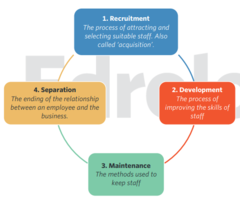
Human resource cycle
1. Recruitment: Process of attracting and selecting suitable staff
2. Development: The process of improving the skills of the staff
3. Maintenance: The methods used to keep staff.
4. Separation: The ending of a relationship between an employee and the business
Training
Teaching employees to perform their jobs more efficiently.
- Formal off-the-job training (external course)
- Informal on-the-job traning (shadowing)
- Computer based training
Vision
- Overarching view of the business as to what the business can be and achieve
- Owner must communicate vision, as it influences how the business is managed and operated
- Goals and objectives part of vision
Social goals
Goals to operate in a way to benefit society, include:
- Promoting human rights
- Hosting community events
- Encouraging cultural diversity
- Empowering marginalised groups
Business plan
A formal written statement that contains important details about the business, its goals, and how the business will achieve its objectives.
- Helps the owner control their business
- Necessary when achieving finance (+ why)
- Clarify business idea and path to success
- Identify potential opportunities and threats
SWOT analysis
Assist with setting goals, evaluating companies strength. Strengths, weaknesses, opportunities, threats
Controlling
Compare business performance with goals established in planning process. Corrective action could be taken if not meeting goals (including changing plans, strategy, cut costs)
Outsourcing
A decision by a corporation to turn over much of the responsibility for production to independent suppliers.
span of control
The number of subordinates who report directly to an executive or supervisor
Establishment options
New business, Enter into a franchise, Purchase an existing business
intrinsic rewards
Satisfaction a person receives from performing the particular task itself
extrinsic rewards
benefits and/or recognition received from someone else
What was Frederick Taylor's philosophy?
by optimizing and simplifying jobs, productivity would increase.
break-even analysis
a method of determining what sales volume must be reached before total revenue equals total costs