4 - Quantum Numbers
 Call Kai
 Learn
Learn Practice Test
 Spaced Repetition
 Match
Match Flashcards
 Knowt Play
1/35

Earn XP
Name | Mastery | Learn | Test | Matching | Spaced | Call with Kai | Chat |
|---|
No analytics yet
Send a link to your students to track their progress
36 Terms
Quantum numbers
______ cover the part of quantum mechanics that talks about energy and location of electrons
Orbital
[QUANTUM NUMBER]
An _____ is a space that accommodates 2 electrons.
2 electrons
[QUANTUM NUMBER]
An ORBITAL is a space that accommodates _____ electrons
Spin
[QUANTUM NUMBER]
An ORBITAL is a space that accommodates 2 electrons and these are held by what we called _____
Node
[QUANTUM NUMBERS]
A _____ is a section of the orbital that cannot hold electrons.
Subshell/ sublevel
[QUANTUM NUMBERS]
Multiple orbitals can be grouped in a __________, and multiple subshells constitute a whole energy shell /level
Energy shell /level
[QUANTUM NUMBERS]
Multiple orbitals can be grouped in a subshell/ sublevel and Multiple subshells constitute a whole________
Subshell / Sublevel
[QUANTUM NUMBERS]
Energy shell have a smaller portion known as ______.
1-7 orbitals
[QUANTUM NUMBERS]
Subshell / Sublevel can have as much as ____ orbitals
Subshell / Sublevel
[QUANTUM NUMBERS]
Multiple orbitals can be grouped in a ______.
Energy shell / Energy level
[QUANTUM NUMBERS]
Multiple subshells constitute a whole _____
Type (symbol) | Represents | Numbers |
Principal (n) | Energy level/shell | 1, 2, 3, 4, and so on |
Azimuthal / Angular (l) | 1) Shape of orbital 2) Sublevel/subshell | 0, 1, 2, 3 |
Magnetic (ml) | Orientation of an orbital | s = 0 only p = -1, 0, +1 d = -2, -1, 0, +1, +2 and so on |
Spin (ms) | Spin of an electron inside an orbital | +1/2 (up arrow) -1/2 (down arrow) |
Type of Quantum Numbers [4]

Part of a Quantum Number
Principal Quantum Number (n)
[QUANTUM NUMBERS]
Energy level / Energy shell of an orbital
Azimuthal / Angular Quantum Number (I)
[QUANTUM NUMBERS]
Shape of orbital
Sublevel/ Subshell
Magnetic Quantum Number (ml)
[QUANTUM NUMBERS]
Orientation of an orbital
Spin Quantum Number (ms)
[QUANTUM NUMBERS]
Spin of an elecron inside an orbital
Azimuthal / Angular Quantum Number (l)
[QUANTUM NUMBERS]
__________ represents both the number and shape of orbitals per sublevel/subshell
ℓ (Azimuthal Quantum Number) | Orbital Type (Subshell) | Number of Orbitals | Shape of Orbitals | Maximum Number of Electrons |
|---|---|---|---|---|
0 | s | 1 | Sphere | 2 |
1 | p | 3 | Dumbbell | 6 |
2 | d | 5 | Four-leaf clover | 10 |
3 | f | 7 | Complex | 14 |
[QUANTUM NUMBERS]
Table 6. Azimuthal Quantum Number Interpretations
Degenerate
[QUANTUM NUMBERS]
Starting from the p-subshell , multiple orbitals of the same subshell have the same energies and are called _____.
Aufbau Principle (Madelung Rule)
Hund’s Rule (Maximum Multiplicity Rule)
[QUANTUM NUMBERS]
There are principles concerned mainly with the principal and azimuthal number such as ____ [2]
Madelung rule
[QUANTUM NUMBERS]
Aufbau principle is also known as ____
Maximum Multiplicity Rule
[QUANTUM NUMBERS]
Hund’s rule is also known as _____
Aufbau principle (Madelung Rule)
[QUANTUM NUMBERS]
In an atom with multiple energy levels and/or sublevels, the electrons are filled up from 1st onward in a predictable fashion by order of increasing energy
a. Aufbau principle
b. Hund’s rule
c. Pauli exclusion principle
Hund’s rule (Maximum Multiplicity Rule)
[QUANTUM NUMBERS]
Electrons fill up degenerate orbitals singly first (+1/2) before pairing up
a. Aufbau principle
b. Hund’s rule
c. Pauli exclusion principle
Pauli exclusion principle
[QUANTUM NUMBERS]
Once the magnetic and spin quantum numbers are considered, the ______ enters, which states that every electron in an atom is unique
a. Aufbau principle
b. Hund’s rule
c. Pauli exclusion principle
Pauli exclusion principle
Example:
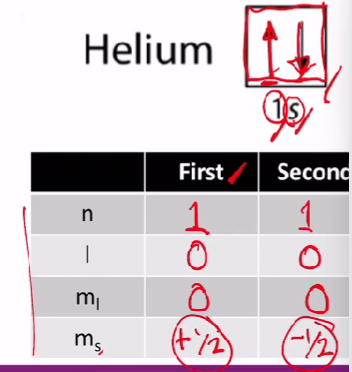
[QUANTUM NUMBERS]
No two electrons have the same set of four quantum numbers.Because they are all unique (or “exclusive)
a. Aufbau principle
b. Hund’s rule
c. Pauli exclusion principle
Electronic configuration
[QUANTUM NUMBERS]
Assume that every electron in an atom is placed in a specific orbital in a specific shell. When all of them are considered, an atom’s ______ can now be written.
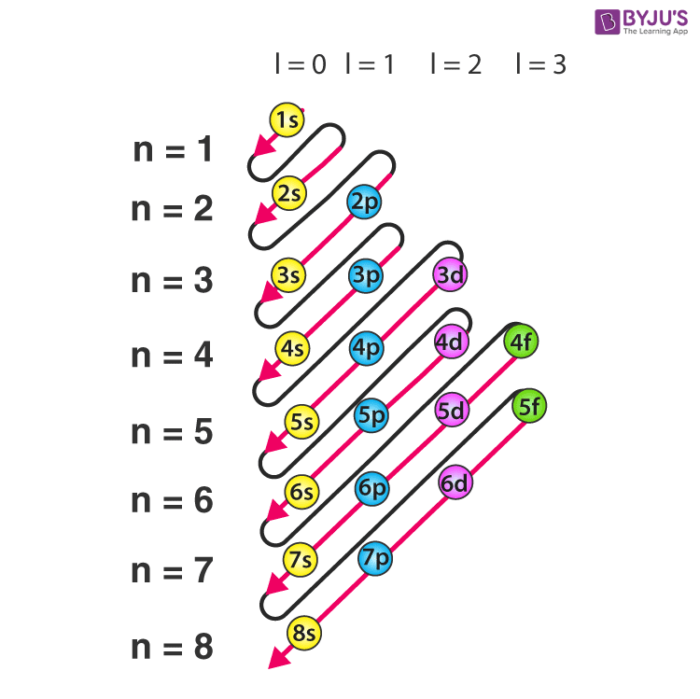
Electronic configuration:
TRUE
[QUANTUM NUMBERS]
TRUE OR FALSE:
Electron Configuration is usually written in the complete form, but if the element is large, it’s fine to use the abbreviated form
Example:
Complete Form (Strontium) = 1s² 2s² 2p⁶ 3s² 3p⁶ 3d¹⁰ 4s² 4p⁶ 5s²
Abbreviated Form (Strontium) = [Kr] 5s²
(Context: Kr = 1s² 2s² 2p⁶ 3s² 3p⁶ 3d¹⁰ 4s² 4p⁶)
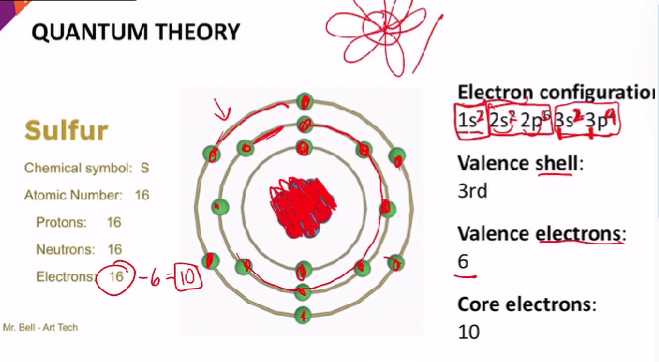
[QUANTUM NUMBERS]
Example of Electron Configuration of Sulfur:
Valence
[QUANTUM NUMBERS]
Outermost (applies to shells, subshells, or electrons)
Core
[QUANTUM NUMBERS]
Inner electrons (anything except the valence)
Octet Rule
[QUANTUM NUMBERS]
According to ______ rule
For smaller atoms, valence electrons of s and p block elements must be eight (8; octa-) to be stable
TRUE
[QUANTUM NUMBERS]
TRUE OR FALSE:
The smaller atoms refer to most non metals in organic compounds , since s and p orbitals are all they have.
TRUE
[QUANTUM NUMBERS]
TRUE OR FALSE:
The larger atoms with d orbitals can attains stability without needing to follow the octet rule.