Empathy Psych Exam 2
 Studied by 0 people
 Call Kai
 Learn
Learn Practice Test
 Spaced Repetition
 Match
Match Flashcards
 Knowt Play
1/56

There's no tags or description
Looks like no tags are added yet.
Name | Mastery | Learn | Test | Matching | Spaced |
|---|
No study sessions yet.
57 Terms
What did initial treatment of people with psychological disorders look like?
Treatments were often ineffective an , far worse, harmful, and unethical
Psychosurgeries
Shock Therapy
Forced sterilization
What aspectes of psychoanalysis seemed broadly related to empathy?
•Transference relationship
•client’s transfer or generalization of feelings to the analyst (e.g. anger towards father). Considered essential to psychoanalysis.
•Countertransference
•analyst’s transfer of feelings or attitudes that THEY have (e.g. analyst’s anger towards their own father) towards the client. NOT supposed to that.
•According to psychoanalysis—and most other therapies—therapists are supposed to avoid “inserting” their own personal background/feelings into the session
However: Freud, himself, said almost nothing about empathy in his vast writings…
What was the problem with psychoanalysis and its relation to empathy ?
IT TRIES TO EXPLAIN TOO MUCH
Everything confirms the theory, nothing disconfirms (or falsifies) it.
This looks like a strength but it is actually a weakness.
Good theories stick their necks out and make real predictions. They can be proved wrong.
According to many critics, psychoanalysis is no better than astrology, i.e. is a pseudoscience.
What are some example of some other important types of therapy besides psychotherapy?
•Gestalt Psychotherapy
•Psychodynamic, but more “present oriented” than Freud
•E.g., Fritz Perls
•Cognitive-oriented Therapy
•Albert Ellis, Aaron Beck
•Humanistic, “Client-centered” Therapy
•Famously, Carl Rogers
•Behavioral approaches
•Directly or indirectly inspired by concepts advanced by B.F. Skinner
•Systematic desensitization
•Modeling
•Token economy
What is systematic desensitization
overcoming phobias via exposure to progressively more fearful stimuli while one remains deeply relaxed.
What is modeling
individual acquires a new behavior; therapist demonstrates a target behavior, then imitated by the client.
What is a token economy
people reinforced for desired behaviors by receiving tokens that may exchanged for desired rewards
What is characteristic of style of the Rogerian therapy ?
Be non-directive: Insight and goals come from the client
Be genuine: Be yourself and be truthful; don’t put on a “therapist” facade
Be accepting; show unconditional positive regard: Help the client learn to accept themselves despite any weaknesses
Be empathetic: Pay careful attention to clients’ feelings, partly by reflecting what you hear the client saying
BEING NICE IS NOT NECESSARILY THE SAME AS BEING EMPATHETIC
What does active listening consists of ?
1.Summarize, paraphrase
“So your father wasn’t around much?”
2.Invite clarification and elaboration
“When you say ‘anxiety,’ what does that feel like to you? What is going on in your body and thoughts?”
3.Reflect Feelings
“It seems like you are disappointed; am I right?”
What are key points about Rogerian therapy that where evident from the gloria tapes
•Unconditional positive regard
•No advice giving. Lots of mirroring techniques.
•Rogerian therapy is non-directive but not directionless; it is about helping the individual to self-direct.
•Goal 1 (of the therapist): Try to help client change.
•Goal 2 (of the therapist): Accept and valuing the client as they are!
What where historical arguments for Rogerian therapy
•RT provides foundation for any therapeutic session, including but not limited to:
•Genuine, attentive listening!
•Empathic concern can be powerful and comforting to most people
•Encourages clarification of client’s concerns and goals
What where historical concerns about Rogerian therapy
•Too “passive”.
•Patient problems occur when they have learned (explicitly or implicitly) dysfunctional behaviors and need to be taught, by the therapist, appropriate skills/behavior.
•Over-emphasizes effectiveness of “self-actualization”. Deep understanding of one’s self is good, but clients need advice and guidance!
Give a brief overview of CBT
Approach is largely focused on cognition and how thoughts influence emotions and behavior
Future oriented
Therapist will typically play active role in helping client find new/more adaptive ways of thinking and acting
What are arguments for CBT
•Stark alternative to Rogerian therapy: therapist offers clear guidance of how to modify behavior/thought.
•“Gets to the heart of the matter”: The need for therapy almost always involves need to change dysfunctional behavior/thought. Let’s make a plan!
What’re concerns about CBT
•Runs the risk of the client feeling lack of true compassion from the therapist
•Problem-solving approaches can be fine, but sometimes effective therapy requires additional elements (e.g. more explicit empathy for the client)
What is the gold standard for evaluating effectiveness of treatment
“Double blind”: Neither patients, nor doctors, know who’s been assigned to which condition
After study is over, condition then revealed to experimenters; data analyzed as a function of group (real drug vs. placebo)
Sometimes there will be a preliminary analysis of the two groups; if real drug is more effective than placebo, the researchers may stop the study and give everyone the real drug.
Knowing when and if to stop the study can be very difficult to decide!
What’re some significant challenges when testing psychotherapy effectiveness
•In theory, researchers likely to want to compare effectiveness of different therapies
•E.g., is Rogerian therapy more effective than CBT?
•However, studies that randomly assign Ps to different therapies are almost unheard of
•Unethical
•E.g., What is the patient doesn’t WANT to be treated by a Rogerian- trained therapist?
•Pragmatic challenges
•Random assignment is much harder than it looks (in this case)
•Confounding factors
•e.g., two different therapists with two different approaches (e.g., Rogerian vs. CBT) likely differ in a near infinite number of ways
•If you find a difference, what’s the explanation?
•There is little or no possibility of a meaningful “placebo group” in this type of endeavor
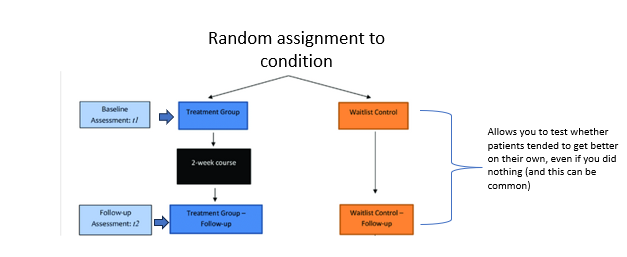
What kind of studies can be done to test psychotherapy effectiveness?
•Key component: waitlist control
•Patients matched on a variety of variables (e.g. demographic factors, severity of psychological problem)
What were the results from evaluating the effectiveness of various types of therapy
Few if any difference between different types of therapy
As long as the therapy was self selected
What makes a good therapist
•Accepting / understanding
•Empathetic
•Calm
•Warm
•Collaborative
•Emotionally expressive
•Helpfulness
•Active listening with questions & comments
What is the upside to being empathetic ?
•Rapport (in therapy) = a foundational relationship of trust, empathy, and mutual understanding between client and therapist
•Essential for effective therapy, fostering open communication (honesty), and better treatment outcomes
•May also be referred to as the therapist-client alliance, working alliance, or therapeutic bond
What is better rapport associated with
•Better clinician-patient communication
•Better treatment adherence
•Higher client retention
•Symptom improvement (in many cases
What are the related dimensions of empathy burnout
•Emotional exhaustion (EE)
•emotional (and sometimes) physical depletion.
•feeling over-extended; unable to offer emotional support to others
•
•Depersonalization (DP)
•“impersonal” response towards recipients of one's care
•
•Decreased sense of personal accomplishment (DPA)
•An increasingly negative view of oneself, particularly in relation to one's work with service users
•E.g. “I just do this anymore; I’m not helping my clients”
What types of physicians/clinician is most likely to experience empathy burnout ?
No clear answer on this yet
What’re the key points on “Neurological down-regulation of pain responses” ? ( In the context of the possible consequences of burnout “dehumanization”
The idea is that doctors/clinicians start to distance themselves from their patients
Conditions: Person getting put in an MRI machine, one receives a “painful stimulus” one control. Observe the reaction of doctor in contrast to no doctor.
Doctors are showing stronger down regulation of empathetic responses.
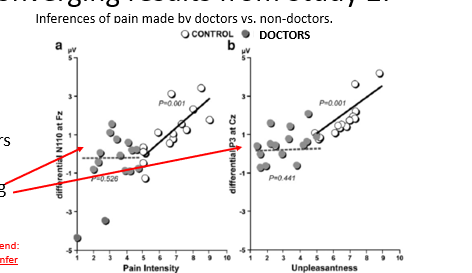
What is the main points of this graph ?
Same point: Doctors (vs. non-doctors) are downregulating
Doctors infer relatively lower levels of pain and unpleasantness being experiences by targets with needles in their cheek
How does down-regulation work?
•Down-regulation is a top-down process where higher level brain regions (i.e., prefrontal cortex) inhibit lower-level emotion-generating regions (i.e., amygdala)
How does down regulation develop ?
•Emotional regions (limbic system) of the brain develop relatively early
•Self-control skills (prefrontal processes) develop later
•This explains why adolescents tend to be more impulsive
What’re different examples of type of “burnout” ?
•“News fatigue” – related to 24/7 news cycle and increased internet access – exposure to a lot of (mostly negative) information
•
•“Caregiver burnout” – related to providing long-term care for someone (younger sibling, older family member, disabled loved one, health aide profession)
•“Workplace burn-out” – may be from toxic workplace environment/stress
•May result from poor work-life balance
What’re some strategies to prevent empathy burn-out?
•Assess personal burn-out feelings and intervene early
•Take breaks
•Effective breaks that allow for “recharging and resetting”
•Maintain self-care
•Adequate sleep, diet and exercise, interpersonal relationships
•Lean on support from others
•clinical supervisors, co-workers, therapist’s therapist
What is the definition of objectifying of women ?
act of treating women as sexual objects or things, rather than as complex human beings. It can involve demeaning women by (e.g.) using women's bodies to sell products, or judging women based on their appearance…
What was discovered by Cogoni et al. and his study on how Ps respond to “sexualized” female targets
•Male and female Ps shown picture of female target getting “q-tip vs. needle”
•Target was either wearing (a) regular shirt or (b) fairly revealing swimsuit/underwear
•Results showed dampened neurological responses to sexualized female target
•Effects were the same regardless of whether participants were male or female
Summarize the main downregulation effects
Seeing others in pain may lead to us neurologically “downregulating” empathetic responses in a couple situations
When neurologically normal people respond to outgroup members
Psychopaths
When perceiver is in profession that requires them to frequently downregulate.
When responding to people portrayed in an objectified manner.
Which of the Big Five personality traits are best predictor of empathetic listening skills? (ELS)
Agreeableness was by far the best predictor of empathic listening skills.
One possible oversight, is that ELS is measured by self report
What does active listening mean ?
Practice of paying full attention to what someone is saying in order to demonstrate unconditional acceptance and unbiased reflection.
According to Carl Rogers this is called reflective listening
What’re some active listening techniques (long af)
•Be in listening, not judging, mode.
•Watch impulse to offer advice; best to wait for them to ask
•Be “present” in the conversation
•Different people are comfortable in different (physical) settings while you talk
•If there’s something important you don’t understand, gently ask for clarification, but wait for a natural pause or opening
•Unless you’re literally their therapist, be their friend, not their therapist.
•Don’t mentally “rehearse” your response while the other person is talking
•Be “upfront” and honest about your own emotions if they’re impacting the conversation
•If you have (what you believe to be) some good advice, ask the other person if they’d be open to some possible ideas/suggestions
What’re the 4 horsemen of communication styles and their counterpart
Criticism ——→ gentle start up
Contempt ——→ Build culture of appreciation
Defensiveness ———> Take responsibility
Stonewalling ——→ physical self soothing
Describe “soft (gentle) start- ups
•Avoid negative, harsh, overly general, or critical start ups; avoid any sentence that prominently features the word “you”.
What is a simple way to increase empathetic understanding
Do something together
What does research conclude about dispositional empathy and accuracy ?
Highly empathetic perceivers can be accurate, only if social targets are sufficiently expressive.
•In other words: highly empathic perceivers are not mind readers, they need to have cues to work with.
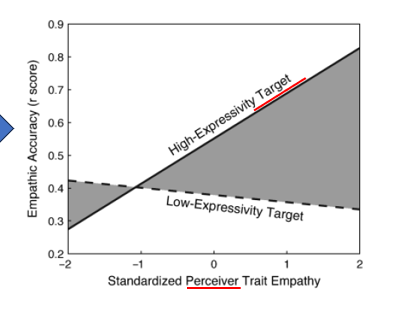
What can be interpreted from this graph
People are more accurately able to empathize with people when they’re more expressive.
What is one way to get better at perspective getting, as opposed to perspective taking
One way of getting better at perspective getting is trying to imagine how someone else feels is often not enough, and can even increase inaccuracy.
Easy solution as opposed to guessing, would be to just ask them
What does it mean to undergo “behavioral immersion “
It means to try out someone’s life, not just their shoes
Helps to cultivate curiosity about strangers lives (without being intrusive or creepy)
Can be a way to facilitate empathy
What’re some major roadblocks in being able to facilitate empathy in everyday life?
•Roadblock 1 - Not Paying Attention
•Roadblock 2 - Feeling the emotion of the other person but not knowing how or when to communicate empathetically.
•Roadblock 3 - Knowing intellectually that you need to communicate empathetically but not feeling the other person's emotion.
What’re the main findings of the IRI for couples
IRI for couples was moderately correlated with their own relationship satisfaction
True for heterosexual and same-sex relationships
when looking at studies on co--habituating heterosexual couples they found more evidence to corroborate previous point, however females perceived satisfaction was relatively accurate as opposed to male perception of woman’s satisfaction which was inaccurate (lol) .
Explain the role of oxytocin in empathy and neurological processes
Oxytocin- naturally produced hormone produced by the body
Scientists theorize that it would lead to improvement in empathetic connections with others, and enhance their “theory of mind” abilities and help to improve trust in others. Evidence relatively weak for this
What is the role of food in empathy and emotion regulation ?
•Infants learn from an early age to associate food with soothing and social interaction.
•Even among adults, food does not merely represent a means to satiety but can also signify comfort or reward.
•These authors suggest, too, that food has the potential to strengthen empathic bonds with others.
•“Eating is an inherently social behavior” (p. 2). A meal shared with others is held in higher esteem and regarded as more of a proper meal than food consumed by oneself
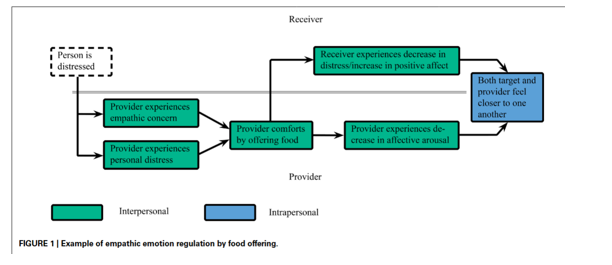
What does this graph show?
Provider feels some emotion that compels them to empathize
Provider offer food
Decrease in stressful situation for provider
Both targets feel closer to one another
What’re some important caveats when it comes to the empathetic effects of food ?
•Depending on the person, stress can either decrease or increase food intake in degrees that might be unhealthy.
•E.g. eating some “comfort food” by yourself is fine, but having 4x times as much as you usually eat obviously isn’t good.
•And of course swinging too far the other way (reduction in food intake) is not healthy on a variety of different levels, including ability to connect with others.
What does Crenshaw et al. 2019 say about accuracy and stress levels ?
•Members of long-term heterosexual couples experiencing moderate levels of stress tend to show higher levels of empathic accuracy compared to those experiencing low or high levels of stress
•Metaphorically, it’s like a bell is going off in their heads: something’s up with my partner, I better pay attention
Inverse may be true when it comes to high levels of stress, leading to decreased levels of empathetic accuracy.
What’re 4 distinct but somewhat correlated facets (review)
Empathetic concern
Perspective taking
Personal Distress
Fantasy
Which facet of empathy seems to be correlated to being attuned to others suffering
Personal distress: Reflects a “self focused aversive reaction to witnessing another person’s suffering”
How does personal distress lead to two possible routes of action in response to someone’s suffering?
Personal distress when perceiving the suffering of others
Motivation to reduce (get rid of) these negative feelings
Two possible routes
Help the other person (approach)
Not help the other person (avoidance)
note: tendency for people to score high in personal distress tends to be stronger for people scoring higher in other forms of empathy. So this suggests one reason why highly empathic people might not always help others.
Explain the live is blind effect
People who are committed to a relationship, and who are moderately empathic, can be motivated to NOT see potentially troublesome aspects of that relationship
Couples who report “happy relationships” display less empathic accuracy compared to couples who are not close.
What is the relation between meditation and empathy
•There is anecdotal evidence that meditation might improve empathy and attentive towards others.
•Here we refer to a specific type of meditation which is called compassion meditation, involving:
•Structured attention (fostered by the instructor) to focus on lovingkindness, and compassion.
•In a study by King et al. (2023), researchers randomly assigned Ps to engage (vs. not engage) in a extended period of meditation.
•Data showed some evidence that this training increased participants’ spontaneous expressions of empathy when shown pictures of other people who were suffering.
•Notably, researchers used non-verbal (i.e., physiological) measures of empathic responses
Can empathy be taught?
•Relevant meta-analysis by van Berkhout and Malouff (2016):
•On average, training programs tend to produce reliable effects (vs. control)
•Moderators of these effects: training programs are more effective with:
•Health professionals (vs. non-health professionals)
•Programs that compensate trainees for their time
•Training that focuses on emotional (vs. cognitive) empathy
What does Gruhn et al. (2008) say about old people and empathy
•Researchers tracked a large number of participants, of various ages, over a 12-year period.
•Classic longitudinal design
•At the beginning of the study (T1), Ps ranged in age from 18 to 75.
•Two years later, these same Ps are measured again (T2); everyone is 2 years older.
•And so on, for the next 12 years.
•T1à T2à T3à T4à etc
•yes, there tended to be some attrition especially for the older Ps
•Results
•No significant changes in empathy across age.
•E.g., Whatever empathy level Mary had when she was 60, she showed the same score when she was 72.
•However, there was a cohort effect: pts born in an earlier era (i.e. 1930s) generally tended to be less empathic