Cardio Exam 3: Tsu AFib
 Call Kai
 Learn
Learn Practice Test
 Spaced Repetition
 Match
Match Flashcards
 Knowt Play
1/63

There's no tags or description
Looks like no tags are added yet.
Name | Mastery | Learn | Test | Matching | Spaced | Call with Kai | Chat |
|---|
No analytics yet
Send a link to your students to track their progress
64 Terms
KNOW IMAGE
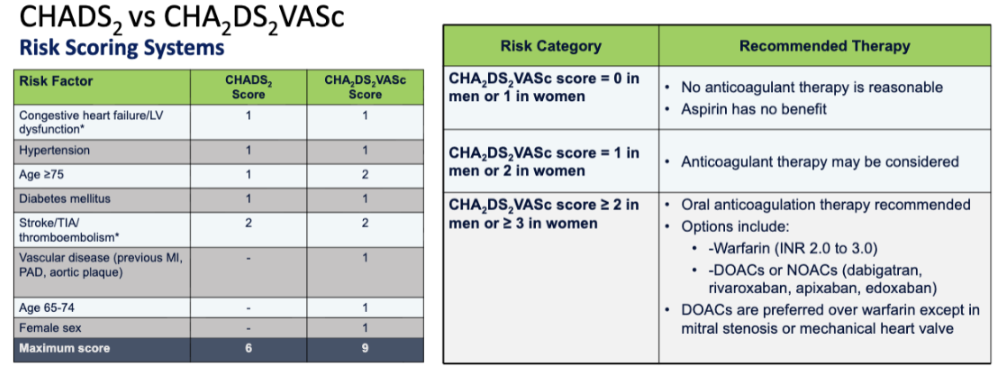
CHADSVASc Scores
Congestive HF/LV dysfunction = ______
HTN = ______
75 and older = ______
DM = ______
Stroke/TIA/Thromboembolism = ______
Vascular Disease (previous MI, PAD, aortic plaque) = ______
65-74 y/o = ______
Female = ______
1, 1, 2, 1, 2, 1, 1, 1
CHADSVASc Scores
______ = no anticoag and aspirin has no benefit
______ = anticoag may be considered
______ = anticoag may be considered
______ = oral anticoag recommends (Warfarin with INR 2-3 OR DOACs/NOACs such as dabigatran, rivaroxaban, apixaban, or edoxaban)
______ = oral anticoag recommends (Warfarin with INR 2-3 OR DOACs/NOACs such as dabigatran, rivaroxaban, apixaban, or edoxaban)
______ are preferred over ______ EXCEPT in ______ or ______
0, 1 in men, 2 in women, 2 or more in men, 3 or more in women, DOACs, Warfarin, mitral stenosis, mechanical heart valve
Causes of AF & Aflutter
Re-entry mechanism4
Aflutter: single dominant reentrant wavelet
AF: multiple reentrant loops
Structural heart disease that ______
______
______
______
High adrenergic states
Thyrotoxicosis, surgery, alcohol withdrawal, sepsis
causes atrial distension, MI, Valvular HD, Congenital abnormalities
Originates from many atrial foci firing at rapid rates
Atrial rate is ~350-450 bpm; Ventricular rate variable
Only depolarizations from some of the foci conduct through ventricles; this occurs in an irregular fashion
Rhythm describe as “irregularly irregular with no discernable p waves”
May be accompanied by Rapid Ventricular Rate (RVR)
Many depolarizations passing through AV node
Rapid pulse (based on ventricular rate)
Sxs due to the arrhythmia include dyspnea, SoB, palpitations
AFib
Atrial Fibrillation (AF)
Originates from many atrial foci firing at rapid rates
Atrial rate is ~______ bpm; ______ rate variable
Only ______ from ______ of the foci conduct through ventricles; this occurs in an irregular fashion
Rhythm describe as “______ with ______”
May be accompanied by ______
Many depolarizations passing through AV node
Rapid pulse (based on ventricular rate)
Sxs due to the arrhythmia include dyspnea, SoB, palpitations
350-450, ventricular, depolarization, some, irregularly irregular, no discernable p waves, Rapid Ventricular rate
______
Atrial impulses faster than SA node impulses
Originates from a single ectopic focus
Rate of firing is ~220-350 per minute
AV node does not allow all impulses to conduct through to ventricles (usually a 2:1 or 3:1 ratio, can be 4:1)
Appears as a “saw tooth” pattern on ECG
Rhythm is regular (unlike AF) – “regularly irregular”
Occurs less frequently than AF
Similar in precipitating factors, consequences and treatment
For rest of lecture, assume discussion is for both AF and Aflutter unless otherwise noted
Aflutter
Atrial Flutter
Atrial impulses ______
Originates from a ______ ectopic focus
Rate of firing is ~______ BPM
AV node does not allow all impulses to conduct through to ventricles (usually a 2:1 or 3:1 ratio, can be 4:1)
Appears as a “______” pattern on ECG
Rhythm is regular (unlike AF) – “______”
Occurs ______ frequently than AFib
Similar in precipitating factors, consequences and treatment
For rest of lecture, assume discussion is for both AF and Aflutter unless otherwise noted
faster than SA node impulses, single, 220-350, sawtooth, regularly irregular, less
Determine whether each statement describes Afib or Aflutter.
Originates from a single ectopic focus in atrium → ______
Rhythm is described as “regularly irregular” → ______
No discernable p waves → ______
Aflutter, Aflutter, Afib
Presentation
Fatigue, Palpitations, SoB, Hypotension, Syncope, Chest pain, and AF with RVR if HR >100 bpm
*However, many pts can be asymptomatic, especially if HR is normal
KNOW
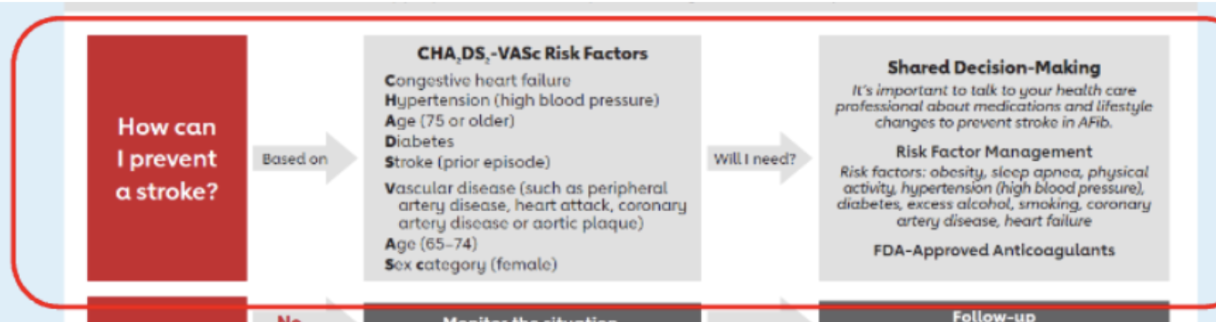
Treatment of AF
______ (and systemic thromboembolism) ______
Stratify risk by CHA2DS2-VASC score
Treatment of tachyarrhythmia
______ control
______ control
Stroke, prevention, rate, rhythm
KNOW IMAGE
Thromboembolism Risk
Thrombus can form in atrium due to blood pooling
Highest risk in ______
Most common thromboembolic event is ______
NOT ______
left atrial appendage, ischemic stroke, PE or MI
RB is a 74 year old, 70kg female who presents to the hospital with
new symptoms of cardioembolic stroke, and is diagnosed with new AF.
PMH: hypertension, hyperlipidemia, diabetes mellitus, myocardial infarction 2010, GI bleed 2012
SH: 1-2 glasses of wine/night, quit smoking 17 years ago
Vitals: BP 140/86 mmHg, HR 80 bpm, RR 20
Labs: Scr 0.8, AST/ALT WNL, electrolytes WNL, H/H 9.9/29.8, HgbA1c 7.2
Current medications: aspirin 81mg PO daily, carvedilol 12.5mg PO BID, simvastatin 40mg PO at bedtime, metformin 500mg PO BID
Assess RB’s risk of stroke versus her risk of bleeding
CHADVASC Score = 8 and HAS-BLED = 5
RB is a 74 year old, 70kg female who presents to the hospital with
new symptoms of cardioembolic stroke, and is diagnosed with new AF.
PMH: hypertension, hyperlipidemia, diabetes mellitus, myocardial infarction 2010, GI bleed 2012
SH: 1-2 glasses of wine/night, quit smoking 17 years ago
Vitals: BP 140/86 mmHg, HR 80 bpm, RR 20
Labs: Scr 0.8, AST/ALT WNL, electrolytes WNL, H/H 9.9/29.8, HgbA1c 7.2
Current medications: aspirin 81mg PO daily, carvedilol 12.5mg PO BID, simvastatin 40mg PO at bedtime, metformin 500mg PO BID
Determine if RB should be treated with anticoagulation
Yes bc his CHADVASC score is 3 and more and periodically assess for bleeding RFs
Anticoagulant Options
______
______
______
______
______
______
______ preferred over ______ EXCEPT with ______, antiphospholipid Ab syndrome or ______
DOACs superior or non-inferior in both efficacy and safety
Does NOT usually require parenteral anticoagulation overlap of ______ (since there is not usually a formed clot yet, but bridging is required if there is a confirmed clot)
Warfarin, DOACs, Dabigatran, Rivaroxaban, Apixaban, Edoxaban, DOACs, Warfarin, mitral stenosis, mechanical heart valve, 5-10 days
Dosing of DOACs in AF
Note that some dosing and renal adjustment is different than for VTE indication
Dabigatran (Pradaxa®) ______
CrCl ______ mL/min: ______
150 mg PO BID, 15-30, 75 mg PO BID
Dosing of DOACs in AF
Rivaroxaban (Xarelto®) ______
CrCl ______ mL/min: ______
20 mg PO QD, 15-50, 15 mg PO QD with food
Dosing of DOACs in AF
Apixaban (Eliquis®) 5 mg PO BID
If 2 of 3 are met (age ______, weight ______ kg, Scr ≥ ______): ______
Some data for use in pts with ESRD and dialysis
5 mg PO BID, >80, <60, 1.5, 2.5 mg PO BID
Dosing of DOACs in AF
Edoxaban (Savaysa®) ______
CrCl 15 – 50 mL/min: 30mg PO daily
Do not use if CrCl > 95 mL/min
60 mg PO QD
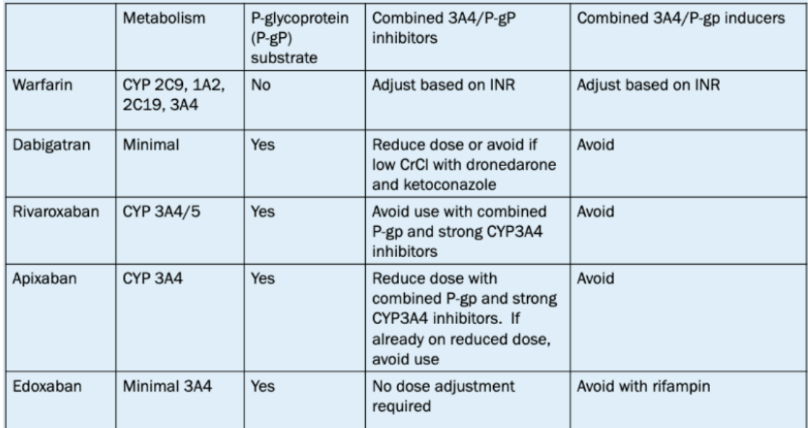
Anticoagulant DDIs
KNOW IMAGE
Back to RB…
RB is a 74 year old, 70kg female who presents to the hospital with new symptoms of cardioembolic stroke, and is diagnosed with new AF.
PMH: hypertension, hyperlipidemia, diabetes mellitus, myocardial infarction 2010, GI bleed 2012
SH: 1-2 glasses of wine/night, quit smoking 17 years ago
Vitals: BP 140/86 mmHg, HR 80 bpm, RR 20
Labs: Scr 0.8, AST/ALT WNL, electrolytes WNL, H/H 9.9/29.8, HgbA1c 7.2
Current medications: aspirin 81mg PO daily, carvedilol 12.5mg PO BID, simvastatin 40mg PO at bedtime, metformin 500mg PO BID
Which of the following is the best recommendation for anticoagulation for RB?
Increase aspirin to 325mg PO daily
Start warfarin 10mg PO daily, titrate to INR 2-3
Start rivaroxaban 15mg PO BID x 21 days, then 20mg daily
Start edoxaban 60mg PO daily and enoxaparin 70mg SC BID
Start apixaban 5mg PO BID
5
KNOW IMAGE
Rate vs Rhythm Control in AF AFFIRM trial
Two groups
______: cardioversion then antiarrhythmic drugs to maintain NSR
______: rate-control medications
Rhythm control, rate control
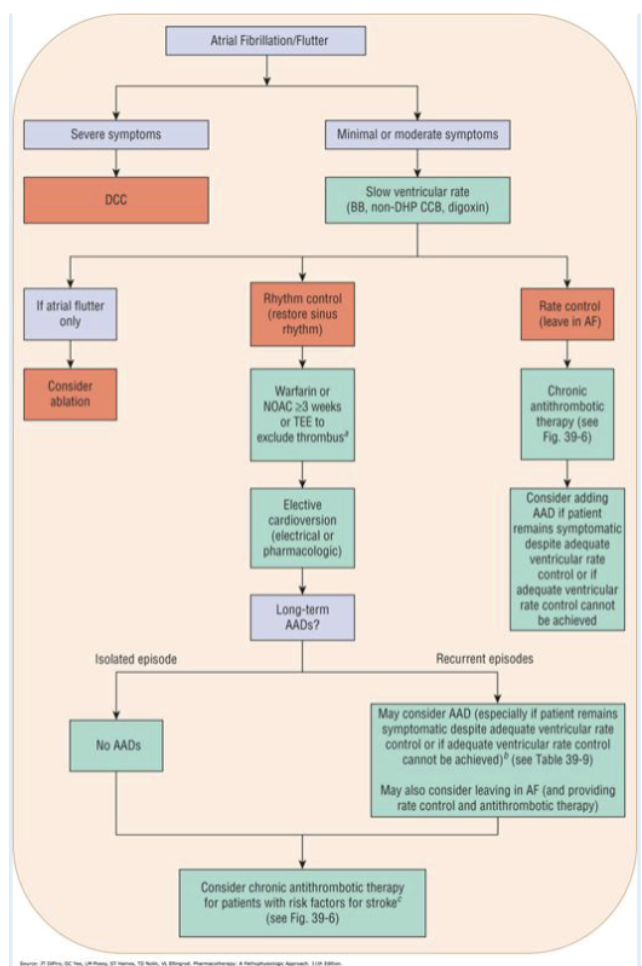
2023 Guideline updates to rate vs rhythm discussion
KNOW IMAGE
Rate control strategy
Goals
Sx control: palpitations, chest pain, SoB, syncope
Increase ventricular filling time
Goal HR
Rest: <______-110 bpm
Medications
______
____________
Digoxin
100, BBs, Non-DHP CCBs, Digoxin
Indications for specific rate control drugs
BBs
______: ______, ______ succinate, bisoprolol
______
Non-DHP CCBs
If BB use is limited → ______, severe reactive ______ disease
Digoxin
______, ______, and Sedentary
HF with low EF, Carvedilol, Metoprolol, CAD, Acute HF exacerbation, airway, systolic HF, Hypotension
Indications for specific rate control drugs
______
HF with low EF: carvedilol, metoprolol succinate, bisoprolol
CAD
______
If BB use is limited → Acute HF exacerbation, severe reactive airway disease
______
Systolic HF, Hypotension, and Sedentary
BBs, Non-DHP CCBs, Digoxin
______
MOA: binds competitively to Na-K-ATPase
Positive inotrope, negative chronotrope
Only slows HR at rest, not during exertion
Is BP neutral
Dosing
Usually 125-500 mcg daily
Can give an IV or PO load (0.75-1.5 mg total) for faster effect
Longer time for full effect than other rate control options
Renally-excreted
Dose must be adjusted in renal insufficiency
Narrow therapeutic index
HF: 0.5-0.8 ng/mL
Arrhythmias: < 1.2 ng/mL
Toxicity risk: > 2 ng/mL
Signs & symptoms of toxicity
Early: anorexia, nausea, vomiting, diarrhea, visual disturbances (yellow halos), headaches
Late: premature ventricular contractions (PVCs), AV block, ventricular tachycardia & fibrillation
Digoxin
Digoxin
MOA: binds competitively to Na-K-ATPase
______, ______
Only ______ at rest, not during exertion
Is ______ neutral
Dosing
Usually 125-500 mcg daily
Can give an IV or PO load (0.75-1.5 mg total) for faster effect
______ time for full effect than other rate control options
______
Dose must be adjusted in renal insufficiency
______ therapeutic index
HF: 0.5-0.8 ng/mL
Arrhythmias: < 1.2 ng/mL
Toxicity risk: > 2 ng/mL
Signs & symptoms of toxicity
Early: anorexia, nausea, vomiting, diarrhea, visual disturbances (yellow halos), headaches
Late: premature ventricular contractions (PVCs), AV block, ventricular tachycardia & fibrillation
Positive inotrope, negative chronotrope, slow HR, BP, longer, renally excreted, narrow
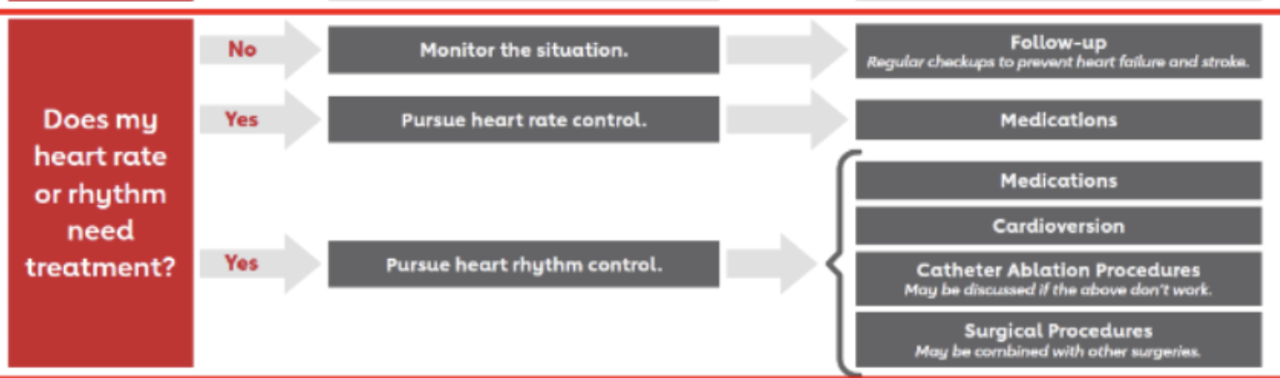
Acute management of AF with rapid ventricular response (RVR)
______ if hemodynamically unstable
Medication options (stable but HR high)
______
Most commonly used except in ______
______
______
______
______
cardioversion, IV non-DHP CCBs, HF, IV BBs, Metoprolol and esmolol, IV digoxin, IV amiodarone

KNOW IMAGE
TM is a 78 year old male who is presenting with fatigue, dizziness, and syncope. He is currently on metoprolol succinate 50mg daily succinate for rate control. His home BP log shows that his HRs are 80-90s, and his BP readings are 100-110s/60-70s. How should we adjust TM’s rate control therapy?
Increase metoprolol to goal HR 60-80
Decrease metoprolol, start diltiazem 120mg ER daily
Decrease metoprolol, start digoxin 0.125 mg daily
Discontinue metoprolol
3 (fatigue, dizziness, syncope), Goal HR <100, not commonly used in AFib, need to taper and treat Sxs

KNOW IMAGE
Rhythm Control
______
______
______ (only if undergoing cardiac surgery for another reason)
Meds, catheter ablation, surgery
Rhythm Control strategy
Goal: restore and maintain ______
Cardioversion
Direct current cardioversion (DCCV)
Pharmacological cardioversion
Efficacy: DCCV 80 – 90% compared to pharmacologic 40-60%
Most patients require anti-arrhythmic drugs (AADs) to maintain NSR after cardioversion
normal sinus rhythm
Electrical Cardioversion
Direct current cardioversion (DCCV)
Electric “shock” attempt to restore NSR
Indications
Emergent (Urgent)
______
Elective
______
______
______
Hemodynamically unstable, rate control not effective, <60 y/o, physically active and poor exercise tolerance with rate control
AADs for pharmacological cardioversion
Medications can also be used to attempt to restore NSR
______ effective than DCCV
Proven efficacy
______
______
______ (IV only)
______
______
Less effective
Disopyramide
Procainamide
Quinidine
Less, Amiodarone, Dofetilide, Ibutilide, Flecainide, Propafenone
Anticoagulation for Cardioversion
Risk of thromboembolism (stroke) if pt has ______
______> ______ in visualizing atrium
If thromboembolism seen, need AC for at least ______ to dissolve clot
Anticoagulate for at least ______, then assess risk of stroke based on CHA2DS2-VASc score
AF for more than 2 days, TEE, TTE, 3 weeks, 4 weeks after cardioversion
WE is a 56 year old male who presents to the hospital with new AF with RVR. He states that his symptoms have been on-and-off for the last week, and he came to the hospital since he is feeling more dizzy and nauseated. His BP is 88/58 mmHg and HR 132 bpm.
Is emergent cardioversion an option for WE?
No bc it’s only for hemodynamically unstable pts (<90 SBP)
WE is a 56 year old male who presents to the hospital with new AF with RVR. He states that his symptoms have been on-and-off for the last week, and he came to the hospital since he is feeling more dizzy and nauseated. His BP is 88/58 mmHg and HR 132 bpm.
Which echo modality should be used to visualize his left atrium?
Transesophageal Echocardiogram (TEE)
WE is a 56 year old male who presents to the hospital with new AF with RVR. He states that his symptoms have been on-and-off for the last week, and he came to the hospital since he is feeling more dizzy and nauseated. His BP is 88/58 mmHg and HR 132 bpm.
Is elective cardioversion an option?
Yes can wait 3-4 weeks as outpatient, need some other way to control sxs now (anticoag for 3 or more weeks so no need to TEE)
WE is a 56 year old male who presents to the hospital with new AF with RVR. He states that his symptoms have been on-and-off for the last week, and he came to the hospital since he is feeling more dizzy and nauseated. His BP is 88/58 mmHg and HR 132 bpm.
Based on his medical chart, you find his CHADS2-VASc score = 6. What recommendation do you have for his antithrombotic therapy (include dosing)?
Need long-term full anticoagulation Warfarin INR 2-3, Pradexa, 150 mg BID, Varelto 20 mg QD, etc.
AADs for Maintenance of Normal Sinus Rhythm
Amiodarone (Cordarone, Pacerone)
Dronedarone (Multaq)
Dofetilide (Tikosyn)
Sotalol (Betapace AF)
Flecainide (Tambocor)
Propafenone (Rythmol)
Specific choice of agent depends on:
Underlying structural heart disease
Renal function
Potential toxicities
KNOW

KNOW IMAGE
______ (______ → ______ but ______)
Cordarone, Pacerone
MOA: Class III, activity from all 4 Vaughn-Williams classes
Prolongs QT and refractoriness
Slows HR, AV node conduction, and intracardiac conduction
Extremely prolonged half-life
~ 60 days
Adverse effects and DDIs can last months after drug discontinuation
Most effective AAD (not 1st line bc of associated with most toxicities)
Frequency of toxicity related to total exposure to medication
Duration
Dosage
Amiodarone, 2nd line, most effective, more toxic
Amiodarone (2nd Line → most effective but more toxic)
Cordarone, Pacerone
MOA: ______, activity from ______ Vaughn-Williams classes
______ and refractoriness
______, ______, and intracardiac conduction
______ half-life
~ 60 days
Adverse effects and DDIs can last months after drug discontinuation
______ (______)
Frequency of toxicity related to total exposure to medication
Duration
Dosage
Class III, all 4, prolongs QT, slows HR, AV node conduction, extremely prolonged, most effective AAD, not 1st line bc it’s more toxic
______
Used in elderly or older adults
Eyes (eye exam), thyroid (hypo- and hyperthyroidism), liver (liver injury/toxicity), skin, neurological
Pulmonary fibrosis most serious toxicity
Symptoms: cough, dyspnea, patchy infiltrates on CXR, reduced PFTs
DDIs: due to CYP inhibition and P-gp inhibition
CYP 2C9, 2D6, 3A4
Extensive: always run an interaction check
Amiodarone
Amiodarone
Used in ______
Eyes (______), thyroid (______), liver (______), skin, neurological
______ most serious toxicity
Symptoms: cough, dyspnea, patchy infiltrates on CXR, reduced PFTs
DDIs: due to CYP inhibition and P-gp inhibition
CYP 2C9, 2D6, 3A4
Extensive: always run an interaction check
elderly or older adults, eye exam, hypo/hyperthyroidism, liver injury/toxicity, Pulmonary fibrosis,
Which statements are accurate regarding amiodarone therapy? SATA.
It can cause renal fibrosis with prolonged use
Drug interactions occur with substrates of CYP 3A4 and P-gP
PFTs and LFTs should be monitored at baseline
Amiodarone’s effects can persist for years
B and C, pulmonary fibrosis, months
______ (______)
Multaq, monitor LFTs and QT interval
MOA: Class III, activity from all 4 Vaughn-Williams classes
Structurally similar to amiodarone
Less lipophilic, shorter t1/2
Not associated with extensive SEs like amiodarone
BBW: Increased risk of death with decompensated HF or permanent AF
Dronedarone, Second 1st line med
Dronedarone (Second 1st line med)
Multaq, monitor ______
MOA: ______, activity from ______ Vaughn-Williams classes
Structurally similar to amiodarone
______, ______ t1/2
Not associated with extensive SEs like amiodarone
______: Increased risk of death with decompensated ______ or permanent ______
LFTs and QT interval, Class III, all 4, less lipophilic, shorter, BBW, HF, Afib
______ (______)
Betapace AF
MOA: Class III, also non-selective BB
NOT used for HTN or rate control
Precautions
Avoid in systolic HF
Monitoring
Renal function
QT prolongation
C/I if QT interval > 450 msec
Sotalol, last line
Sotalol (Last Line)
Betapace ______
MOA: ______, also ____________
NOT used for HTN or rate control
Precautions
Avoid in ______
Monitoring
______
______
C/I if QT interval > 450 msec
AFib, Class III, non-selective BB, HTN or rate control, systolic HF, renal function, QT prolongation
______ (______)
Tikosyn
MOA: Pure class III
Highest risk of Torsades de Pointes
0.3 – 4.7%
Previously required hospitalization for first 5 doses
Can be used for cardioversion and maintenance of NSR
Monitoring
Renal function
QT interval
Drug interactions (increases QT interval)
Verapamil, HCTZ, cimetidine, ketoconazole, prochlorperazine, trimethoprim
Any other drug that prolongs QT interval
Dofetilide, Second 1st line med
Dofetilide (Second 1st line med)
Tikosyn
MOA: ______
Highest risk of ______
0.3 – 4.7%
Previously required ______
Can be used for ______ and maintenance of ______
Monitoring
______
______
______ (______)
Verapamil, HCTZ, cimetidine, ketoconazole, prochlorperazine, trimethoprim
Any other drug that prolongs QT interval
Pure class III, torsades de Pointes, hospitlization for 1st 5 doses, cardioversion, NSR, renal function, QT interval, DDIs, increases QT interval
______ (______)
Tambocor and Rythmol
MOA: Class IC agents
C/I in patients with structural heart disease (MI or HF, increases risk of death)
“Pill-in-the-pocket” approach
Pt only takes oral medication when having an episode of AF
Flecainide and Propafenone, 1st line
Flecainide & Propafenone (1st line)
Tambocor and Rythmol
MOA: ______ agents
C/I in patients with ______ (______, increases risk of ______)
“Pill-in-the-pocket” approach
Pt only takes ______ when having an episode of ______
Class IC, structural HD, MI or HF, death, oral med, AFib
Adverse Effects Oral AASs
Amiodarone → order ______ (______ tests, ______, ______) to ensure pt doesn’t develop ______
baseline tests, thyroid function, EKG, LFTs, SEs
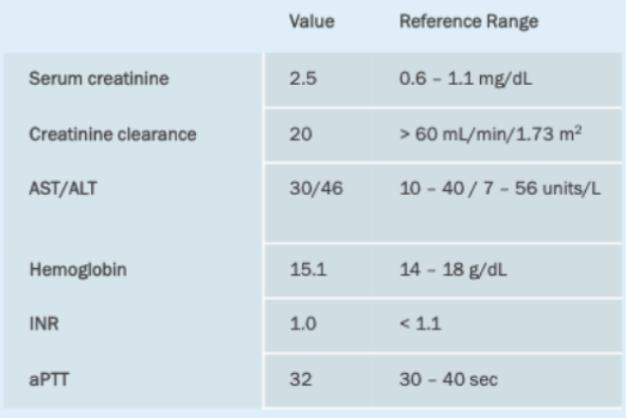
HH is a 72-year-old, 80 kg male who presents to the emergency department with a racing heart, shortness of breath, wheezing, and syncope.
EKG: atrial fibrillation
HR: 140 bpm
BP: 120/86 mmHg
PMH: hypertension, diabetes
Medications prior to admission: aspirin 81mg PO daily, amlodipine 10mg PO daily, insulin glargine 10 units at bedtime
TEE: negative for thrombus
The medical team wants to start an anti-arrhythmic treatment for the patient. Which antiarrhythmic would be the best choice for HH?
Amiodarone
Sotalol
Dronedarone
Dofetilide
Atenolol
3, 2nd line, n/a, high risk of torsades bc of renal dysfunction, n/a
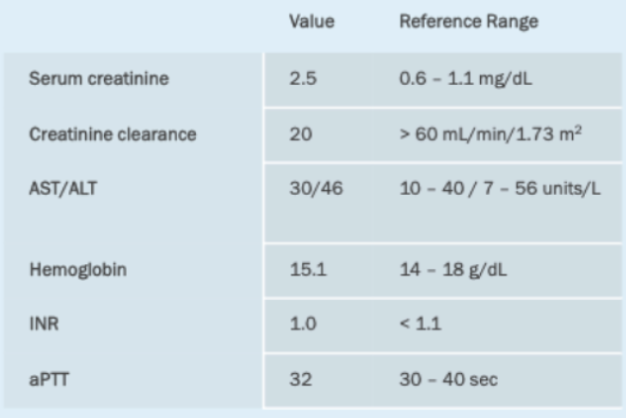
HH is a 72-year-old, 80 kg male who presents to the emergency department with a racing heart, shortness of breath, wheezing, and syncope.
EKG: atrial fibrillation
HR: 140 bpm
BP: 120/86 mmHg
PMH: hypertension, diabetes
Medications prior to admission: aspirin 81mg PO daily, amlodipine 10mg PO daily, insulin glargine 10 units at bedtime
TEE: negative for thrombus
Which statement regarding AADs for maintenance of NSR is most accurate?
Sotalol and dronedarone are first-line options for HF patients
Flecainide and propafenone should not be used in structural heart disease
Amiodarone is the first-line AAD for pts with and without structural heart disease
Lidocaine is a second-line option
2, Flecainamide and Propafenone, Dofetilide, Amiodarone
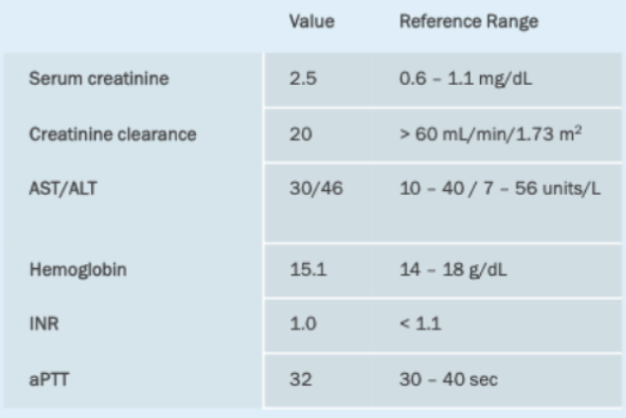
HH is a 72-year-old, 80 kg male who presents to the emergency department with a racing heart, shortness of breath, wheezing, and syncope.
EKG: atrial fibrillation
HR: 140 bpm
BP: 120/86 mmHg
PMH: hypertension, diabetes
Medications prior to admission: aspirin 81mg PO daily, amlodipine 10mg PO daily, insulin glargine 10 units at bedtime
TEE: negative for thrombus
Which statement regarding sotalol use for AF is most accurate?
It can be used for both pharmacological cardioversion and maintenance of NSR
Monitoring parameters include HR, BP, and LFTs
It can cause QT prolongation leading to TdP
Its main mechanism in AF is for rate control
3, Dofetilide, Renal function, QT interval, BP, HR, and electrolytes, NOT used for HTN or rate control, but for rhythm control
Catheter Ablation
Pulmonary vein isolation
Can be ______
Anticoagulation based on ______
AV node ablation
______
AF persists → ______
Indications
If ______ are ineffective, C/I, or not tolerated
______ in ______ pts with few comorbidities to improve ______ + prevent ______
curative for AFib Sxs, risk assessment, permanent pacemaker, continue anticoag, anti-arrhythmic meds, 1st line, younger, Sxs, AFib progression

Review of AF management
KNOW IMAGE