Lecture 3: Economic Motives for Marriage, Theory of Marriage & Household Decision Making
 Call Kai
 Learn
Learn Practice Test
 Spaced Repetition
 Match
Match Flashcards
 Knowt Play
1/23

There's no tags or description
Looks like no tags are added yet.
Name | Mastery | Learn | Test | Matching | Spaced | Call with Kai | Chat |
|---|
No analytics yet
Send a link to your students to track their progress
24 Terms
TOPIC 1: ECONOMIC MOTIVES FOR MARRIAGE
8 Economic Motives for Marriage
1) Specialization & Exchange- focus of this set
2) Scale economies- dual income
3) Public- cooking for 2, sharing interests
4) Externalities- happiness & satisfaction produced from activities of marriage such as feeding kids.
5) Marriage- specific investments
6) Risk Pooling- dual income (protected against unemployment because you still have one income, protected injury).
7) institutional advantages- joined taxation (lower tax rate as couple)
8) love
1-6 are also results of cohabitation and not marriage exclusively
Utility maximization by individual i
Bennefit (Marriedi) > Cost (Marriedi ) then get married
Why did cohabitation increase with time?
professional degree attainment
introduction of contraception
religious ideal changing social norms
IN 2019 across ethnicity who had the highest and lowest marriage percentages
highest: asians
lowestL black individuals
Difference caused by educational attainment, incarceration, and cultural norms.
TOPIC 2: Gains from Marriage: Specialization and Exchange
Absolute Advantage
Ability to produce a greater quantity of a good, product, or service than peers/competitors using the same amount of resources.
Comparative Advantage
ability to produce a good at a lower opportunity cost than peers/ competitors
Opportunity cost
value of the next best alternative when one is chosen. forgone production.
opportunity cost= given up/gained

EX who has the comparative/absaloute advantage at home versus the market

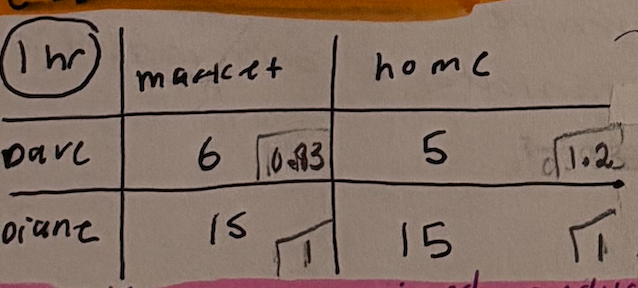
EX: who has the comparative/absolute advantage at home versus the market

Separate and combined production possibility frontiers (Jim & Kathy)

TOPIC 3: Utility & Household Preferences
What is utility and how is it represented
households maximize their utility (satisfaction) given constraints
Utility is represented by indifference curves
The shape of indifference curve is determines by household preferences
we assume we can aggregate individual preferences into household prefrences.
show an indifference curve that shows preference towards home production versus market production

Household Choice- what 2 things does it depend on
How much tie each member of the household dedicates to home versus market production depends on: 1) comparative advantages 2) preferences for market vs. home goods
Optimum point between PPF and IC

Other placement of indifference curves and what they mean

How do households make decisions (3)
consensus decision making (neoclassical model)
Co-operative bargaining (with threat points)
non-cooperative bargaining
Flaws in neoclassical becker model
THis model abstracts away from many issues such as:
a) how marriages/couples are formed
b) what happens if comparative advantages changes
c) what happens if couples divorce
d) difference by race, ethnicity, and socioeconomic status
SECTION 4: Marriage Market
What is marriage market
who married whom, when, and why?
Changing dynamics in marriage are attributed to:
a) Women have become more educated than men; there are not enough college-educated men for “assortative matching.”
b) comparative advantages have started to equalize for market work (wages, LFP, employment, and occupational opportunity are converging). The more different the comparative advantage is, the more the PPF can be maximized
c) Divorce laws have changed through no-fault divorce (since 1970) and unilateral divorce (explicit consent of both parties in the divorce no longer required).
d) Technology advances (contraception) played a role in declining marriage rates.