Unit 0 vocab AP psych + study guide
 Call Kai
 Learn
Learn Practice Test
 Spaced Repetition
 Match
Match Flashcards
 Knowt Play
1/30

There's no tags or description
Looks like no tags are added yet.
Name | Mastery | Learn | Test | Matching | Spaced | Call with Kai | Chat |
|---|
No analytics yet
Send a link to your students to track their progress
31 Terms
Biopsychosocial
approach explains human behavior and mental processes by analyzing how biological traits, psychological thoughts, and social-cultural environments interact with one another.
Confirmation bias
The tendency to search for, interpret, and recall information in a way that confirms pre-existing beliefs while ignoring or discounting contradictory evidence.
Hindsight Bias
The tendency to believe, after learning an outcome, that one would have foreseen or predicted it all along (also known as the "I-knew-it-all-along" phenomenon).
Overconfidence
The tendency to overestimate the accuracy of one's knowledge, judgments, and abilities.
Random Assignment
The procedure in an experiment where participants are randomly placed into control or experimental groups by chance, ensuring each person has an equal probability of being assigned to any group to minimize pre-existing differences.
Correlation
A statistical measure that expresses the extent to which two variables are linearly related and change together, which helps predict one variable from another without proving causation.
Directionality problem
limitation of correlational research where two variables are statistically related, but it is impossible to determine which variable causes the other because either one could be driving the change.
Third- variable problem
limitation in correlational research where an unmeasured extraneous variable (a confounding variable) causes the observed relationship between two other variables, creating a false appearance of a direct cause-and-effect link.
Case study
An in-depth observational research method where one individual or small group is studied in detail to reveal universal psychological principles.
Meta-analysis
A statistical method that combines and analyzes the results of multiple independent scientific studies on the same topic to identify overall trends and determine a stronger, more reliable conclusion.
Operational definitions
A clear, precise, and measurable statement of the exact procedures or metrics used to define a research variable so that the experiment can be accurately replicated.
Generalizability
Easy definition: How well the results of a study can be applied to other people or situations beyond the people who were studied.Can these results apply to everyone else?"
Single blind
asy definition: One group in the study doesn't know which treatment they're getting.
AP Psych shortcut: 👉 "One side doesn't know."
v Double Blind
Neither the participants nor the researchers know who gets which treatment.
AP Psych shortcut: 👉 "Both sides don't know."
peer review
: Other experts check a study before it is accepted or published. "Experts check it."
replication
Easy definition: Repeating a study to see if you get the same results shortcut: "Do it again."
IRB
A group that checks if a research study is ethical and safe for participants.
AP Psych shortcut: "Protect the people."
Informed consent
: Participants agree to be in a study after being told what it involves.shortcut: "Know before you agree."
Protect from harm
Researchers must make sure participants are not seriously harmed during a study.
: 👉 "Keep participants safe."
Confidentiality
Keeping participants' personal information private.
"Keep it private." Protects participants' privacy and builds trust.
Debriefing
n: Explaining the study to participants after it's over. "Explain after."
Why it's important: Makes sure participants understand what happened and why.
Human and animal ethics
Easy definition: Rules that protect people and animals in research.
AP Psych shortcut: 👉 "Treat subjects fairly and safely."
Why it's important: Prevents unnecessary harm and protects their well-being.
Identify variables in charts/graphs
Identify Variables in Charts/Graphs
Easy definition: Figure out the independent variable (x-axis) and dependent variable (y-axis).
AP Psych shortcut: 👉 "X = cause, Y = effect."
Central Tendency
Central Tendency
Easy definition: The middle or typical score in a set of data.
AP Psych shortcut: 👉 "What's typical?
Mode
The number that appears most often.AP Psych shortcut: 👉 "Most = mode."
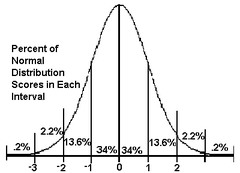
Normal Curve
n: A bell-shaped graph where most scores are in the middle and fewer are at the extremes.
AP Psych shortcut: 👉 "Most in the middle.
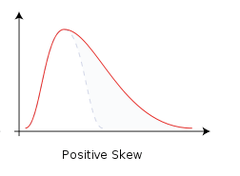
Skew
Easy definition: When data is pulled more toward one side of a graph.
AP Psych shortcut: 👉 "Which way is the tail?"
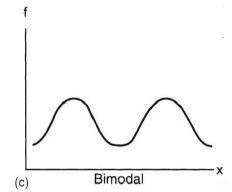
Bimodal
A graph with two most common scores/peaks.
AP Psych shortcut: 👉 "Bi = two modes."
Distribution of Scores
Easy definition: How scores are spread out across a group.
AP Psych shortcut: 👉 "How are the scores spread?"
Correlation Coefficient
Easy definition: A number that shows the strength and direction of a relationship between two variables.
AP Psych shortcut: 👉 "How strong + which direction?
.B Explain how cultural norms, expectations and circumstances, as well as cognitive biases apply to behavior and mental processes.
Because people learn cultural rules, develop expectations, and use mental shortcuts, which influence how they interpret situations and choose how to act.