3.1 - 3.3 Second-Order Differential Equations (Real, Complex, Repeated Roots of Equations)
 Call Kai
 Learn
Learn Practice Test
 Spaced Repetition
 Match
Match Flashcards
 Knowt Play
1/3

There's no tags or description
Looks like no tags are added yet.
Name | Mastery | Learn | Test | Matching | Spaced | Call with Kai | Chat |
|---|
No analytics yet
Send a link to your students to track their progress
4 Terms
Characteristic Equation for a 2nd-Order Differential Equation
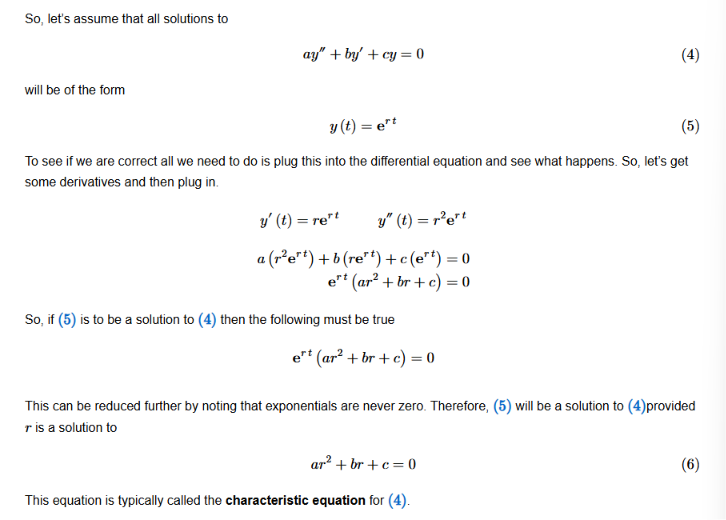
The general solution to any second-order differential equation of the form ay” + by’ + cy = 0 is always in the form of y(t) = e^(rt); more specifically, we will always have two solutions in the form of
y1(t) = e^(r1t)
y2(t) = e^(r2t)
When plugging in the general form of y(t) = e^(rt), we will always obtain a quadratic equation in terms of r. This is the characteristic equation.
Real Roots Solution
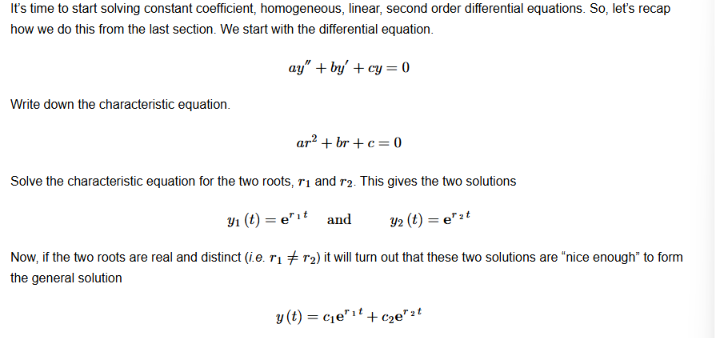
Depending on the nature of the characteristic equation, the solution will be changed accordingly; in this instance, we assume real roots to the solution. If the roots are real, then the solution will always be in the form of:
Complex Roots
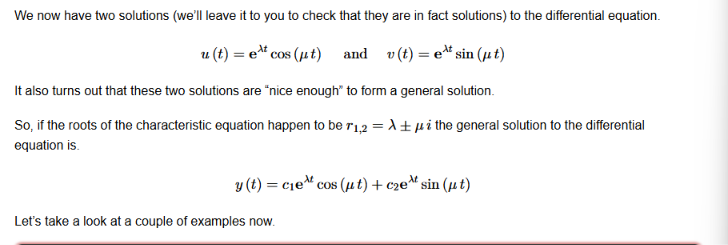
If the roots are complex, then we obtain an alternative form to the solution. In this instance, the imaginary part of the root is in the argument of the trigonometric functions and the real part is in the argument of the exponent.
Repeated Roots (Preservation of Linearity)
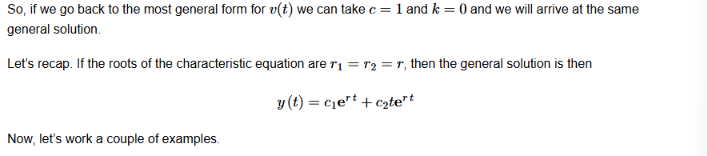
If the roots of the characteristic equation repeat themselves, then we must alter the original solution ever-so-slightly so that we retain linear independence.
Notice that we multiply the second solution by a factor of t, which makes it linearly independent.