Schopenhauer Essay
 Call Kai
 Learn
Learn Practice Test
 Spaced Repetition
 Match
Match Flashcards
 Knowt Play
1/23

There's no tags or description
Looks like no tags are added yet.
Name | Mastery | Learn | Test | Matching | Spaced | Call with Kai | Chat |
|---|
No analytics yet
Send a link to your students to track their progress
24 Terms
In this essay you’ll need to explain three things: (1) Schopenhauer’s metaphysics of
Will, (2) Schopenhauer’s pessimism and how it flows from his metaphysics, and
finally, (3) an evaluation of his pessimism. In the third section, I’ll look for an
existential examination of his pessimism. Do you think his pessimism is
philosophically justified and is it existentially feasible? That is, can we realistically
adopt Schopenhauer’s pessimism and his recommendations for living?
Your essay should have an introduction and a thesis statement explaining the
contents of the essay and your overall estimation of Schopenhauer’s pessimism.
The essay will be written in class in a blue book. You may have your copy of
Schopenhauer’s World as Will and Representation and his essay “The Vanity and
Suffering of Life” in class for use on the essay.
Book 2 focuses on the will, the thing-in-itself, the inner aspect of the world. The outer aspect is appearance, the world as representation.
Space, time, and causality are the main forms of representation.
Book 2 asks the question: what is the inner nature of objects of experience?
We first need to consider the body → our knowledge of the world in itself starts with the knowledge of the body.
The body is a representation like other objects. But unlike other objects, I can observe my body as subject to my will.
“… the answer to the riddle (how we can know the thing-in-itself?) is given to the subject of knowledge appearing as individual, and this answer is given in the word Will. This and this alone gives him the key to his own phenomenon, reveals to him the significance and shows him the inner mechanism of his being, his actions, and his movements (p. 100).”
“He cannot actually will the act without at the same time being aware that is appears as a movement of the body”
The body appears in two different ways
(1) An object among objects; subject to laws
(2) As my Will, i.e., an act of my body is an act of my will.
“The action of the body is nothing by the act of will objectified, i.e., translated into perception.”
“As such it is called pain when it is contrary to the will, and gratification or pleasure when in accordance with the will.”
The body is the condition of knowledge of my will.
Will =
the thing-in-itself
All representation is of will
Will is mindless, endless striving
Single, non-spatiotemporal (i.e., principle of sufficient reason does not apply)
All life and action is really the manifestation or ____ of the will.
objectification
What is the concept of the objectification of the will?
Objectification is will becoming or manifesting as representation, appearance.
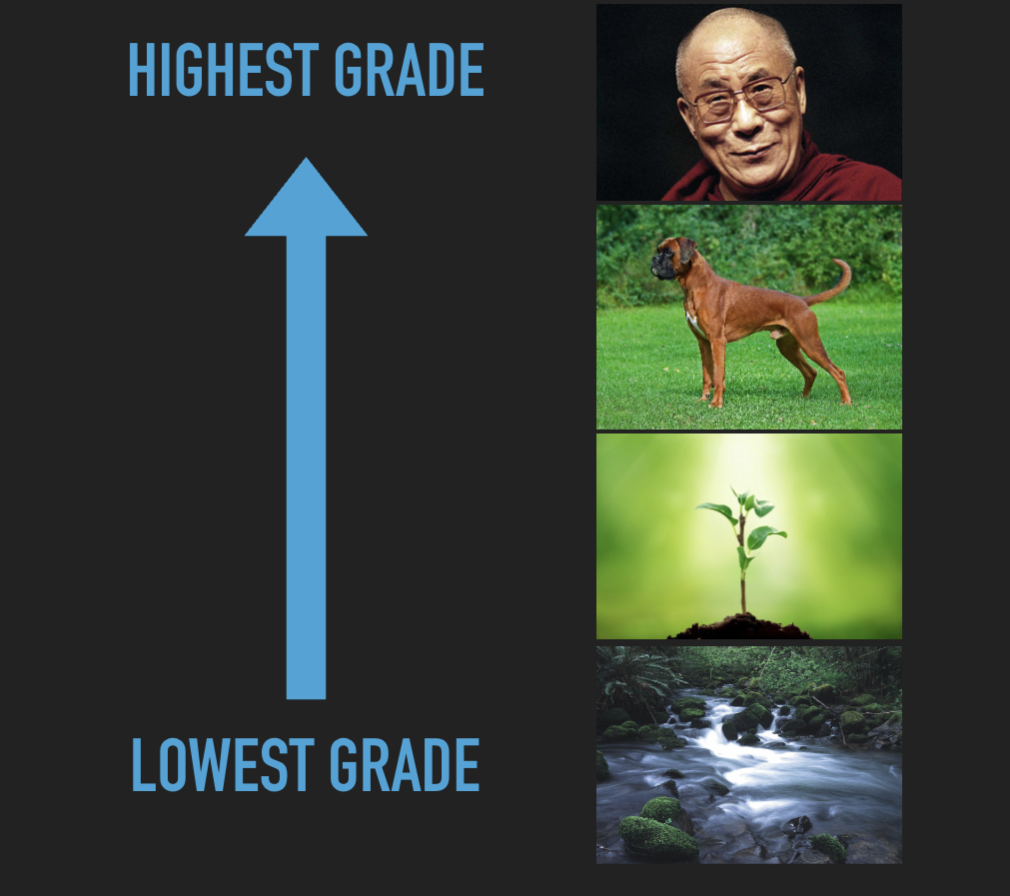
The ONE will is objectified into plurality in various gradations/degrees.
He ranks the degrees of objectification: low being trees/plants, middle being animals, highest being humans.
What is the relation between the world as Will and the world as representation?
The thing-in-itself does not cause appearances — it is merely the object stripped of its representational qualities (space,time,etc). What is left is technically unknowable, yet we can have direct awareness of Will.
What are Ideas/Forms?
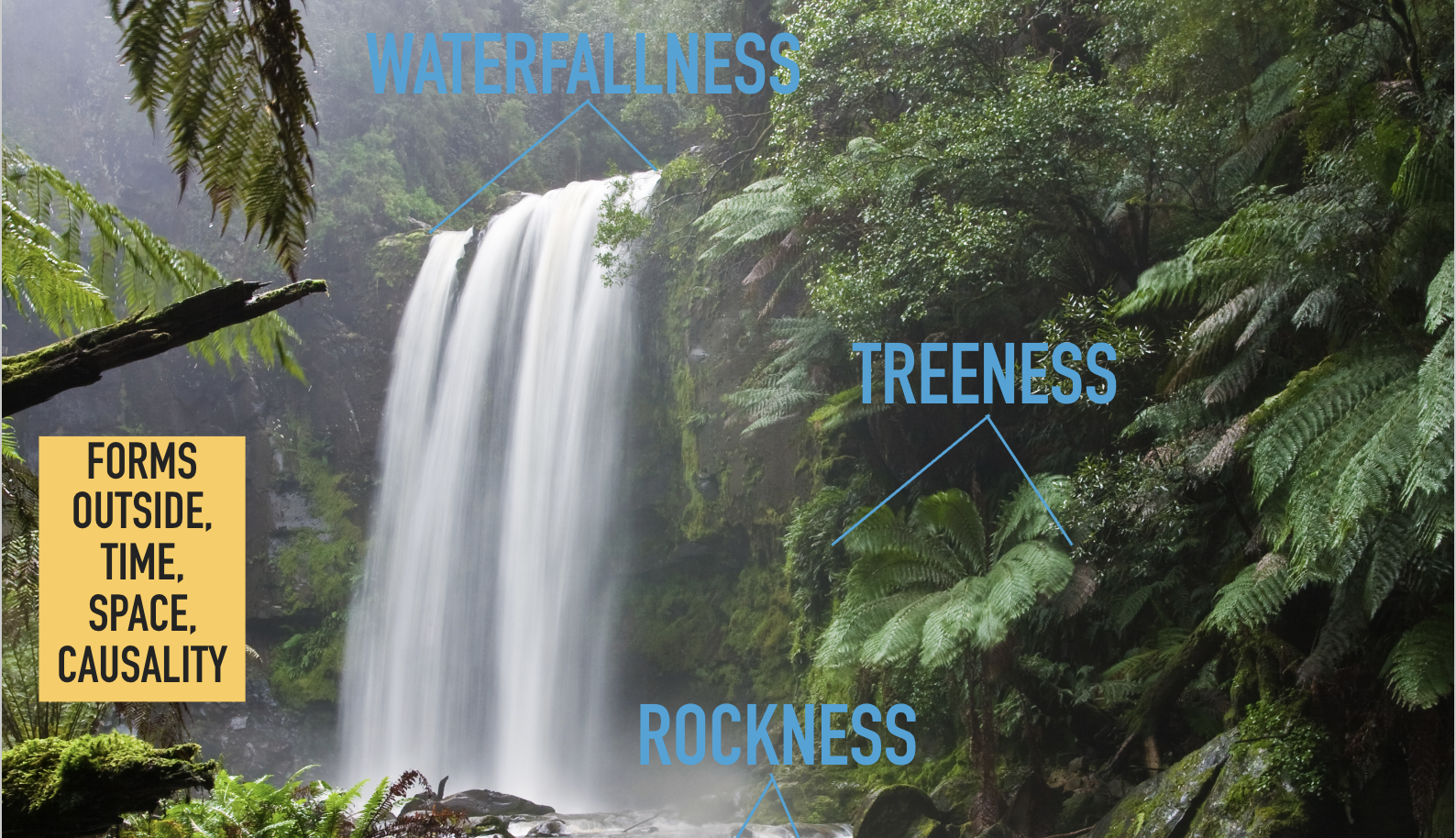
Objectified Will = Plato’s Forms
Schopenhauer says that he will use Plato’s notion of Idea for each definite and fixed degree of the Will’s objectification.
“Therefore every universal, original force of nature is, in its inner essence, nothing but the objectification of the Will at a low grade, and we call every such grade an eternal Idea in Plato’s sense (p. 134).”
How does the world considered as Will lead to Schopenhauer’s pessimism?
The essential nature of Will is endless striving; Will is ‘eternal becoming, endless flux,’ eternal recurrence of Form.
“… everywhere in nature we see contest, struggle, and the flunctuation of victory…
Every grade of the Will’s objectification fights for the matter, the space, and the time of another…
This universal conflict is to be seen most clearly in the animal kingdom. Animals have the vegetable kingdom for their nourishment, and within the animal kingdom again every animal is the prey and food of some other. This means that the matter in which an animal’s Idea manifests itself must stand aside for the manifestation of another Idea, since every animal can maintain its own existence only by the incessant elimination of another’s.
Thus the will to life generally feasts on itself, and is in different forms of its own nourishment… (p.146-7)”
Schopenhauer thinks that nature ‘cares’ only for species but not individuals of that species.
He sees the world as a god-less, meaningless horror.
The world is endless striving to no effect, no goal or ultimate satisfaction. It is a war of all against all.
On the Vanity and Suffering of Life
Human beings are endlessly striving, making goals, seeking desire that will never fully be fulfilled.
Vanity of Life:
Everything conditioned by time, the form of our experience.
All things perish.
the objects of his desire continually delude, waver, and fall, and accordingly brig more misery than joy.
What are the 3 main arguments for the Vanity of Life?
We feel pain, but not painlessness; we become conscious of good things — health, youth, and freedom — only after we have lost them.
Time passes slowly in pain and boredom, quickly when we are not paying attention to it.
Pain outweighs any amount of pleasure.
What is Schopenhauer’s anti-natalist view? (From Vanity of Life and Suffering)
Non-existence is preferred to existence
Nothing in the world justifies its existence.
Existence is groundless, mere blind will.
Life is not a gift but a debt, one paid off with death.
Why does Schopenhauer flat out REJECT Leibnizs’ optimistic view that our world is the best of all possible worlds?
Our world is more like the WORST of all possible worlds.
The universe is not coherent or full of harmony — it is fragile and always subject to collapse.
The arrangment of our world is only maintained just barely.
“Now this world is so arranged as to be able to maintain itself with great difficulty; but if it were a little worse, it could no longer maintain itself. Consequently a worse world, since it could not continue to exist, is absolutely impossible: thus this world itself is the worst of all possible worlds.”
How do we achieve tranquility in this horror-filled life?
Book 3 is about how we can cope with our condition through aesthetics, appreciating beauty.
Through aesthetic perception: the subject ceases to be merely individual and becomes a pure ‘will-less subject of knowledge.’
“Losing onself” in an object, being enraptured.
Instead of seeing the particular, spatiotemporal object, we take in the whole array of Platonic Ideas.
“We lose all sense of our individuality and become immersed or engulfed in the object. We become a pure will-less, painless, timeless subject of knowledge.”
According to Schopenhauer, what is the role of the genius?
Genius = the ability to know Ideas, complete objectivity, state of pure perception for extended periods of time.
“The gift of genius is nothing but the most complete objectivity, i.e., the objective tendency of the mind, as opposed to the subjective directed to our own person, i.e., to the Will. Accordingly, genius is the capacity to remain in a state of pure perception…”
Through art, the genius makes these Ideas manifests in ways clearer and more accessible than normal.
The Idea comes to us more easily from the work of art than directly from nature/reality.
Beauty =
Apprehension of Ideal types (Forms)
How can art help us cope?
All willing springs from lack, from deficiency, and thus from suffering → Art can lift us out of mundane life; rid us of willing.
Through aesthetic perception, we are able to transcend egocentric consciousness. Our subject fades, we become will-less.
How is the quality of art determined?
By its ability to put us in touch with reality (Ideas) and lessen desire/suffering.
For Schopenhauer, Music is the highest form of art, following poetry, painting and sculpture.
Why is Schopenhauer a fan of tragedy?
Tragedy exposes us to the bitterness and worthlessness of life (the sublime).
The highest poetical achievement is “the description of the terrible side of life.”
He thinks that this helps life: in the tragedy we face the terribleness of life, but detached.
Leads to an experience of ‘resignation.’
Why is music the highest quality of art for Schopenhauer?
All other arts represent and give us access to the Platonic Ideas. Music, however, has a different function and goal:
“It is directly a copy of the will itself, and therefore expresses the metaphysical to everything physical in the world, the thing-in-itself to every phenomenon.”
Music copies will (like nature does).
Music achieves this by embodying the abstract forms of feelings. This allows to perceive “sadness itself,” “joy itself,” etc — without the contingent contents that would typically cause suffering.
“By expressing emotion in this detached or disinterested way, music allows us to apprehend the nature of the world without the frustration involved in daily life, and hence, in a mode of aesthetic awareness that is akin to the tranquil philosophical contemplation of the world.”
Aesthetic appreciation is not ultimately what helps us cope with our condition — what does?
Book 4: Describes the ‘road to salvation.’ S. describes a progression from egoism to a kins of mystical asceticism, via altruism/virtue.
The point of Schopenhauer’s ethical aim for a time-free awareness of reality
Will objectifies itself and comes to know itself through some of its objectifications. It discovers that it is the source of endless suffering but then acts to reduce and annul suffering in the world of representation.
Once we recognize what reality ultimately is (Will objectifying itself), we can begin to view it from a timeless, detached perspective.
What is the first step in moral development?
To recognize that suffering is essential to our existence.
Pain is essential to life; even when we have fulfilled all our desires, we become bored, which induces despair.
Schopenhauer says that as depressing as this is, Stoic indifference can offer a consolation for our condition.
When we recognize the necessity of our pain, of old age, physical suffering, and death, we can be at peace with it.
What does Schopenhauer view as the state of ultimate freedom in humans?
Freedom from desiring; living as a saint, a mystical asceticism.
The ‘Saint’ understands that Will permeates everything and is the source of suffering. She realizes that everything suffers but also that, as Will, she herself is the source of misery and suffering.
Ultimately → Denial of the will-to-live: rejecting Will, desire. An act of rebellion against Will, against reality.
Practically, this plays out as repentance and self-punishment in the form of asceticism: celibacy and poverty, refusing to return evil for evil, eating barely enough to sustain oneself, etc..