Exam 1 study guide mistakes
 Call Kai
 Learn
Learn Practice Test
 Spaced Repetition
 Match
Match Flashcards
 Knowt Play
1/22

There's no tags or description
Looks like no tags are added yet.
Name | Mastery | Learn | Test | Matching | Spaced | Call with Kai | Chat |
|---|
No analytics yet
Send a link to your students to track their progress
23 Terms
Draw and label a tripeptide with the N-terminal the C-terminal each peptide bond
and R1, R2 and R3.
Answer
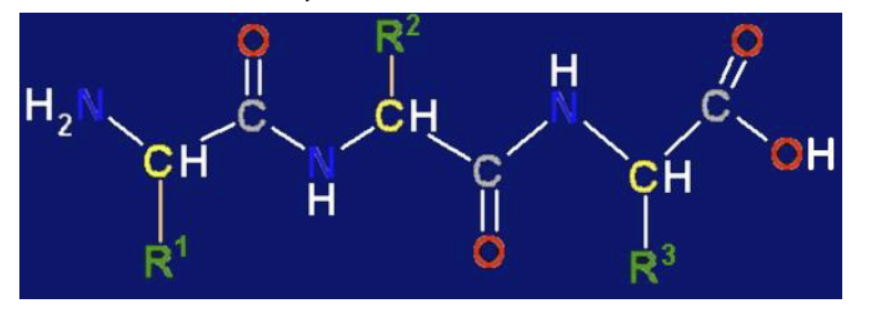
Review catalytic triad
(on iPad)
Why are the R and T states important for hemoglobin’s function?
R state: high affinity for oxygen → BINDS/TAKES oxygen in HIGH oxygen concentration areas (ex. lung)
T state: low affinity for oxygen → (binds less tightly to oxygen), RELEASES oxygen in LOW oxygen concentration areas (ex. tissues)
An amino acid that is a good phosphomimetic has:
Negatively charged side chains (ex. aspartate, glutamate)
Aromatic
Ring shaped structure in amino acid side chains
What are the common characteristics of hydrophobic side chains?
Nonpolar, uncharged
What is immunohistochemistry?
Used to study in-situ observations
cut cells thin and attach to a microscope slide
primary antibody finds target protein in sample
secondary antibody finds primary antibody based on its constant (Fc) region
makes a brown color where antibody is bound (due to color changing enzyme)
How can an antibody that recognizes protein on a Western blot not recognize it in immunohistochemistry?
In immunohistochemistry, the proteins are native. in western blot, the proteins are denatured. so the antibody may not recognize the folding.
Which amino acids are targets for phosphorylation?
serine, threonine, tyrosine
Which amino acids absorb UV?
Tyrosine, Tryptophan, Phenylalanine
Review Lysozyme mechanism
(on iPad)
substitution mutation
one nucleotide (letter) is replaced with another in a codon
frameshift mutation
When a single nucleotide (letter) is added or deleted, which shifts the whole reading frame (sequence of codons)
What happens when you add a solute to: vapor pressure, boiling point, freezing point, melting point, and osmotic pressure?
Colligative property | What happens when solute is added? | Example |
|---|---|---|
Vapor pressure | ⬇ Decreases | Salt water evaporates less readily than pure water |
Boiling point | ⬆ Increases | Salt water boils at a slightly higher temperature |
Freezing/melting point | ⬇ Decreases | Salt on roads prevents water from freezing |
Osmotic pressure | ⬆ Increases | Water moves toward the more concentrated solution |

Practice
The reading frame can only be read starting with AUG because it is the universal start codon
so, to solve this problem:
identify AUG in the sequence (you don’t have to read in threes for this part)
then solve the problem
Arg → Arg (CGC → CGA), so silent mutation
What does it mean if an alpha-helix has a metadipole?
the individual peptide-bond dipoles within the α-helix add together because they’re oriented in the same direction → The overall charge at the n-terminal domain or C-terminal domain have a net charge (Like a big charged finger)
What is BLAST and what does it do?
Compares peptide sequences to a database and aligns them to find the identity of your unknown protein
What enzymatic activity does the proteasome have in its barrel?
Trypsin, chymotrypsin
What classification of an enzyme would a kinase be?
Transferase
Why do we want trypsin in our bodies?
To break down old or broken peptide bonds, or digestion
How does heath enthalpy (H) correlate to reaction energy?
The formation of bonds and breaking of bonds can be measured by energy
What does Keq tells us differently than standards Gibbs free energy?
ΔG° | Keq | |
|---|---|---|
ΔG° < 0 → favorable forward reaction | Keq > 1 → products favored | |
ΔG° > 0 → unfavorable forward reaction | Keq < 1 → reactants favored | |
ΔG° = 0 → equilibrium | Keq = 1 → neither side strongly favored |
How to determine if a reaction is favorable?
What you're comparing | Result | Meaning |
|---|---|---|
Q < Keq | Forward direction | Forward reaction is favorable |
Q > Keq | Reverse direction | Reverse reaction is favorable |
Q = Keq | At equilibrium | No net movement, no change in reactants or products |