Targeted Con Law
 Call Kai
 Learn
Learn Practice Test
 Spaced Repetition
 Match
Match Flashcards
 Knowt Play
1/137

There's no tags or description
Looks like no tags are added yet.
Name | Mastery | Learn | Test | Matching | Spaced | Call with Kai | Chat |
|---|
No analytics yet
Send a link to your students to track their progress
138 Terms
Scope of Judicial Power
Limited to cases and controversies:
Arising under U.S. Constitution, federal laws, and federal treaties
When U.S. is a party
Between 2 or more states, or between a state and citizens of another state
Between citizens of different states, or between citizens of the same state claiming lands under grants of different states, or
Between a state—or its citizens—and foreign states, citizens, or subjects
Judiciary has the power to review:
Another branch’s act and declare it unconstitutional
The constitutionality of a decision by a state’s highest court
State actions under the Supremacy Clause to ensure conformity with the Constitution
11th Amendment Immunity
Prohibits citizens of one state from suing another state in federal court
Immunizes states—but not local governments—from suits in federal court for money damages or equitable relief
Bars suits in federal court against state officials for violating state law
Exceptions to the 11th Amendment
Consent
State official sued for injunctive or declaratory relief
Damages paid by state officers
Congressional enforcement of 13th, 14th, and 15th Amendment rights
Rule: Adequate and Independent State Grounds
SCOTUS cannot review a final state-court judgment that rests on adequate and independent state grounds.
Adequate State Grounds
State law fully resolves the issues
Independent State Grounds
The state court’s ruling does not depend on an interpretation of federal law
Elements of Standing
A plaintiff must establish:
Injury in Fact
Causation
Redressability
Prudential Standing
Injury in Fact (Standing)
π suffered a concrete and particularized injury, but it need not be physical or economic.
A future injury must be actual or imminent.
Causation (Standing)
π’s injury was caused by ∆’s violation of a constitutional or other federal right.
Redressability (Standing)
The relief requested will likely prevent or redress the injury
Prudential Standing (Standing)
π is a proper party to invoke judicial resolution of the dispute
Exceptions to General Standing Rule:
Taxpayer Status
A taxpayer generally has no standing to challenge a government’s allocation of funds, but a a taxpayer does have standing to:
Litigate how much is owed on her tax bill
Challenge government expenditures as violating the Establishment Clause
Exceptions to General Standing Rule:
Third-Party Standing
π lacks standing based on 3rd party claims except when:
There is a special relationship between the π and the 3rd party;
The 3rd party is unable to assert its own rights; and
There is a risk that disallowing 3rd party standing will dilute the third party’s rights
Exceptions to General Standing Rule:
Organizational Standing
An organization can sue on its own behalf or on behalf of its members if:
Its members would have standing to sue in their own right; and
The interests at stake are germane to the organization’s purpose
Exceptions to General Standing Rule:
Legislative Standing
Legislators lack standing to challenge laws they voted against, but the legislature may have institutional standing if the claim has something to do with its institutional functions.
Timeliness
Ripeness
π must have experienced a real injury or imminent threat of injury
Timeliness
Mootness
There must be a live controversy at each stage of review.
A case is not moot if:
The controversy is capable of repetition but evading review
∆ voluntarily ceases its illegal or wrongful action upon commencement of litigation, but could resume it at any time
Justiciability Issue
Advisory Opinions
Federal courts are limited to deciding actual "cases" or "controversies”. Abstract or hypothetical disputes are prohibited.
Justiciability Issue
Declaratory Judgment
Federal courts may hear lawsuits seeking a determination of the legal effect of proposed conduct but not damages or injunctive relief if conduct poses a “real and immediate danger” to a party’s interests
Justiciability Issue
Political Question Doctrine
An issue is not subject to judicial review when the Constitution has assigned decision-making on the subject to a different government branch, or the matter is inherently not one that the judiciary can decide.
Abstention
A federal court may abstain from deciding a claim only when strong state interests are at stake. A court may abstain:
Because there is unsettled case law (Pullman)
From pending state criminal cases in the absence of bad faith, harassment, or invalid state statute (Younger)
If parties are seeking injunctive relief that would interfere with a complex state regulatory scheme (Burford)
If the case is substantially similar to another case being heard in state court (Colorado River)
Commerce Clause
Congress has power to regulate the channels and instrumentalities of interstate commerce, as well as intrastate activities that substantially affect interstate commerce.
Commerce Clause
Analysis for Congressional Regulation of Intrastate Activities
Ask: Economic or non-economic activity?
Economic → Aggregation Principle/Substantial Effects
Congress needs rational basis for concluding that the total incidence of the activity substantially affects interstate commerce (economic activities are presumed to have substantial economic effect)
Non-Economic → Very limited, requires direct connection to channels/instrumentalities of interstate commerce
Congressional Powers
Taxing Power
A tax by Congress will be upheld if it has a reasonable relationship to revenue production.
The General Welfare Clause gives Congress plenary power to impose taxes to raise revenue for any public purpose.
Congressional Powers
Spending Power
Congress has the power to spend for the general welfare—i.e., for any public purpose—not just to pursue its enumerated powers, and may place conditions on disbursed funds
Congressional Powers
Limitations on Conditional Spending
Congress cannot
Impose unconstitutional conditions
Enforce conditions that are ambiguous or unrelated to the program
Coerce state behavior with its spending conditions
Congressional Powers
Property Power
No express limit on Congress’s power to dispose of federal property. However, Congress may only take private property for public use with just compensation and to effectuate an enumerated power.
Congressional Powers
Power Over Noncitizens and Citizenship
Congress has plenary power over noncitizens in the United States, subject to the 5th Amendment Due Process Clause.
Congress has exclusive authority over the naturalization (citizenship) process
Congressional Powers
Necessary and Proper Clause
Congress has the power to enact any legislation necessary and proper to execute any authority granted to any branch of the federal government.
NOT an independent source of power → MUST carry into effect another enumerated power.
Congressional Powers
Power to Enforce Civil War Amendments | 13th Amendment
Ban on Slavery
Gives congress power to adopt legislation rationally related to eliminating racial discrimination
Only amendment that authorizes Congress to regulate purely private conduct
Congressional Powers
Power to Enforce Civil War Amendments | 14th Amendment
Equal Protection & Due Process
Permits Congress to pass legislation to enforce—not to expand or create—equal protection and due process
Congressional Powers
Power to Enforce Civil War Amendments | 15th Amendment
Voting
Prohibits state and federal governments from denying any citizen the right to vote based on race, color, or previous condition of servitude
Presidential Powers
Domestic Power
Power to enforce—but not make—the law
Can issue executive orders telling administrative agencies what to do
Can set enforcement and rulemaking priorities, subject to control by congressional statute
Presidential Powers
Pardon Power
Can grant pardons at any time after the commission of a federal offense—not state crimes or cases of impeachment
Presidential Powers
Veto Power
President has 10 days to act on proposed legislation once presented by Congress
Sign → Bill becomes law
Veto → Bill sent back w/ objections; can be overriden by 2/3 vote in each hosue
Nothing → If Congress is in session, bill becomes law; If Congress is adjourned, bill does not become law
Presidential Powers
Appointment of Officials
President appoints all “officers of the United States” (e.g., U.S. Supreme Court justices, cabinet secretaries) with the advice and consent of the Senate.
Presidential Powers
Removal of Officials
The president may generally remove any executive appointee without cause and without Senate approval.
Presidential Powers
President’s Powers re. Foreign Affairs
Commander-in-Chief
Treaties
Executive Agreements
Presidential Powers (Foreign Affairs)
Commander-in-Chief
Only Congress can declare war.
The president can take military action without a declaration of war in the case of actual hostilities against the United States, but Congress may limit these activities through its military appropriation (i.e., funding) power.
Presidential Powers (Foreign Affairs)
Treaties
President has exclusive power to negotiate treaties, which must then be ratified by a 2/3 vote of senators present.
Treaty cannot conflict with Constitution; if it does, Constitution trumps the treaty
Presidential Powers (Foreign Affairs)
Executive Agreements
President has power to enter into executive agreements with foreign nations without Senate approval
Conflicting federal statutes and treaties take precedence over executive agreements
Executive agreements take precedence over conflicting state laws
Appropriation
If Congress explicitly mandates expenditure of funds, then the president …
… cannot impound those funds by refusing to spend them.
Appropriation
If Congress does not explicitly mandate expenditure of funds, then the president …
… may decide whether to spend the funds.
Legislative Veto
It is unconstitutional to attempt a legislative veto of an executive action
Delegation of Legislative Power
Congress may delegate some of its authority to the executive branch if Congress specifies an “intelligible principle” to guide the delegate.
NOTE: Certain powers are nondelegable (e.g., impeachment power, power to declare war).
Judicial Immunity
A judge has ___________ from civil liability for damages resulting from judicial acts, but does not have immunity regarding ________.
“absolute immunity”; “nonjudicial activities (e.g., hiring and firing court employees)”
Legislative Immunity
Members of Congress have ______________ for statements made and conduct that occurred in the ______________.
“absolute immunity from civil or criminal liability”; “regular course of the legislative process”
Executive Immunity
President has immunity from civil liability regarding …
… any act performed as part of the president’s official responsibilities.
Executive Immunity
President has no immunity from …
A civil action based on alleged conduct before the president took office or completely unrelated to presidential duties (even while in office)
Compliance with a subpoena in federal or state criminal proceedings and
Compliance with a congressional subpoena involving personal matters (at the court’s discretion and subject to restrictions).
Federal Immunity
States cannot regulate the federal government except when …
… permitted by Congress or when the regulation is not inconsistent with federal policy.
Federal Immunity
The federal government and its instrumentalities are immune from taxation by the states except for …
… generally applicable indirect taxes that do not unreasonably burden the federal government.
State Immunity from Federal Regulation
Tenth Amendment's Anti-Commandeering Doctrine | General Rule
Congress cannot commandeer state legislatures by commanding them to enact/not enact specific legislation
State Immunity from Federal Regulation
Tenth Amendment's Anti-Commandeering Doctrine
Congress can regulates states through conditional funding if the condition:
Is for the general welfare
Is unambiguous
Relates to federal interest in particular national projects or programs
Does not induce states to act unconstitutionally and
Does not exceed the point at which “pressure turns into compulsion.”
Dormant Commerce Clause
Limits the power of states to legislate in ways that impact interstate commerce.
If Congress has not enacted legislation in a particular area of interstate commerce, then states can regulate interstate commerce so long as the regulation does not:
Discriminate against out-of-state commerce
Unduly burden interstate commerce or
Purposefully regulate wholly out-of-state activity.
Dormant Commerce Clause | Analysis
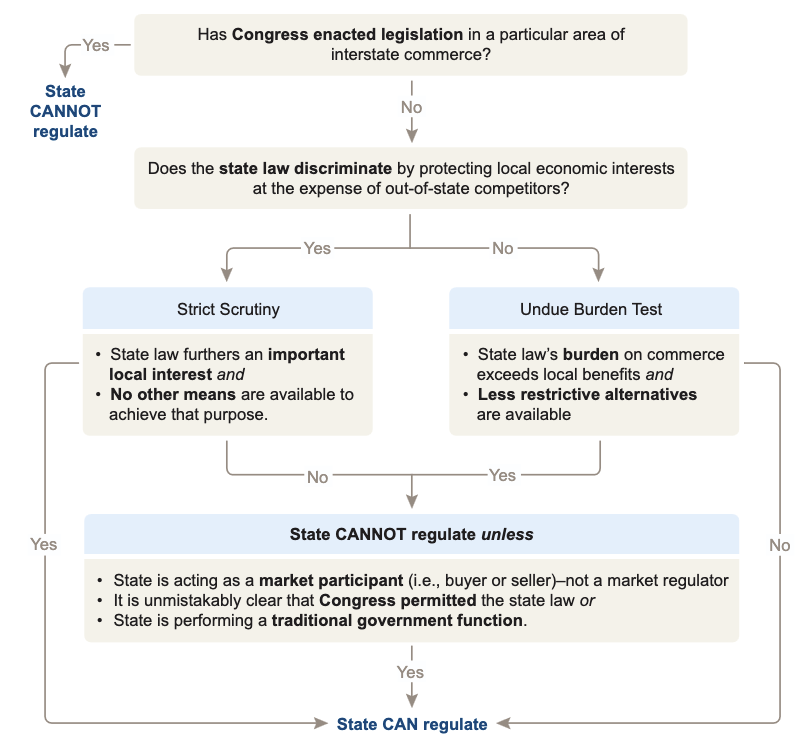
Dormant Commerce Clause
Discrimination Against Out-of-State Commerce
RULE: A state or local government cannot enact a discriminatory regulation that protects local economic interests at the expense of out-of-state competitors except when:
The regulation is necessary to an important state interest AND
No nondiscriminatory means are available to achieve that purpose
Dormant Commerce Clause
Undue Burden on Interstate Commerce
RULE: A nondiscriminatory state regulation may be struck down if it imposes an undue burden on interstate commerce. To determine if an undue burden exists, a court will:
Balance the purpose of the state law against the burden on interstate commerce AND
Evaluate whether there is a less restrictive alternative.
Dormant Commerce Clause
Exceptions
Market-Participant
Traditional Government Function
Congressionally Permitted Discrimination
Dormant Commerce Clause Exceptions
Market-Participant
A state can favor local commerce or discriminate against nonresident commerce if the state is acting as a buyer or seller and not as a market regulator.
Dormant Commerce Clause Exceptions
Traditional Government Function
State and local regulations can favor state and local government (not private) entities if the entities are performing a traditional government function (e.g., waste disposal).
Dormant Commerce Clause Exceptions
Congressionally Permitted Discrimination
An otherwise impermissible state regulation is valid if it is unmistakably clear that Congress intended to permit it.
Federal Preemption of State Law
General Rule
Federal law supersedes conflicting state or local laws.
If federal law does not preempt state law, then a state is free to enact legislation regarding the same issue.
Federal law sets a floor below which a state law cannot go, but federal law does not set a ceiling above which state law cannot go.
Federal Preemption of State Law
Express Preemption
Constitution makes federal power exclusive or
Congress has enacted legislation explicitly prohibiting state regulation in the same area
Federal Preemption of State Law
Implied Preemption
Field Preemption — Congress’s pervasive regulation shows an intent to occupy the entire field, or
Conflict Preemption — When it is nearly impossible to comply with both laws or when state/municipal frustrates the federal law’s purpose
Full Faith and Credit Clause
A court must give out-of-state judgments effect if:
The court rendering judgment had jurisdiction over the parties and the subject matter
The judgment was on the merits (addressed substantive elements of a claim or defense) and
The judgment was final (settled the rights of the parties and disposed of all issues).
State Action Doctrine
The Constitution generally protects against wrongful conduct by the government—not private parties. State action, which encompasses action by federal and local governments, is therefore a prerequisite to triggering constitutional protections.
State Action Doctrine
Traditional Government Function
State action occurs when a private person carries on a traditional government function, which is an activity that is traditionally performed exclusively by the state (e.g., running primary elections, running a company town).
State Action Doctrine
Entwinement
State action may exist if there are sufficient mutual contacts between the conduct of a private entity and the government such that the government is pervasively entwined with the entity and:
Constitutional standards should apply to the private entity
A mutual benefit results (e.g., joint venture) or
The state creates a private entity by special law to further governmental objectives and retains permanent control of the entity.
Mere licensing or regulation of a private party is not state action. The state must affirmatively facilitate, encourage, or authorize the activity.
Factual Trigger for Procedural Due Process Analysis
Deprivation of life, liberty, or property without adequate process.
Procedural Due Process
Steps for Analysis
Was there a deprivation of a life, liberty, or property right?
If yes, courts determine amount of process due (usually some form of notice and opportunity to be heard).
Balance (1) private interest, (2) government interest, and (3) risk of erroneous deprivation through procedures used vs. value of additional/substitute procedural safeguards.
Procedural Due Process
Courts determine the amount of process due by weighing:
Individual interest affected;
Risk of erroneous deprivation and value of additional safeguards; and
Government’s interest, incl. burden/cost of additional process.
Procedural Due Process
Individual whose interest is being deprived is generally entitled to:
Notice of government’s action by an unbiased decision-maker, and
An opportunity to be heard
Substantive Due Process
General Rule
Laws should be reasonable (not arbitrary) and protect individual freedom.
Substantive Due Process
Level of Scrutiny for Government Action Infringing on Fundamental Right
Strict Scrutiny: Government has the burden of proving that the law is the least restrictive means (i.e., necessary) to achieve a compelling government interest.
Substantive Due Process
Level of Scrutiny for Government Action Infringing on Ordinary Right
Rational Basis Review: Challenger has the burden of proving that the law is not rationally related to a legitimate state interest.
Restrictions on Fundamental Right to Travel
Reasonable residency requirements/waiting periods may be imposed on receipt of some government benefits, but durational residency requirements that impinge on the right of interstate travel by denying newcomers “basic necessities of life” are permitted only if the state can satisfy strict scrutiny.
Restrictions on Fundamental Right to Voting/Ballot Access
Ordinary/non-discriminatory restriction → RBR
E.g., voter registration, short-term residency reqs, photo-ID reqs, disallowing write-in voting, prohibiting felons from voting.
Sever (discriminatory) restriction → Strict Scrutiny
E.g., poll tax, property ownership req, disallowing 3rd party candidates
The fundamental right to privacy encompasses the right:
To marry
To obtain and use contraception
To engage in intimage and consensual sexual behavior
Of parents to make decisions regarding the care, custody, and control of their children
Of families to live together
To possess obscene material
To refuse medical treatment
To avoid disclosure of personal medical information
Fourteenth Amendment Equal Protection Clause
When government substantially burdens a fundamental right or intentionally discriminates against a suspect class
Apply strict scrutiny:
Requires the government to prove that its action is the least restrictive means to achieve a compelling governmental interest
Fourteenth Amendment Equal Protection Clause
Suspect Classes
Race
Ethnicity
National origin
Citizenship status
Fourteenth Amendment Equal Protection Clause
When government intentionally discriminates against a quasi-suspect class
Apply intermediate scrutiny:
Requires the government to prove that its action is substantially related to an important governmental interest.
Fourteenth Amendment Equal Protection Clause
Quasi-Suspect Classes
Gender
Legitimacy (nonmarital children)
Fourteenth Amendment Equal Protection Clause
When governmental action does not impact a fundamental right or discriminate against a suspect or quasi-suspect class
Apply rational basis review:
Challenger must prove that the law is not rationally related to a legitimate governmental interest (i.e., is arbitratry or irrational)
Fourteenth Amendment Equal Protection Clause
To trigger strict or intermediate scrutiny, there must be _________________ on the part of the government.
discriminatory intent
Fourteenth Amendment Equal Protection Clause
Facially Discriminatory
Language of the law distinguishes between different classes of persons
Fourteenth Amendment Equal Protection Clause
Discriminatory Application
A facially neutral law is applied differently to different classes of persons
Need proof of purposeful discrimination
Fourteenth Amendment Equal Protection Clause
Discriminatory Impact
A law that is neutral on its face and in its application disproportionately impacts a particular class
Need proof of purposeful discrimination, such as legislative history
Article IV Privileges and Immunities Clause (i.e., the Comity Clause)
Prohibits a state from discriminating against citizens of another state with respect to fundamental rights or essential activities (e.g., pursuit of employment, transfer of property, access to state courts).
Privileges and Immunities Clause
Discrimination against out-of-state citizens may be valid if the state can show:
A substantial reason for the difference in treatment and
A substantial relationship between the discrimination and the state’s objective
14th Amendment Privileges or Immunities Clause
Protects citizens from infringement by the states upon the privileges/immunities of national citizenship (e.g., interstate travel, voting for national offices, entering public lands, peaceable assembly).
5th Amendment Takings Clause
Provides that private property cannot be taken for public use without just compensation. It serves as a check on the government’s eminent domain power.
5th Amendment Takings Clause
A person must have a _____________ to challenge a governmental action as an unconstitutional taking.
property interest
5th Amendment Takings Clause
Types of Takings
Physical
Recharacterization
Regulatory
Exaction
5th Amendment Takings Clause
Physical Taking
Seizure of property
Primary challenge is whether the owner has received just compensation.
May also arise from damage to or destruction of property.
5th Amendment Takings Clause
Recharacterization Taking
When the government recharacterizes private property as public property
5th Amendment Takings Clause
Partial Regulatory Takings Analysis
Regulatory takings that do not result in a permanent total loss of the property’s economic value are also referred to as “partial” regulatory takings and are subject to a three-part test:
the economic impact of the regulation on the property owner;
the extent to which the regulation interferes with the owner’s reasonable, investment-backed expectations regarding use of the property; and
the character of the regulation, including the degree to which it will benefit society, and whether the regulation violates any of the owner’s essential attributes of property ownership.
5th Amendment Takings Clause
Per Se (“Total”) Regulatory Taking
When a regulation results in:
a permanent physical occupation of the property by the government or a third party or
a permanent total loss of the property’s economic value.
5th Amendment Takings Clause
Exaction Taking
Exacting promises from a developer does not violate the Takings Clause if there is
an essential nexus between legitimate state interests and the conditions imposed on the property owner and
rough proportionality between the burden imposed on the property owner and the impact of the proposed development.