1, (33 T&F) (65 the rest)
 Call Kai
 Learn
Learn Practice Test
 Spaced Repetition
 Match
Match Flashcards
 Knowt Play
1/97

There's no tags or description
Looks like no tags are added yet.
Name | Mastery | Learn | Test | Matching | Spaced | Call with Kai | Chat |
|---|
No analytics yet
Send a link to your students to track their progress
98 Terms
is the foundation for understanding how we send, receive, and lose messages.
What is the Communication Framework?
true
Every clinical error involving miscommunication traces back to a breakdown in one of the elements of the Communication Framework ✅❌
true
Mastering the communication framework will enable you to diagnose communication failures before they cause harm. ✅❌
true
Poor communication is the single most common cause of patient complaints against healthcare professionals worldwide ✅❌
medical error
adverse patient outcomes
malpractice claims.
What are the leading outcomes to which poor communication contributes in healthcare field?
false, You will spend more time communicating than performing any single clinical procedure, regardless of your specialty.
You will spend more time performing clinical procedures than communicating, regardless of your specialty. ✅❌
Patients:
Communication skills ≥ clinical technical expertise
Communication skills > clinical technical expertise
Senior healthcare managers:
Effective communication → primary attribution for professional success
What do studies consistently show about patients' valuation of their HCP's communication skills? + healthcare managers?
the successful transfer of a message AND meaning from one person or group to another
How is communication defined?
Meaning is the critical element.
=> Both sender and receiver must agree on the same meaning of what is being communicated.
What is the critical element of communication?
false, is a process involving multiple sequential steps, and each step can fail independently.
Communication is a single-step process in which failure can occur only at the beginning or end. ✅❌
false, Communication is bidirectional because both the sender and receiver play active roles.
Communication is unidirectional because only the sender plays an active role while the receiver is passive ✅❌
true
Communication is fragile because factors called “noise” can disrupt or distort meaning at every step. ✅❌
true
Communication is about what the other person understands, not simply what you say. ✅❌
The Sender Has an Idea to Communicate
The Sender Encodes the Idea into a Message
The Message Travels Over a Channel
The Receiver Decodes the Message
The Receiver Understands and Sends Feedback
What are the five steps of the communication process?
true
NOISE during the communication process is anything that disrupts, distorts, or blocks the process at any point. and runs through all five steps simultaneously. ✅❌
The sender begins with something they want to convey — a thought, instruction, clinical finding, question, or feeling.
what is the definition of the first step The Sender Has an Idea to Communicate?

What shapes the sender's idea?
false, Even before a word is spoken, the HCP’s state of mind can shape the message they are about to send.
The HCP’s state of mind has no influence on the message until after communication has already occurred. ✅❌
false, An HCP who is fatigued, distracted, or stressed will form a less clear idea than one who is focused and present.
Fatigue, distraction, or stress have no effect on the clarity of the idea formed by an HCP. ✅❌
to transform the idea into a form that can be transmitted.
The sender chooses from a wide range of encoding options
What does it mean to encode?

What are the encoding options listed in healthcare?
A skilled communicator selects the encoding method the receiver is most likely to understand — not the method that is easiest for the sender
What is the encoding principle?
A skilled communicator selects the encoding method the receiver is most likely to understand — not the method that is easiest for the sender.
What is the encoding principle?
This encoding uses words AND demonstration — two channels simultaneously.
“I'm going to need you to place your arm flat on this table with your palm facing up, and hold still while the image is taken. I'll show you with my own arm first.”
What does the encoding in the continued radiology example use?
true
Encoding in medical jargon when a patient does not understand clinical language is a failure of encoding, regardless of how clinically precise it is. ✅❌
the medium through which the encoded message travels from sender to receiver.
What is a channel?
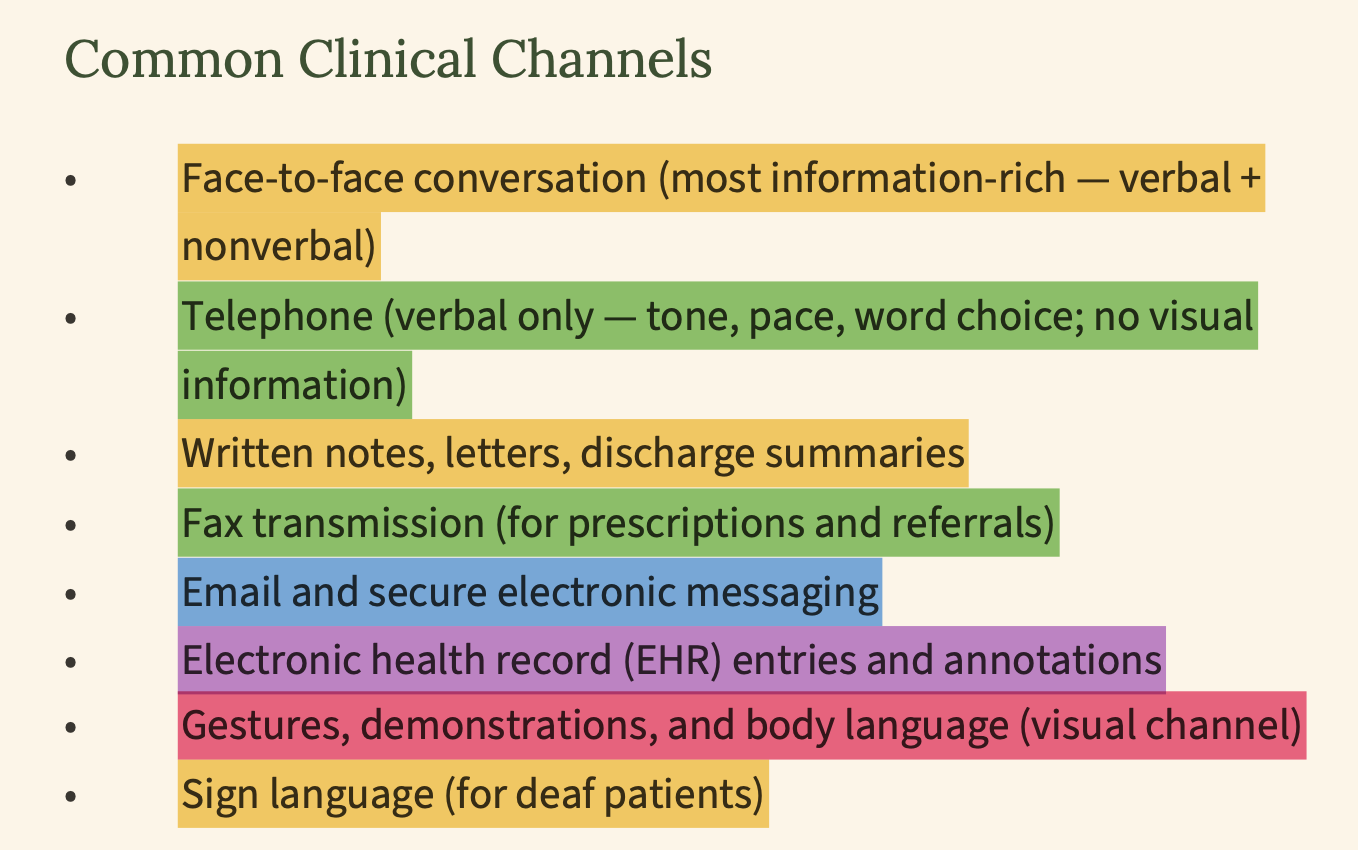
What are the common clinical channels?
Each channel has different information capacity
Why does channel selection matter?
tone and all nonverbal signals.
What does written text eliminate?

What are the examples of channel noise?
The receiver translates the encoded message back into meaning
what does The Receiver Decodes the Message mean?
occurs during decoding
Where does much clinical miscommunication occur?
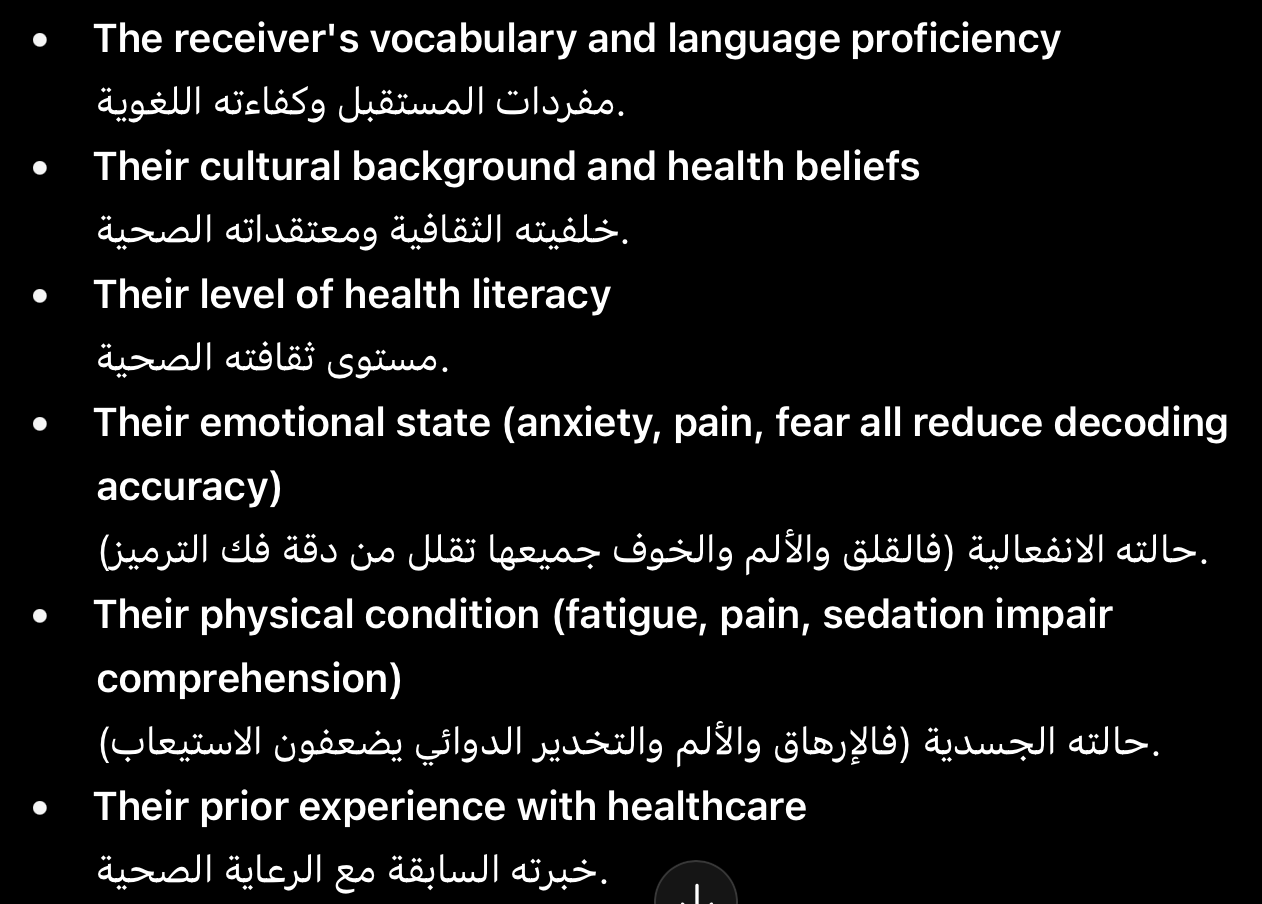
What shapes decoding?
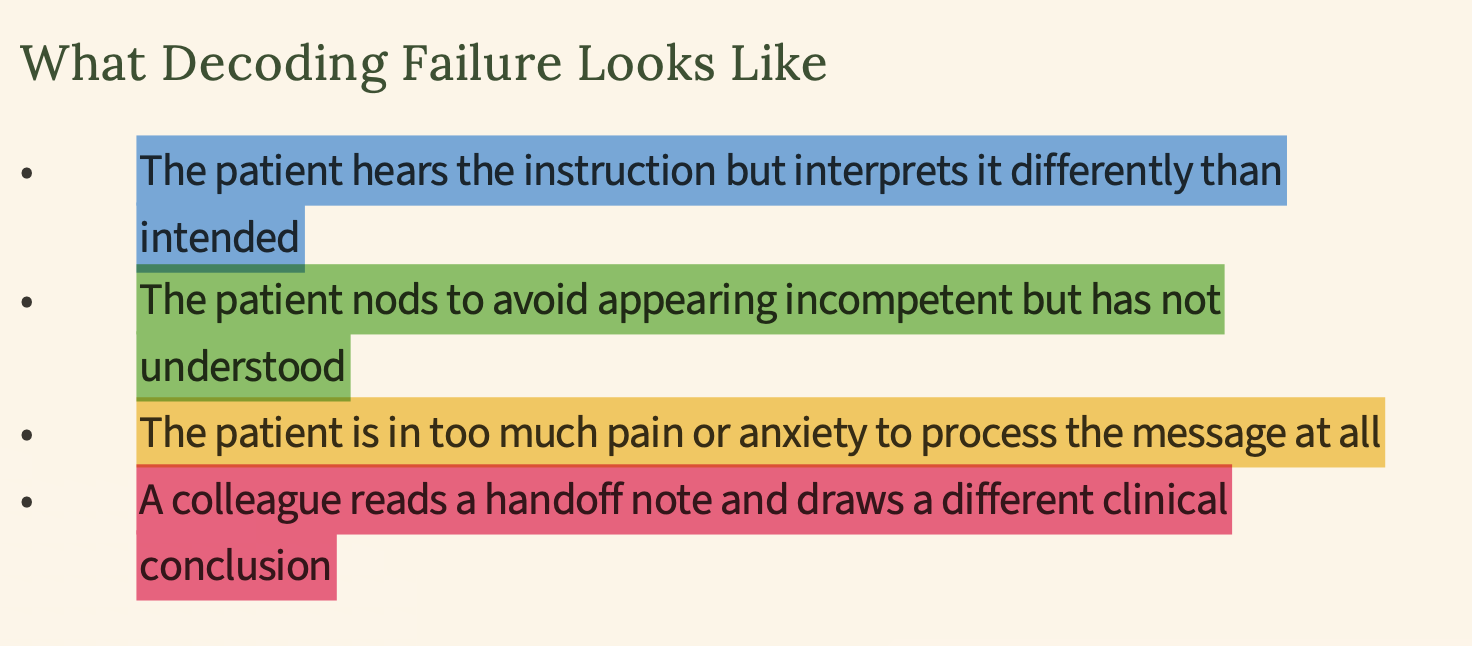
What are examples of what decoding failure looks like?
decoding failure
“Despite the technologist's clear instruction and demonstration, the patient — in significant pain and anxious — places their arm at a slightly incorrect angle.”
this is an example of?
false, Always build in a verification step, because you should never assume that decoding was successful simply because the instruction was clear.
If an instruction is clear, you can assume that the receiver decoded it successfully without any need for verification ✅❌
indicates that the message was received and understood
What does the receiver indicate in Step 5?
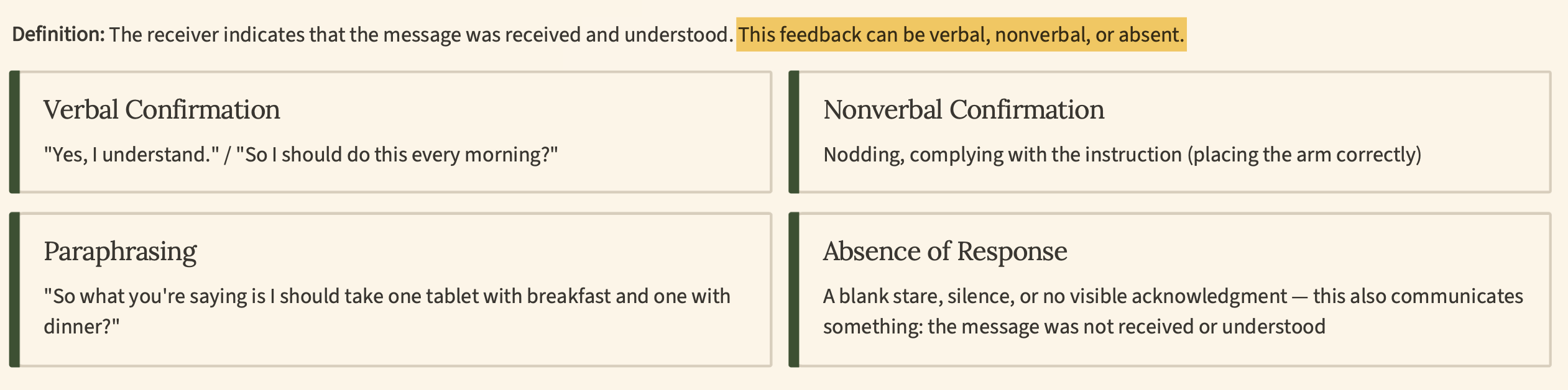
What forms can feedback take?
Verify understanding actively:
"Can you tell me in your own words what you'll do when you get home?"
Communicate at a time and under circumstances convenient to the receiver
Do not provide more information than the receiver can process at one time
cognitive overload prevents successful feedback
How can the sender enhance the feedback step?
After providing instruction, ask the patient to explain it back
What is the Teach-Back Method?
feedback
The patient asks: “Is this how you want me to do it?”
this is an example of?

identify the five steps of the communication process?

The failure originated at Step 3 and propagated through Steps 4 and 5 undetected.
Channel noise caused by audio distortion in the voicemail.
A pharmacist identifies an expired bronchodilator prescription and calls the clinic at 12:30 pm, leaving a detailed voicemail with the drug name, dosage, quantity, and frequency. The medical assistant listens to the voicemail but hears the dosage incorrectly because the audio is distorted. The incorrect dosage is written down, and the physician later signs the prescription without noticing the error. The patient then receives the wrong dose.
At which step did the communication failure originate?
What caused the initial communication failure?
is anything that inhibits, disrupts, or distorts effective communication at any point in the five-step process.
Despite the name, noise does not have to be literal sound.
What is Noise in the communication process?

What are the four categories of Noise?
HCPs cannot eliminate all noise, but they are professionally responsible for minimizing it
by choosing
the right channel,
the right setting,
the right language,
and the right moment.
And by always checking for understanding.
A healthcare professional is communicating with a patient and cannot completely eliminate all sources of Noise. What is the healthcare professional professionally responsible for doing?
false, In healthcare, the responsibility for reducing communication noise sits primarily with the HCP because the clinical encounter is inherently asymmetric.
In healthcare, the responsibility for reducing communication noise is always shared equally between the HCP and the patient. ✅❌
true
Patients are often in an unfamiliar environment, which contributes to the HCP’s greater responsibility for reducing communication noise. ✅❌
true
Patients may perceive a power differential that inhibits them from saying, “I don’t understand.” ✅❌
Choose a private space
ensure the patient is as physically comfortable as possible;
review available information so the encounter is efficient.
Before a clinical encounter, an HCP wants to reduce environmental Noise, What should the HCP do?
• speak in plain language matched to the patient's literacy level
• Pace information delivery — one concept at a time
• Watch for nonverbal signs of confusion, pain, or anxiety
• Use multiple encoding channels
• Always check for understanding using teach-back
During a clinical encounter, an HCP wants verifies understanding. What should the HCP do?
Provide written summaries for the patient to take home
offer a clear follow-up pathway for questions that arise later.
After a clinical encounter, what can an HCP do to support communication after the patient leaves?
all communication between the HCP and the patient — and the patient's family — that takes place specifically to advance the patient's well-being and clinical care.
It begins the moment the patient sees you in the waiting room.
What is Therapeutic Communication?
Collect Healthcare Information
Provide Healthcare Feedback
Support Behavioral Change.
What are the three main purposes of Therapeutic Communication?
Collect Healthcare Information
A healthcare professional needs information from a patient in order to assess, diagnose, and plan care. The quality of the information obtained depends on the quality of the interaction with the patient.
What purpose of Therapeutic Communication does this illustrate?
true
in the collect healthcare information principle, The quality of that information is determined by the quality of therapeutic communication. ✅❌
Provide Healthcare Feedback.
A healthcare professional needs to communicate a diagnosis, treatment plan, procedure, medication instructions, and self-management skills to a patient. The way this information is communicated affects whether the patient understands, accepts, and acts on it. What purpose of Therapeutic Communication does this illustrate?
Support Behavioral Change
A patient has a health condition that requires changing long-standing habits. The HCP uses communication to motivate the patient, support the change, and monitor the patient's progress. What purpose of Therapeutic Communication does this illustrate?

What are the three qualities of Therapeutic Communication?
Therapeutic communication is a clinical competency with measurable impact on patient health outcomes
Is therapeutic communication considered a “soft skill” or a clinical competency, and what impact does it have on patient health outcomes?
50–90%, substantially driven by inadequate therapeutic communication.
What is the estimated non-compliance rate with medication regimens, and what is it substantially driven by?
ما معدل عدم الالتزام المُقدّر بالأنظمة الدوائية، وما العامل الذي يسهم فيه بدرجة كبيرة؟
true
Communication failures are implicated in the majority of sentinel events, which are serious preventable adverse events, in hospitals worldwide ✅❌
true
Effective communication directly improves patient health outcomes including medication adherence and measurable health indicators.
يحسّن التواصل الفعّال نتائج صحة المرضى بشكل مباشر، بما في ذلك الالتزام بالأدوية والمؤشرات الصحية القابلة للقياس.
✅❌
Communication skill is not peripheral to clinical competence. It is core to it.
Is communication skill peripheral to clinical competence or core to it?
true
Radiography and medical imaging involve some of the most anxiety-provoking clinical encounters patients experience. Patients entering imaging suites are often frightened, in pain, uncertain about their diagnosis, and confronting unfamiliar technology ✅❌
اقري سلايد ١٧ فيها معلومات زيادة
true
health educator should share the Health statistics about a risk in ways that are understood, accurate, and neither sensationalized nor minimized. ✅❌
Goal: Gather accurate clinical information.
Tools:
Open-ended questions,
active listening,
paraphrasing.
Example: Taking a history from a new patient.
What is the goal, tools, and example of Assessment Communication?
Goal: Transfer accurate clinical information to the
patient. Tools:
Plain language,
teach-back,
visual aids,
written summaries.
Examples: Explaining a diagnosis, describing a procedure.
What is the goal, tools, and examples of Informational Communication?
Goal: Change the patient's health knowledge, attitudes, and behavior.
Tools:
Behavioral objectives,
motivational framing,
demonstration.
Examples: Teaching inhaler technique, dietary counseling.
What is the goal, tools, and examples of Educational Communication?
Goal: Help the patient manage the emotional dimensions of illness.
Tools:
Empathy,
silence, acceptance,
nonjudgment,
therapeutic presence.
Examples: Breaking difficult news; supporting a patient through grief.
What is the goal, tools, and example of Supportive Communication?
Goal: Work with the patient as a partner in their own care decisions.
Tools:
Shared decision-making,
eliciting patient preferences,
respecting autonomy.
Example: Discussing treatment options with a patient who has multiple valid choices.
What is the goal, tools, and example of Collaborative Communication?
Does this person seem competent?
Does this person care about me as a person?
Can I trust this person with sensitive information?
Will this person judge me?
What four questions does a patient implicitly consider when forming an initial impression of an HCP?
true
“Every encounter is a therapeutic encounter” means that even a brief procedural interaction carries therapeutic weight ✅❌
true
The patient’s experience during the encounter is clinically relevant, not just the clinical content. ✅❌
true
Clear communication is considered a patient safety practice because it is a professional obligation, not merely a courtesy. ✅❌
Encoding Failure — “Strenuous activity” was not defined specifically enough for a layperson.
A 67-year-old patient is discharged after cardiac catheterization. The cardiologist tells him, “Avoid strenuous activity for one week,” but does not define what “strenuous” means. The patient interprets it as competitive sport and later develops a complication.
Which communication failure occurred?
Decoding Failure — the patient decoded “strenuous” through his own reference frame, not the clinical one.
Feedback Failure — no teach-back was used; the patient's nod was accepted as confirmation of understanding.
A 67-year-old patient is told after cardiac catheterization to “avoid strenuous activity.” He interprets “strenuous” as competitive sport, while the cardiologist meant exertion that raises blood pressure. The patient interprets the message through his own reference frame rather than the clinical one. nods when the cardiologist asks if he understands. The cardiologist accepts the nod as confirmation and does not ask the patient to explain what he will do at home. What communication failure occurred?
What communication failure occurred?
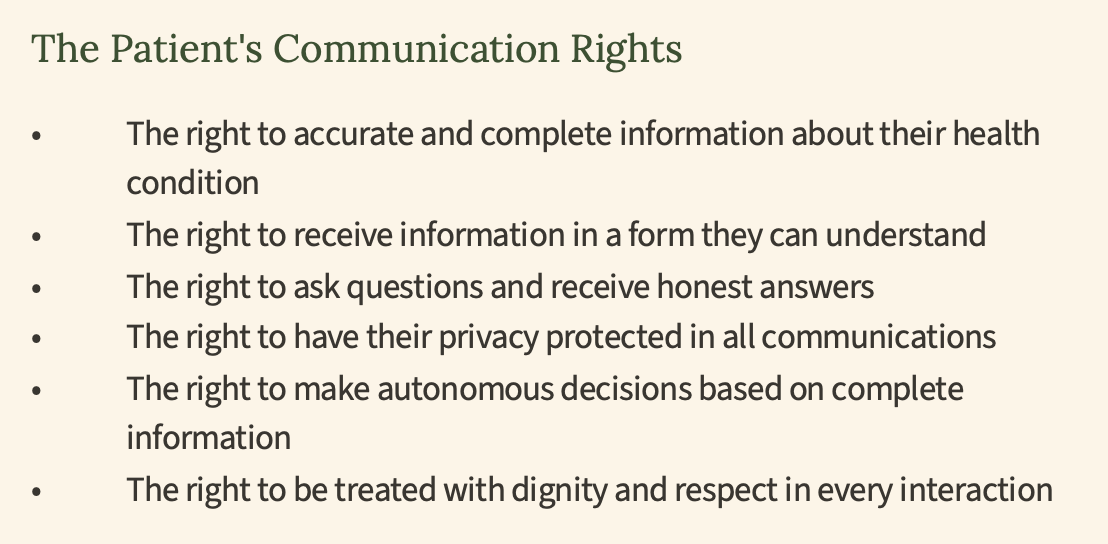
What are the patient's six communication rights?
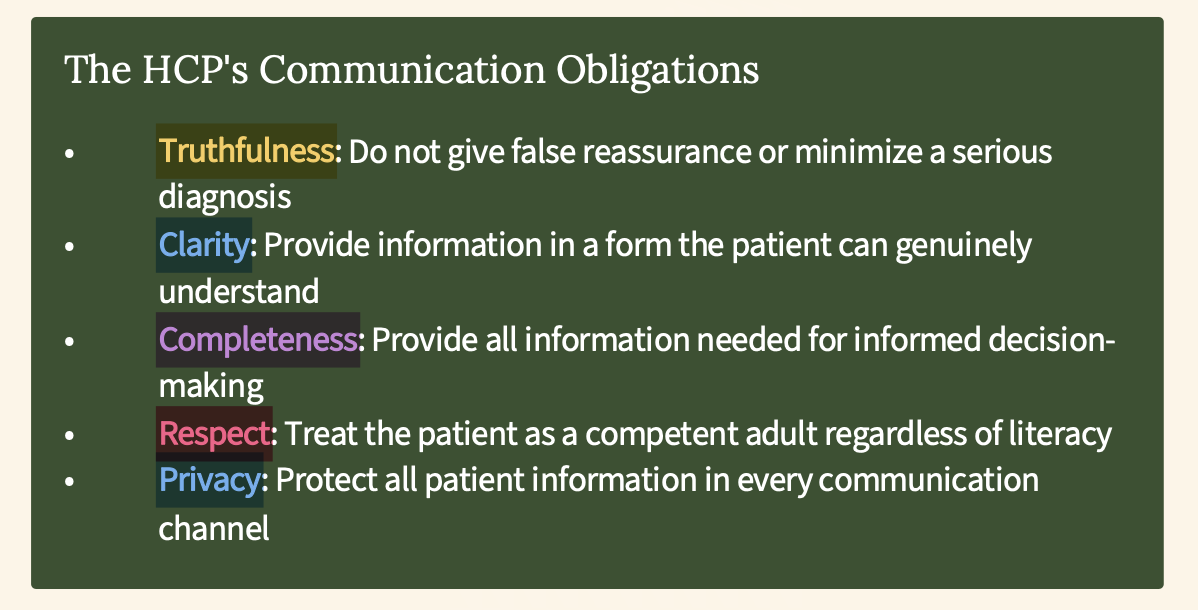
What are the HCP's five communication obligations?
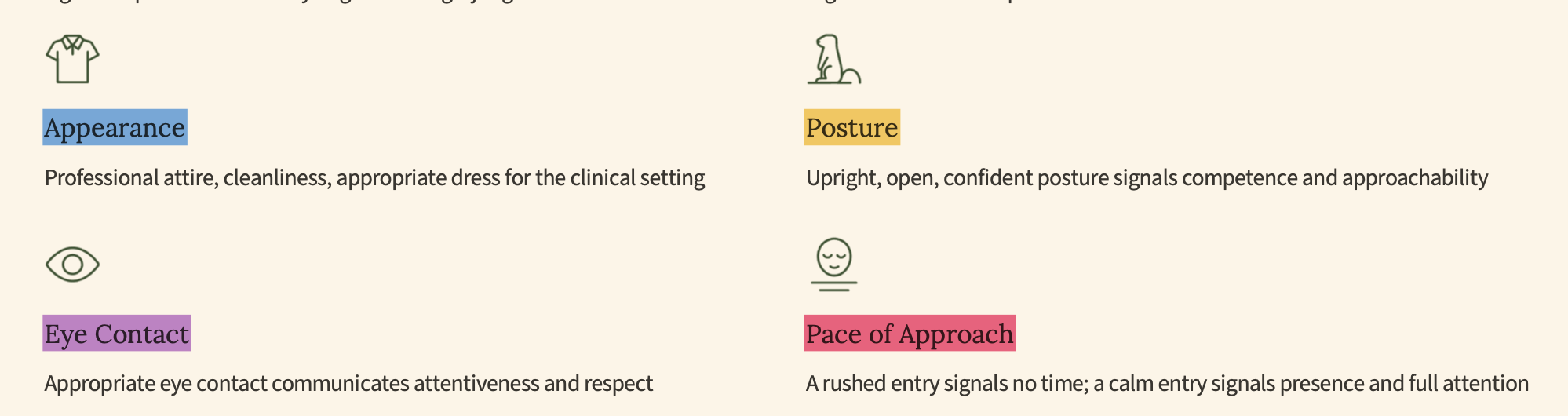
What four aspects contribute to a patient's first impression of an HCP?
the degree to which patients follow through on clinical recommendations.
What is compliance in the context of healthcare communication?

What are the strengths of verbal versus written communication in clinical settings?

What are the limitations of verbal versus written communication in clinical settings?
Use verbal communication as the foundation of every encounter.
Use written communication to reinforce and extend what was discussed verbally.
Never use written communication as a substitute for the therapeutic relationship.
What is the best practice for using verbal and written communication in clinical settings?
1. Time pressure.
2. Assumptions.
3. Emotional reactions to patients.
4. Compassion fatigue.
5. Over-reliance on clinical jargon.
على كل وحده فيه مثال بالمحاضرة أفيهم سلايد رقم ٢٩
What five HCP-side barriers can undermine therapeutic communication?
1. Was I truly present?
2. Did I listen or did I wait to speak?
3. Did I assume or did I ask?
4. Did I use jargon or plain language?
After each clinical encounter, what four self-awareness questions should an HCP reflect on?
feedback
Of all five steps in the communication process, (-) is the most consistently neglected in busy clinical settings.
true
HCPs may send a message, observe no obvious sign of confusion, and proceed, interpreting silence or a nod as successful communication ✅❌
true
A nod almost never means “I understand”; it most often means “I hear you” or “I want to appear cooperative.” ✅❌
true
A nod almost never means “I understand”; it most often means “I hear you” or “I want to appear cooperative.”✅❌
false, Patients who do not understand frequently do not say so because of embarrassment, deference to authority, or simply not knowing what they do not know.
Patients who do not understand will always tell the HCP that they are confused and need clarification. ✅❌
true
Listening is not a passive state; it is an active clinical skill. ✅❌

What are the four components of effective clinical listening?
Interrupting the patient before they finish;
finishing the patient's sentence;
formulating your response while the patient is still speaking;
focusing on documentation rather than the patient;
selective listening — hearing only what fits your clinical hypothesis.
What are common listening failures in clinical communication?
true
HCPs interrupt patients on average within 18 seconds of the patient beginning to speak. Patients who are allowed to complete their opening statement rarely take more than 90 seconds. ✅❌
false, The first patient interaction sets the tone for subsequent care
The first interaction has no effect on subsequent care ✅❌
true
True: Discharge is a high-risk communication point because patients may still be anxious, affected by medication, and without immediate clinical support. ✅❌
false
Handoffs do not involve communication and cannot cause adverse events ✅❌