4 - Pharmacology and Pharmaceutic Principles of Anti-Arrhythmic Drugs
 Call Kai
 Learn
Learn Practice Test
 Spaced Repetition
 Match
Match Flashcards
 Knowt Play
1/81

There's no tags or description
Looks like no tags are added yet.
Name | Mastery | Learn | Test | Matching | Spaced | Call with Kai | Chat |
|---|
No analytics yet
Send a link to your students to track their progress
82 Terms
What does hERG blockade have to do with long QT?
hERG blockade → decreasing K⁺ efflux → slower ventricular repolarization → prolonged QT interval → increase the risk of torsades de pointes
How does Ca²⁺ blockade affect long QT?
Long QT → increase the risk of EADs
Ca²⁺ blockade → decreases EADs → therefore decreases risk of Torsades
Why is anti-arrhythmic drug therapy dangerous?
Can worsen existing arrhythmias or cause new ones
Benefits must outweigh risks!
What is the main goal of anti-arrhythmic drugs?
Is to blunt/prevent → abnormal impulse formation and/or abnormal conduction
What are the 4 major classes of anti-arrhythmic drugs?
Class I → Na⁺ channel blockers
Class II → decreasing sympathetic activity → β-blockers
Class III → K⁺ channel blockers
Class IV → Ca²⁺ channel blockers in the heart
What are the therapeutic objectives of anti-arrhythmic drug therapy?
Alter one or more of the following:
Effective refractory period (ERP)
Rate of depolarization / repolarization
Resting potential

What phase does Class I anti-arrhythmic drugs affect?
Phase 0
Depolarization → blocks Na⁺ channels

What phase does Class II anti-arrhythmic drugs affect?
Phase 2
Contraction → decreases contractility

What phase does Class III anti-arrhythmic drugs affect?
Phase 3
Repolarization → blocks K⁺ channels
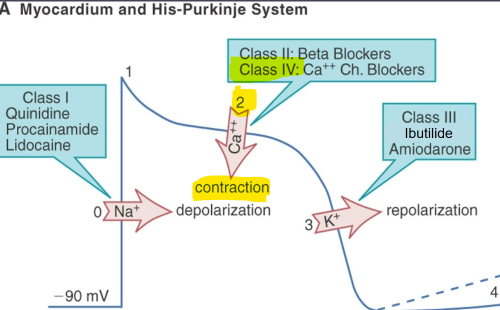
What phase does Class IV anti-arrhythmic drugs affect?
Phase 2
Contraction → blocks Ca²⁺ channels
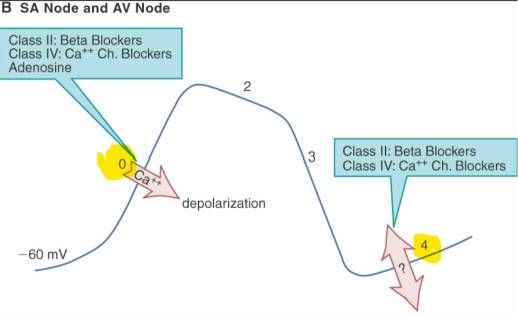
What phases do Class II and IV affect in SA/AV nodes?
Affect Ca+2
Affects depolarization of the SA/AV nodes
What is the role of Ca²⁺ in cardiac muscle?
It triggers cardiac muscle contraction
Why does cardiac relaxation require more ATP than contraction?
Ca²⁺ must be actively pumped back into the SR by SERCA (pump)
Requires ATP → ~55% of ATP use vs ~45% for contraction
What do CCBs do in cardiac muscle?
Block L-type Ca²⁺ channels (gateways that let Ca²⁺ enter cardiac muscle)
Decreasing Ca²⁺ entry → decreasing contraction → decreasing O2 demand
Why use CCBs cautiously with β-blockers?
Verapamil and diltiazem
They decrease contractility and cardiac output
With β-blockers, effects are additive → excessive decrease in HR and contractility
What are the 3 main CCB families?
Dihydropyridines (DHPs)
Phenylalkylamine
Benzothiazepine
What does the Dihydropyridine family mainly act on?
Mainly on vascular L-type Ca²⁺ channels
Ex → Nifedipine, amlodipine, nicardipine, felodipine
What does the Phenylalkylamine and Benzothiazepine families mainly act on?
Act as a non-selective block of cardiac and vascular Ca2+ channels
Phenylalkylamine → Verapamil
Benzothiazepine → Diltiazem
What are the Class IA antiarrhythmic drugs?
Quinidine
Procainamide
Disopyramide
MOA of Class IA antiarrhythmics?
Na⁺ channel blockade → decreases Phase 0 depolarization and Vmax → slows conduction velocity
Slower conduction + longer action potential → prevents abnormal impulses
What are the Class IB arrhythmic drugs?
Lidocaine
Phenytoin
Mexiletine
MOA of Class IB arrhythmic drugs?
Blocks Na⁺ channels, especially inactivated channels → slows Na⁺ channel recovery and increases the EFP
What are the Class IC drugs?
Flecainide
Propafenone
MOA of Class IC drugs?
Strongly blocks Na⁺ channels → greatly decreases Phase 0 depolarization / Vmax → slows conduction
Strong Na⁺ block + very slow conduction + no major AP change
Why is increasing the effective refractory period (ERP) good for treating arrhythmias?
It makes the cardiac cells stay unable to respond to new impulses longer
Abnormal impulses have a harder time spreadiing
Quinidine?
Class IA
Oral
Hepatic → will inhibit 2D6
Major adverse effects of quinidine?
Anticholinergic effect → cardiotoxic
Major drug-drug interactions with Quinidine?
CYP2D6 → some antidepressants, or macrolide antibiotics (mycin)
Digoxin
Procainamide?
Oral, IM, IV
CYP2D6
N-acetyltransferase enzyme coverts it into → acetylated to NAPA → NAPA can block K⁺ channels → TdeP
Major adverse effects of Procainamide?
Systemic lupus erythematosus (SLE)-like syndrome
Torsades de Pointes → due to increased NAPA
Major drug-drug interactions with Procainamide?
Cimetidine
Does not interfere with digoxin
Disopyramide?
Class IA
Oral
CPY3A4
Major adverse effects of Disopyramide?
Anticholinergic effect → cardiotoxic
Strong negative inotropic effect
Major drug-drug interactions with Disopyramide?
CYP2D6 → macrolide antibiotics (mycin)
Lidocaine?
Parenteral only → only 3% of oral appears in plasma due to rapid hepatic metabolism
IV preferred → can be IM
Major adverse effects of lidocaine?
Direct CNS effects at high doses → Seizures !
Major drug-drug interactions with lidocaine?
Drugs that decrease hepatic blood flow → B-blockers, cimetidine
Drugs that inhibit Cyto-P450 enzymes
Mexiletine?
Orally active conger of lidocaine → low first pass effect
Hepatic → CYP1A2, CYP2D6
Major side effects of Mexiletine?
Mostly GI
Neurologic → tremors, dizziness, psychosis, convulsions
Major drug-drug interactions with Mexiletine?
Anti-depressants → CYP1A2, CYP2D6
Theophylline → CYP1A2
How does lidocaine block cardiac Na⁺ channels?
Blocks inactivated Na⁺ channels more than open channels and dissociates rapidly (<1 sec)
Why does lidocaine selectively affect depolarized or rapidly firing cells?
Depolarized or rapidly firing cells have more Na⁺ channels in the inactivated state → lidocaine blocks these cells more strongly
Why are Class IB drugs useful for ischemic or cardiac glycoside-induced arrhythmias?
They preferentially target depolarized (“sick”) cardiac cells → helps treat arrhythmias in these damaged cells
Why are Class IC drugs considered highly pro-arrhythmic?
Study found a 2.5-fold increase in fatal arrhythmias in patients with a prior MI
Contraindicated in patients with history of MI or cardiac ischemia
Flecainide and Propafenone?
Class IC
Oral
Major adverse effects of Flecainide and Propafenone?
Contraindicated in patients with history of MI or cardiac ischemia
MOA Class II antiarrhythmics?
Block β1 receptors → decrease sympathetic activity → decrease heart rate and slow AV node conduction
MOA Class III antiarrhythmics?
Blocks K⁺ channels → slows repolarization → increases action potential duration, EFP and QT
MOA Class IV antiarrhythmics?
Blocks Ca²⁺ channels in nodal cells → decreases Ca²⁺ entry → slows AV node conduction and increases AV node refractory period
Examples of Class II drugs?
Propranolol
Metoprolol
Esmolol
Acebutolol
What beta blocker is ideal for rate control situations where a long acting BB is not ideal?
Esmolol → 9-minute half-life → ideal for rate control when a long-acting β-blocker is not ideal
What are Class II antiarrhythmics used for?
“Slow it down”
SVT and AFib/AFlutter rate control
How do Class II anti-arrhymics work?
Decrease HR and AV conduction
Adverse effects of Class II?
Potential to make heart failure worse
AV block
Sinus arrest
Bronchospasm in asthmatic patients
Example of Class IV drugs?
Calcium channel blockers!
Verapamil
Diltiazem
What are Class IV antiarrhythmics used for?
“Control the AV node”
SVT + AFib/AFlutter rate control
How do Class IV antiarrhythmics work?
Block Ca2+ → slows the heart + AV node
Adverse effects of Class IV drugs?
Bradycardia → possible AV block
Hypotension
Potential to make heart failure worse
Peripheral edema
GI issues
Amiodarone and Dronedarone membrane action?
slower + longer!!!
Slow everything + prolong QT
Amiodarone and dronedarone effect on EKG?
Slower and longer!
QT = longer; HR, PR, QRS = slower
Therapeutic uses of amiodarone and dronedarone?
Amiodarone → commonly used for post-operative arrhythmias.
Supraventricular + ventricular arrhythmias
How are amiodarone and dronedarone metabolized?
Liver → CYP3A4
Very long half-life →13–103 days
Vd: 60 L/kg
Dofetilide and Ibutilide membrane?
Increases refractory period → harder to fire again
Increases inward sodium channel
Decreases outward potassium channel
Dofetilide and Ibutilide effects on EKG?
Decrease sinus rate
Increase QT interval
Amiodarone?
Class III
Oral and IV in acute cases
Adverse effects of amiodarone?
Bradycardia or heart block
Increased risk of long QT
Pulmonary fibrosis
Corneal deposits
Hypothyroidism / Hyperthyroidism
Drug-drug interactions of Amiodarone?
Can increase serum levels of several Class I and → digoxin, warfarin, and statins
Dronedarone?
Class III
Oral
Dronedarone adverse effects?
Less toxic than amiodarone
Exacerbation of severe heart failure
Increased risk of long QT
Ibutilide and Dofetilide?
Class III
Oral and rarely IV
What classes does amiodarone act as?
Dual acting Class III + Class I
It also has mild β, α, and Ca²⁺ blocking effects
It is a mixture of all 4 classes
How does amiodarone stay in the body so long?
It is highly lipid-soluble → stored in fat, liver, and lungs.
It also has an extremely long half life → ~6 months
What is important to remember about amiodarone's safety?
It can cause serious side effects → so benefits must be weighed against risks
What is dronedarone?
Class III
An amiodarone analog with a much shorter half-life (1–2 days)
Thought to have fewer serious side effects than amiodarone → BUT it can worsen heart failure.
Sotalol / Betapace?
Dual acting class → Class II + III
Its stuck between the 2 classes
How is sotalol given and what is it used for?
Usually oral → ~100% bioavailable
Used for A-fib + severe ventricular arrhythmias
What are the major concerns with sotalol?
↑ QT → ↑ Torsades risk → Risk is higher with bradycardia, low K⁺, or low Mg²⁺
Few drug interactions
What is the main action of adenosine?
Transiently / briefly blocks Ca²⁺ channels → slows AV-node conduction
Activates K⁺ channels → hyperpolarizes the membrane
temporarily slows AV-node conduction and makes the membrane less excitable
How is adenosine given and what is it used for?
IV only → lasts only 10–15 seconds.
Used for AV-nodal reentry + paroxysmal SVT.
Adverse effects → Dizziness and shortness of breath
What is Mg²⁺ used for in arrhythmias?
Weakly blocks Ca²⁺ channels and affects Na⁺/K⁺ ATPase → useful for long QT, digitalis toxicity, and Torsades de Pointes.
What is K⁺ used for in arrhythmias?
Slows AV conduction → useful for digitalis toxicity and arrhythmias caused by electrolyte imbalance.
Electrolyte administration and adverse effects?
IV typically, K+ can be oral
Mg → muscle weakness
K → overdose can be pro-arrhythmic even fatal