AP Chem (Unit 1): Atomic Structure
 Call Kai
 Learn
Learn Practice Test
 Spaced Repetition
 Match
Match Flashcards
 Knowt Play
1/49

There's no tags or description
Looks like no tags are added yet.
Name | Mastery | Learn | Test | Matching | Spaced | Call with Kai | Chat |
|---|
No analytics yet
Send a link to your students to track their progress
50 Terms
nucleus
a small, positively charged core that has protons (+) and neutrons (0)
mass number
protons + neutrons (always a whole number)
atomic mass
the average mass of all isotopes
isotope notation
A - mass number, Z - Atomic number (A,Z)

isotopes
have the same number of protons, but different numbers of neutrons (neutrons have no effect on Chemistry)
amu
atomic mass units (g)
mass spectrometry
compares the masses of isotopes

How to find the amu of an isotope
AV mass = (isotope mass x %)+ (isotope mass x %) —> AVERAGE MASS FOUND ON PERIODIC TABLE

AV mass = (34.969x0.7578) + (36.996×0.2422)
35.45 amu → the element is chlorine
absorption of light
electrons become excited, jump energy levels, no light
emission of light
electrons go back to ground state, releases light as ELECTROMAGNETIC RADIATION
light
characterized by wavelength and frequency
frequency
how many wavelengths pass a certain wavelength per second (nu, v, s^-1, s/1, Hz)
cycle
movement of crest and trough

wavelength
the distance between two corresponding points on consecutive waves
electromagnetic radiation
energy traveling through space (c=wavelength*frequency)
1 m
10^9 nm
10^-9 m
1 nm
Spacing of E lvls
N=1 and n=2 has the biggest gap, and it gets smaller as you move up

Lyman series
electrons end at n=1, large E gap = ultraviolet radiation
Balmer series
electrons end on n=2 (visible light)
concentric degenerate energy levels
the data that the spectrum of a hydrogen produced led to the more refined model of ever increasing of ever increasing energy levels with ever decreasing gaps of E between them
Cathode Ray Tube
JJ Thompson created a negatively charged particle beam through a tube full of air; vacuumed air out and electors were left = DISCOVERED ELECTRONS

Gold Foil Experiment
Ernest Rutherford shot alpha particles at a thin gold sheet, the gold’s nucleus repelled alpha particles = MASSIVE, DENSE, POSITIVELY CHARGED NUCLEUS (+ solar system model, most of the atom is empty space)

alpha particles
radioactive, positively charged, 2p+ and 2n (helium nucleus)
Discovery of the Neutron
James Chadwick shot alpha particles at Be, Br, Li (rays get released through the atoms) something was shot out (neutral). Then, he put parafin on he rays and the protons flew out = NEUTRONS ARE NEUTRALLY CHARGED IN THE NUCLEUS AND HAVE THE SAME MASS OF PROTONS

electrons closest to the nucleus are…
Harder to pull off
ionization energy
the energy required to remove an electron and make a cation
high potential energy
valence electrons, easier to remove, lower ionization energy
low potential energy
electrons closest to the nucleus, harder to remove, high ionization energy
Einstein's Photoelectric Effect
if you put the right amount of energy (light) on a metal, you should be able to knock off the atoms
electrostatic attraction (repulsion)
opposites attract, likes repell
Coulomb's Law
Force of Attraction (FoA): the closer opposite charges are to each other, the greater the Foa, bigger charges = stronger force
photoelectron spectroscopy (PES)
high energy photons remove electrons from any shell, not just outer (KE of e- determined and frequency of electrons is determined)
How is Ionization Energy (IE) calculated?
IE = hv - KE
when there is a larger nuclear charge…
the element has a higher ionization energy
shielding effect
repulsion from the inner electrons (successive shells are larger than the previous shells, spend more time farther from the nucleus)
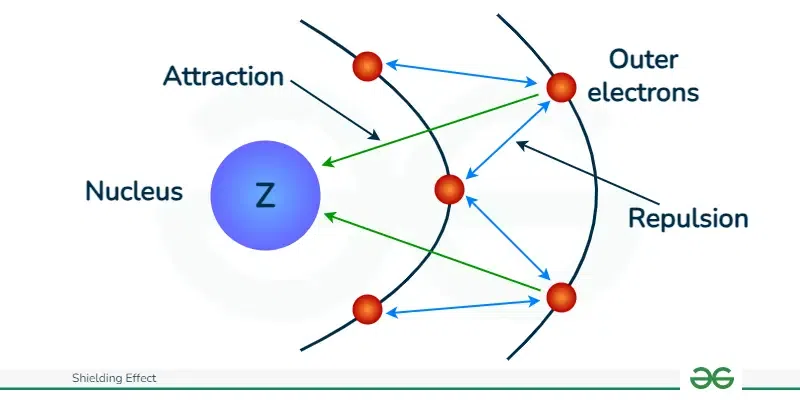
Zeff
charge experienced by an electron, decreases as shielding increases (more E lvls)
atomic radius trend
decreases as protons increase and energy levels stay the same, increases as energy levels are added (shielding is constant across a period)
cation radius
MUCH smaller than the radius of the atom the came from (remove an entire energy level, decreases left to right
anion radius
anion radius is slightly bigger than the atom the came form (increases in electron repulsion), decreases left to right, first anion radius increases dramatically bc of repulsion
first ionization energy
the minimum amount of energy necessary to remove the least tightly held electron form an atom or ion in the gas phase (decreases as energy levels are added, generally increases when nucleus is bigger, except for p sub shell)
Why does every element have a sudden increase in ionization energy?
the electron configuration drops an energy level, and the radius shrinks more than other ionizations
Why is second ionization energy greater than the first?
every electron costs more than the one before it, its harder to take an electron form a more positive space!
electron affinity
the energy change that occurs when an electron is added to a gaseous atom to form a negative ion, energy comes in (THE CLOSER AN ELECTRON CAN GET TO THE NUCLEUS, THE MORE ENERGY)
if the EA value is negative
it is exothermic, releases energy because it is more energy efficient to accept an electron
if the EA value is positive…
it is endothermic, it takes more energy to accept the electon
electron affinity trend
decreases as energy levels increase, electron affinity increases as atomic number increases (group 2 - e- goes to the p sub shell, group 8 - extra electron goes to a new energy level, oxygen)
electronegativity
al elements ability to attract electrons in a chemical bond
electronegativity trend
increases as protons increase in the same energy level and decreases as as energy levels are added (inc. as atomic radius dec.)