Amines, amides, amino acids and proteins
0.0(0)
Studied by 0 people Call Kai
 Learn
Learn Practice Test
 Spaced Repetition
 Match
Match Flashcards
 Knowt Play
Card Sorting
1/67

Earn XP
Description and Tags
Last updated 1:23 PM on 11/7/22
Name | Mastery | Learn | Test | Matching | Spaced | Call with Kai | Chat |
|---|
No analytics yet
Send a link to your students to track their progress
68 Terms
1
New cards
Reduction of aromatic nitro compound conditions second step
heat
2
New cards
Reduction of aromatic nitro compound reagents second step
Sn, HCl
3
New cards
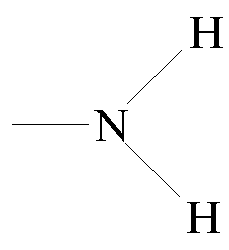
amine functional group
NH2
4
New cards
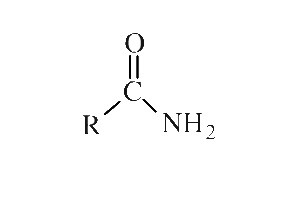
Amide functional group
CONH2
5
New cards
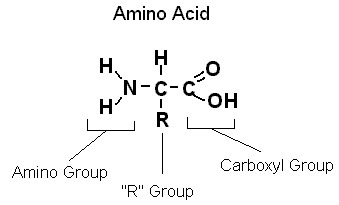
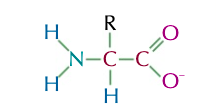
amino acid
H2N-CHR-COOH
6
New cards
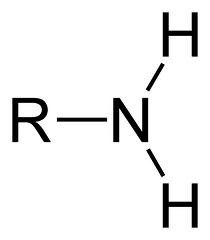
primary amines
one H of NH3 is replaced by an alkyl group
7
New cards
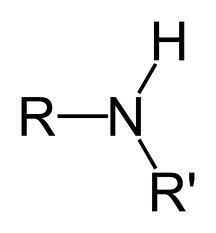
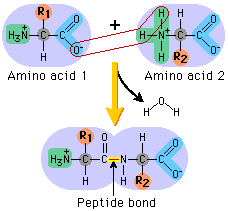
secondary amines
two H of NH3 are replaced by an alkyl group
8
New cards
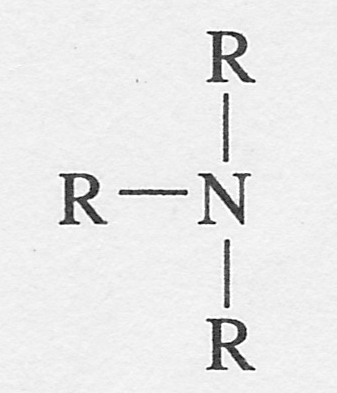
tertiary amines
all H of NH3 are replaced by an alkyl group
9
New cards
naming amines
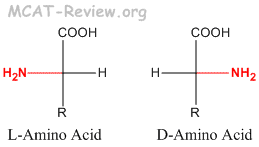
alkyl chain length - amine eg. methyl amine
10
New cards
naming of amines when two or more amine groups are present
-amino prefix used. Amine becomes premodifying group eg. diaminobutane
11
New cards
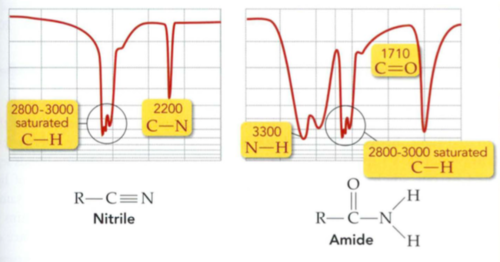
IR absorption of N-H
3500-3300cm-1
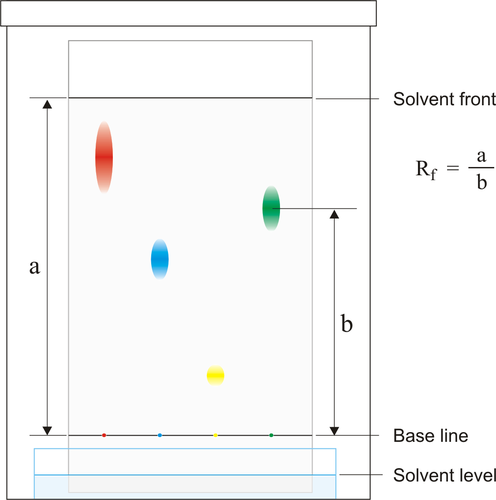
12
New cards
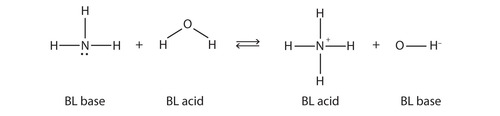
amines with water (acting as a base)
RNH2 + H2O ⇌ RNH3+ + OH-
13
New cards
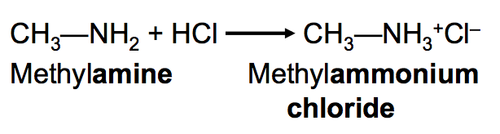
amines with acids equation
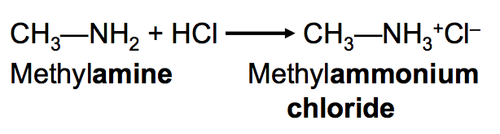
CH3NH2 (aq) + HCl (aq) → CH3NH3+Cl-
14
New cards
amines with acids
amine+acid-> alkyl ammonium chloride
- reversible as addition of NaOH converts back to the amine
- These ionic salts will be solid crystals, if the water is evaporated, because of the strong ionic interactions
- The ionic salts formed in this reaction means that the compounds are soluble in the acid e.g. Phenylamine is not very soluble in water but phenylammonium chloride is soluble
- reversible as addition of NaOH converts back to the amine
- These ionic salts will be solid crystals, if the water is evaporated, because of the strong ionic interactions
- The ionic salts formed in this reaction means that the compounds are soluble in the acid e.g. Phenylamine is not very soluble in water but phenylammonium chloride is soluble
15
New cards
butyl amine and ethanoyl chloride equation
C4H9NH2 + CH3COCl -> CH3CONHC4H9 (n-butyl ethanamide)
16
New cards
amines with acyl chlorides
amine+acyl chloride -> amide (CONH2)
17
New cards
naming compounds of acyl chloride and amides
N prefix always, amine gives alkyl prefix eg. butyl, acyl gives suffix eg. ethanoyl = N-butyl ethanamide
18
New cards
amines with halogenoalkanes equation
RNH2 + CH3Cl → RNHCH3 + HCl (H from amine and Cl from chloroalkane)
19
New cards
amines with halogenoalkanes
a substitution reaction in which the organic product is a secondary amine and the inorganic product is a hydrogen halide
20
New cards
amines to form complex ions (as ligands)
Lone pair of electrons on N means it can form dative covalent bonds to transition metal ions.
21
New cards
amines to form complex ions equation
[Cu(H2O6]2+ +2C2H5NH2-> [Cu(H2O)4(OH)2] pale blue precipitate + 2C2H5NH3+ (takes two hydrogens from complex). In excess of amine, gives deep blue complex as amine replaces 2 more H2O and the 2 OH.
![[Cu(H2O6]2+ +2C2H5NH2-> [Cu(H2O)4(OH)2] pale blue precipitate + 2C2H5NH3+ (takes two hydrogens from complex). In excess of amine, gives deep blue complex as amine replaces 2 more H2O and the 2 OH.](https://knowt-user-attachments.s3.amazonaws.com/fcab7fe02ebc48a8b7de4a7456f9cc50.png)
22
New cards
Preparation of primary aliphatic amines
Reaction of ammonia with halogenoalkanes, the reduction of nitriles and reduction of aromatic nitrocompounds
23
New cards
ammonia with halogenoalkanes reagents
halogenoalkane and excess concentrated ammonia dissolved in ethanol
24
New cards
ammonia with halogenoalkanes conditions
heat under reflux
25
New cards
ammonia with halogenoalkanes nucleophile
NH3
26
New cards
Ammonia with halogenoalkanes step 1
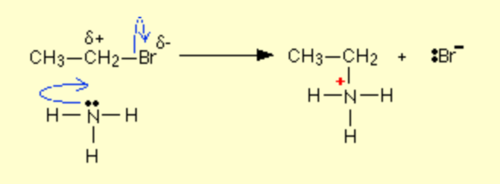
lone pair on N atom of ammonia is attracted to positive charge in carbon in halogenoalkane. Lone pair forms a covalent bond between N-C producing a quaternary salt. (CH3-N+H2- CH3)
27
New cards
Ammonia with halogenoalkanes step 2
amine is released from the salt by removal of a proton using excess ammonia which attacks H on NH3 to make it an amine and form the salt NH4Br
28
New cards
reduction of nitriles by hydrogenation catalyst
nickel
29
New cards
reduction of nitriles by hydrogenation
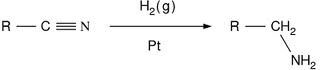
nitrile+hydrogen-> alkyl amine (eg. butane nitrile+hydrogen-> butyl amine)
30
New cards
reduction of nitriles by LiAlH4 reagents
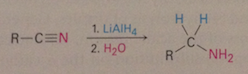
LiAlH4 catalyst in ethoxyethane, followed by dilute acid
31
New cards
reduction of nitriles by LiAlH4
nitrile+reducing agent->amine
32
New cards
basicity of amines as the chain length increase
increases as an increase in alkyl groups cause the nitrogen to be more electron rich/electrognegative due to inductive effect
33
New cards
strength of base decided by
availability of lone pairs of electrons on the N atom to accept a proton
34
New cards
why phenyl amine does not act as base
lone pair on N gets donated into delocalised ring so does is not readily available to accept a proton
35
New cards
order of basicity of amines
aliphatic>ammonia>aromatic
36
New cards
reduction aromatic nitro compounds
first turn benzene into nitrobenzene, then turn nitrobenzene into phenyl amine by replacing NO2 with NH2
37
New cards
to form nitrobenzene from benzene
concentrated H2SO4, concentrated HNO3, and heat under reflux at 50-60c
38
New cards
Reduction of nitrobenzene to phenyl amine
Sn and HCl and heat
39
New cards
total reduction of aromatic nitro compounds
1. conc. H2SO4 and HNO3, heat under reflux 50-60c
2. Sn, HCl and heat
2. Sn, HCl and heat
40
New cards
preparation of amides
from acyl chlorides and ammonia/amine
41
New cards
acyl chloride+ammonia
acyl amide + HCl
42
New cards
acyl chloride+amine
N- alkyl acylamide + HCl
43
New cards
reaction for formation of a polyamide
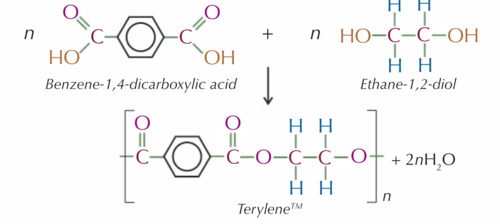
condensation polymerisation
44
New cards
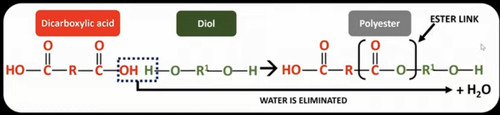
dicarboxylic acids+ diols
polyester + water (lose OH from acid and H from diol)
45
New cards
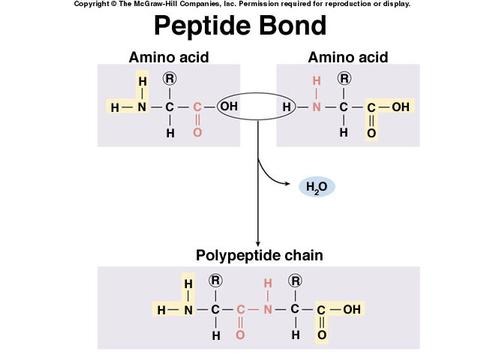
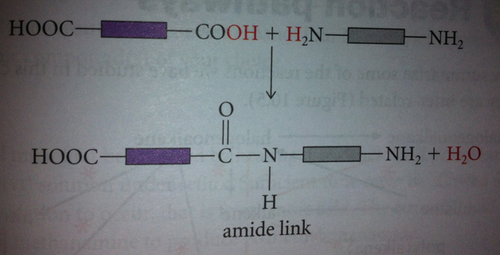
amino acid+amino acid
polypeptide + water
46
New cards
dicarboxylic acid+diamines
polyamide+water
47
New cards
isoelectronic point
the pH at which molecules of the amino acid will be in the zwitterion form
48
New cards
different isoelectronic points of amino acids
due to different character of their R groups
49
New cards
Zwitterion
a molecule or ion having separate positively and negatively charged groups.
50
New cards
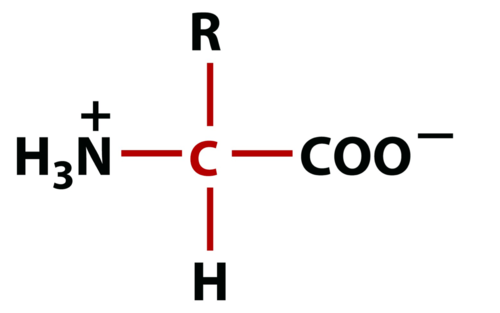
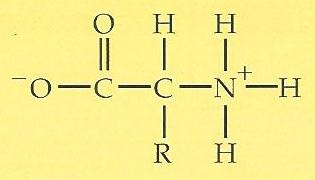
amino acid zwitterion
H3N+ - CHR - COO-
51
New cards
Amino acid at neutral pH
zwitterion
52
New cards
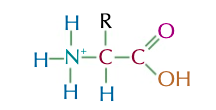
amino acid at acidic (low) pH
H3N+ - CHR - COOH
53
New cards
amino acid at alkaline (high) pH
H2N - CHR - COO-
54
New cards
chirality of amino acids
all but glycine so will rotate polarised light
55
New cards
in aqueous solutions carboxyl group
is ionised, releasing H ions
56
New cards
in aqueous solutions amino groups
act as a base and accept hydrogen ions
57
New cards
in aqueous solutions amino acids
form zwitterions
58
New cards
peptide bond/Amide link (C=O NH)
formed when amino acids combine by condensation polymerisation
59
New cards
polypeptide
10-50 amino acids
60
New cards
protein
50+ amino acids
61
New cards
hydrolysis of proteins reactants/conditions
water, conc. HCl, heat under reflux
62
New cards
hydrolysis of proteins method
chromatography
63
New cards
Chromatography method
1. set up chromatography paper, draw start line in pencil (prevent ink leaking and altering results)
2. add dots of test solution (protein) onto start line
3. lower the paper into beaker with solvent and wait for it to travel up the paper
4. dry chromatography paper and spray with ninhydrin paper
5. analyse chromatogram
2. add dots of test solution (protein) onto start line
3. lower the paper into beaker with solvent and wait for it to travel up the paper
4. dry chromatography paper and spray with ninhydrin paper
5. analyse chromatogram
64
New cards
use of ninhydrin in chromatogram
a locating agent which is sprayed onto paper to react with separated amino acids to form coloured products so they can be seen
65
New cards
ninhydrin effect on amino acid colour
colourless to purple then fades to brown
66
New cards
type of solvent in chromatography
use according to polarity - polar substance use polar solvent (but not too soluble so surpasses paper)
67
New cards
amino acids are zittwerions
in aqueous solution and solid
68
New cards
amino acids mp
high melting points due to being crystalline solids as there are strong ionic attractions between one ion and its neighbour (stronger than hydrogen)