L29 - Etiology of Cancer and Interactions between Host and Tumor
 Call Kai
 Learn
Learn Practice Test
 Spaced Repetition
 Match
Match Flashcards
 Knowt Play
1/56

There's no tags or description
Looks like no tags are added yet.
Name | Mastery | Learn | Test | Matching | Spaced | Call with Kai | Chat |
|---|
No analytics yet
Send a link to your students to track their progress
57 Terms
What is Neoplasia?
Physiologically independent new growth that may be benign or malignant
What is the difference between a Benign and Malignant Neoplasm?
Benign: does not invade surrounding tissues or metastasize
Malignant: capable of local invasion and distant spread (metastasis)
What are the TWO key allmark features of Malignancy?
Local tissue invasion
Distant spread (metastasis)
What does “cancer” refer to in this lecture?
A malignant neoplasm
What is Hypertrophy?
An increase in cell size (or organ size)
What is Hyperplasia?
An increase in the number of cells
What is Metaplasia?
Altered differentiation of cells, usually in response to chronic inflammation
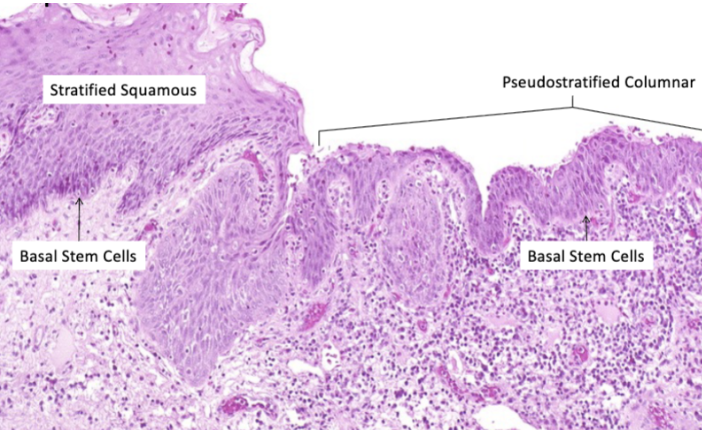
Why is Metaplasia concerning as a pre-malignant condition?
Cells experience altered differentiation and new growth signals
If the insult persists, the persistent growth stimulus can favor neoplasia
What epithelial change is used as the example of Metaplasia?
Pseudostratified columnar → stratified squamous epithelium in response to chronic irritation/inflammation

What is Dysplasia?
Loss of architectural arrangement + increased cellular pleomorphism
Why is Dysplasia clinically important?
It is a significant pre-neoplastic lesion and can progress toward carcinoma in situ and carcinoma
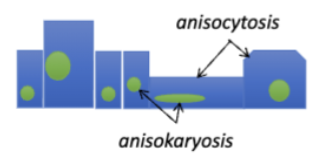
What is Anisocytosis?
Variation in cell size and shape
What is Anisokaryosis?
Variation in nuclear size and shape
Easy way to remember Anisocytosis vs. Anisokaryosis?
Cyto = cell → anisocytosis = variable cells
Karyo = nucleus → anisokaryosis = variable nuclei
What does Homogeneous describe?
The entire population consists of one cell type

What does Heterogeneous describe?
The population contains multiple different cell types

What does Monomorphic mean?
Cells within a specific population have a similar appearance

What does Pleomorphic mean?
Cells within a specific population vary significantly in appearance
Homogeneous/Heterogeneous vs. Monomorphic/Pleomorphic — what is the difference?
Homogeneous/heterogeneous: describes the entire cell population and number of cell types
Monomorphic/pleomorphic: describes the appearance of cells within a specific population
Can a population be homogeneous AND pleomorphic?
Yes
It can consist of one cell type whose individual cells vary greatly in size/shape.

Why can a Homogeneous, Pleomorphic tumor resemble a Heterogeneous population?
The same type of neoplastic cell can look very different, making it appear as though multiple cell types are present
Why is distinguishing Heterogeneous from Homogeneous-but-Pleomorphic populations clinically important?
It may help distinguish inflammation from neoplasia (cancer)

What may be needed when morphology alone cannot distinguish these populations?
Special stains
Immunohistochemistry
Molecular diagnostics
What is Anaplasia?
Loss of features associated with normal cellular differentiation
Why is Anaplasia important when diagnosing tumors?
Highly anaplastic cells have lost their identifying features, making the tumor's cell/tissue of origin difficult to determine
What are the 3 Major Stages in the Development of Malignancy?
Initiation → Promotion → Progression

What occurs during Initiation?
Cell proliferation/replication results in a heritable mutation, creating an initiated cell

Is Initiation reversible or irreversible?
ALWAYS IRREVERSIBLE
Why is Initiation always irreversible?
Once the mutation becomes fixed through replication, the resulting cell carries the genetic alteration
What does irreversible initiation mean clinically?
Removing the original initiating cause does not remove the mutation already present in the initiated cell
What can initiate cells according to the lecture?
Cell division/growth
Environmental toxins
Ionizing radiation
UV radiation
What occurs during Promotion?
Growth signals favor proliferation of already-mutated/initiated cells

Is Promotion reversible or irreversible?
Reversible
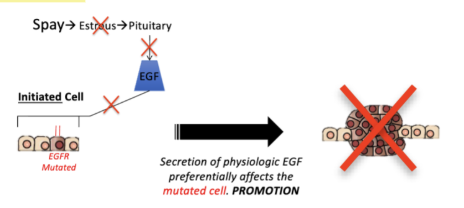
What is the lecture's example of promotion?
Physiologic EGF preferentially promotes growth of the mutated cell

What is the clinical example showing that promotion can be reversible?
Spaying a dog removes estrus-associated promotion, reducing the growth stimulus
What occurs during Progression?
Promoted cells move toward malignancy through additional changes

How can Progression occur irreversibly?
Additional cell divisions → additional mutations → malignancy
How can Progression occur reversibly?
Inflammation → EGF release → promotes progression
Reducing inflammation can delay this pathway
Which stage is ALWAYS irreversible?
INITIATION
Promotion is reversible; progression can involve reversible or irreversible mechanisms
Quick way to distinguish Initiation, Promotion, and Progression?
→ Initiation = mutation
→ Promotion = growth of mutated cells
→ Progression = further changes toward malignancy
What is an Adenoma?
A benign epithelial neoplasm

What is Carcinoma in situ (CIS)?
A non-invasive epithelial neoplasm with cellular atypia but an intact basement membrane

Has carcinoma in situ invaded through the basement membrane?
No
The basement membrane remains intact.
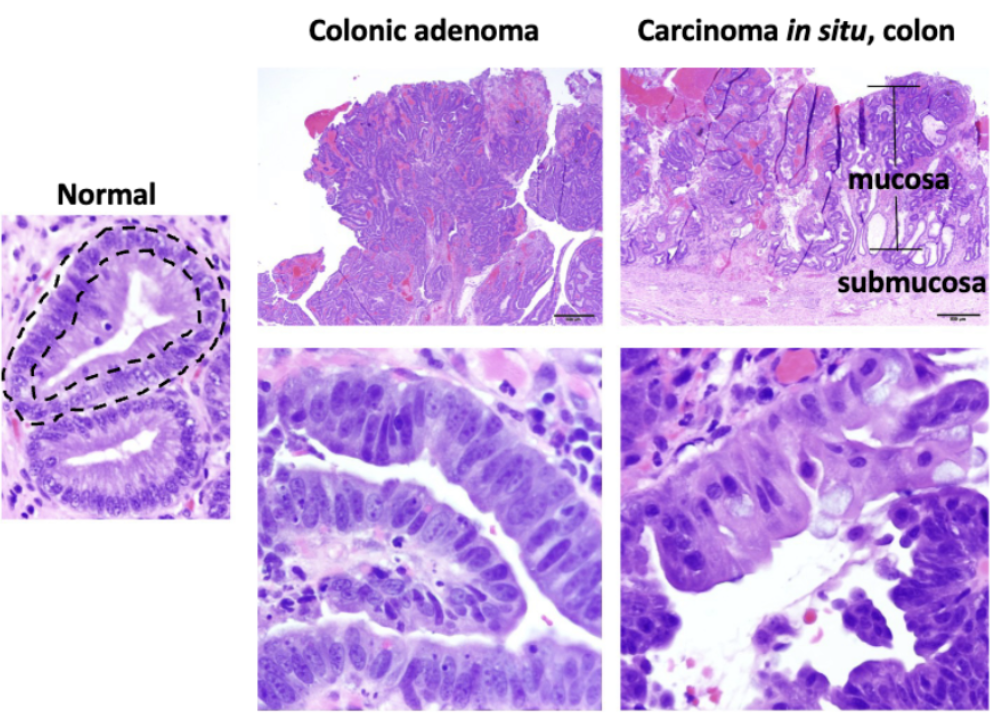
What distinguishes carcinoma from carcinoma in situ?
Carcinoma has invaded locally through the basement membrane
CIS has not
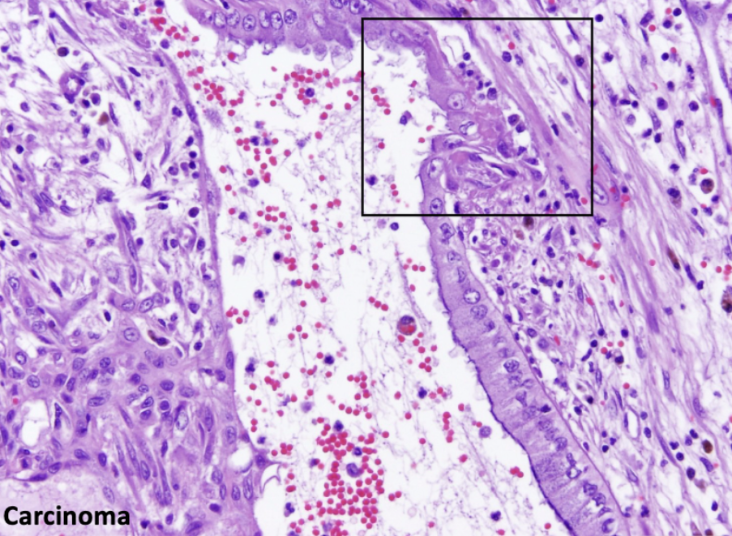
Compare Adenoma → Carcinoma in situ → Carcinoma.
Adenoma: benign
CIS: marked atypia, but no invasion
Carcinoma: malignant with local tissue invasion

What feature should you look for when deciding whether an epithelial tumor has become invasive carcinoma?
Invasion through the basement membrane into surrounding tissue

What is a Hamartoma?
Overgrowth of cells where they normally belong
What is the lecture's example of a Hamartoma?
Birthmark
What is a Choristoma?
Overgrowth of cells not normally present at that location
What is the lecture's example of a Choristoma?
Dermoid

What is a Teratoma?
A germ cell tumor containing tissues derived from endoderm, ectoderm, and mesoderm

Benign vs. Malignant SUMMARY
Feature | Benign | Malignant (Cancer) |
Local invasion | No | Yes |
Metastasis | No | Can occur |
Key Concept | Remains non-invasive | Invades surrounding tissue ± spreads |
Example | Adenoma | Carcinoma |
Cell Morphology Vocabulary SUMMARY
Cyto = cell → anisocytosis
Karyo = nucleus → anisokaryosis
Term | What varies/is described? | Meaning |
Anisocytosis | Cell | Variation in cell size & shape |
Anisokaryosis | Nucleus | Variation in nuclear size & shape |
Monomorphic | Specific cell population | Cells look similar |
Pleomorphic | Specific cell population | Cells look different |
Homogeneous | Entire population | One cell type |
Heterogeneous | Entire population | Multiple cell types |
Anaplasia | Differentiation | Loss of recognizable differentiated features |
Homogeneous vs. Heterogeneous: Clinical Significance SUMMARY
Heterogeneous | Homogeneous + Pleomorphic | |
Number of cell types | Multiple | One |
Appearance | Cells look different because they are different types | Cells look different despite being the same type |
Often suggests | Inflammation | Neoplasia |
Why confusing? | Different cell types naturally look different | Tumor cells can vary dramatically in size/shape |
If uncertain | Ancillary diagnostics | Ancillary diagnostics |
Initiation vs. Promotion vs. Progression SUMMARY
Initiation = MUTATE → Promotion = MULTIPLY → Progression = MALIGNANT
Initiation | Promotion | Progression | |
Key Concept | Mutation becomes fixed | Growth of initiated cells favored | Further changes → malignancy |
Genetic? | Genetic | Genetic | Genetic and/or nongenetic |
Reversible | ALWAYS irreversible | Reversible | Can be reversible or irreversible |
Example | Mutagenesis during replication | EGF favors mutated-cell growth | Additional mutations or inflammation/EGF |
Clinical significance | Mutation remains even if cause removed | Removing promoter can reduce growth stimulus | Drives population toward malignancy |
Adenoma → Carcinoma in Situ → Carcinoma SUMMARY
Feature | Adenoma | Carcinoma in situ (CIS) | Carcinoma |
Behavior | Benign | Non-invasive neoplasm | Malignant |
Cellular atypia | Less severe | Present | Present |
Basement membrane | Intact | Intact | Invaded |
Local invasion | No | No | Yes |
Key identifier | Benign epithelial tumor | Abnormal cells but no invasion | Abnormal cells but no invasion |
Metaplasia → Dysplasia → Neoplasia SUMARY
Change | Main concept | Why care? |
Metaplasia | Altered differentiation | Persistent growth cues may favor neoplasia |
Dysplasia | Loss of architecture + ↑ pleomorphism | Significant pre-neoplastic lesion |
CIS | Epithelial neoplasia, basement membrane intact | Non-invasive |
Carcinoma | Invasion through basement membrane | Malignant |