AI in Dentistry - Final Review Slides⭐️
 Call Kai
 Learn
Learn Practice Test
 Spaced Repetition
 Match
Match Flashcards
 Knowt Play
1/116

There's no tags or description
Looks like no tags are added yet.
Name | Mastery | Learn | Test | Matching | Spaced | Call with Kai | Chat |
|---|
No analytics yet
Send a link to your students to track their progress
117 Terms
What empowers systems to learn from training data to perform specific tasks?
Machine Learning (ML)
how does machine learning improve over time
By identifying patterns + relationships
Deep learning is a _______ of machine learning
Subset

What learns by trial & error and can adjusts its weights based on feedback from mistakes, similar to human learning?
Neural network
Define the following:
Intelligence demonstrated by machines, as opposed to natural intelligence displayed by humans.
Artificial Intelligence (Al)
Sometimes referred to as "intelligence amplification." __________ plays a similar role to AI, except that it keeps human intelligence elements in the procedure.
Augmented Intelligence (AuI)
Define the following:
Acts as a tool to assist the clinician in the task - it enhances human judgment rather than replacing it
Augmented Intelligence (AuI)
What is symbolic AI primarily based on?
Explicit rules and logic (rule-based logic)
Which is a key advantage of symbolic AI?
Its decisions are explainable and transparent
What has the following characteristics?
- Explainable logic
- Rule-based systems (Built on explicit rules and domain knowledge, not black boxes)
- Human-readable logic (Logic expressed in clear, structured if-then rules people can understand)
- Transparent decision making (Every outcome can be traced, verified, and trusted)
- Explainable "why" (Delivers clear reasons for every decision, improving trust and accountability)
Symbolic AI
Define the following:
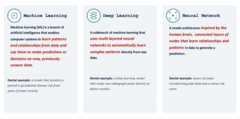
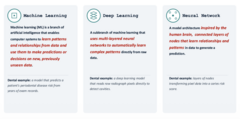
A branch of artificial intelligence that enables computer systems to learn patterns and relationships from data and use them to make predictions or decisions on new, previously unseen data.
Machine Learning (ML)
What is this an example of?
A model that predicts a patient's periodontal disease risk from years of exam records.
Machine Learning (ML)
Define the following:
A subbranch of machine learning that uses multi-layered neural networks to automatically learn complex patterns directly from raw data.
Deep learning
What is this an example of?
A model that reads raw radiograph pixels directly to detect cavities.
Deep learning

Define the following:
A model architecture inspired by the human brain, connected layers of nodes that learn relationships and patterns in data to generate a prediction.
Neural network
What is this an example of?
Layers of nodes transforming pixel data into a caries risk score.
Neural network

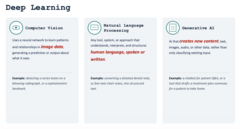
What are computer vision, natural language processing, and generative AI all examples of?
Deep learning
Define the following:
Uses a neural network to learn patterns and relationships in image data, generating a prediction or output about what it sees
Computer vision

What is this an example of?
Detecting a caries lesion on a bitewing radiograph, or a cephalometric landmark.
Computer vision

Define the following:
Any tool, system, or approach that understands, interprets, and structures human language, spoken or written.
Natural language processing

What is this an example of?
Converting a dictated dental note, or free-text chart notes, into structured text
Natural language processing

Define the following:
Al that creates new content, text, images, audio, or other data, rather than only classifying existing input.
Generative AI

What is this an example of?
A chatbot for patient Q&A, or a tool that drafts a treatment-plan summary for a patient to take home.
Generative AI
What are the 5 steps of machine learning?
1. Data collection
2. Data split (80/20)
3. Model building
4. Testing and evaluation
5. Decision-making
What is a method for testing machine learning?
Measuring accuracy using True/False positives + negatives
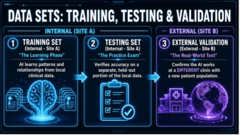
Define the type of data set:
Al learns patterns and relationships from local clinical data.
Training set ("The Learning Phase")
Define the type of data set:
Verifies accuracy on a separate, held-out portion of the local data.
Testing set ("The Practice Exam")

Define the following:
Confirms the Al works at a DIFFERENT clinic with a new patient population
External validation ("The Real-World Test")

An AI model is developed and tested using data from Site A. It is then evaluated using patients from Site B. What is this final step called?
External validation ("The Real-World Test")
Define the following:
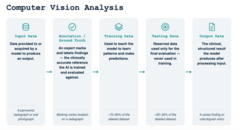
Data provided to or acquired by a model to produce an output (Ex: A panoramic radiograph or oral photograph)
Input data
Define the following:
An expert marks and labels findings - the clinically accurate reference the Al is trained and evaluated against (Ex: Marking caries location on a radiograph)
Annotation/Ground Truth

Define the following:
Used to teach the model to learn patterns and make predictions (~70-80% of the labeled dataset)
Training Data
Define the following:
Reserved data used only for the final evaluation - never used in training (~20-30% of the labeled dataset)
Testing Data
Define the following:
The clinical, structured result the model produces after processing input (Ex: A caries finding or odontogram entry)
Output data

What is the best available reference standard used to train and evaluate an AI model?
Ground truth

What is the ground truth in dental imaging?
The expert-verified label or annotation that the model should learn

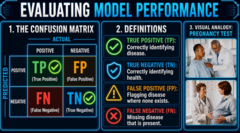
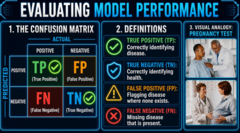
Define the following:
Correctly identifies that disease is present.
True Positive (TP)
Define the following:
Correctly identifies that disease is absent (aka health)
True Negative (TN)
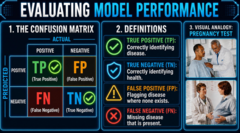
Define the following:
Incorrectly identifies disease as present when it is actually absent.
False Positive (FP)

Define the following:
Incorrectly identifies disease as absent when it is actually present.
False Negative (FN)

A patient has a disease, but the AI predicts that the patient is healthy. What is this classified as?
False Negative (FN)

In a confusion matrix, what is being compared?
Predicted outcomes and actual outcomes

Which scenario is an example of a false negative?
A) A pregnancy test is positive in someone who is pregnant
B) A pregnancy test is negative in someone who is not pregnant
C) A pregnancy test is positive in someone who is not pregnant
D) A pregnancy test is negative in someone who is pregnant
D) A pregnancy test is negative in someone who is pregnant
Define the following:
Retraining a pretrained model on targeted data for one specific task
Fine-tuning
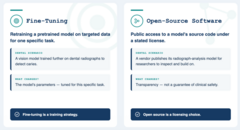
What is this an example of?
A vision model trained further on dental radiographs to detect caries
Fine-tuning

T/F: Fine-tuning is a training strategy
True

Define the following:
Public access to a model's source code under a stated license.
Open-source software

What is this an example of?
A vendor publishes its radiograph-analysis model for researchers to inspect and build on.
Open-source software

T/F: Open source is a licensing choice.
True

Define the following:
Systematic and unfair patterns in model predictions that arise when the training data does not adequately represent the diversity of patients or clinical sites.
Algorithmic Bias

Define the following:
The ability of a model to maintain good performance on new, unseen patients and clinical sites beyond the data it was trained on.
Generalization

Define the following:
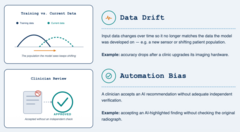
Input data changes over time so it no longer matches the data the model was developed on - e.g. a new sensor or shifting patient population.
Data drift

Define the following:
A clinician accepts an Al recommendation without adequate independent verification.
Automation bias
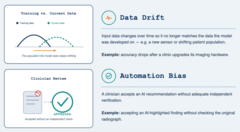
What is this an example of?
Accuracy drops after a clinic upgrades its imaging hardware
Data drift

What is this an example of?
Accepting an Al-highlighted finding without checking the original radiograph
Automation bias
In the IMPACTS framework for evaluating AI applications, what domain does this question reflect:
Does it fit the clinical workflow, and can it technically connect to your systems?
Infrastructure, Interoperability & Workflow

In the IMPACTS framework for evaluating AI applications, what domain does this question reflect:
Who watches performance, and who's responsible when it's wrong?
Monitoring, Governance & Accountability

In the IMPACTS framework for evaluating AI applications, what domain does this question reflect:
How accurate, reliable, and generalizable is it?
Performance & Quality Metrics

In the IMPACTS framework for evaluating AI applications, what domain does this question reflect:
Will clinicians and patients actually use it well?
Acceptability, Trust & Training

In the IMPACTS framework for evaluating AI applications, what domain does this question reflect:
Is it worth what it costs, long-term?
Cost & Economic Evaluation

In the IMPACTS framework for evaluating AI applications, what domain does this question reflect:
Is it safe, explainable, and does a human stay in command?
Technological Safety & Transparency

In the IMPACTS framework for evaluating AI applications, what domain does this question reflect:
Does it work broadly - and does it truly improve care?
Scalability & Impact

What part of the IMPACTs framework does the following describe?
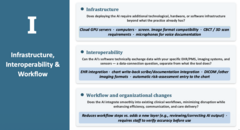
- Does deploying the Al require additional technological, hardware, or software infrastructure beyond what the practice already has?
-Examples: Cloud GPU servers • computers • screen. image format compatibility • CBCT / 3D scan requirements • microphones for voice documentation
I - Infrastructure

What part of the IMPACTs framework does the following describe?
- Can the Al's software technically exchange data with your specific EHS/PMS, imaging systems, and sensors - a data-connection question, separate from what the tool does?
- Examples: HER integration • chart write-back scribe/documentation integration • DICOM/other imaging formats• automatic risk-assessment entry to the chart
I - Interoperability
What part of the IMPACTs framework does the following describe?
- Does the Al integrate smoothly into existing clinical workflows, minimizing disruption while enhancing efficiency, communication, and care delivery?
- Examples: Reduces workflow steps vs. adds a new layer (e.g., reviewing/correcting Al output) • requires staff to verify accuracy before use
I - Workflow and organizational changes

What part of the IMPACTs framework does the following describe?
- How will we detect performance decline, data drift, or safety events after deployment?
- Examples: Tracking false +/- rates as patient demographics shift · flagging drops in AI confidence scores · vendor dashboards showing accuracy drift after a scanner update · incident logs for missed findings caught later by a dentist
M - Monitoring

What part of the IMPACTs framework does the following describe?
- Who controls approval, data use, privacy, consent, updates, and auditing?
- Examples: Policy on using patient X-rays to retrain the vendor's model · HIPAA compliance · approval process before a new AI version goes live · patient consent disclosing AI-assisted diagnosis · audit log of AI findings and dentist decisions
M - Governance

What part of the IMPACTs framework does the following describe?
- Who is responsible when the AI is wrong, and can the dentist review & correct it?
- Examples: Malpractice liability resting with the treating dentist, not the vendor · an override button to reject and document an AI-flagged finding · QA review of missed diagnoses
M - Accountability

What part of the IMPACTs framework does the following describe?
- Examples: Accuracy / Sensitivity/specificity . Precision · F1-score · AUC (Area Under the Curve)
P - Performance metrics

What part of the IMPACTs framework does the following describe?
- Examples: External validation on data from a different clinic/country · representative sample size · who labelled the data. calibration among labeling dentists · peer-reviewed publication vs. a company white paper
P - Validation evidence

What part of the IMPACTs framework does the following describe?
- Does performance hold across different patients, clinics, operators, devices, and image quality, or is there evidence of algorithmic bias in specific subgroups?
P - Reliability & generalizability

What part of the IMPACTs framework does the following describe?
- Examples: Testimonials . Independent research . Free trial: Are dentists, staff, and patients willing to use the tool appropriately in routine care
A - Acceptance

What part of the IMPACTs framework does the following describe?
- Can clinicians trust the AI appropriately, without accepting its output uncritically? This is where automation bias becomes the central risk
A - Trust

What part of the IMPACTs framework does the following describe?
- Examples: Hands-on training with real patient cases drove effective clinician use · training that covers what the AI can and cannot do · ongoing support when the AI is updated
A - Training & support

What part of the IMPACTs framework does the following describe?
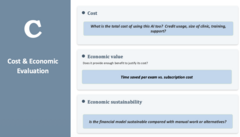
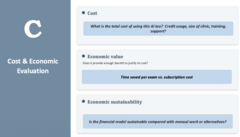
- What is the total cost of using this AI too? Credit usage, size of clinic, training, support?
C - Cost
What part of the IMPACTs framework does the following describe?
- Does it provide enough benefit to justify its cost? - Examples: Time saved per exam vs. subscription cost
C - Economic value

What part of the IMPACTs framework does the following describe?
- Is the financial model sustainable compared with manual work or alternatives?
C - Economic sustainability
What part of the IMPACTs framework does the following describe?
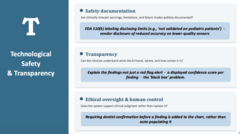
- Are clinically relevant warnings, limitations, and failure modes publicly documented?
- Examples: FDA 510(k) labeling disclosing limits (e.g., 'not validated on pediatric patients') · vendor disclosure of reduced accuracy on lower-quality sensors
T - Safety Documentation

What part of the IMPACTs framework does the following describe?
- Can the clinician understand what the AI found, where, and how certain it is?
- Examples: Explain the findings not just a red flag alert · a displayed confidence score per finding · the 'black box' problem.
T - Transparency

What part of the IMPACTs framework does the following describe?
- Does the system support clinical judgment rather than replace it?
- Example Requiring dentist confirmation before a finding is added to the chart, rather than auto-populating it
T - Ethical oversight & human control
What part of the IMPACTs framework does the following describe?
- Does using the AI improve real clinical outcomes for patients?
- Examples: Earlier caries/bone-loss detection leading to less invasive treatment
S - Clinical Effectiveness

What part of the IMPACTs framework does the following describe?
- Does it improve use of time, staff, and resources without reducing quality?
- Examples Less time spent in daily huddles and more time given to treatment and communicating with patients
S - Clinical efficiency

What part of the IMPACTs framework does the following describe?
- Is the platform sustainable and designed for use across multiple products, practices, and systems?
- Examples: How established . Number of users . Deployment across locations
S - Intended scalability

Is FDA Clearance specific?
Yes - FDA status is generally product-, indication-, version-, and market-specific. It does NOT mean every product made by that company is cleared for every dental use, and it does not eliminate the need for dentist oversight.
Example: Always check the specific product's FDA authorization - not just the vendor's general marketing claims.

What are 2 recognized methods for de-identifying protected health information?
Expert Determination
Safe Harbor

T/F: "No name" in a record automatically means it's de-identified
False - "No name" in a record does not automatically mean it's de-identified (one of these two formal methods - Expert Determination and Safe Harbor- must actually be applied.

What are 18 HIPAA identifiers?
Information that must be removed from health information for it to qualify as de-identified under HIPAA's Safe Harbor method

How many identifiers must be addressed for data to be de-identified under the HIPAA Safe Harbor method?
18 (see image with all)

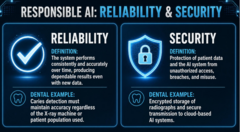
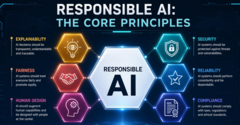
What are the 6 core principles of AI?
- Explainability
- Fairness
- Human design
- Security
- Reliability
- Compliance
Define the following core principle of AI:
AI decisions should be transparent, understandable, and traceable
Explainability
Define the following core principle of AI:
AI systems should treat everyone fairly and promote equity
Fairness

Define the following core principle of AI:
- AI should augment human capabilities and be designed with people at the center
- AI is designed to support human decision-making, not replace it (Human-in-the-loop)
Human design
Define the following core principle of AI:
AI systems should be protected against threats and vulnerabilities
Security

Define the following core principle of AI:
AI systems should perform consistency and be dependable
Reliability
Define the following core principle of AI:
AI systems should comply with laws, regulations, and ethical standards
Compliance
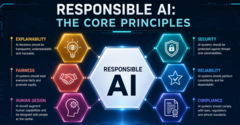
What is this an example of?
The dentist reviews Al findings but makes the final diagnosis based on clinical exam and history
Human design

What is this an example of?
Ensuring Al tools have proper FDA clearance + meet HIPAA data privacy standards
Compliance

What is this an example of?
Reasoning for differential diagnosis (Cyst vs. Lesion) across all demographics and treatment options
Explainability

What is this an example of?
Consistent accuracy across all demographics and ethnicities
Fairness

What is this an example of?
Caries detection must maintain accuracy regardless of the X-ray machine or patient population used
Reliability