chap 3
 Call Kai
 Learn
Learn Practice Test
 Spaced Repetition
 Match
Match Flashcards
 Knowt Play
1/43

There's no tags or description
Looks like no tags are added yet.
Name | Mastery | Learn | Test | Matching | Spaced | Call with Kai | Chat |
|---|
No analytics yet
Send a link to your students to track their progress
44 Terms
How can we predict the products in a nuclear reaction"?
conservation “rules”
properties of a system that do not change are said to be conserved
conserved properties;
mass (in nucleus, P+N)
energy
Forms of energy
potential energy
stored energy
ex. radioactive decay, held by mass inside nucleus
kinetic energy
mass of particles
radiation energy
light, gamma rays (electromagnetic energy)
excitation energy
thermal energy
heat
Potential energy
the stored ability to do work
ex.
compressed spring
2 magnets held apart
raised pendulum or swing
mass (inside nucleus, P+N)
Kinetic energy
energy of motion
ex
a child swinging
car in motion
thrown football
decay products/particles carry __ __ away from the nucleus
Radioactive decay
spontaneous transformation of 1 isotope into another through the emission of 1 (or more) particles AND release of energy
Where des the energy in radioactive decay come from?
the mass of the particles
for energy to be released, mass must be converted to energy
potential → kinetic
energy can also be released by photons, or electromagnetic radiation
Change in __ is the energy released
mass
bc thats where its stored
Q value
energy released by a nuclear reaction
also called
transition energy
reaction energy
decay energy
Q > 0 means energy is released
Q < 0 means energy is needed
change in mass = (mass of reactants) - (mass of products)
Q = [(mass of parent) - (mass of daughter + mass of emissions*)] x c²
Q = [MP - (Md + Me*)] x c²
Q = [MP - Md - Me*] x c²
the answer for _ in decay events will always be positive
![<ul><li><p><strong>energy released </strong>by a nuclear reaction</p></li><li><p>also called</p><ul><li><p>transition energy</p></li><li><p>reaction energy</p></li><li><p>decay energy</p></li></ul></li><li><p>Q > 0 means energy is <strong>released</strong></p></li><li><p>Q < 0 means energy is <strong>needed</strong></p></li><li><p>change in mass = (mass of <strong>reactants</strong>) - (mass of <strong>products</strong>)</p></li><li><p>Q = [(mass of parent) - (mass of daughter + mass of emissions*)] x c²</p></li><li><p>Q = [MP - (Md + Me*)] x c²</p></li><li><p>Q = [MP - Md - Me*] x c²</p></li><li><p>the answer for _ in decay events will always be positive </p></li></ul><p></p>](https://assets.knowt.com/user-attachments/cd653879-a6e3-49ed-9004-4b76f6bf759d.jpg)
Electron Volts (eV)
1 eV = kinetic energy of an electron accelerated through a 1V potential
Converting mass to energy
E = mc²
1 amu = 931.5 MeV/c²
so if we convert 1 amu to energy, we get 931.5 MeV
its a conversion factor, basically like saying 1 lb = 2.2 kg
How to calculate Q for a nuclear reaction
start w the complete reaction
calculate mass of reacting particles (parents)
calculate mass of products (daughter, *)
determine the difference of step 2 - step 3, then multiply by c²
convert to energy (931.5 MeV/c² per u)
C²
speed of light squared
mass unit to energy unit
Ways to help predict the outcome of a decay event
atomic notation
chart of nuclides
nuclear equations & conservation/balancing
energy calculations/estimations
decay schemes
decay modes
Decay modes
The specific way an unstable atomic nucleus (radionuclide) or subatomic particle spontaneously transforms into a more stable state, emitting particles and/or energy in the process
types
alpha decay
beta decay (isobaric transitions, 3 forms)
same mass, diff atomic #
gamma decay (isomeric transitions, 2 forms)
same atoms, arranged differently
Decay Schematic
graphical representation of decay scheme
common conventions
set up is on a standard graph
Z is represented on the X-axis
moving RIGHT → INCREASES Z protons
instead of N, a decay scheme displays energy
energy is represented on the Y-axis
moving DOWN the scheme RELEASES (or decreases) energy
at least in this course, __ __ will always point down
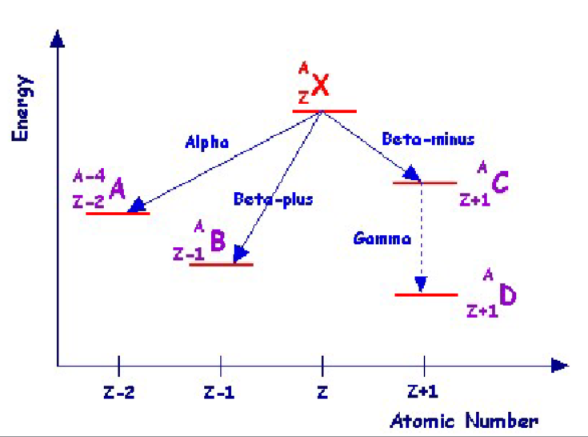
Notation
horizontal lines = energy state of nucleus
diagonal lines = particle emission (a, B)
vertical lines = gamma emissions (y)

Horizontal lines =
energy states of nucleus
Diagonal lines
particle emissions (a, B)
Vertical lines
gamma emissions (y)
What specific info is on a decay scheme?
possible decay modes
“what” and “how many” decay reactions are possible?
energy info
energy of the emitted particles
alpha energy or maximum beta energy
gamma energy
Q value
energy difference between ground states
branching ratio
probability (%) of decay mode
mode 1, mode 2, mode 3
Branching ratio
probability (%) of a given decay mode
mode 1, mode 2, mode 3

Gamma decay
isomeric transitions (same atoms, arranged differently)
__ __
Internal conversion - IC
Other decay modes
spontaneous fission
neutron emission
Beta-plus
Z-1 (loss of proton)
+ release of energy


Alpha decay
spontaneous emission of an alpha particle + release of energy
4^He²+ ion (+2 charge, no electrons)
2 protons, 2 neutrons
in the daughter…
A-4
Z-2 (loss of 2 protons)
N-2
only observed for heavy nuclei
lead (Z=82) & higher
bc its the fastest way to loose mass
typical energy release (Q) = 3-7 Mev
can also produce a gamma ray
parent decays by producing an _ particle
is mono-energetic
for a given transition, the __ will ALWAYS have the same energy
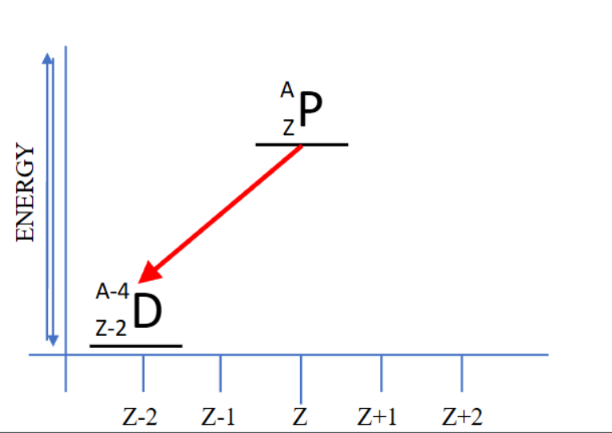
Alpha decay Diagrammatic Repressentation
start heavy nucleus
radioactively decaying by emission of 2 protons + 2 neutrons

balancing is
“conservation of nucleons”
How is the energy divided up? (alpha decay)
gamma energy first
subtract any gamma emissions from Q
remainder is kinetic energy
alpha gets approx 98%
daughter gets the remainder
recoil energy
alpha decay is mono-energetic
for a given transition, the alpha will ALWAYS have the same energy
Alpha decay is __-energetic
mono
for a given transition, the alpha will ALWAYS have the same energy
every alpha particle emitted from a specific radioactive decay process has the exact same amount of kinetic energy
only the alpha particle carries the energy from the decay event
chart displays the energy spectrum for alpha decay
for a single release of energy of a alpha decay

Conservation of momentum (alpha decay)
before the decay - nothing is moving
after the decay - movement
movement is energy
and it must be conserved
alpha & daughter must have same momentum
opposite directions
Beta decay
isobaric transitions
isotopes w same atomic mass, diff atomic # & diff neutrons
Modes
• Beta Minus Decay (β-) – called Beta Decay or “Negatron” Emission/decay
• Beta Plus Decay (β+) – called Beta Plus Decay or “Positron” Emission/decay
• Electron Capture - EC
can occur w light or heavy isotopes
neutron-RICH isotopes: B-decay
neutron-POOR isotopes: B+ or ec
Neutron rich isotopes will undergo
B - decay
Neutron poor isotopes will undergo
B + decay or ec

Beta (-) Decay / Negatron emission
emission of an beta particle (negatron) & anti-neutrino
anti-neutrino helps balance momentum of equation
the emitted electron (e-): identical to the atomic electron
except it is emitted from the nucleus
only observed for neutron-RICH isotopes
typical energy range: 0.1 to 2 MeV
can also produce a gamma ray
in the daughter…
A = unchanged (isobaric)
Z + 1 (move up)
N - 1 (move left)
neutron spontaneously transforms into a proton
gains proton bc if one neutron is loss, then a proton needs to be added to maintain mass

negatron
negative electron
compensates for the change in charge
when a neutron → proton
anti-neutrino
small mass
electrically neutral and has a net charge of 0
helps balance momentum of equation
Beta (-) Decay / Negatron emission Diagrammatic representation
start w neutron rich nucleus, neutron spontaneously transforms to proton
2a. emission of anti-neutrino
emission of negatron (negative electron)

How is the energy divided up? (beta - decay)
gamma energy first
subtract any gamma emissions from Q
remainder is kinetic energy
beta & anti-neutrino SHARE the emission energy
daughter gets the remainder
so the energy from this decay is shared by
the beta (negatron), the antineutrino, & the daughter
Beta decay is POLY energetic
Beta - decay is __ energetic
poly
chart displays the energy spectrum for beta - decay
for a single release of energy of a beta - decay
maximum beta energy = Q
average beta energy = 1/3 Q

Conservation of momentum (beta - decay)
similar to alpha decay, except we have 3 particles now
electron & anti neutrino are much lighter than the recoil
recall, mass of an electron is abt 2000X smaller than a proton
conservation of energy & momentum
almost all (>99.9%) of energy goes to small particles
divided randomly between e- & anti-neutrio
not evenly, average beta energy is 1/3 Q
Nuclides near the top right part of the Chart of Nuclides are typically
decay by alpha decay
unstable
heavy nuclei
when calculating q for beta - decay why is electron mass not accounted for
Standard mass tables list the masses of neutral atoms (nuclei plus their surrounding electrons), not bare nuclei. In \(\beta ^{-}\) decay, the parent atom turns into a daughter atom with one extra proton, meaning the daughter atom naturally needs one more orbital electron to remain neutral. The mass difference between the neutral parent atom and the neutral daughter atom automatically accounts for the newly created beta particle (electron)
the electron's mass naturally balances out on both sides of the equation because the daughter atom gains an extra orbital electron to match its new, higher atomic number
Nuclides to below and to the right of the Line of Stability are typically
decay by negatron / B - decay
light to heavy nuclei
unstable
what does m final represent in the equation for Q
emission particles
daughter nuclides