Lecture 5: Disorders caused by Chromosome Rearrangements (focus on cancer)
 Call Kai
 Learn
Learn Practice Test
 Spaced Repetition
 Match
Match Flashcards
 Knowt Play
1/35

There's no tags or description
Looks like no tags are added yet.
Name | Mastery | Learn | Test | Matching | Spaced | Call with Kai | Chat |
|---|
No analytics yet
Send a link to your students to track their progress
36 Terms


Balanced vs. Unbalanced Rearrangements
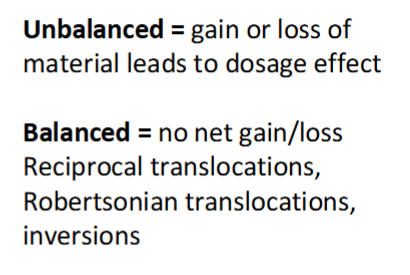
True or false: BALANCED rearrangements are OFTEN Benign?
TRUE
but it is NOT ALWAYS
4 ways balanced rearrangements cause disease

****Of the 4 Ways Balanced rearrangements cause disease Which mostly result in CONSTITUTIONAL vs. CANCER diseases?

****What is an Example of a disease caused by GENE disruption?
Hemophilia A
X-linked condition causing severe bleeding (loss of clotting factors)
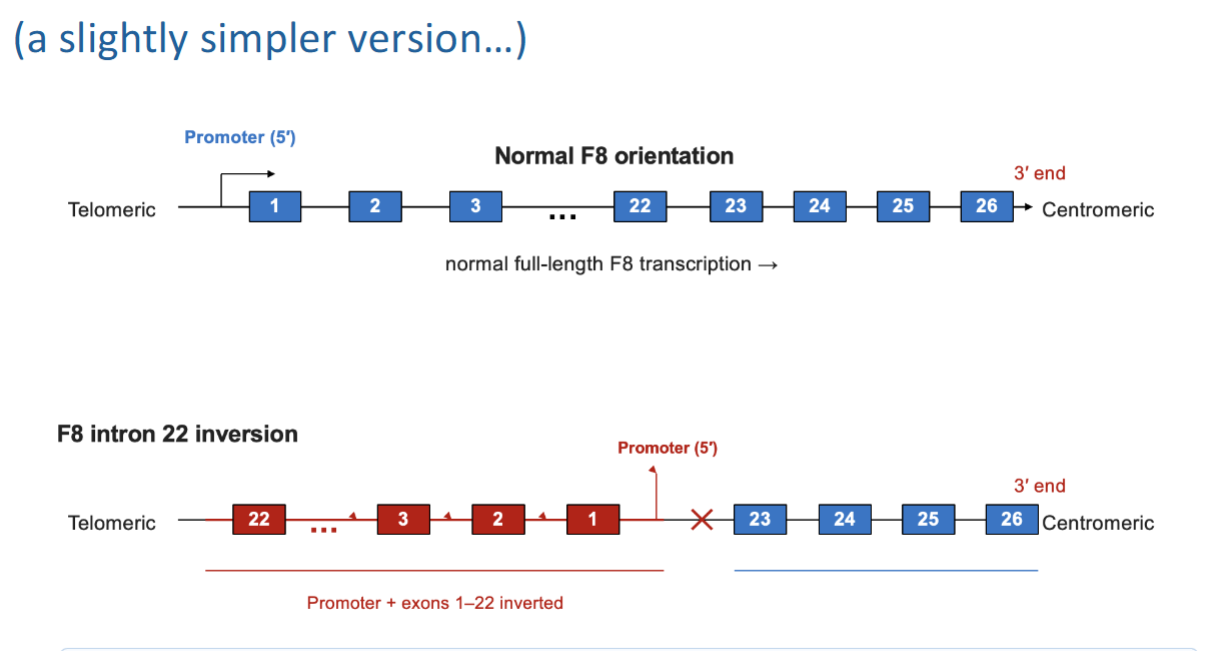
****What is the most common CAUSE of Hemophilia A + What is the mechanisms + outcome?

****What are CIS-REGULATORY ELEMENTS in genetic disease?
contrast them to Trans-regulatory elements
Cis-regulatory elements are non-coding DNA sequences on the same molecule of DNA that regulate nearby genes
trans-regulatory elements are diffusible molecules like proteins or RNA that can regulate target genes anywhere in the genome
******Balanced Rearrangements POSITION EFFECTS. What are the 3 Cis-regulatory elements in genetic disease?
Promoters: DNA sequence immediately upstream of a gene where RNA poly and transcription factors bind; required to initiate transcription
Enhancers: Noncoding DNA elements that boost gene transcription. Can act at long distances, even if upstream, downstream or intronic.
Locus Control Regions (LCR): “super enhancers” coordinates expression of an entire gene cluster
****If a rearrangement separates a gene from its enhancer/LCR what will happen?
The gene will become silent despite being intact
****Position effect in Genetic diseases: What is an example of a Separation from LCR
What is the Mechanism
What is the result?
B-thalassemia
B-globin genes (hemoglobin) are arranged in a cluster on chromosome 11
expression is developmentally regulates (different protein in embryo, fetus and adult)
LCR upstream of cluster is essential for switching them ON in a RBC precursor
If balanced translocation SEPERATES the LCR form the cluster the B-globin genes are intact but they CANNOT BE EXPRESSED

******Position effects in Cancer: ENHANCER HIJACKING
What is an example
the mechanism
OUTCOME?
Proto-oncogene activation in B-cell Lymphomas
IgH heavy chain locus is on chr 14q32. IgH has VERY STRONG ENHANCERS + PROMOTERS that norm drive antibody gene expression in a B-cell
In B-cell malignancies, chromosomal translocations bring PROTO-ONCOGENES under Igh control
This “enhancer high jacking” leads to ONCOGENE OVEREXPRESSION + lymphoma development
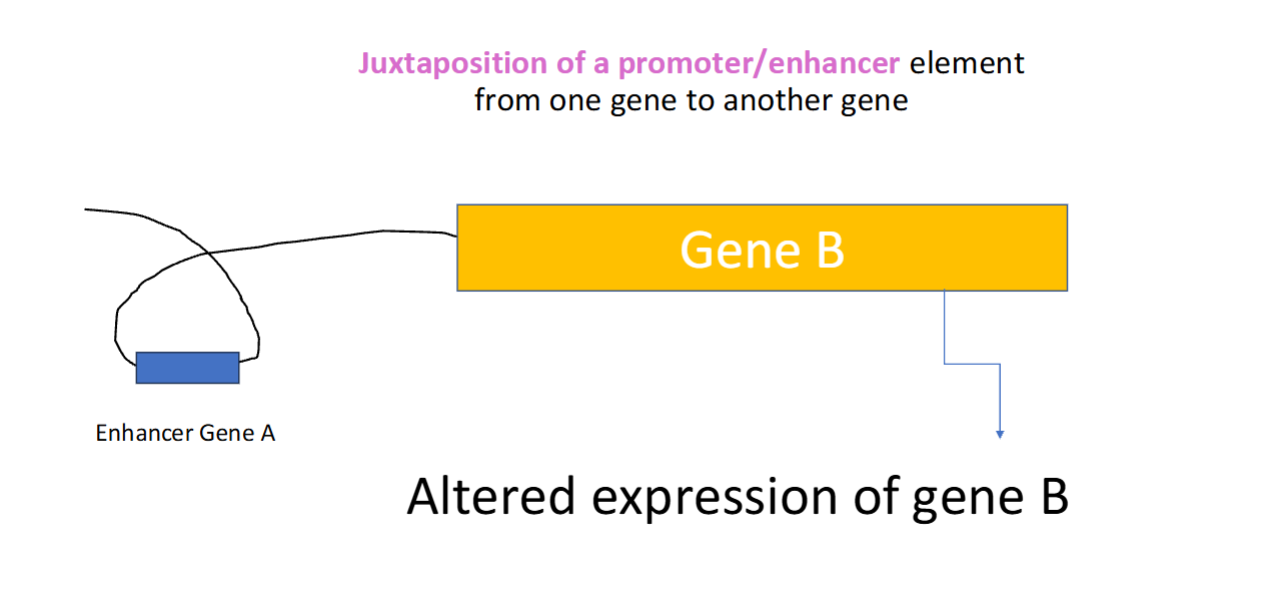
*****What is BURKITT’S LYMPHOMA associated with?
Hint: Think Position effects
What is the mechanism + result of this disease
Burkitt’s lymphoma = aggressive B-cell Lymphoma
Typically associated with t(8;14) translocation putting MYC under control of the IGH enhancer
Proto-oncogenes brough into proximity with new cis-regulatory elements
MYC = Proto-oncogene
Normally regulates cell growth + proliferation
When overexpressed drives uncontrolled division
MECHANISM: IgH enhancer drives MYC overexpression → lymphoma

*****What are FUSION GENES? They are a KEY MECHANISM to what?
Rearrangement joins 2 genes together to form a new fusion transcript/protein
Key mechanism in CANCER

******What are 2 examples of FUSION GENES
BCR-ABL (t(9;22)) - Philadelphia chromosome → CML
PML-RARA (t(15;17)) - Acute promyelocytic leukemia
******ONCOGENIC FUSION PROTEINS: Philadelphia Chromosome (Ph)
What is it a hallmark of
What is the mechanism
What is the outcome?
Hallmark of CML (chronic myeloid leukemia)
First cancer marker chr. discovered
Reciprocal translocation t(9;22)(q34;q11)
Fuses BCR gene (chr 22) with ABL1 gene (Chr 9)
Creates BCR-ABL fusion protein (CONSTITUTIVELY ACTIVE TYROSINE KINASE)
Always on growth signal
CONTINUOS SIGNALLING → UNCONTROLLED PROLIFERATION

******ONCOGENIC FUSION PROTEINS: PML-RARA
What disease/cancer does it cause
What is the mechanism
What is the outcome
Acute promyelocytic Leukemia (APL)
t(15;17) resulting in Fusion of PML (tumor suppressor) + RARA
NORMAL RARA: responds to retinoic acid (Vit A) → Switches ON GENES that drive Myeloid differentialtion
Fusion protein (PML-RARA) stays in OFF MODE → PML affinity for repressors acts as a Super repressor → causes DIFFERENTIATION BLOCK
RESULT: IMMATURE PROMYELOCYTES ACCUMULATE

***What is the HALLMARK of APL (Acute promyelotic leukemia)?
Accumulation of immature promyelocytes
****What is the importance of discovering these cancer-causing translocations?
potential to target cells with these genetic mutations. TARGETED THERAPY
Find a therapy that seeks and destroys a specific translocation or cells that have learned to depend on a translocation for survival and/or growth, and you can kill cancer without killing surrounding, healthy cells

***CML before 2000
survival
Disease progression
Treatment options available?

*****True or false: The FIRST successful TARGETED cancer treatment was to treat CML?
TRUE
*******What is the mechanism behind how the First TARGETED Cancer therapy to treat CML WORKS?
Impact>
Proof- of-concept
Small-molecule tyrosine Kinase inhibitor (TKI)
Binds to the ATP-binding pocket of BCR-ABL = prevents phosphorylation of downstream targets (halts the abnormal “always on” growth signal)
Impact: Blood counts normalize within weeks. Lon term survival dramatically improved CML = now a manageable chronic condition
Proof-of-concept: drugging the molecular driver can transform cancer care
Nxt gen TKIs are being developed to overcome resistance

**APL before targeted therapy
Used to be the MOST LEATHAL LEUKEMIA
characterized by promyelocyte accumulation and severe Coagulopathy (DIC). Patients often died within weeks of diagnosis from bleeding complications
Standard chemotherapy was Ineffective - cure rates very low
Discovery: t(15;17) → PML-RARA fusion blocks differentiation of myeloid precursors
******What is the modern targeted therapy to cure APL?
what are the components
How does it work
Impact?
ATRA + Arsenic - Differentiation therapy
All-trans retinoic acid (ATRA): binds the RARA portion of the fusion = releases repressor complexes → allows promyelocytes to differentiate into neutrophils
Arsenic Trioxide (ATO): directly degrade the PML-RARA fusion protein + restores normal nuclear body function
Impact: cure rates >90. APL no longer the most lethal but one of the most curable cancers in adults
Cancer therapy can sometimes mean restoring normal maturation not just killing cells

*****What are Chromosomal Instability syndromes?
Rare INHERITED DISORDERS caused by defects in DNA repair or Cell cycle checkpoints, leading to an increased rate of chr. breakage and rearrangement
****What are CHROMOSOMAL INSTABILITY syndromes Clinically characterized by?
Growth + developmental problems
Immunodeficiency
strong predisposition to cancer
*****What do cells from Individuals affected by Chromosomal instability syndrome often show HYPERSENSITIVITY TO?
DNA damaging agents → thus why they are predisposed to Cancer
this may be used in diagnostic workup
*****What are 4 of the more common chromosomal instability syndromes?

****Info dump on BLOOM SYNDROME
Cause?
Mechanism
CLINICAL FEATURES?
HALLMARK?
Autosomal recessive condition cause by Defects in the BLM gene (RecQ helicase family)
defects in DNA helicase leads to impaired homologous recombination repair(error prone) resulting in increased sister chromatid exchange + genomic instability
CLINICAL FEATURES: growth deficiency, recognizable facial features, photosensitivity (Malar rash of face), Immunodeficiency, predisposition to cancer esp. leukemias, lymphomas + GI (areas of high cell renewal)
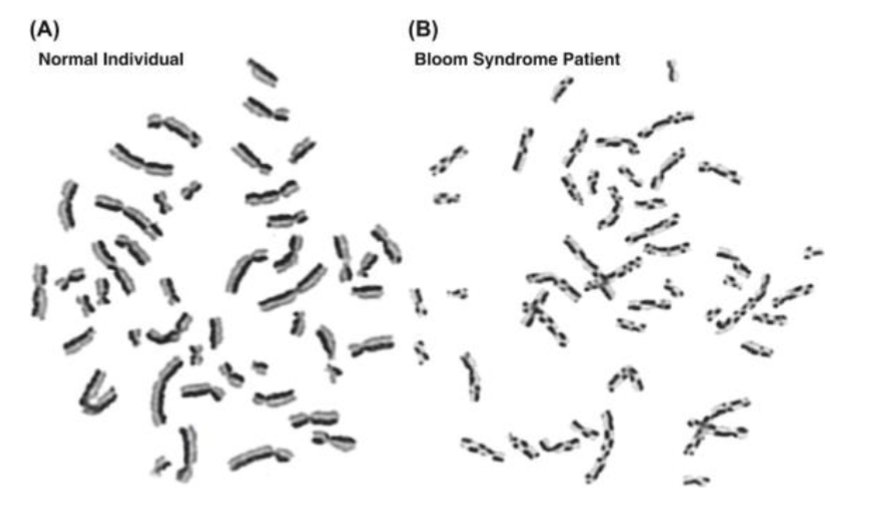
Hallmark = INCREASED SISTER CHROMATIC EXCHANGE
chromosomes are stained so that sister chromatid genetic material can be distinguished
sister chromatid exchange is rare in a lymphocyte from a normal individual but occurs at a high frequency in a lymphocyte from a patient with bloom syndrome
****Info dump on FANCONI ANEMIA SYNDROME
Cause?
Mechanism
CLINICAL FEATURES?
HALLMARK?
Caused by defects in the FANC pathway - DNA damage response network (mostly autosomal recessive, rare x-linked)
Result = defect in DNA interstream crosslink repair ==> chromosomal breakage
CLINICAL FEATURES: progressive bone marrow failure (Pancytopenia - decrease in levels of all cell types), Congenital anomalies, hyperpigmentation, increased cancer risk esp. AML, head/neck SCC
Chromosome breakage assay: increase in chromosome aberrations induced by DNA cross-linking agents (DEB or MMC) = increase in spontaneous chromosome breaks
HALLMARK = increase in spontaneous chromosome nonsymmetric TRIRADIAL + QUADRIRADIALS

****What is CHROMOTHRIPSIS?
cause + result?
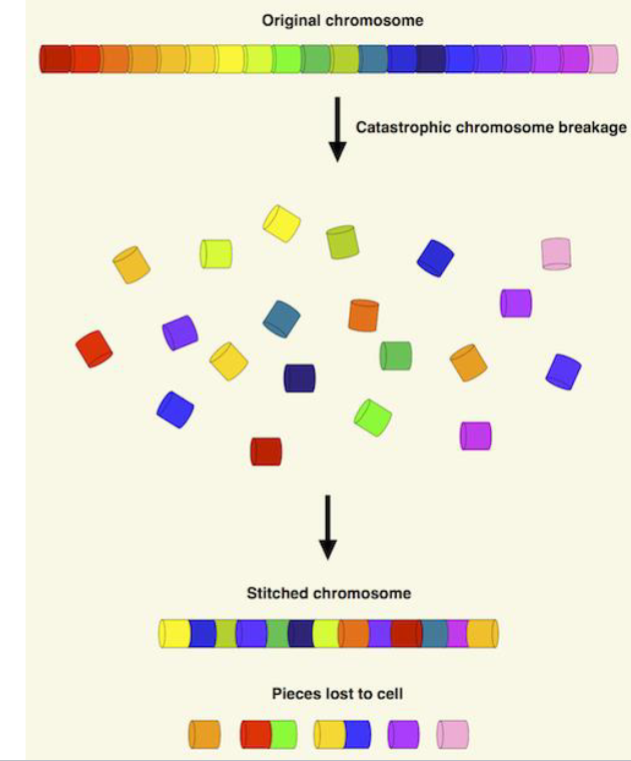
Chromosome shattering
catastrophic event where a chromosome breaks into many pieces in a single cellular crisis + gets stitched back together in a haphazard order
Result: Massive complex rearrangement, loss and gain of DNA segments (deletions, duplications, inversions).
Tens to hundreds of rearrangements all at once (instead of gradual accumulation)
*****CHROMOTHRIPSIS MECHANISM?
Hint: 3 potential models
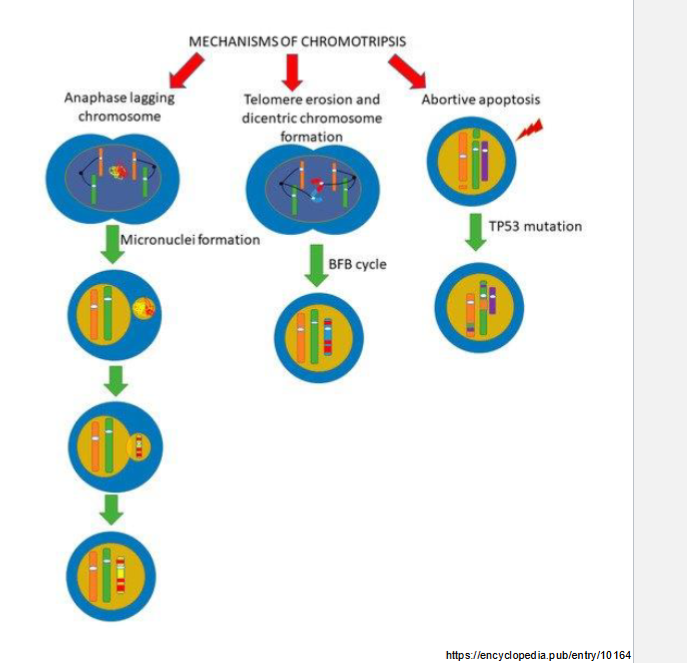
Not fully understood
micronuclei hypothesis: A chromosome or fragment gets trapped outside the nucleus during mitosis → undergoes faulty replication + shatters → reintegrated with errors
Telomere crisis/ dicentric chromosomes: breakage-fusion-bridge cycles lead to pulverization
Ionizing radiation: Could also cause shattering
****CHROMOTHRIPSIS SIGNIFICANCE (aka. what can chromothripsis result in/ what disease is it associated with)
in both CANCER + CONSTITUTIONAL/GERMLINE disease
CANCER:
Associated with poor prognosis + aggressive biology
Can create oncogene amplifications or disrupt tumor suppressors in a single step
Extrachromosomal DNA (ecDNA) Formation: circular DNA fragments carrying oncogenes. They can amplify to very high copy numbers, segregate unevenly and act as mobile enhancers driving tumor heterogeneity, aggressiveness and therapy resistance
CONSTITUTIONAL/GERMLINE
RARE but can occur. Patients often present with a unique complex rearrangement not fitting of typical CNV syndromes

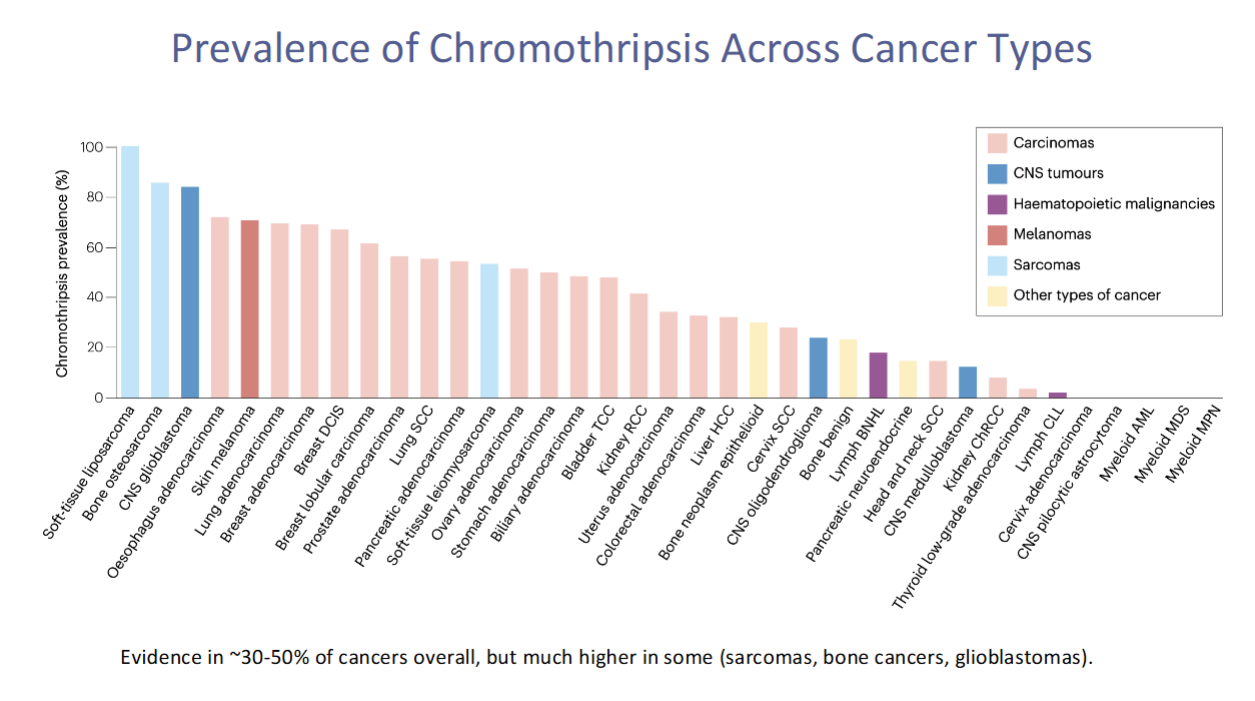
***Prevalence of Chromothripsis across cancer types
SARCOMA = most common
Blastoma
then CARCINOMA

****Group the Structural rearrangements talked about today into one of the 2 following categories
