Diabetic Retinopathy: Risk Factors, Diagnosis, and Treatment Strategies
 Call Kai
 Learn
Learn Practice Test
 Spaced Repetition
 Match
Match Flashcards
 Knowt Play
1/21

There's no tags or description
Looks like no tags are added yet.
Name | Mastery | Learn | Test | Matching | Spaced | Call with Kai | Chat |
|---|
No analytics yet
Send a link to your students to track their progress
22 Terms
What is the strongest predictor of diabetic retinopathy (DR) progression?
Duration of diabetes; having diabetes for longer increases the chances of developing DR.
How does hyperglycemia affect the development of diabetic retinopathy?
Patients with well-controlled glucose levels are less likely to develop diabetic retinopathy.
What are some risk factors for developing diabetic retinopathy?
Hypertension, dyslipidemia, smoking, nephropathy, pregnancy, and puberty.
What does the HbA1c test measure?
It shows the average level of blood glucose over the past 2 to 3 months.
What are the normal and abnormal values for HbA1c?
Normal: < 5.6%, Prediabetes: 5.7%-6.4%, Diabetes: ≥ 6.5%.
When should newly diagnosed type 1 diabetes patients have dilated eye exams?
3-5 years after their diabetes diagnosis.
When should newly diagnosed type 2 diabetes patients have dilated eye exams?
Shortly after the diagnosis of diabetes is made.
What is the etiology of diabetic retinopathy?
Chronic hyperglycemia induces metabolic changes in retinal microvasculature, leading to endothelial dysfunction and vascular leakage.
What are the clinical findings associated with diabetic retinopathy?
Microaneurysms, intraretinal hemorrhages, retinal edema, and neovascularization.
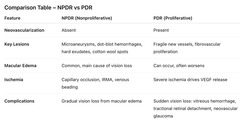
What distinguishes proliferative diabetic retinopathy (PDR) from non-proliferative diabetic retinopathy (NPDR)?
PDR involves new blood vessel growth and more severe retinal damage, while NPDR is characterized by microaneurysms and retinal capillary damage without neovascularization.
What are cotton wool spots and their significance in diabetic retinopathy?
Cotton wool spots are fluffy white patches indicating nerve fiber layer infarction, found in moderate and severe NPDR.
What is clinically significant macular edema?
Retinal thickening due to leaky vessels, which can impair central vision and should be treated when certain criteria are met.
What is the purpose of panretinal photocoagulation (PRP) in treating PDR?
To reduce oxygen demand in the retina, causing abnormal new blood vessels to shrink and die, preventing complications.
What is the role of vitrectomy in treating proliferative diabetic retinopathy?
It involves removing blood-filled vitreous gel to clear the cavity and reattach the retina, used for advanced cases.
How do intravitreal anti-VEGF medications work?
They block vascular endothelial growth factor to reduce abnormal blood vessel growth in the eye.
What lifestyle changes can help manage non-proliferative diabetic retinopathy?
Management of blood sugar, blood pressure, weight, and cholesterol levels.
What is the significance of the 4-2-1 rule in diabetic retinopathy?
It helps classify the severity of NPDR based on the presence of microaneurysms and hemorrhages in different quadrants.
What are hard exudates in diabetic retinopathy?
Yellow waxy lipid byproducts left behind in the retina due to leaky vessels and fluid accumulation.
What are microaneurysms and their appearance in diabetic retinopathy?
They are small bulges in retinal capillaries that can rupture, appearing as 'dot and blot' hemorrhages.
What is the impact of neovascularization in diabetic retinopathy?
It can lead to the formation of fragile new blood vessels that are prone to rupture, causing vision complications.
What is the relationship between ischemia and diabetic retinopathy?
Ongoing ischemia reduces retinal perfusion, leading to the upregulation of VEGF and subsequent neovascularization.
What are the potential outcomes of untreated clinically significant macular edema?
It can lead to significant vision loss and impaired central vision.