biochem unit 4
 Call Kai
 Learn
Learn Practice Test
 Spaced Repetition
 Match
Match Flashcards
 Knowt Play
1/20

There's no tags or description
Looks like no tags are added yet.
Name | Mastery | Learn | Test | Matching | Spaced | Call with Kai | Chat |
|---|
No analytics yet
Send a link to your students to track their progress
21 Terms
Identify the cell type in which triacylglycerols are stored and the hormone that stimulates the release of free fatty acids when blood glucose levels fall.
TAGs are stored in adipocytes and are triggered for release by glucagon.
Define lipolysis and state the products of the breakdown of one triacylglycerol.
Lipolysis is the breakdown of triacylglycerols into free fatty acids. One TAG will produce 3 fatty acids and 1 glycerol.
Explain why cells must keep the concentration of free fatty acids low and state the two ways cells do this.
Cells must keep the concentration of FFAs low to prevent cellular toxicity since they form micelles; this is done by binding FFAs to serum albumin in the blood or converting them to acylCoA or TAG in cells.
Describe the overall process of fatty acid oxidation.
The fatty acid will be converted to a number of acetyl CoA (equal to half the number of carbons in the original FFA) that will enter the CAC. FFAs must be activated in the cytosol, then shuttled to the mitochondrial matrix, where beta oxidation occurs.
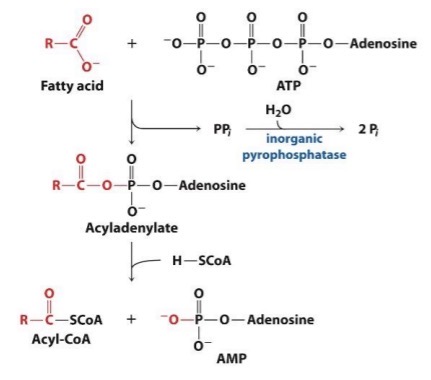
Write the three chemical steps through which fatty acids are activated for β-oxidation by formation of acyl-CoA (structures not necessary). Identify the reaction that ensures that the overall biochemical standard free energy is large and negative
Hydrolysis of pyrophosphate makes the activation of fatty acids favorable.
Identify the mitochondrial matrix as the site of β-oxidation.
Acyl-CoA is shuttled in from cytosol to mitochondrial matrix via the carnitine shuttle system.
Describe the carnitine shuttle and state its purpose.
The carnitine shuttle is needed to move acyl-CoA from the cytosol, through the intermembrane space, and into the mitochondrial matrix. It is required because acyl-CoA is too large of a molecule to be moved into the mitochondria – acyl-CoA will briefly become acyl-carnitine (a much smaller molecule), then will be converted back to acyl-CoA for beta-oxidation.
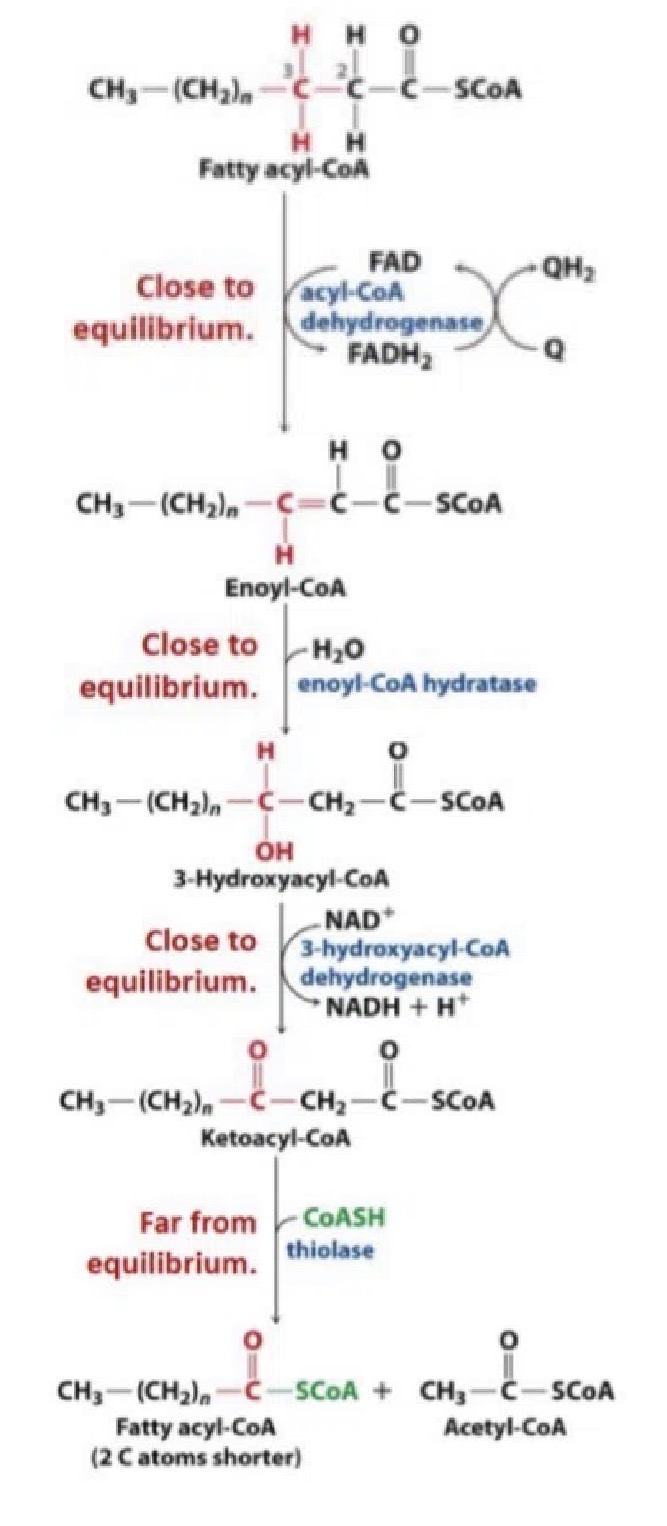
Write the four reactions of one round of β-oxidation, providing structures of the fatty acyl-CoA at each step. Explain what chemical processes are happening in each step and state their closeness to equilibrium.
Step 1: Oxidation: oxidation of acyl-CoA at the 2,3 position is catalyzed by acyl-CoA dehydrogenase – 2 electrons are removed from the acyl-CoA and transferred to an FAD group, yielding a 2,3-enoyl-CoA. Reaction close to equilibrium
Step 2: Hydration: water is added to the 2,3-enoyl-CoA across its double bond formed in step 1, yielding 3-hydroxyacyl-CoA (catalyzed by a hydratase). Reaction close to equilibrium.
Step 3: Oxidation: the 3-hydroxyacyl-CoA is oxidized by its dehydrogenase to form ketoacyl-CoA. Electrons are transferred to NAD+ in this step instead of FAD. In this step, a keto group is formed to destabilize the C-C bond. Reaction close to equilibrium
Step 4: Thiolysis: ketoacyl-CoA reacts with a thiolase and CoASH to form an acetyl-CoA and an acyl-CoA that is 2 carbons shorter than the original one. The acyl-CoA will continue back to step one and repeat the cycle. Reaction far from equilibrium.
Indicate how a pair of electrons enters the mitochondrial electron transport chain from FADH2, the enzyme-bound reduced cofactor in step 1.
A pair of electrons enters the ETC from the acyl group – they are first transferred to FAD, converting it to FADH2, which will then transfer those electrons to a Q, which will become a QH2 and enter the ETC.
Indicate how fatty acid oxidation is connected to citric acid cycle.
Fatty acid oxidation connects to the CAC by producing acetyl-CoA in every round. Additionally, if there is an odd-numbered double bond present on the original fatty acid, then succinyl-CoA will be produced, which can be used during the CAC and to fuel anapleurotic reactions.
State how much ATP is produced per round of beta oxidation.
4 ATP (1.5 from QH2 and 2.5 from 1 NADH)

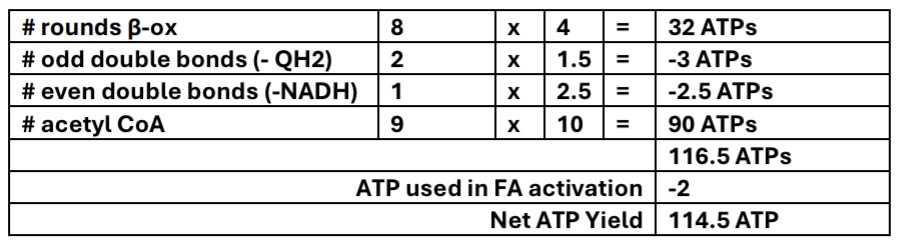
Calculate the net ATP yield for the complete oxidation of the following fatty acid
Describe the differences in lipid catabolism for unsaturated fatty acids and odd carbon fatty acids.
If the double bond is in an odd number carbon, it is isomerized to the start in the alpha carbon. This is the reactant of step 2, effectively bypassing step 1. For this particular round there is one less QH2 produced.
If the double bond is in an even number carbon, it is reduced using an NADH. For this particular round there is one less NADH produced.
For an odd number fatty acid, the last round produces a propionylCoA that is converted to succinylCoA that can enter CAC.
State the function of ketone bodies in human metabolism
Ketone bodies can be used by our body as mobile energy units. They are capable of crossing the blood-brain barrier and being converted back to acetyl-CoA for use in CAC or fatty acid synthesis.
Indicate the nutritional and pathological states that lead to ketogenesis.
When there is not enough glucose in the body. More specifically, ketogenesis will occur when there is not enough oxaloacetate in the liver to accept acetyl-CoA, forming ketone bodies.
Specifically:
• Fasting
• Diets with no carbohydrates
• Metabolic disorderes
Identify the molecular “building block” for ketogenesis.
Acetyl-CoA
Identify where ketogenesis and ketolysis take place (organelle and tissue)
Both processes occur in liver mitochondria. Ketogenesis in the liver, ketolysis in the muscle or brain.
Briefly describe the overall steps related to ketogenesis and ketolysis.
Ketogenesis:
1. Join two acetylCoA and release two CoA to make acetoacetate.
2. Reduce acetoacetate to β-hydroxybutyrate.
Ketolysis:
1. Oxidize 3-hydroxybutyrate to make acetoacetate.
2. Break acetoacetate into two acetylCoA.
Identify the starting molecules and the final products of the anabolism and catabolism of ketone bodies.
Starting for ketogenesis: 2 acetylCoA
Final for ketogenesis: β-hydroxybutyrate
Starting for ketolysis: β-hydroxybutyrate
Final for ketogenesis: 2 acetylCoA
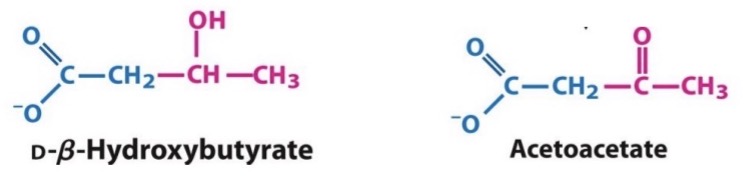
Draw the structures of the ketone bodies 3 hydroxybutyrate and acetoacetate. Indicate how they are related.
Acetoacetate can be reduced to make β-hydroxybutyrate using NADH.
Calculate the ATP yield from the complete oxidation of 3 hydroxybutyrate and acetoacetate.
From β-hydroxybutyrate:
2 acetyl-CoA x 10 =20 ATP
1 NADH=2.5 ATP
Total: 22.5 ATPs
From acetoacetate:
2 acetyl-CoA x 10 =20 ATP