Lifespan Nutrition: Infancy ad Toddlerhood
 Call Kai
 Learn
Learn Practice Test
 Spaced Repetition
 Match
Match Flashcards
 Knowt Play
1/29

Earn XP
Description and Tags
Lecture 6: 6/29/2026
Name | Mastery | Learn | Test | Matching | Spaced | Call with Kai | Chat |
|---|
No analytics yet
Send a link to your students to track their progress
30 Terms
Critical Time for Growth
Highest growth rates:
Soon after birth: 10%-12% body weight is lost
2 weeks: Weight gain starts
4-6 months: Birth weight doubles
1 year: Birth weight triples, grows ~10 inches
2 years: ~half adult height
Highest energy (caloric) requirement based on weight than any other stage of life
Calories Needs
0-2 months 100-110 kcal/kg/
3-5 month 85-95 kcal/kg/
6-8 months 80-85 kcal/kg/
9-11 months 80 kcal/kg/d
12-24 month 80-83 kcal/kg/d
Critical Time for Brain Development
The first 1,000 days
Birth to 6 months
Breastmilk preferred sole source
Infant formula used as an alternative or supplement if necessary
6 months to 12 months
Introduction of complimentary foods
Breastmilk or formula remains a primary source
12 to 23 months
Include wide variety of foods
Avoid of added sugar and sodium
Breastmilk still encouraged if available
Transition from formula to cow’s milk
Vitamin K
0.5 to 1.0 mg IM Vitamin K (phytonadione) routinely administered to all infants on the first day of life to reduce the risk of Vitamin K deficiency bleeding
Vitamin D
400 IU/day should be given to all exclusively and partially breastfed infants consuming less than 28oz of formula per day
Breastmilk
“Exclusive breastfeeding recommended for first six months of life, followed by continued breastfeeding with introduction to appropriate complementary solids for at least the first year of life and beyond”
Benefits of Breastfeeding for the Infant
Natural and easily digested
Contains:
Antimicrobial agents
anti-inflammatory agent
immunoregulatory agents
living leukocytes
Appropriate composition of fat, carbohydrate, protein, water, and vitamins
Composition changes dramatically over time to match nutritional needs as the infant grows
Research shows an association of 6 months of exclusive breastfeeding with decreased rates of:
Respiratory tract infection
Severe Diarrhea
Otitis media
Obesity (during childhood)
Eczema (atopic dermatitis)
Sudden infant death syndrome (SIDS)
Asthma
Leukemia (during childhood)
Type 2 diabetes
Necrotizing enterocolitis in premature infants
Timeline of Breastmilk Composition
Colostrum (birth to ~3-5 days)
Thick, yellow “first milk”
High in antibodies and immune factors
High in protein, low in fat and lactose
Supports gut development and immunity
Transitional Milk (Days 5 to 14)
Milk volume rapidly increases
Pro ↓, Fat ↑, Lactose↑, calories ↑
Supports rapid growth & increased energy needs
Mature Milk (2wks to 12mo +)
87% water
Provides carbs, fats, protein, vitamins, and minerals
Continues to provide antibodies and immune protection
Composition adapts to infant needs
Absolute Contraindications to Breastfeeding
Classic galactosemia
Maternal HIV infection
Maternal Human T-cell lymphotropic virus type I and II infections
Certain Maternal Medications
Antineoplastic/Cytotoxic agents (chemotherapy)
Radioactive isotopes (e.g., iodine-131)
Some immunosuppressive medication (e.g., MTX)
Maternal Illicit Drug Use (cocaine and phencyclidine)
Conditions that are NOT usually Contraindications to breastfeeding
Most maternal common infections or fever
Mastitis
Maternal Hepatitis B (if infant receives appropriate prophylaxis)
Maternal Hepatitis C
Breast implants
Influenza vaccine
Most prescription medications
Breastfeeding Considerations
Active herpetic lesions on the breast: breastfeeding is discouraged from that breast until healed
Tobacco use: strongly discouraged
Nicotine: ↓milk production and shorter lactation
Secondhand smoke: ↑ risk of SIDS, asthma, and other respiratory illnesses
Alcohol use: only in moderation
Breast milk alcohol concentrations closely parallel blood alcohol concentrations (highest levels occurring 30-60min after consumption)
Moderate alcohol intake (1 drink) is not known to cause harm
Consuming more than 2 standard alcoholic drinks or intoxication during breastfeeding is strongly discouraged
Marijuana use: effects unknown, thus discouraged
Common Reasons for Discontinuation of Breastfeeding
Inconvenience or fatigue with breastfeeding
Concern about milk supply
Problems with breastfeeding
sore nipples, breast pain, engorged breasts, mastitis, leaking milk, poor infant latch
Mother/infant separation
Return to work
Maternal medical conditions
Baby center factors and medical conditions
Infant Formulas
Commercial formulas are FDA-regulated
Ensures it is meeting minimum nutritional and safety requirements
FDA and AAP warn against homemade infant formulas and illegally imported formulas
Iron-fortified infant formulas are recommended
Liquid or powdered forms
Use until age 12 months, then can transition to cow’s milk (preferably whole milk with Vit D)
Similac Advance
Information in image

Similac Alimentum
Information in image


Similac Sensitive
Information in image
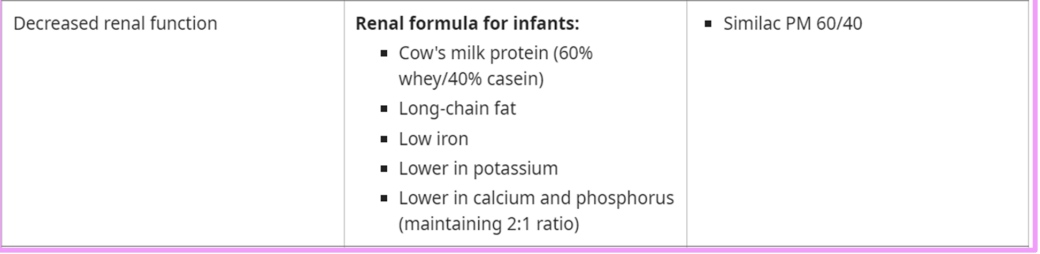
Similac PM 60/40
Information in image
Feeding schedule recommendations: 1st days of life
Feeding every 1-2 hours
1-2 oz/feeding
Feeding schedule recommendations: First several weeks of life
Feeding at least every 2-3 hours
2-6oz/feeding
16-28oz/day
Feeding schedule recommendations: 4-6 months
Feeding will be every 3-4 hours
4-6oz/feeding
22-28oz/day
Feeding schedule recommendations: 6-12 months
Feeding every 3-4 hours
7-8 oz/feeding
28-34 oz/day
introduction of solid foods in between feedings
Self-Regulation & Responsive Feeding
Key Concept
Infants and toddlers are born with the ability to regulate their food intake through internal hunger and fullness cues
Responsive Feeding Principles
Recognize and respond to hunger cues
Offer food when a child is hungry
Stop feeding when a child shows signs of fullness
Avoid pressuring, bribing, or forcing a child to eat
Why it Matters
Promotes healthy eating behaviors
Supports appetite and self-regulation
May reduce the risk of overeating later in life
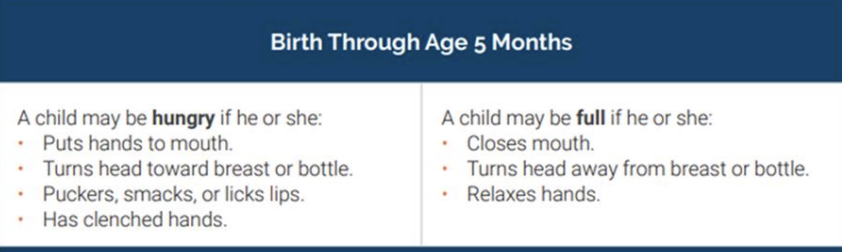
Signs a Child is Hungry or Full: Birth Through Age 5 Months
Information in image
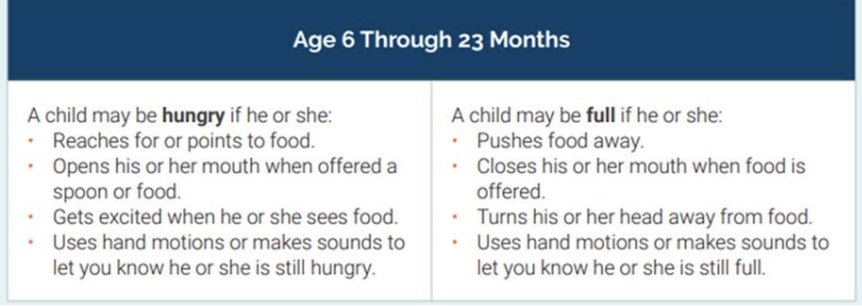
Signs a Child is Hungry or Full: Age 6 Through 23 Months
Information in image
Complementary Feeding
Should begin between the ages of 4-6 months
Signs that an infant is ready:
Able to control head and neck
Sitting up alone or with support
Brings objects to the mouth
Grasps small objects, such as toys or food
Swallowing food rather than pushing it back out onto the chin
Steps to decrease choking risk:
Offer foods in appropriate size, consistency, and shape
Make sure the infant is sitting up in a high chair or other safe, supervised place
Ensure an adult is supervising feeding during mealtimes
Avoid putting infant cereal or other solid foods in an infant bottle
Introduce foods from all 5 food groups
Fruits, vegetables, grains, protein foods, dairy
New foods may require 8-10 exposures before acceptance
Prioritize iron- and zinc-rich foods
Supports growth, brain development, and immunity
Sources: meats, seafood, eggs, dairy products, and legumes
Introduce common allergens early
Early introduction may reduce food allergy risk
Common Allergens: Peanut, egg, fish, soy
Infants at high risk of peanut allergy (severe eczema and/or egg allergy) should consider introducing peanut-containing products as early as 4-6 months
Foods to Avoid/Limit During Complementary Feeding
Honey and unpasteurized foods before 12 months
Risk of infant botulism
Cow’s milk before 12 months
High protein content can harm immature kidneys and irritate the gastric lining
Not a good source of iron or vitamin C
Dairy products okay
Added Sugar
Limit Sodium