(BIO 271) Chapter 4 Tissue Level of Organization
 Call Kai
 Learn
Learn Practice Test
 Spaced Repetition
 Match
Match Flashcards
 Knowt Play
1/25

There's no tags or description
Looks like no tags are added yet.
Name | Mastery | Learn | Test | Matching | Spaced | Call with Kai | Chat |
|---|
No analytics yet
Send a link to your students to track their progress
26 Terms
Tissue
Groups of cells/extracellular products that carry out a common function.
Histology
The study of tissues + their relationships with organs.
Epithelial Tissue
A type of tissue that covers body surfaces and lines cavities of organs, body, ducts and vessels, forming protective barriers. Also used to make up glands.
Epithelium
composed of one or more layers of closely packed cells.
4.1A Characteristics of Epithelial Tissues: CELLULARITY
Composed entirely of cells, bound closely together by a variety of intercellular junctions.

Characteristics of Epithelial Tissues: Polarity
3 structural asymmetrical domains: Apical(exposed), Lateral(contain intracellular junctions and located on the sides that face and connect to neighboring epithelial cells) and Basal surfaces (bottom surface attached to underlying connective tissue.
Characteristics of Epithelial Tissues: Attachment to basement Membrane
Epithelial tissue are attached to a thin layer called the basement membrane connected to the underlying connective tissue.
Characteristics of Epithelial Tissues: Avascularity
All Epithelial tissues contain no blood vessels.
Characteristics of Epithelial Tissues: Innervation
Epithelia contain lots of nerve endings to detect the environment, most are located underneath the tissue.
Characteristics of Epithelial Tissues: High regeneration capacity
Apical surface are frequently damaged but replace fast thanks to stem cells found near the basement membrane.
4.1B Functions of Epithelial Tissue: Physical Protection
Protects internal surfaces from dehydration, abrasion and destruction by physical, chemical and biological agents.
Functions of Epithelial Tissue: Selective Permeability
Epithelial act as “gate keepers”, exhibiting impermeable to some and assisting other molecules by absorption and Secretion.
Functions of Epithelial Tissue: secretion
Some epithelial cells may form a gland to produce specific secretions.
Functions of Epithelial Tissue: Sensations
Contain nerve endings that detect environmental changes concerning touch, pressures temperature and pain collectively known as sensation.
4.1C specialized structures of Epithelial Tissue: basement membrane
Provides support, Anchor, and barrier from movement for the epithelium, and the underlying connective tissue.
4.1D classification of epithelia tissue: Simple epithelium
One cell layer thick direct contact with basement membrane : can be located internal linings intestine and blood vessels
classification of epithelia tissue: stratified epithelium
Two or more layers of cells making it strong against stress applied and are located in esophagus, pharynx or vagina.
classification of epithelia tissue: pseudostratified
Cells appear layered but are all attached to basal surfaces therefore is classified under simple epithelium (Ciliated pseudo stratified epithelium make up the linings of the nasal cavity
Classification by cell shape: squamous cells
Cells are flat, wide, and irregular in shape.
Classification by cell shape: cuboidal cells
They are as tall as they are wide and irregular in shape,
Classification by cell shape: columnar cells
are slender and taller than they are wide found common in the basal layer.
Classification by cell shape: transitional
Readily change their shape depending on now stretched the epithelium becomes. Found in the lining of the bladder wich fills ruin and expels it (swells to relax state).

4.1E TYPES OF EPITHELIUM: SIMPLE squamous epithelium
Single layer, irregular flattened cells, appear lightly bound together.
Found in moist surfaces such as the lung air sacs
Specialized for rapid membrane transport processes
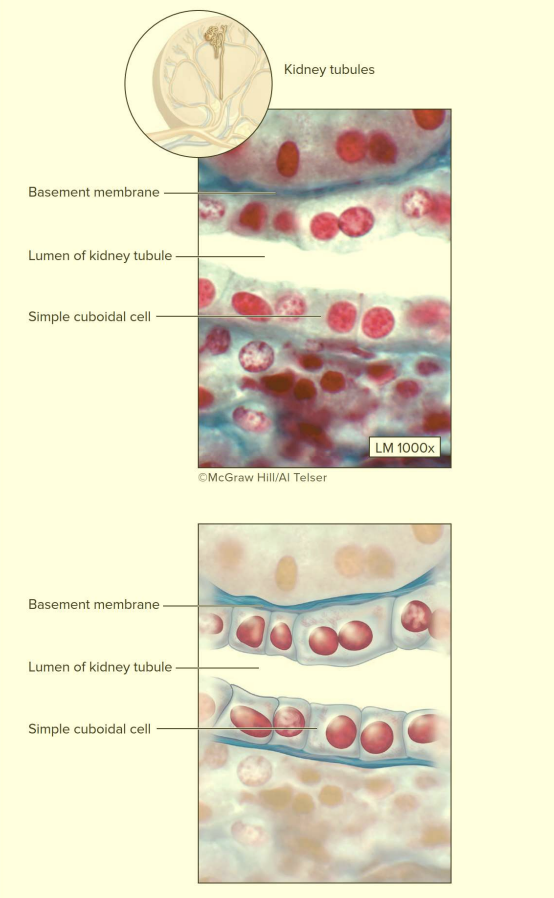
4.1E TYPES OF EPITHELIUM: SIMPLE cuboidal epithelium
Single layer of tall/wide cells.
Makes up the walls of kidney tubules, ovary and thyroid gland.
Functions for absorption and secretion

4.1E TYPES OF EPITHELIUM: SIMPLE columnar epithelium
Single layer cells that are tall and narrow.
Located within the basal surface
Active absorption ans secretion
Has two forms: Ciliated and no-ciliated
Non-ciliated SCE have microvilli and goblet cells, located in the lining of the digestive tract.