Section 1.2 DNA Replication
 Call Kai
 Learn
Learn Practice Test
 Spaced Repetition
 Match
Match Flashcards
 Knowt Play
1/35

There's no tags or description
Looks like no tags are added yet.
Name | Mastery | Learn | Test | Matching | Spaced | Call with Kai | Chat |
|---|
No analytics yet
Send a link to your students to track their progress
36 Terms
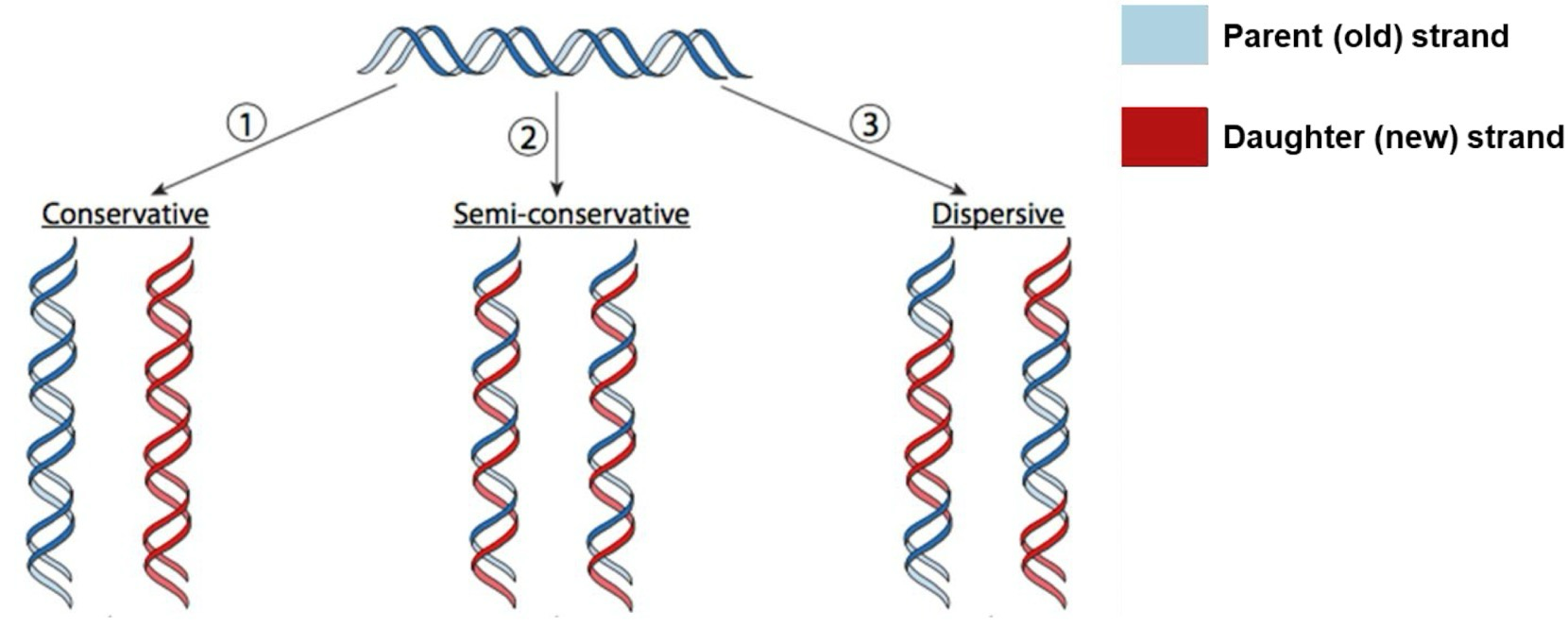
Theories surrounding mechanism of DNA replication
Conservative replication: Yields an original intact fully parental DNA and one fully daughter DNA
Semi-conservative replication: Yields two DNAs, each with one parent and daughter strands
Dispersive replication: Yields two DNA molecules that are hybrids/mixtures of parental and daughter DNA
Meselson and Stahl Experiment
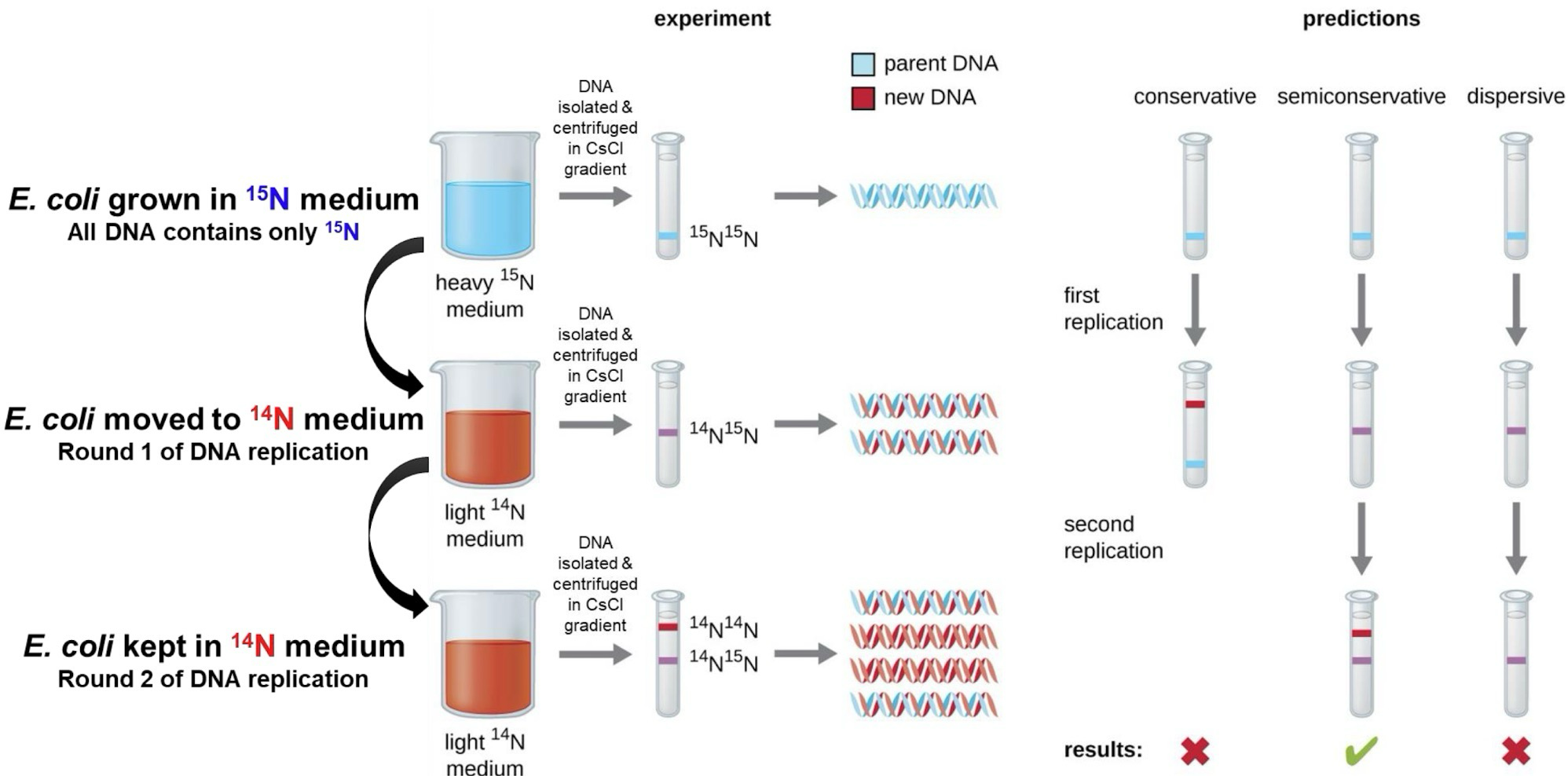
Grew E. coli in 15N (tracer isotope) medium, then grew them in consecutive 14N mediums
Isolate and centrifuge DNA in CsCl gradient; Heavier 15N15N DNA would be at the bottom, then 15N14N, then 14N14N.
If ______ was correct, what should have happened?
Conservative: After first and consecutive replications, only 15N15N and 14N14N would be shown
Semi-conservative: First replication yields only 15N14N, consecutive replication shows 15N14N and 14N14N
Dispersive: After first and consecutive replication, only 15N14N would be shown
DNA polymerase
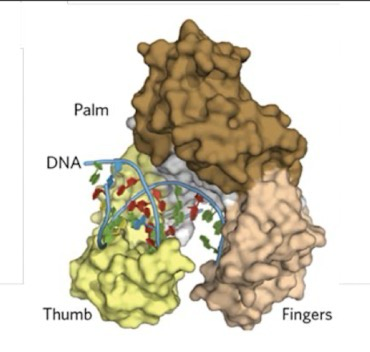
Uses dNTPs; Catalyzes extension of DNA strand one dNMP at a time; synthesizes 5’ → 3’; requires a template and DNA/RNA primers
DNA synthesis reaction
Phosphoryl group transfer; dephosphorylates dNTP to dNMP; requires two Mg2+ ions at the active site, held by D to stabilize intermediate form
3’-OH of 3’ nucleotide attacks α phosphate of dNTP, releasing PPi
Based on “Watson-Crick-Franklin” base pairing rules
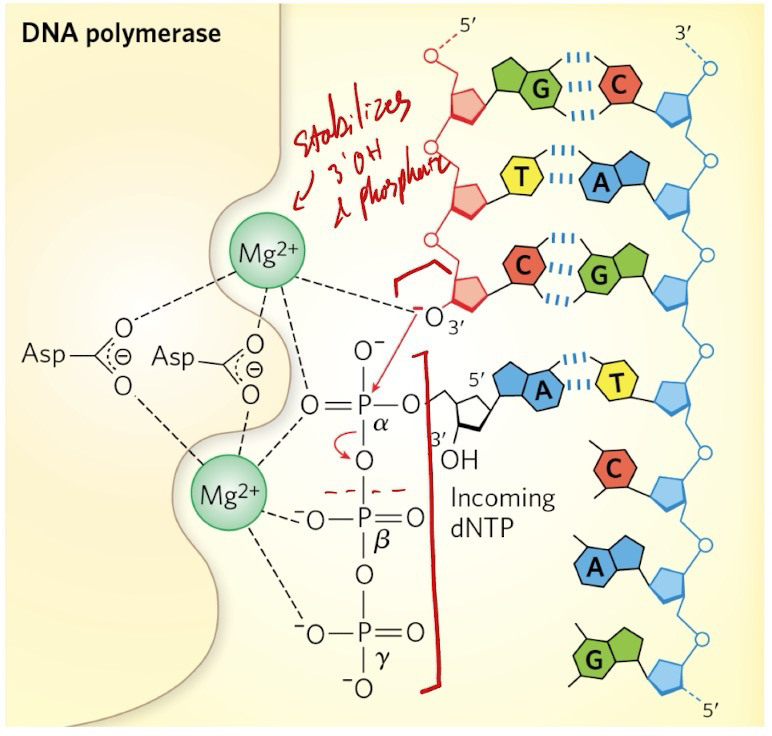
DNA pol nomenclature in bacteria vs in eukaryotes
Bacteria: Roman numerals; DNA pol I, Pol IV
Eukaryotes: Greek letters; DNA pol α, DNA pol ε
Accuracy of replication/DNA pol
Error in replication can introduce mutation into genome permanently, passing it onto subsequent daughter cells
Average E. coli (4.6 × 10⁶ bp) has mutation rate of 1bp in 109-1010 bp (1 error per 1,000-10,000 replications)
DNA pol active site restricts base pairing to “Watson-Crick-Franklin” bp; referred to as Presynthetic error control (Does this nt fit into this active site?)
DNA pol adds wrong base every 10-4/-5
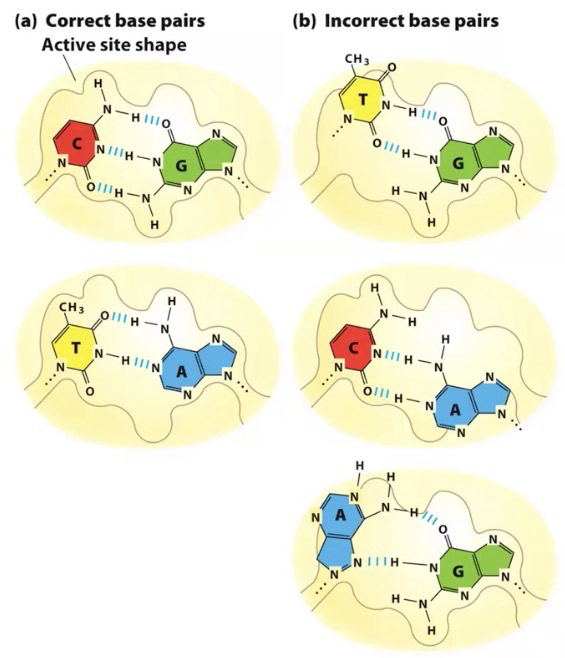
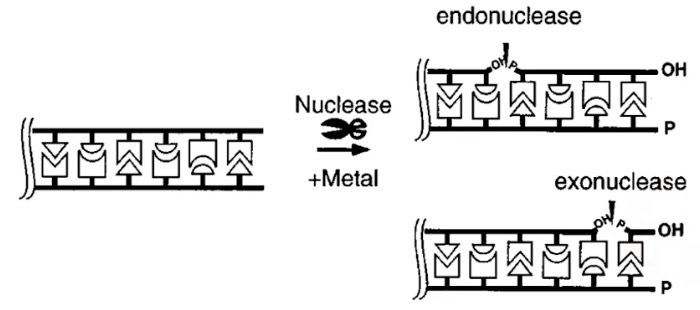
What enzyme removes nucleotides? What are the types of this enzyme?
Nucleases is the general term; DNase is specific for DNA; RNase is for RNA
Two types:
Exonucleases only breaks phosphodiester bonds at one end of a polynucleotide chain; Can work both 5’ → 3’ or 3’ → 5'
Endonucleases only breaks phosphodiester bonds within a polynucleotide chain
May be sequence-independent or -specific
Can either induce single-strand (nick) or double-strand breaks
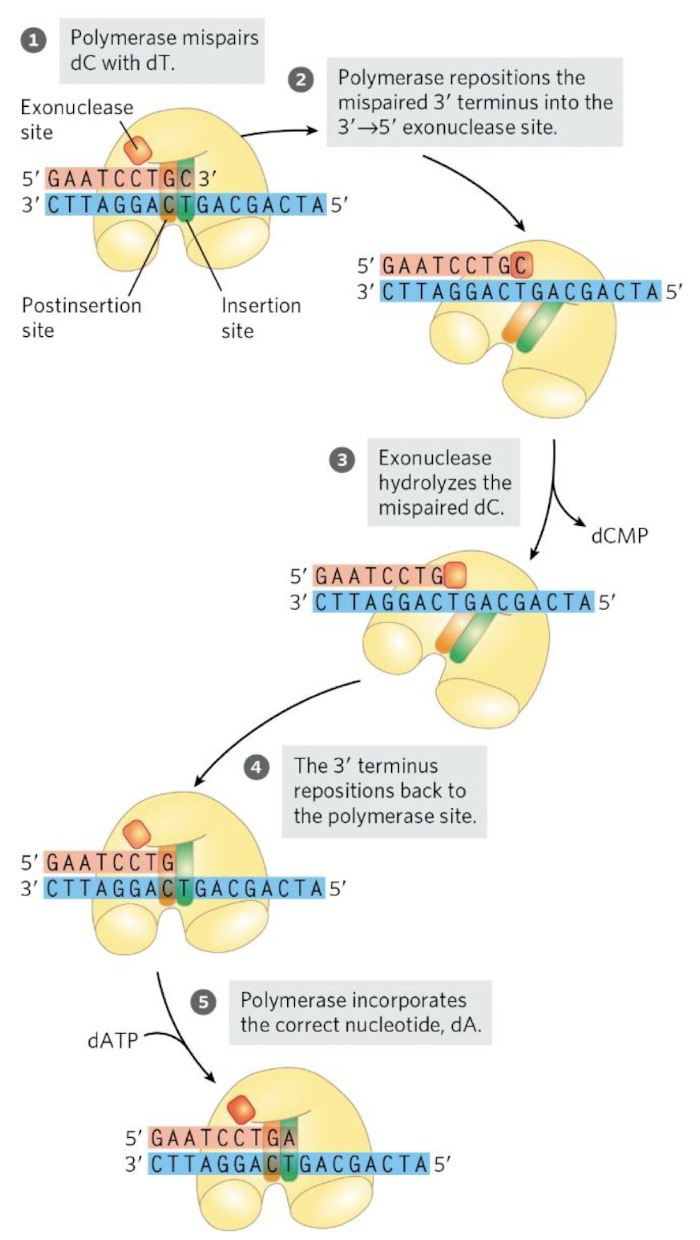
How do DNA pols proofread during replication
High-fidelity DNA polymerases can proofread; All DNA pol for genome replication for example, are high-fidelity
They contain two active sites:
Typical catalytic site for DNA synthesis
3’ → 5’ exonuclease site for removing mis-incorporated nucleotides
DNA synthesis is 5’ → 3’ while proofreading occurs 3’ → 5’
DNA synthesis begins where?
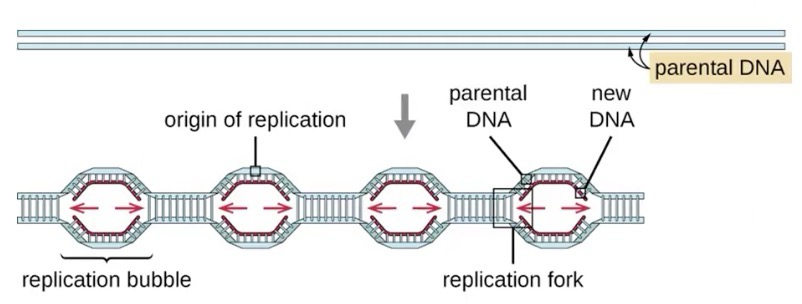
DNA synthesis begins at an origin of replication sequence; Parent strands separate and bidirectional synthesis is initiated; DNA is synthesized by DNA pol at replication forks
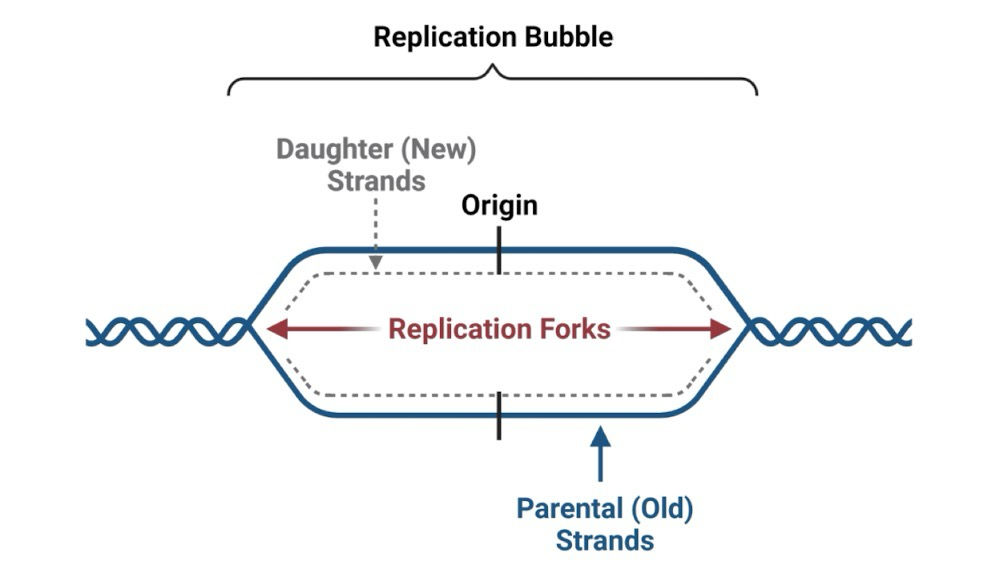
Replication fork; Leading vs lagging strand
Where parent DNA is being used as a template for replication by DNA polymerase
Helicase unwinds strands via ATP hydrolysis
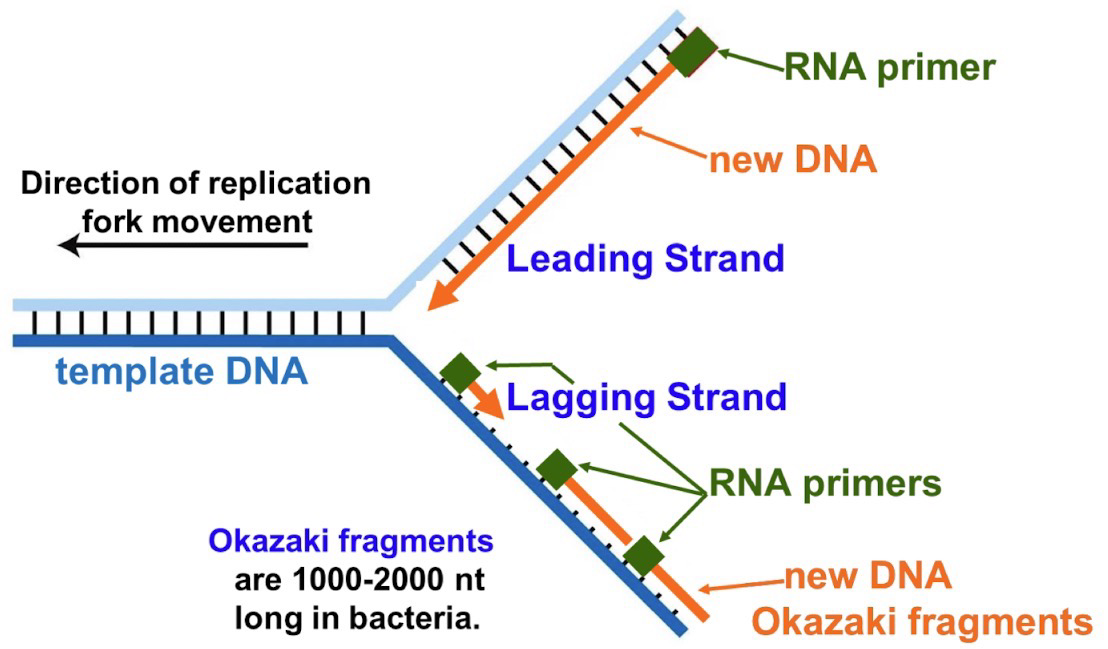
Leading Strand: DNA synthesis occurs continuously 5’ → 3’
Lagging Strand: DNA synthesis occurs discontinuously in Okazaki fragments as a series of 5’ → 3’ reactions

Supercoils
Caused by torsional stress due to under/over-winding of DNA
Overwound B-DNA has <10.5 bp/turn
Underwound B-DNA has >10.5 bp/turn
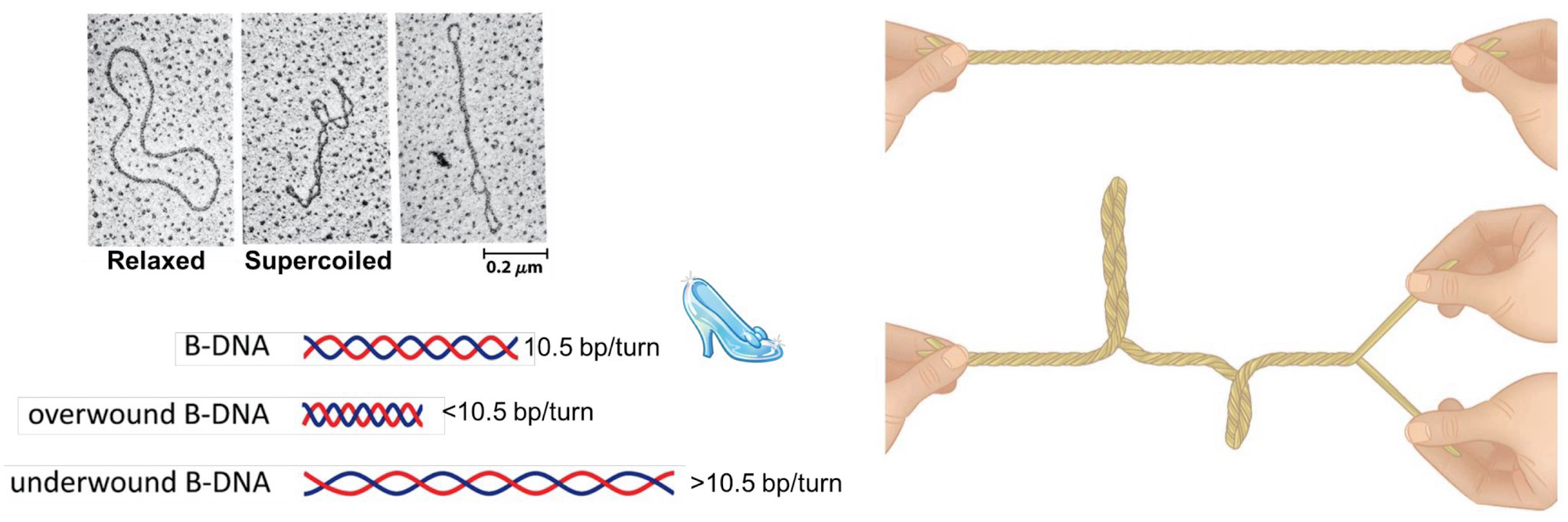
What enzyme add/remove supercoils?
Topoisomerases adds/removes supercoils by cutting phosphodiester bonds in one or both strand, unwrapping the helix, and resealing the strands
Topoisomerase II (DNA gyrase)
In bacteria; Introduces negative supercoils to compact the genome and also removes positive supercoils in front of replication forks
Clinical application of topoisomerases; Selective toxicity
DNA gyrase is an essential supercoiling enzyme that only exists in bacteria
Fluoroquinolones (Ex, ciprofloxacin) are a classification of drugs that target DNA gyrase by blocking its ability to reseal DNA
This type of targeting is called selective toxicity; we specifically target bacterial enzymes to treat conditions such as UTIs, respiratory infections, and gastrointestinal infections
The more selective a drug is, the fewer side effects it has for humans
Initiation of replication in bacteria
Replication occurs once per cycle of division, with initiation being the most regulated step (bc DNA replication is energy-intensive)
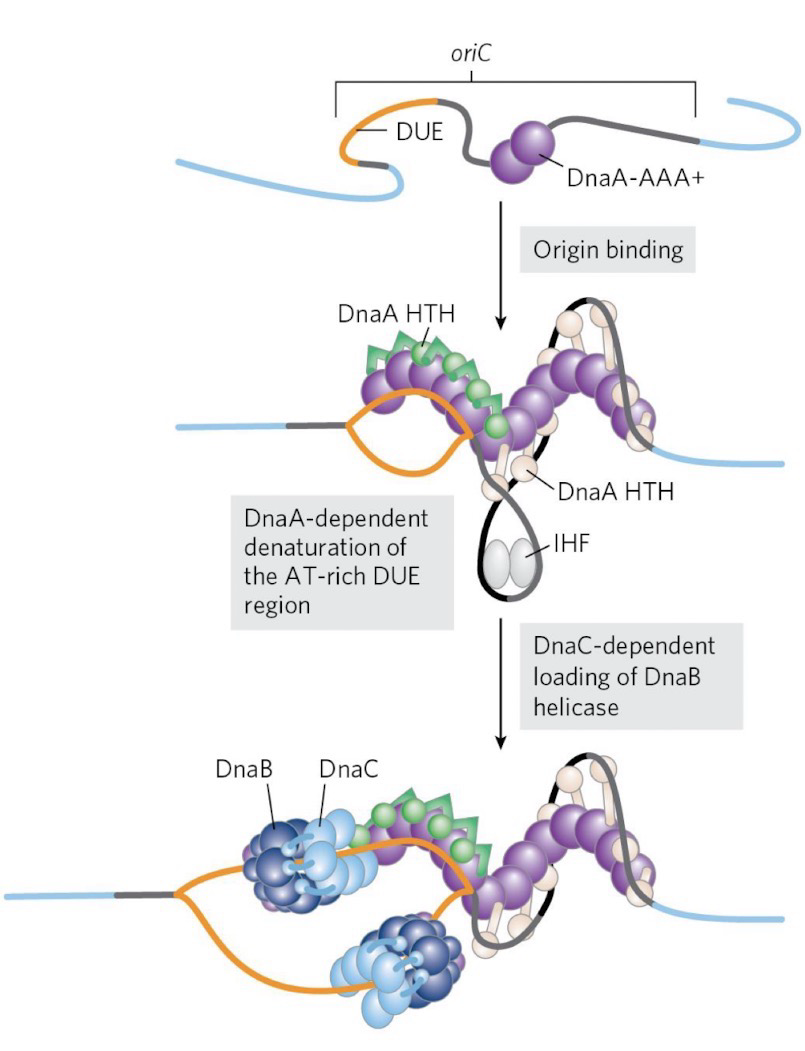
Replication begins at the origin of replication “oriC”, a unique 245bp sequence
DNA unwinding element (DUE) is an AT-rich segment where separation occurs
Note:
R1-5 and I1-3 are binding sites for the DnaA protein
IHF and FIS are binding sites for replication initiation factors

Steps of E. coli DNA replication initiation (Pathway)
Many DnaA proteins bind ATP and become active, they bind to oriC and create a helical shape, causing a positive supercoil that results in DNA denaturation at DUE
DnaC binds ATP and loads a DnaB helicase at both ends of the replication bubble; Helicase leads replication fork 5’ → 3’ via ATP; DnaC dissociates
DNA polymerase and additional proteins are added to DnaB helicase
ATP on DnaA is hydrolyzed and it dissociates; DnaA is very slow to release ADP (regulation of initiation)
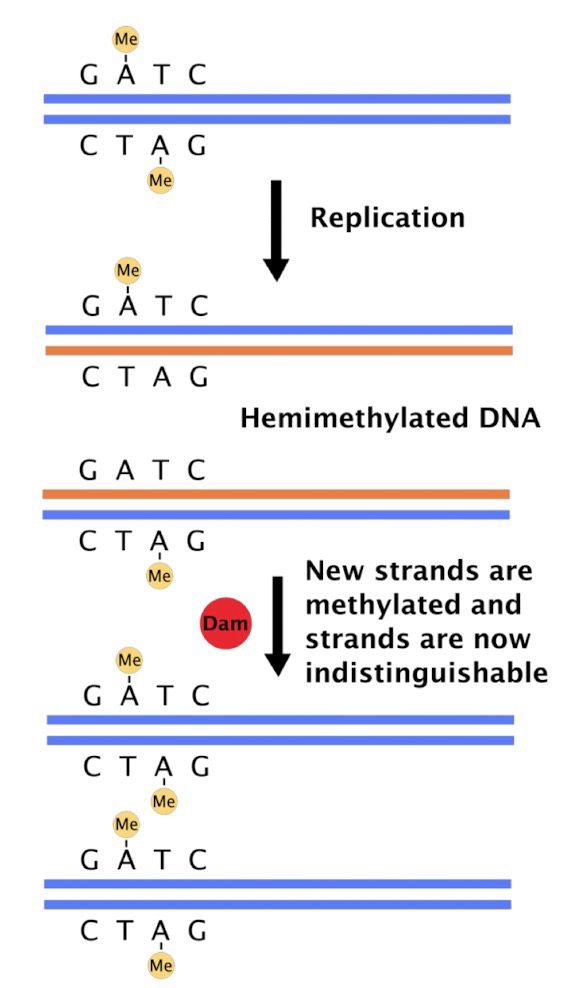
Methylation as a regulator of replication initiation in bacteria
oriC is methylated by Dam methylase (DNA adenine methylation), which methylates the N6 position of A within (5’) GATC sequence
After DNA replication, DNA is hemimethylated (Half-methylated); hemimethylated oriC associates with plasma membrane and is sequestered; replication begins only after it is fully methylated (Which takes a while for Dam methylase)
Important Prokaryotic DNA Polymerases
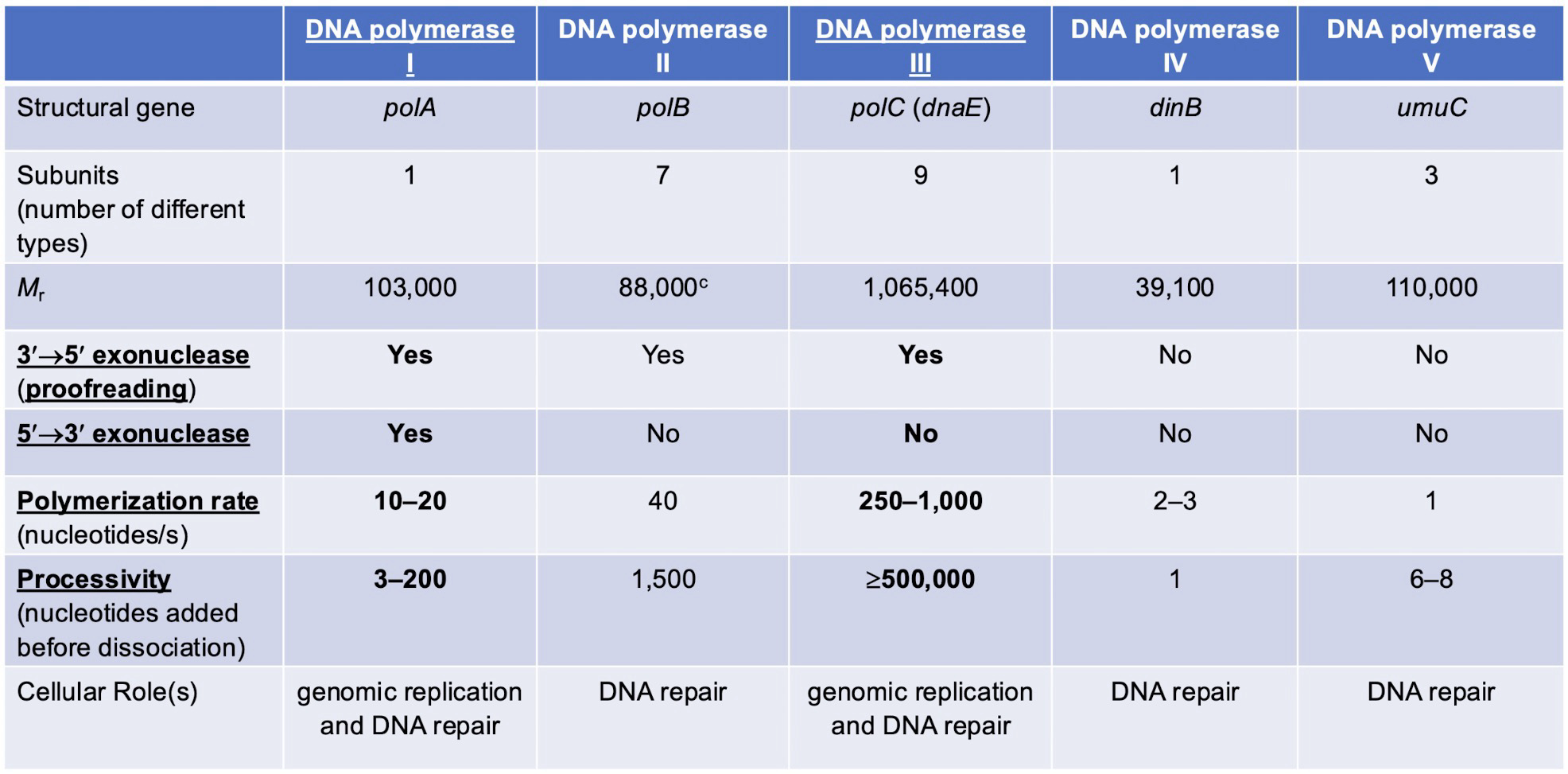
3’ → 5’ exonuclease serves as a proofreader in bacteria
Polymerization rate is how fast it catalyzes nt addition
Processivity is how many nt it adds before dissociating
DNA polymerase I: Has both 3’ → 5‘ and 5’ → 3’ exonuclease, a polymerization rate of 10-20 nt/s and a processivity of 3-200
DNA polymerase III: Only has 3’ → 5’ exonuclease, a polymerization rate of 250-1,000 nt/s and a processivity of >500,000
They both play a role in genomic replication (High-fidelity) and DNA repair. DNA pol III is the main replicator
DNA pol I is the only enzyme with 5’ → 3’ exonuclease
Holoenzyme
Main/core enzyme plus its accessory proteins
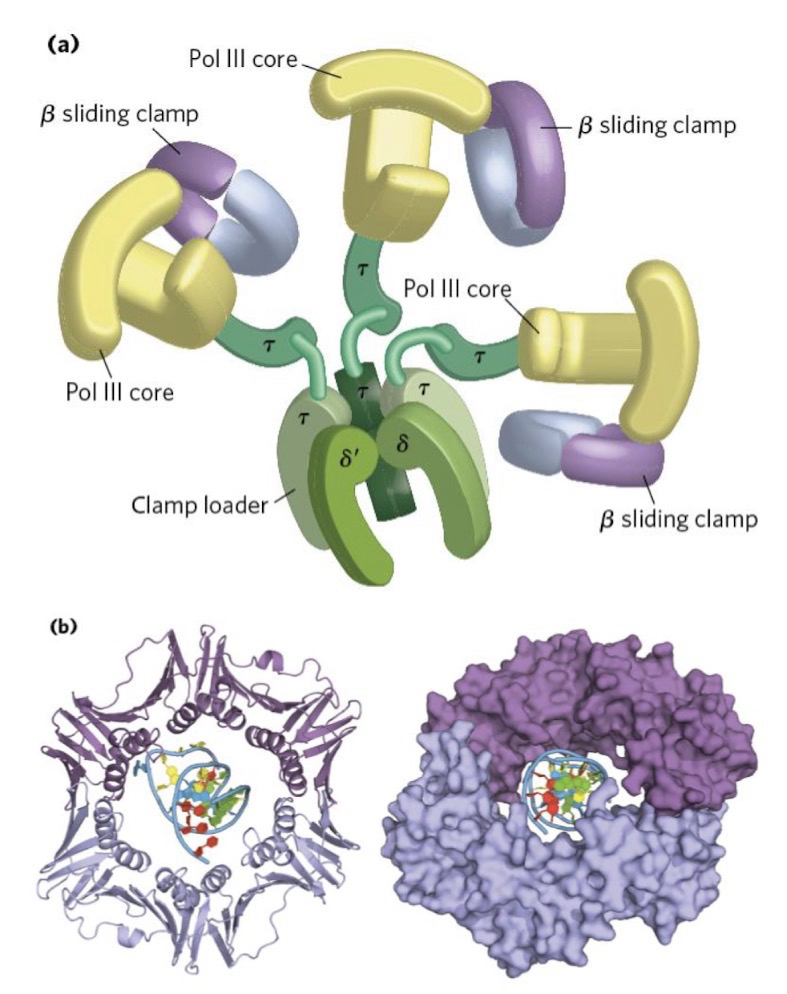
DNA polymerase III Holoenzyme
Core polymerase (Pol III) catalyzes DNA synthesis
Clamp loader: Acts as a scaffold for DNA polymerase III complex; assembles β clamp onto DNA via ATP; coordinates the replication fork by interacting with DnaB helicase through τ subunit
β clamp (sliding clamp) tethers the core pol to DNA; Decreases dissociation and increases processivity
Primase
DNA pol III requires a primed DNA template (3’-OH)
Primase is an RNA polymerase; DNA template-dependent, Primer-independent; synthesizes <9nt RNA primer at the beginning of leading strand and each Okazaki fragment
Lagging Strand Synthesis Pathway in bacteria
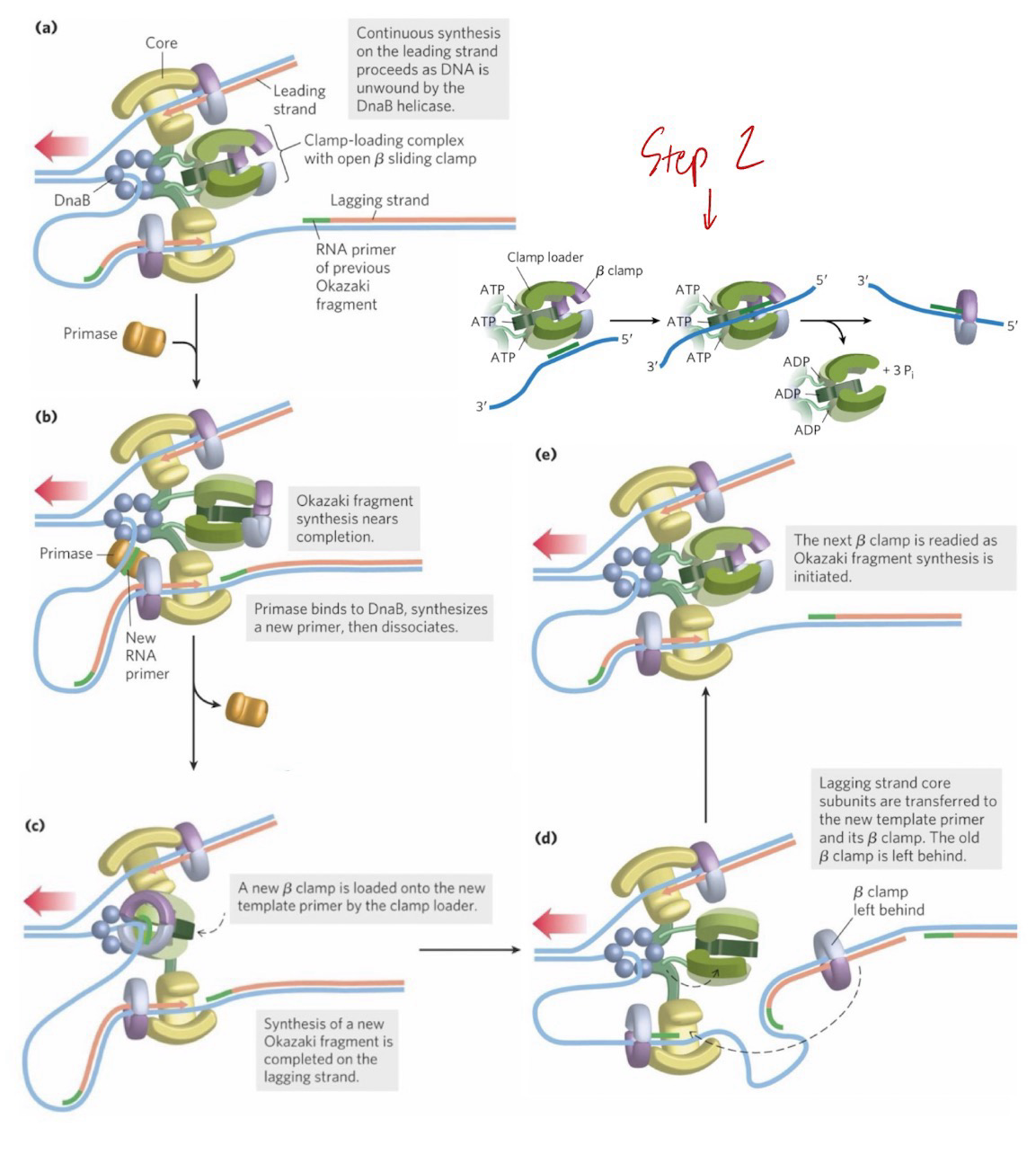
DnaB helicase travels along the lagging template strand in the 5’ → 3’ direction and unwinds DNA
Single-strand DNA-binding protein (SSB) binds single-stranded DNA (Stabilization)
DnaG primase occasionally associates with DnaB and synthesizes a short RNA primer; this occurs at the replication fork right as the core polymerase is almost done with an Okazaki fragment
A new β clamp is loaded onto the lagging strand at each new RNA primer by the clamp loader
Clamp loader binds ATP, then the sliding clamp, and opens the clamp at one subunit interface
ATP hydrolysis closes the clamp and allows the loader to dissociate
DNA pol III synthesis of Okazaki fragment is complete when it reaches the previous primer
Lagging strand core pol stops, releases its β clamp, and is then transferred to the new β clamp, leaving the old one behind for lagging strand processing and in DNA repair pathways
Lagging strand core polymerase initiates synthesis of the next Okazaki fragment
Clamp loader acquires a new β clamp and opens it to prep loading for the next primer
Lagging strand processing in bacteria
DNA pol I uses its 5’ → 3’ exonuclease to remove primer and synthesizes DNA to fill the gap
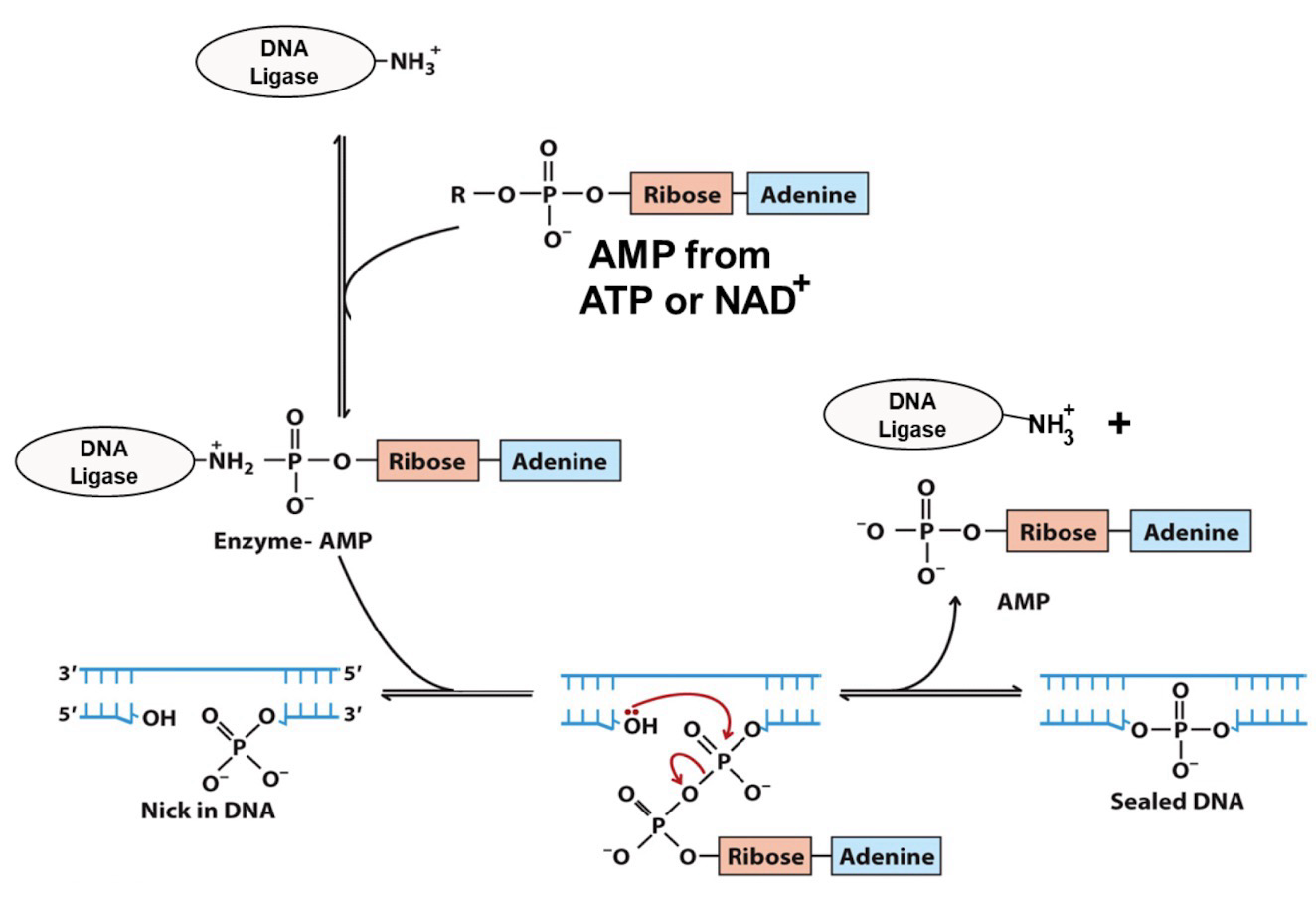
DNA ligase repairs the nick between fragments, linking them into a single DNA strand (Bacteria use NAD+ for DNA ligase)
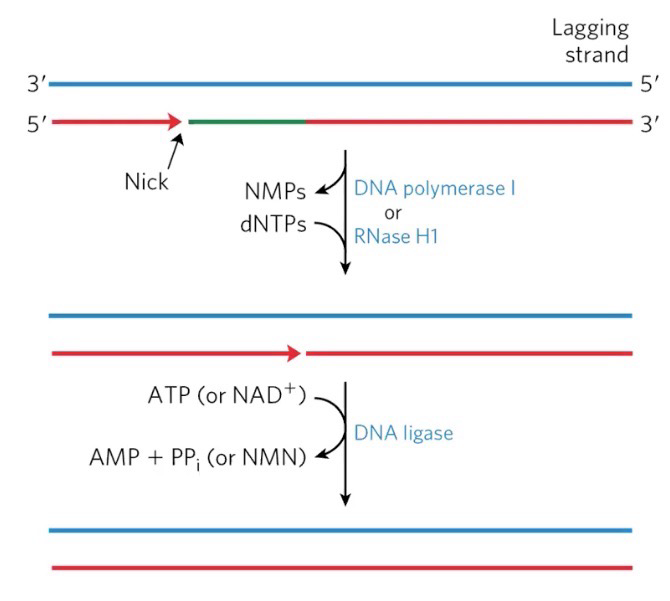
DNA ligase
Links two existing DNA chains together by forming a phosphodiester linkage; resulting in a continuous 5’ → 3’ strand
In vivo, its primary role is to seal single-strand breaks (nicks)
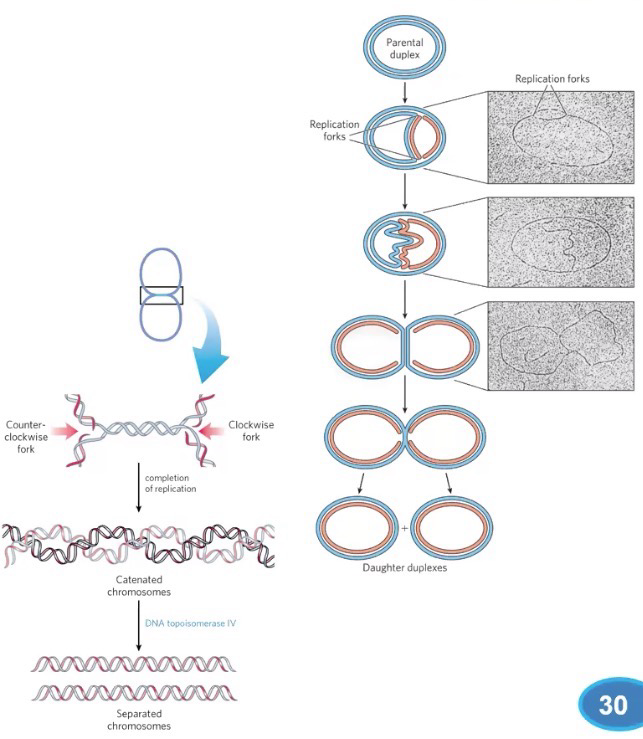
Completion of circular DNA molecule in bacteria
Bidirectional, semiconservative replication yields two identical DNA molecules
After replication, circular chromosomes are linked like links in a chain (catenated state); separation of catenated circles in E. coli requires topoisomerase IV
Quick comparison of prokaryotic vs eukaryotic DNA replication
Similarities:
Eukaryotes also have many DNA polymerases (~15) with specialized functions like DNA repair;
DNA synthesis is still semiconservative, bidirectional, template- and primer-dependent, in the 5’ → 3’ direction, continuous in the leading strand, and discontinuous in the lagging strand;
Some polymerases are high fidelity with proofreading abilities
Differences:
Eukaryotic chromosomes are linear and can be very long; DNA polymerase complex “replicase” architecture studies are not yet complete
Replicase has both DNA pol ε and DNA pol δ
Primase is in a complex with DNA pol ⍺
Replication initiation is very different; Eukaryotes have multiple origins of replication; coordination of regulation requires “licensing”
Replication elongation is slower with smaller Okazaki fragments, and the removal/replacement of RNA primers is different
Telomeres are unique to eukaryotes
Eukaryotic origin of replication
Human chromosomes have ~30,000 - 50,000 origins of replication
On average, ~25,000 bp apart, though the locations used may vary depending on cell type
Usually an AT-rich element and is associated with actively transcribed genes
Our DNA is wrapped around proteins to help condense the genome (They unbind during replication)
Licensing coordination in eukaryotic replication initiation; How does this prevent reactivation of replication?
Origin of replication complexes (ORC) binds tightly to DNA in G1 phase and recruits proteins
Cell division cycle (CDC6) and chromatin licensing and DNA replication factor (CDT1) join to load the helicase Mini Chromosome Maintenance (MCM) (x2), which translocates 3’ → 5’ along the leading strand template using ATP
In S phase, replication is initiated by phosphorylation of ORC proteins by a cyclin-dependent kinase (CDKs); the replisome is assembled, and bidirectional DNA synthesis is initiated
How does this prevent reactivation of replication?
Cdc and Cdt are phosphorylated to begin replication, meaning they can’t reattach to the complex post-dissociation
Licensing can also only occur during G1 phase

Meier-Gorlin Syndrome
DNA replication disorder: Mutation in the MCM5 gene, which encodes a component of the helicase complex. This makes helicase MCM inefficient, slowing replication/cellular division/development
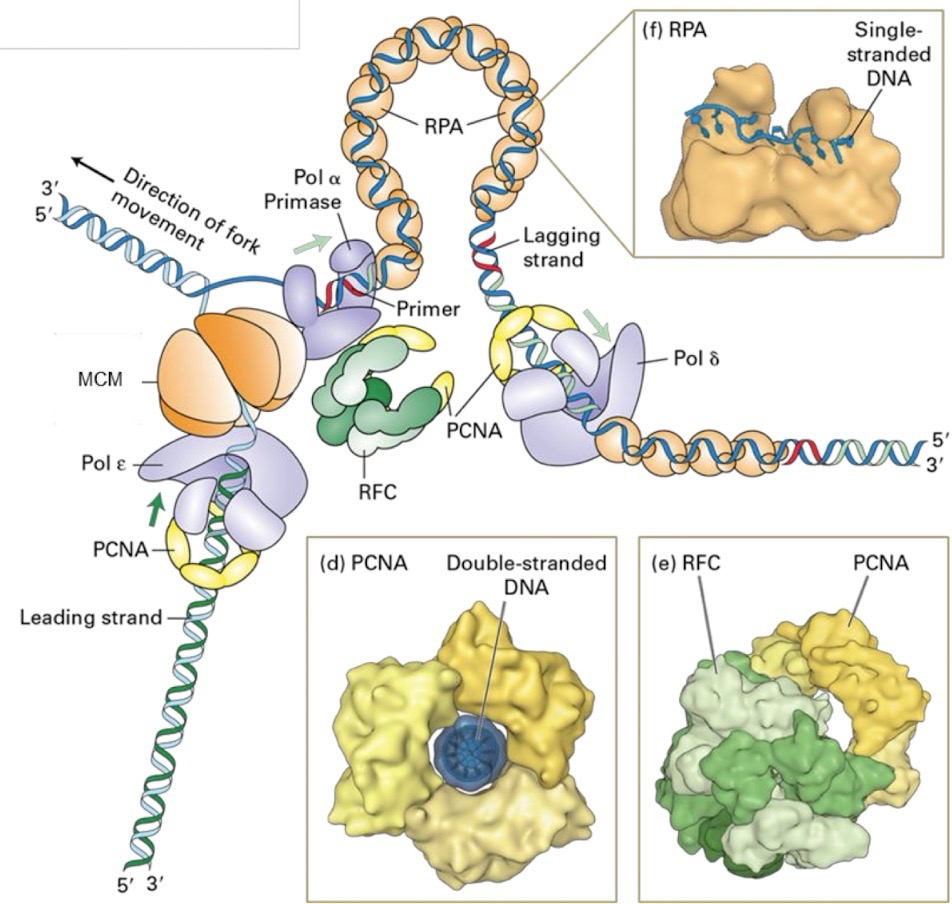
Parts of The Eukaryotic Replisome
MCM in helicase
DNA pol ε synthesizes leading strand; High processivity and proofreads
DNA pol δ synthesizes lagging strand; Proofreads
DNA pol ⍺-primase complex contains primase for RNA primer synthesis and a separate DNA synthesis activity
⍺-primase makes the primer, then its DNA pol portion comes in to extend the primer with a bit of DNA
Replication factor C (RFC) is the clamp loader
Proliferating cell nuclear antigen (PCNA) is the sliding clamp; Increases processivity
Replication protein A (RPA) is the single-stranded DNA-binding protein (SSB)
Lagging Strand Processing in Eukaryotes
Replication elongation is very similar to prokaryotes
Differences: Replisome uses two different core enzymes; completion of lagging strand is also different
DNA pol δ makes the lagging strand; Also called “Strand-displacing” DNA polymerase; The enzyme pushes the previous template off the template as it synthesizes DNA; This process leaves behind an overhang of the RNA primer
Flap endonuclease-1 (FEN1) clips off the overhang and DNA ligase repairs the nick to join the Okazaki fragments

Synthesis of linear chromosomes in humans
Humans have 46 linear chromosomes
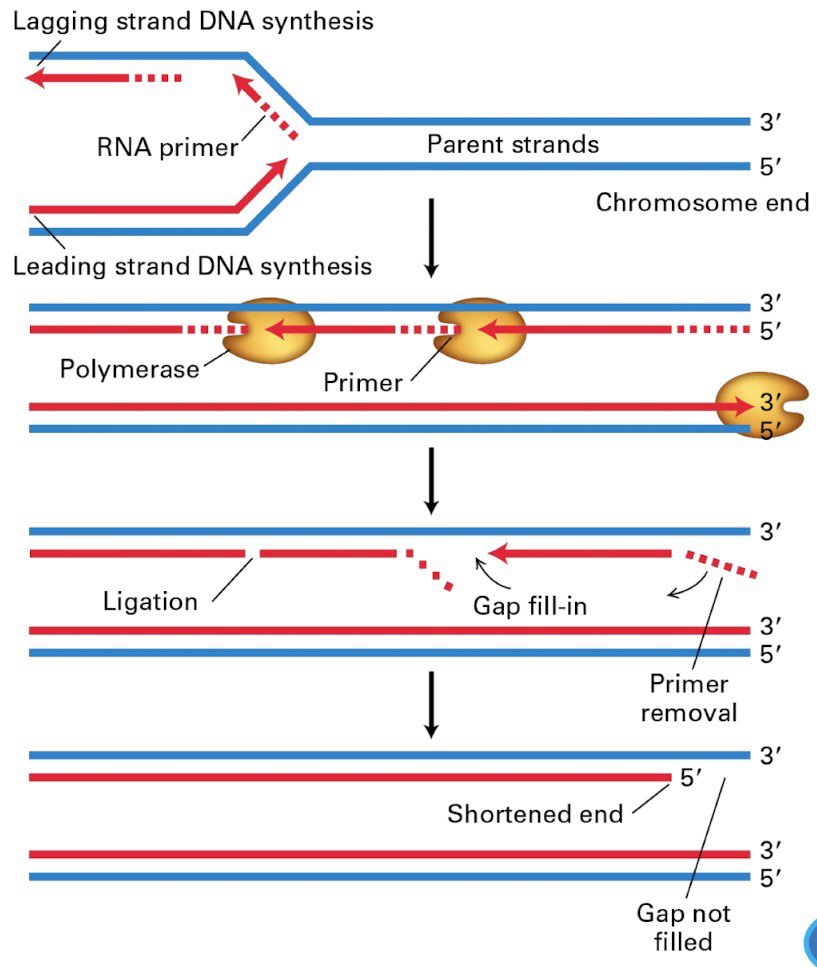
Ends of DNA molecules are substrates for DNA repair enzymes and nucleases (Basically they can cause unnecessary repair and breakage)
These ends also shorten after every round of replication because primers are needed for replication but templates are not available at the ends of the chromosomes
Telomeres
Telomeres are DNA structures at the end of eukaryotic chromosomes that protects the chromosome
Consists of a repetitive short sequence; In human it’s TTAGGG (TG strand); this strand is always longer than the complementary strand (CA strand)
No genes or important sequences exist within the telomere, so if they shorten as a result of replication, no genes are lost
T-Loops in Telomeres
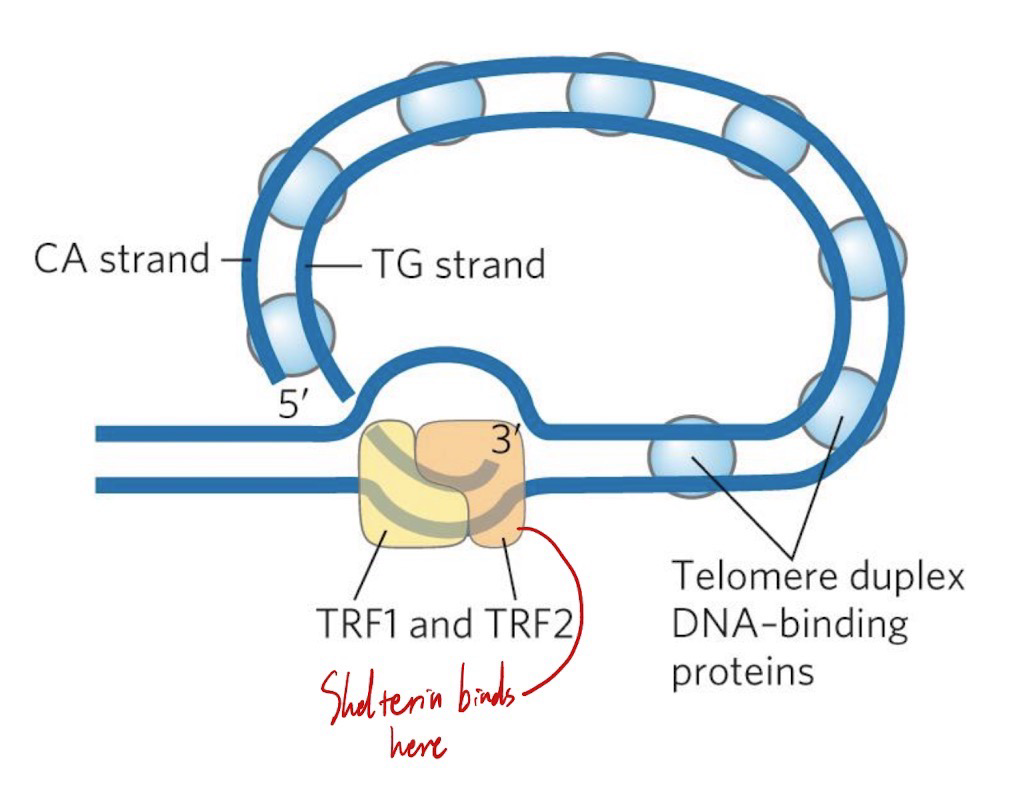
T-loops are specialized structures that sequester the single-stranded end of the telomere by base pairing, which protects the 3’ ends from nucleases and repairing enzymes
Proteins are bound to the telomere to form the T-loop; Shelterin proteins protect the single-stranded 3’ end in the DNA duplex; TTAGGG repeat factor, TRF1 and TRF2 bind the looped DNA
Telomere length shortens with age, why?
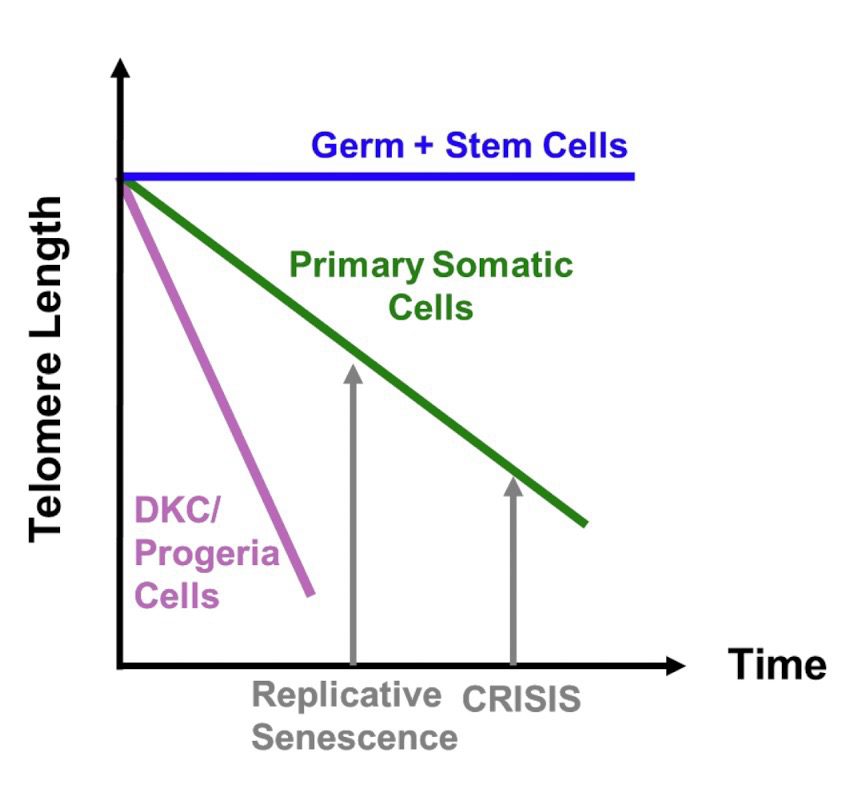
Shortening of telomeres in somatic cells helps to keep track of the cell’s “age”
When telomeres reach a critical length, the cell no longer divides, enters G0 permanently (senescence), and goes through apoptosis (programmed cell death
Prevents the loss of important DNA and cancer development
Rapid aging phenotypes of diseases like Progeria are associated with shorter telomeres
Germ and stem cells do not have shortening of telomeres
Telomere synthesis (Only RT covered)
Only occurs in stem and germ cells
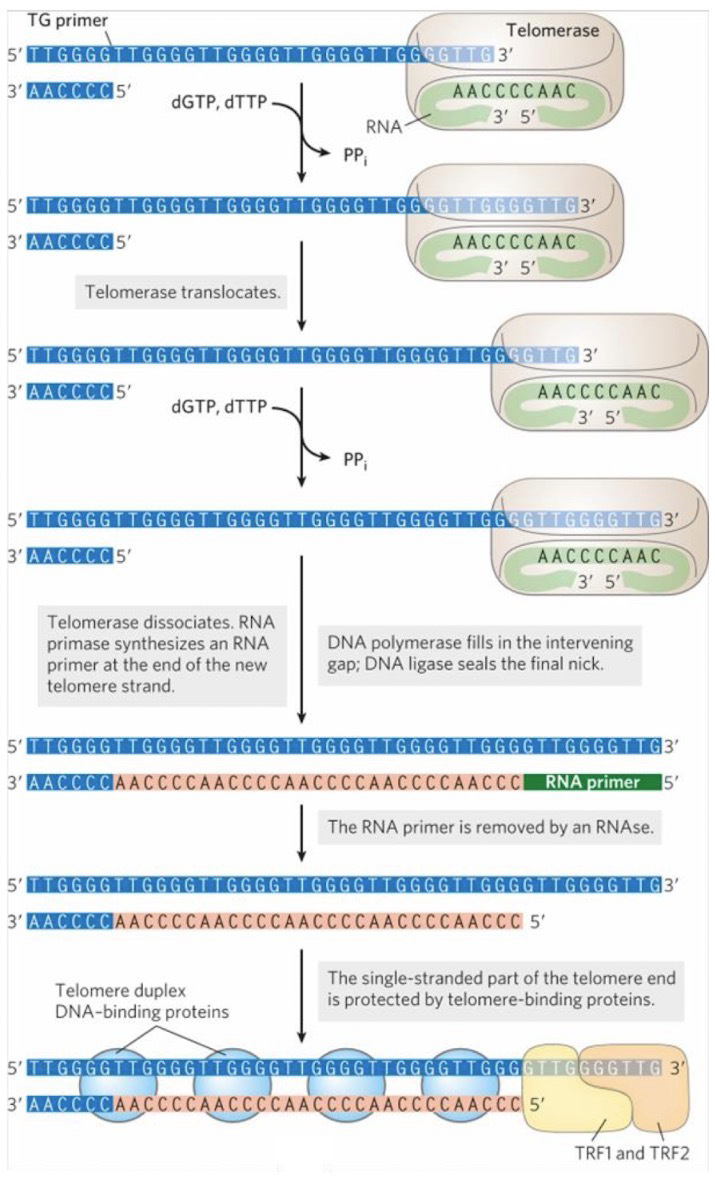
Telomerase is a specialized reverse transcriptase; also classified as a ribonucleoprotein (RNA and protein); contains an internal RNA with CA-rich repeat that serves as a template
Template RNA anneals to existing TG sequence at a telomere; Telomerase catalyzes 5’ → 3’ DNA synthesis of the TG strand; then shifts so template RNA can anneal to the newly synthesized DNA; process repeats
Complementary CA strand is synthesized by DNA pol ⍺-primase
After the RNA primer is removed, the overhang 3’ end base pairs to the CA strand and forms a T-loop