CHEM 3653: AC2 Problems
 Call Kai
 Learn
Learn Practice Test
 Spaced Repetition
 Match
Match Flashcards
 Knowt Play
1/30

There's no tags or description
Looks like no tags are added yet.
Name | Mastery | Learn | Test | Matching | Spaced | Call with Kai | Chat |
|---|
No analytics yet
Send a link to your students to track their progress
31 Terms
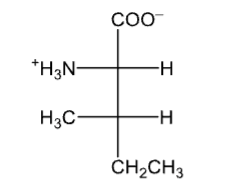
Consider the representation of the amino acid shown below. What is the relative configuration (D or L) of the ∂-carbon?
L
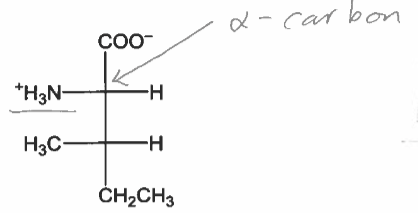

Consider the representation of the amino acid shown below. What is the absolute configuration (R or S) of the ∂-carbon?
S

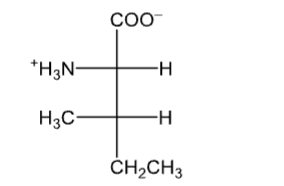
Consider the representation of the amino acid shown below. Does the molecule have any other chiral carbons? If so, what is/are the absolute configuration(s) (R or S) of this/these other carbon(s)?
S at the other chiral carbon

The two pKa’s of leucine are 2.33 and 9.74. At pH 2.33, what percentage of leucine molecules are in the zwitterion form?
50%

What is the average net charge of the amino acid aspartate at pKa2 (the pKa of its α-aminium group)?
-1.5

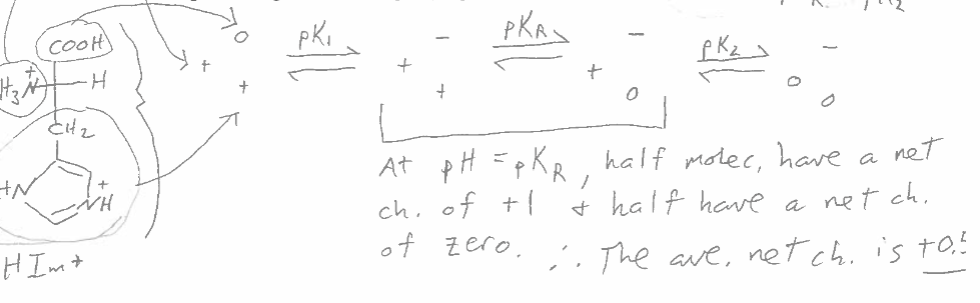
What is the average, net charge of histidine at pKR (the pKa of its side-chain imidazolium group)?
+0.5
A compound is discovered and determined to have two carboxyl groups and one guanidinium functional group (like the side chain of arginine). The pKas of the three groups are 2.3, 4.7, and 12.3, respectively. Estimate the pI of this compound? Report your answer to two figures.
pl = 3.5

A compound is discovered and determined to have two carboxyl groups and one guanidinium functional group (like the side chain of arginine). The pKas of the three groups are 2.3, 4.7, and 12.3, respectively. What is the net charge of this molecule at pH = 2.3? Report your answer to one figure.
+0.5
The pK2 of serine is 9.21. At pH 8.61, what percent of serine molecules would have their amino group in the basic (~NH2) form? Enter your answer to two figures.
20%
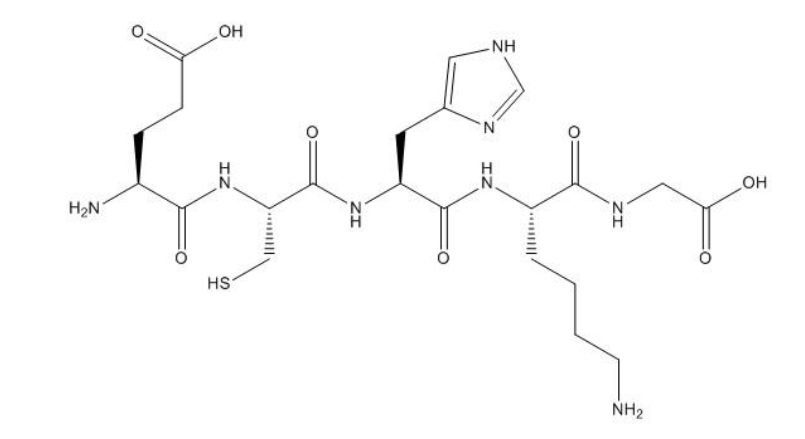
Name the following peptide as one long word.
Glutamylcysteinylhistidyllysylglycine

Name the following peptide using the three-letter code.
Glu-Cys-His-Lys-Gly

Name the following peptide using the one-letter code.
ECHKG

What are the absolute configurations of the chiral centers?
Glu S
Cys R
His S
Lys S
Gly achiral
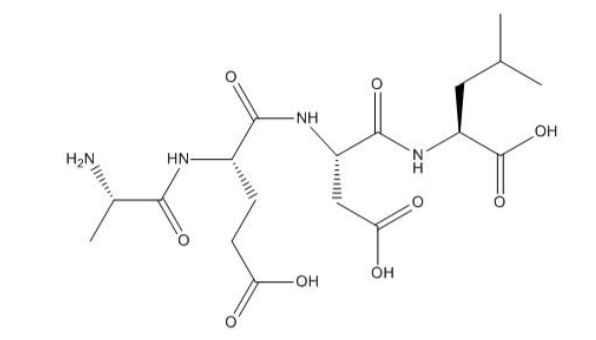
The following peptide is shown in a “folded” conformation and in an unusual protonation state. Name the peptide the same three ways as above and determine the absolute configurations of the chiral centers. Also, consider the three adjacent carboxyl side chains. If the one closest to the N-terminus has a pKa of 3.9, and if the C-terminal one has a pKa of 3.3, what would you predict for the pKa of the middle one? Would it be higher or lower than the pKas of the above-noted groups?
Alanylglutamylaspartylvaline; Ala-Glu-Asp-Val; AEDV. Configurations: S, S, S, S. Middle carboxyl pKa would be higher than 3.9 and 3.3 because nearby negative charges make its deprotonation less favorable.


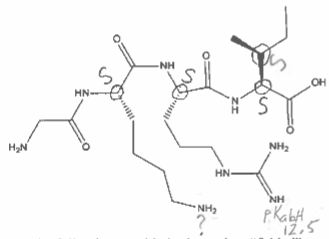
The following peptide is shown in a “folded” conformation and in an unusual protonation state. Name the peptide the same three ways as above and determine the absolute configurations of the chiral centers. Also, consider the side chains of the two adjacent, internal amino acid residues. If the one that occurs later in the sequence has a pKabH (pKa of the conjugate acid of the form shown) of 12.5, what would you predict for the pKabH of the one that occurs earlier in the sequence? Would it be higher or lower than the pKabH of the side chain of the corresponding free amino acid?
Glycyllysylarginylisoleucine; Gly-Lys-Arg-Ile; GKRI. Gly achiral; Lys S, Arg S, Ile 2S,3S. Earlier Lys side-chain pKabH would be lower than free Lys (~10.4) due to positive-charge repulsion.

The following peptide is shown in a “folded” conformation and in an unusual protonation state. Name the peptide the same three ways as above and determine the absolute configurations of the chiral centers. Also, consider the side chains of the two adjacent, internal amino acid residues. If the one that occurs later in the sequence has a pKa of 3.9, what would you predict for the pKabH (pKa of the conjugate acid of the form shown) of the one that occurs earlier in the sequence? Would it be higher or lower than the pKabH of the side chain of the corresponding free amino acid?
Prolylhistidylaspartylmethionine; Pro-His-Asp-Met; PHDM. Configurations: S, S, S, S. His pKabH would be higher than free His (~6.0) because His⁺ is stabilized by nearby Asp⁻.

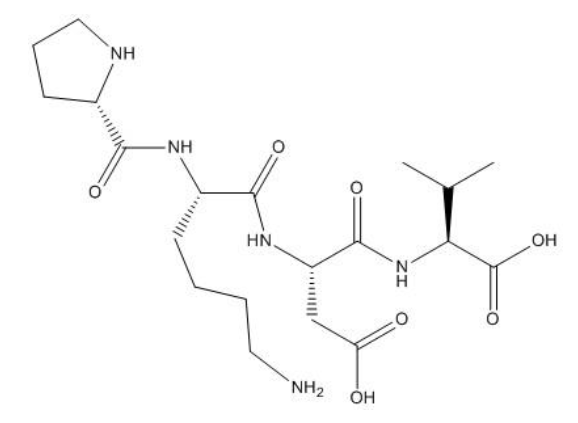
The following peptide is shown in a “folded” conformation and in an unusual protonation state. Name the peptide using the one-letter code and determine the absolute configurations of the chiral centers. Also, consider the side chains of the two adjacent, internal amino acid residues. If the one that occurs later in the sequence has a pKa of 3.9, what would you predict for the pKabH (pKa of the conjugate acid of the form shown) of the one that occurs earlier in the sequence? Would it be higher or lower than the pKabH of the side chain of the corresponding free amino acid?
PKDV. Configurations: S, S, S, S. Lys pKabH would be higher than free Lys (~10.4) because Lys⁺ is stabilized by nearby Asp⁻.

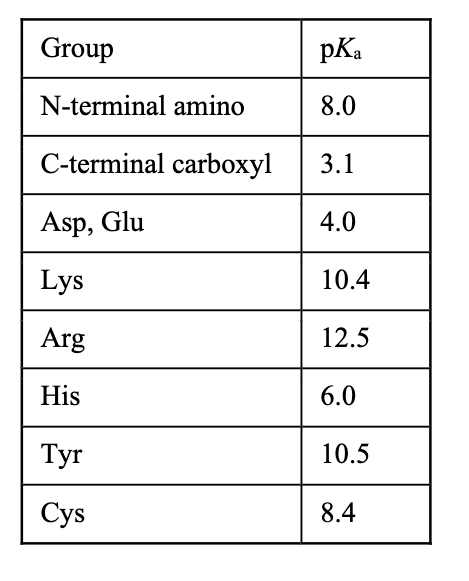
Determine the net charge of the following peptide at pH 4.7: AGLCEK. Use the pKa values in the table below. Report your answer to three figures. Recall that we will consider a group to be fully protonated (or unprotonated) if the separation between the pH and the pKa of the group being considered is 2 units or greater. This approximation will greatly simplify the math.
+0.191
Imagine that the peptide EALWRK was incubated with the protease trypsin. What would be the sequence(s) of the resulting fragment(s)? Use the one-letter code to indicate your answer.
EALWR + free K
Imagine that the peptide DAYWRG was incubated with the protease chymotrypsin. What would be the sequence(s) of the resulting fragment(s)? Use the one-letter code to indicate your answer.
DAY + free W + RG
Imagine that the peptide DAYWPG was incubated with the protease chymotrypsin. What would be the sequence(s) of the resulting fragment(s)? Use the one-letter code to indicate your answer.
DAY + WPG
Imagine that the peptide EALWRK was incubated with the protease carboxypeptidase A. What would be the sequence(s) of the resulting fragment(s)? Use the one-letter code to indicate your answer
EALWRK
Imagine that the peptide MAIWRMG was incubated with cyanogen bromide. What would be the sequence(s) of the resulting fragment(s)? Use the one-letter code to indicate your answer.
free M + AIWRM + free G
A sample of a hexapeptide that contains phenylalanine, lysine, arginine, glycine, serine, and methionine is incubated with Sanger’s reagent and the FDNB-derivative of glycine is detected. (Recall that Sanger’s reagent [1-fluoro-2,4- dintrobenzene, also simply called fluorodinitrobenzene (FDNB) or dinitrofluorobenzene (DNFB)] forms a covalent bond with the N-terminal amino group, and, after incubation with FDNB, the resulting sample is refluxed with 6 M HCl until all peptide bonds are broken; the resulting sample (along with appropriate standards) are then applied to a thin layer chromatography plate, developed with the appropriate solvent, and analyzed.) A second sample of the hexapeptide is incubated with chymotrypsin, and a tetrapeptide and dipeptide result. A third sample of the hexapeptide is incubated with trypsin, and free serine, free lysine, and a tetrapeptide result. Finally, a fourth sample of the hexapeptide is incubated with cyanogen bromide, and two tripeptides result. One of the tripeptides contains serine, arginine, and lysine. What is the sequence of the hexapeptide? Use the one-letter code to report your answer.
GFMRKS
Estimate/calculate the MW of the peptide shown below two ways. For the first way, use the weighted, average of the MW of an amino acid residue in a protein, and for the second way, enter the sequence of the peptide into the Protparam program that you can find online. Comment on how close the two values are, and, if the two estimates are different, speculate as to why that might be the case.
AGKLMWTYRIVCSTMPHAGFQNMAV
2750 Da and 2813 Da don’t agree with each other since the petide is small, and small amino acids don’t perform well.
Which of the following is least soluble in aqueous solutions?
palmitic acid
Within the aqueous environment of an animal cell, sugars are stored as polymers rather than as monomers. If the sugars were stored as monomers instead of polymers, which of the following properties would be LEAST affected?
pH

The adjacent series of reactions are at equilibrium. The formation of T can be increased by an increase in the concentration o all of the following EXCEPT.
N
If the reaction A+B→C is first order with respect to A and first order with respect to B, the the rate equation for the forward reaction would be ____.
rate = k[A][B]

The most likely amino acid that would yield the adjacent titration curve would be ___.
glycine
When 50 µL of a 14C sample is added into 10 mL of scintillation cocktail, a liquid scintillation counter reports 15,200 counts per minute (cpm), with an efficiency of 0.92. Which of the following is closet to the number of disintegrations per minute (dpm) in the 50 µL sample?
16,522 dpm