TLC of Photosynthetic Pigments 🍂

0.0(0)
studied byStudied by 0 people
0.0(0)
full-widthCall with Kai
learnLearn
examPractice Test
spaced repetitionSpaced Repetition
heart puzzleMatch
flashcardsFlashcards
GameKnowt Play
Card Sorting

1/13

encourage image

There's no tags or description

Looks like no tags are added yet.

Study Analytics
Name
Mastery
Learn
Test
Matching
Spaced
Call with Kai

No study sessions yet.

14 Terms

1
New cards

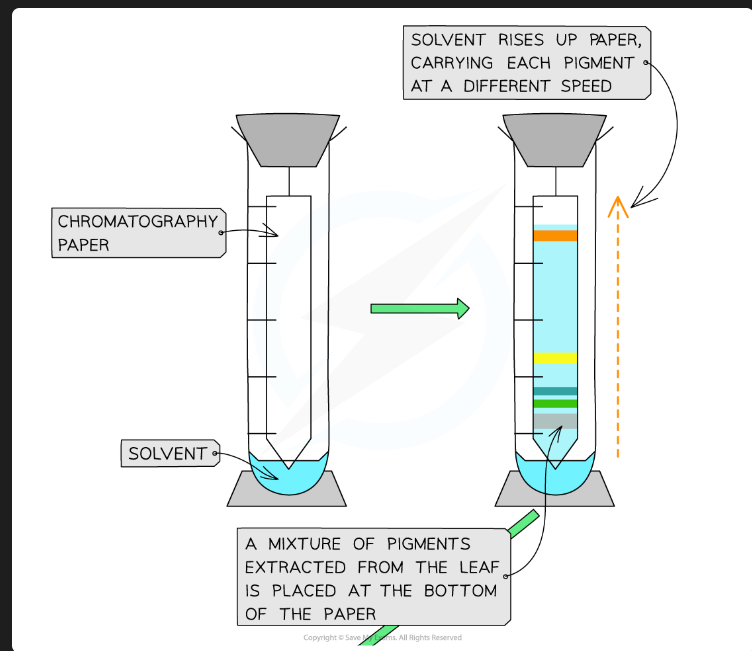
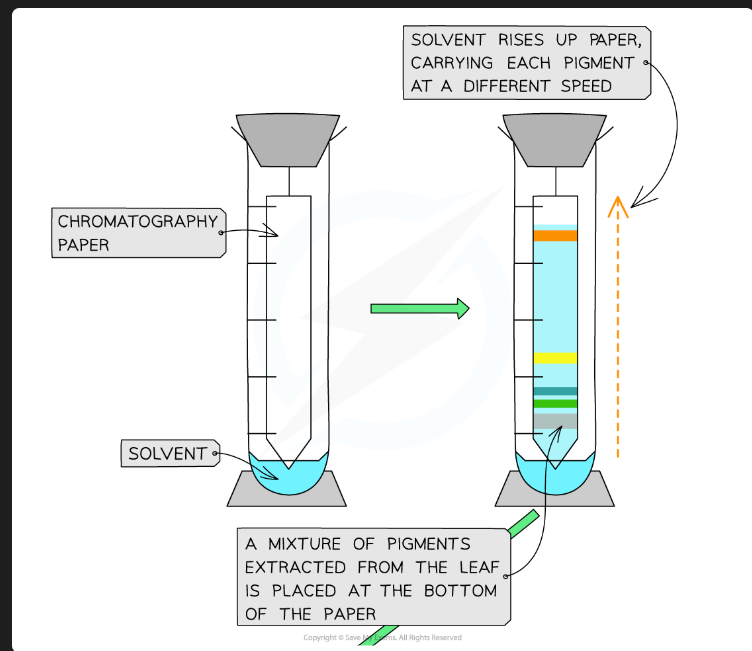
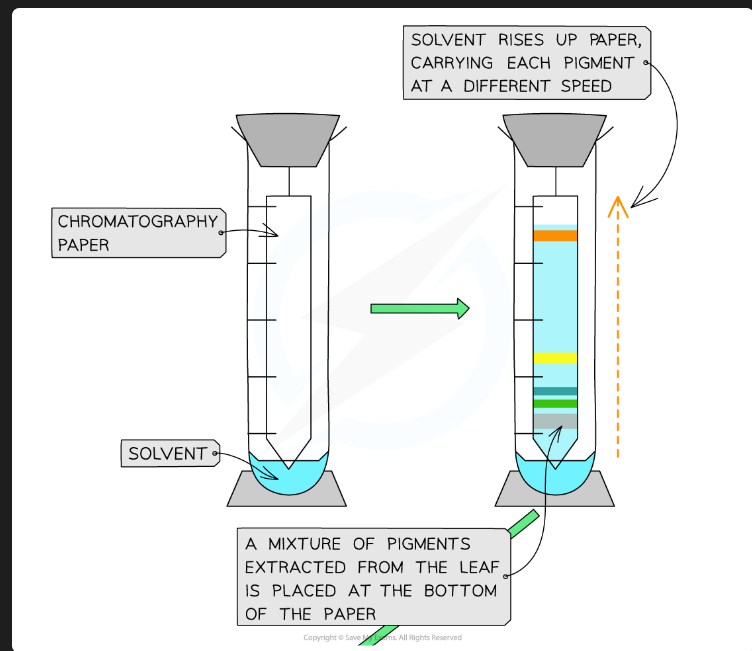
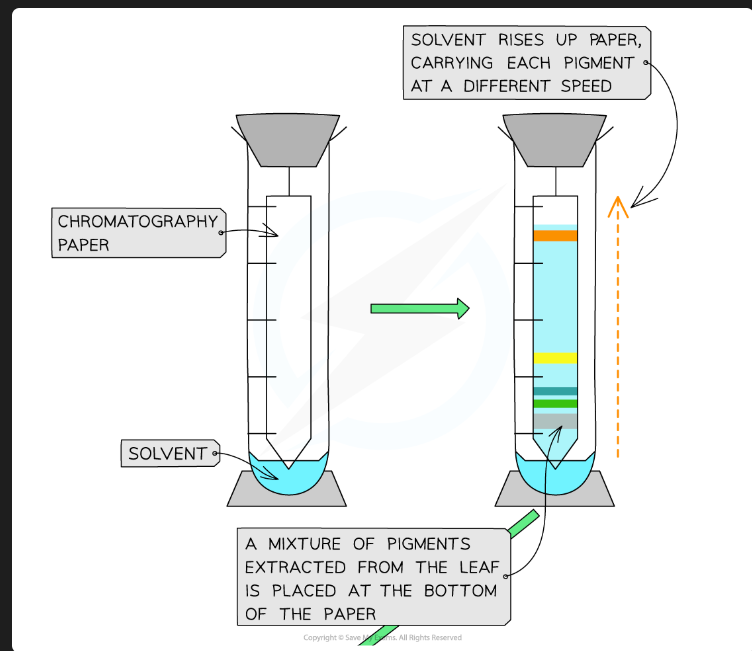
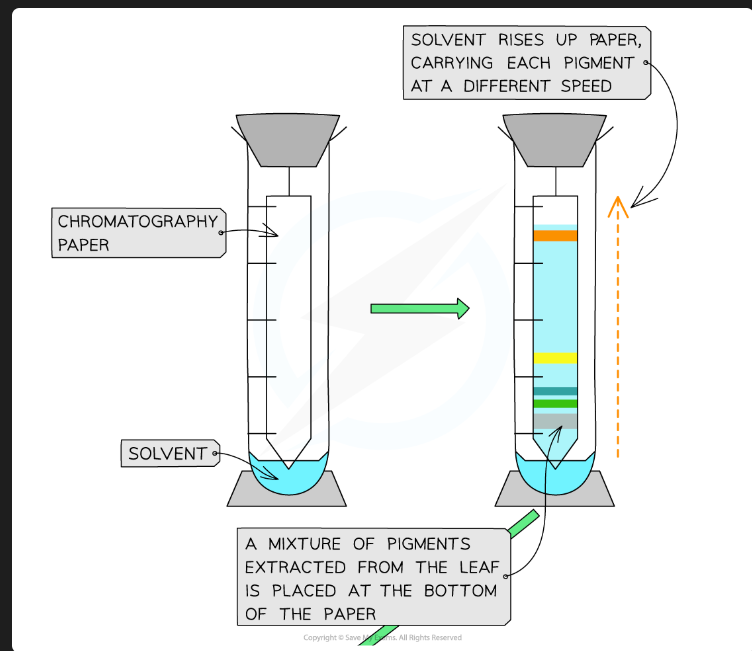
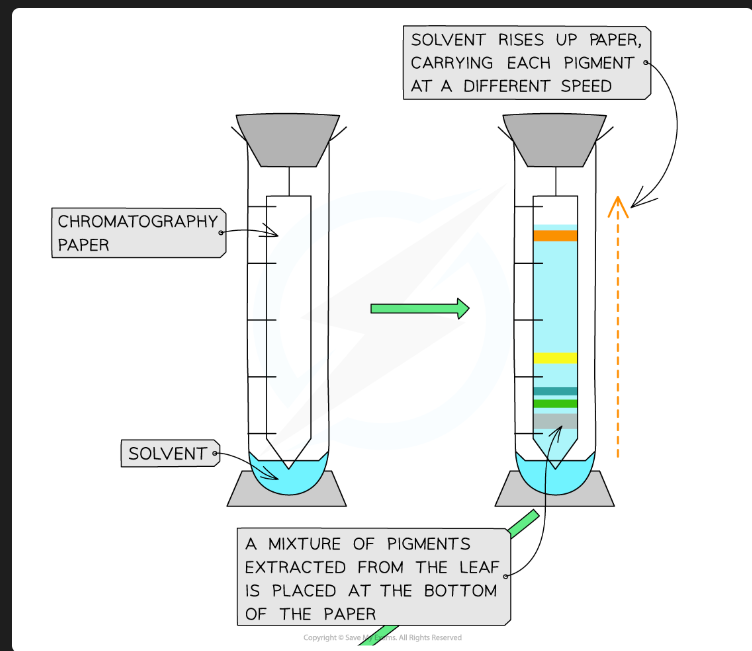
What is the purpose of thin-layer chromatography (TLC) for pigments?

  • To separate the different photosynthetic pigments (e.g., chlorophyll a, chlorophyll b, carotenoids) from a leaf extract.
<ul><li><p>To <strong>separate</strong> the different photosynthetic pigments (e.g., chlorophyll a, chlorophyll b, carotenoids) from a leaf extract.</p></li></ul><p></p>
2
New cards

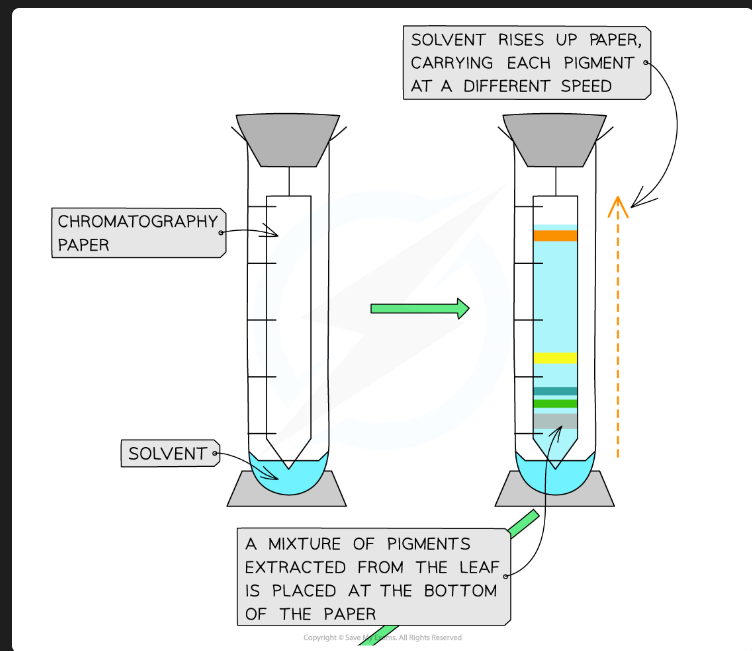
What are the stationary phase and mobile phase in this practical?

  • Stationary Phase: The TLC plate (coated in silica gel or alumina).

  • Mobile Phase: The solvent (e.g., a mixture of organic solvents).
<ul><li><p><strong>Stationary Phase:</strong> The <strong>TLC plate</strong> (coated in silica gel or alumina).</p></li><li><p><strong>Mobile Phase:</strong> The <strong>solvent</strong> (e.g., a mixture of organic solvents).</p></li></ul><p></p>
3
New cards

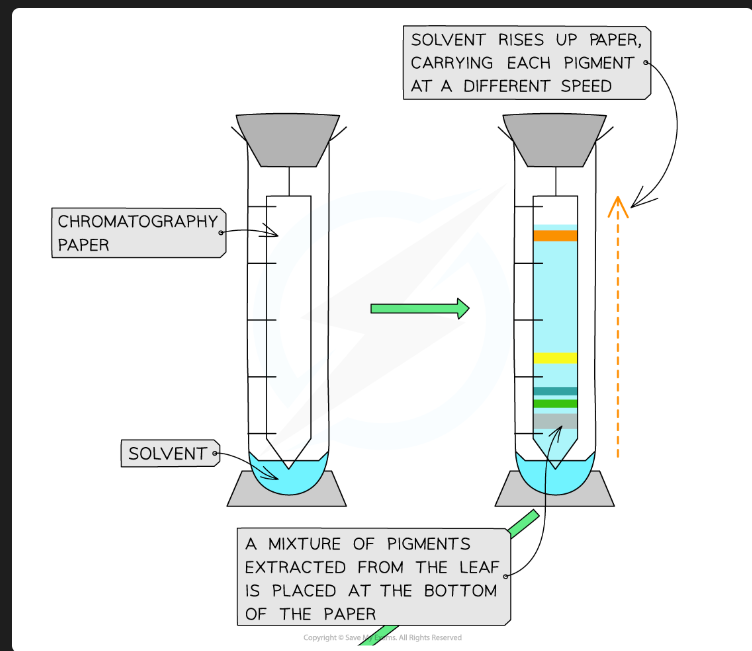
On what principle does separation by TLC depend?

  • Separation is based on the solubility of the pigment in the mobile phase vs. its affinity/adsorption to the stationary phase.
<ul><li><p>Separation is based on the <strong>solubility</strong> of the pigment in the mobile phase vs. its <strong>affinity/adsorption</strong> to the stationary phase.</p></li></ul><p></p>
4
New cards

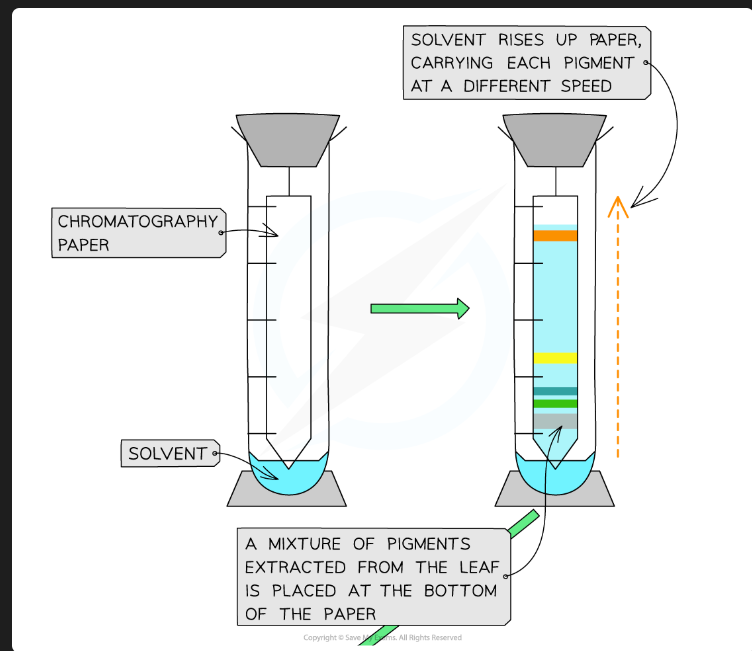
Which pigments travel furthest up the plate?

  • The pigments that are most soluble in the mobile phase and have the lowest affinity (are least strongly adsorbed) to the stationary phase.
<ul><li><p>The pigments that are <strong>most soluble</strong> in the mobile phase and have the <strong>lowest affinity</strong> (are least strongly adsorbed) to the stationary phase.</p></li></ul><p></p>
5
New cards

Why must the origin line be drawn in pencil?

  • Pencil is insoluble in the solvent. If you used an ink pen, the ink pigments would dissolve and separate along with the plant pigments, invalidating the results.
<ul><li><p>Pencil is <strong>insoluble</strong> in the solvent. If you used an ink pen, the ink pigments would dissolve and separate along with the plant pigments, invalidating the results.</p></li></ul><p></p>
6
New cards

Why must the solvent level in the beaker be below the origin line?

  • If the solvent is above the origin, the pigment spot will just dissolve into the reservoir of solvent at the bottom instead of being carried up the plate.
<ul><li><p>If the solvent is <em>above</em> the origin, the pigment spot will just <strong>dissolve</strong> into the reservoir of solvent at the bottom instead of being carried <em>up</em> the plate.</p></li></ul><p></p>
7
New cards

Why should you put a lid on the beaker?

  • To create a saturated atmosphere (the air is saturated with solvent vapour). This prevents the solvent from evaporating from the surface of the plate as it moves up, which ensures an even run.
<ul><li><p>To create a <strong>saturated atmosphere</strong> (the air is saturated with solvent vapour). This <strong>prevents the solvent from evaporating</strong> from the surface of the plate as it moves up, which ensures an even run.</p></li></ul><p></p>
8
New cards

How do you calculate the Rf value (retardation factor)?

R_f = \frac{\text{Distance moved by pigment spot}}{\text{Distance moved by solvent front}}
<p>$$R_f = \frac{\text{Distance moved by pigment spot}}{\text{Distance moved by solvent front}}$$ </p>
9
New cards

An R value is always...

  • ...less than 1. (Because the solvent front always moves further than any pigment spot).
<ul><li><p>...<strong>less than 1</strong>. (Because the solvent front <em>always</em> moves further than any pigment spot).</p></li></ul><p></p>
10
New cards

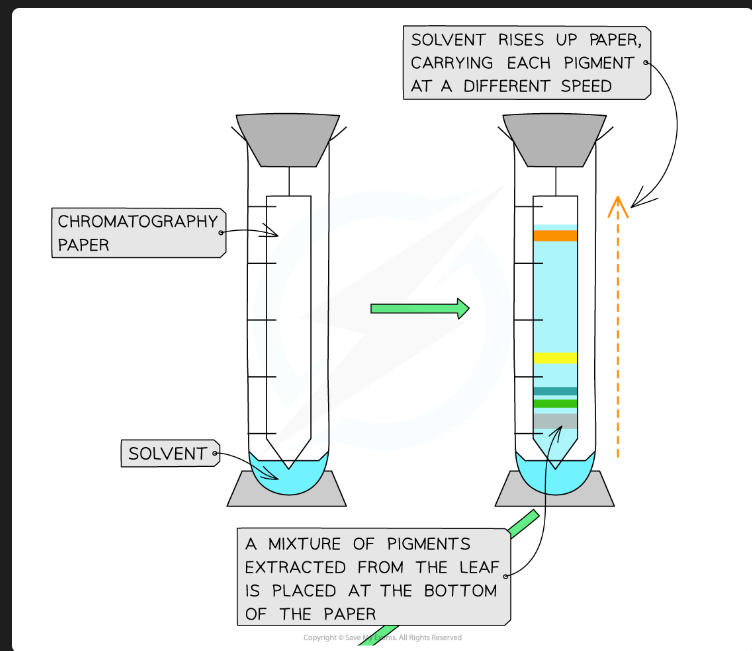
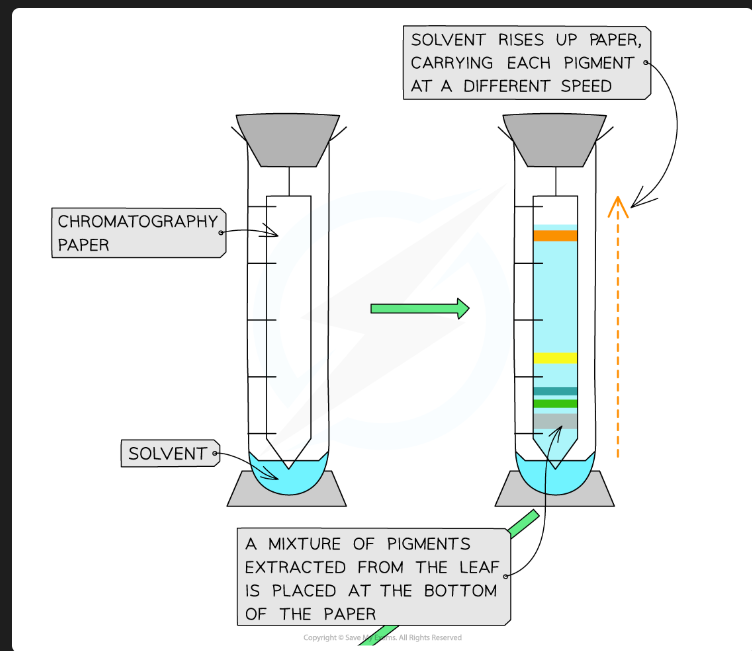
What pigments would you expect to see, in order from top to bottom?

  • Carotenes (e.g., Beta-carotene - orange)

  • Xanthophylls (yellow)

  • Chlorophyll a (blue-green)

  • Chlorophyll b (yellow-green)

    (Chlorophyll b is the most polar/least soluble, so it's at the bottom).
<ul><li><p><strong>Carotenes</strong> (e.g., <span>Beta</span>-carotene - orange)</p></li><li><p><strong>Xanthophylls</strong> (yellow)</p></li><li><p><strong>Chlorophyll a</strong> (blue-green)</p></li><li><p>Chlorophyll b (yellow-green)</p><p>(Chlorophyll b is the most polar/least soluble, so it's at the bottom).</p></li></ul><p></p>
11
New cards

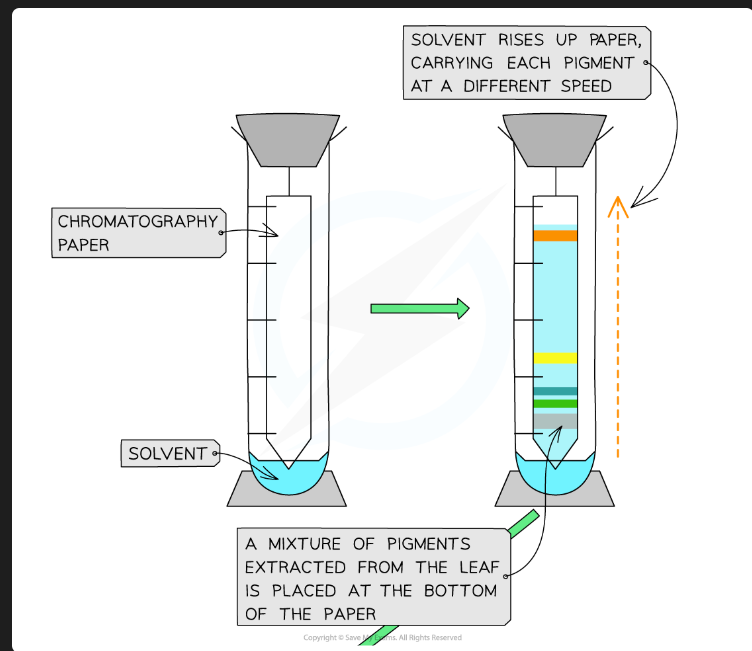
Describe a method to separate photosynthetic pigments from a leaf using thin-layer chromatography (TLC).(6 marks)

  • Extract: Grind a leaf with a solvent (e.g., propanone) and sand (using a pestle and mortar).

  • Origin: Draw a pencil line (origin) near the bottom of a TLC plate.

  • Spot: Use a capillary tube to build up a small, concentrated spot of the pigment extract on the origin.

  • Chamber: Place the plate in a beaker with a small amount of solvent (mobile phase), ensuring the solvent level is below the origin line.

  • Run: Cover the beaker (e.g., with a watch glass) and allow the solvent to run up the plate.

  • Finish: Remove the plate when the solvent front is near the top and immediately mark its position in pencil.

  • Analyse: Calculate Rf values for each separated spot.
<ul><li><p><strong>Extract:</strong> <strong>Grind</strong> a leaf with a solvent (e.g., propanone) and sand (using a pestle and mortar).</p></li><li><p><strong>Origin:</strong> Draw a <strong>pencil line</strong> (origin) near the bottom of a TLC plate.</p></li><li><p><strong>Spot:</strong> Use a <strong>capillary tube</strong> to build up a small, <strong>concentrated spot</strong> of the pigment extract on the origin.</p></li><li><p><strong>Chamber:</strong> Place the plate in a beaker with a small amount of <strong>solvent</strong> (mobile phase), ensuring the solvent level is <strong>below the origin line</strong>.</p></li><li><p><strong>Run:</strong> <strong>Cover</strong> the beaker (e.g., with a watch glass) and allow the solvent to run up the plate.</p></li><li><p><strong>Finish:</strong> Remove the plate when the <strong>solvent front</strong> is near the top and <strong>immediately mark its position</strong> in pencil.</p></li><li><p><strong>Analyse:</strong> Calculate <span>Rf&nbsp;</span>values for each separated spot.</p></li></ul><p></p>
12
New cards

In a TLC experiment, the solvent front moved 9.2 cm from the origin. A yellow pigment spot moved 6.8 cm from the origin. Calculate the Rf value for this pigment. (Show your working).

<p></p>
13
New cards

Front: Explain the principle of separation in TLC. Why do different pigments travel at different speeds?

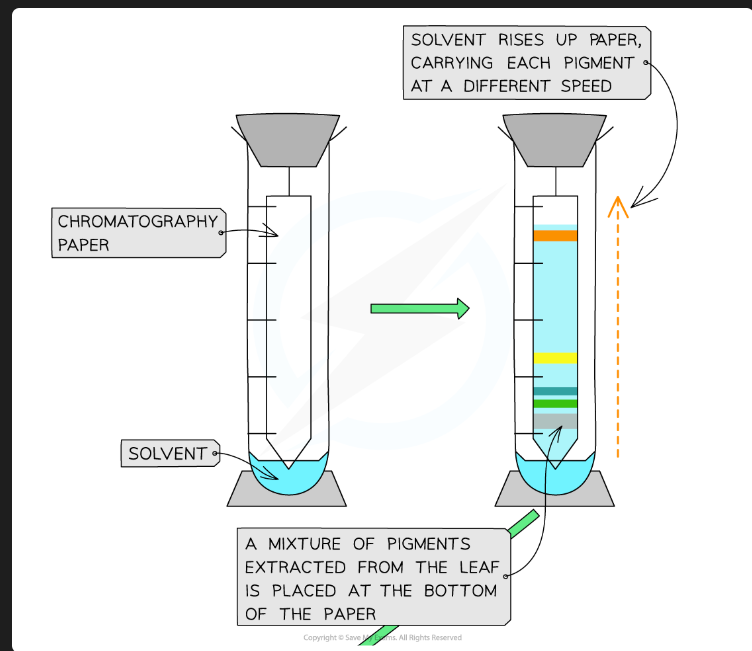
  • The principle involves two phases: a stationary phase (the TLC plate) and a mobile phase (the solvent).

  • Pigments have different solubilities in the mobile phase and different affinities (adsorption) for the stationary phase.

  • A pigment that is more soluble in the solvent and has a lower affinity for the plate will be carried further up.

  • A pigment that is less soluble and has a higher affinity for the plate will travel slower and not as far.
<ul><li><p>The principle involves two phases: a <strong>stationary phase</strong> (the TLC plate) and a <strong>mobile phase</strong> (the solvent).</p></li><li><p>Pigments have different <strong>solubilities</strong> in the mobile phase and different <strong>affinities</strong> (adsorption) for the stationary phase.</p></li><li><p>A pigment that is <strong>more soluble</strong> in the solvent and has a <strong>lower affinity</strong> for the plate will be carried <strong>further up</strong>.</p></li><li><p>A pigment that is <strong>less soluble</strong> and has a <strong>higher affinity</strong> for the plate will travel <strong>slower and not as far</strong>.</p></li></ul><p></p>
14
New cards

A student failed to put a lid on the developing tank. Explain what effect this would have on the Rf values.

  • Without a lid, the solvent will evaporate from the surface of the plate as it moves up.

  • This will slow down the movement of the solvent front, so the solvent front will not travel as far as it should.

  • This would lead to higher (and inaccurate) Rf values, as the denominator (distance moved by solvent front) would be artificially small.
<ul><li><p>Without a lid, the <strong>solvent will evaporate</strong> from the surface of the plate as it moves up.</p></li><li><p>This will <strong>slow down</strong> the movement of the solvent front, so the <strong>solvent front will not travel as far</strong> as it should.</p></li><li><p>This would lead to <strong>higher (and inaccurate) </strong><span><strong><span>R</span><sub><span>f</span></sub></strong></span><strong> values</strong>, as the denominator (<span><span>distance moved by solvent front</span></span>) would be artificially small.</p></li></ul><p></p>