Surf's Up Dude! - Page 81-92 in Resource Binder
 Studied by 0 people
 Call Kai
 Learn
Learn Practice Test
 Spaced Repetition
 Match
Match Flashcards
 Knowt Play
1/77

There's no tags or description
Looks like no tags are added yet.
Name | Mastery | Learn | Test | Matching | Spaced | Call with Kai |
|---|
No study sessions yet.
78 Terms
What are the eight factors that affect a coast’s character?
Wave action, rock type, slope, sea/land level changes, volcanic activity, coral formations, glaciers, action of man
What is the bottom of a wave called?
trough
What is the top of a wave called?
Crest
Water grows into waves under _____________ pressure
wind
What happens to a wave when it enters shallow water?
It breaks and the top of it is thrown forward
What is swash?
Water that goes up the shore from a breaking wave
What is backwash?
Water coming back down the shore from a breaking wave
What is meant by the highest water level?
the level reached by the most powerful storm waves
The height and power of the wind depend upon the ______________________________________________
strength and fetch of the wind
What is the fetch?
distance of open water over which wind blows
Describe how wind creates ripples in the water as step one in wave formation
Wind blows over the sea in layers that experience drag from the water and one another. The top layer with the least drag moves fastest and eventually develops circular motion exerting downwards pressure at the front and upwards pressure at the back
Wind presses on the __________ of a developing wave ultimately causing it to grow bigger
back
What is more powerful: swash or backwash? Why
swash because it has the force of the breaking wave behind it.
What is a constructive wave?
a wave that breaks at a rate of ten or less a minute, meaning each breaking wave is able to run its course without interference from the wave behind it.
What is a destructive wave?
When waves break more frequently, especially over fifteen a minute, then the backwash of a wave runs into the swash of the wave behind. The force of the swash is therefore reduced in comparison with the force of the backwash. These waves remove pebbles and sand from a coast. They are destructive waves.
What are the three kinds of erosion a wave can cause?
Corrasion, hydraulic action and attrition
What is corrasive action?
boulders, pebbles and sand are hurled against the base of a cliff by breaking waves and this causes undercutting and rock break-up.
What is hydraulic action?
water thrown against a cliff face by breaking waves causes air in cracks and crevices to become suddenly compressed. When the waves retreat the air expands; often explo- sively. This action causes the rocks to shatter as the cracks become enlarged and extended.
What is attrition?
Boulders and pebbles dashed against the shore are themselves broken into finer and finer particles.
Give a real-world example of a wave-cut platform
The Strandflat off the west coast of Norway
Where do caves develop?
along a line of weakness at the base of a cliff which has been subjected to prolonged wave action.
What is a cave?
cylindrical tunnel which extends into the cliff following the joint, and whose diameter decreases from the entrance.
Under what conditions will a cave form a blowhole?
If a joint extends from the end of the tunnel to the top of the cliff, this becomes enlarged in time and finally opens out on the cliff top to form a blow hole.
What do a cave and a blowhole eventually form after erosive action wears them away?
A narrow sea inlet.
What kind of cave will create an arch?
Caves which develop on either side of a headland and ultimately join together, give rise to a natural arch.
What is formed when an arch collapses?
When the arch collapses, the end of the headland stands up as a stack.
What is the end stage of a stack?
Eventually stacks will disappear completely due to wave erosion.
What is the load?
All the material carried by breaking waves
What are the three key sources of the load?
rivers entering the sea, landslides on cliffs, and wave erosion.
What materials are commonly found in the load?
mud, sand and shingle
Outline longshore drift and the circumstances under which it happens
material being moved along the beach by waves breaking obliquely
What can stop the movement of material by longshore drift?
groynes or walls out to sea
What is the underlow?
an under current which balances the piling up of water along the coast by breaking waves and high tides
What carries material off-shore into deeper water ?
The underlow
What are the three cardinal wave depositional features,
Beaches, spits/ bars and mud flats
What coast type will erosion dominate at?
A highland coast
What coast type will deposition dominate at?
A lowland coast
What is the main action of constructive waves?
The main action of constructive waves is to deposit pebbles, sand and mud, which, when deposited along a coast, form a gently sloping platform, called a beach.
How is beach material transported?
Longshore drift
Describe the depositional process for storm beaches
storm waves throw material beyond the normal level reached by waves at high tide.
What dominates in bays?
Typically deposition as wave action isn’t strong
What is a spit?
Material deposited further along the coast by longshore drift forming a low, narrow ridge of pebbles or sand joined to the land at one end with the other end terminating in the sea
What is a bar?
Similar to a spit, a common type of bar extends right across a bay known as a “bay-bar”. This starts as a spit growing out from a headland but ultimately it stretches across the bay to the next headland.
What kind of action prevents the bar from “being continuous”?
tidal action
On what kind of coast will an offshore bar develop?
Gently sloping coasts
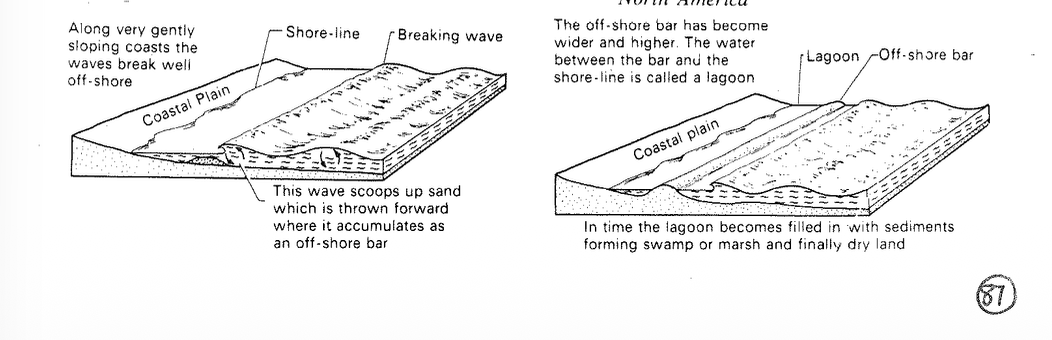
What is this diagram pair showing?
How an offshore bar can be built by wave action
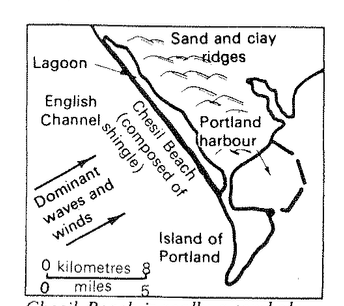
What feature is Chesil Beach? Why?
A tombolo because it connects the island of portland to the mainland
How do mud flats develop?
Tides tend to deposit fine silts along gently shelving coasts, especially in bays and
estuaries. The deposition of these silts together, perhaps, with river alluvium, results in the building up of a platform of muds called a mud flat.
What happens to mud flats over time?
Salt tolerant plants soon begin to colonise the mud flat which, in time, becomes a marsh or swamp.
What do mudflats often become in tropical regions?
Mangrove swamps
What is a mangrove?
a salt-tolerant tree or shrub that grows in coastal saline or brackish water in tropical/subtropical regions (AI generated)
What are the two broad categories of coastline type?
submergent and emergent
What are the subcategories of coast types?
highland / lowland submerged or emerged coastlines
Name three types of submerged, highland coasts
Ria, Longitudinal and Fjord coasts
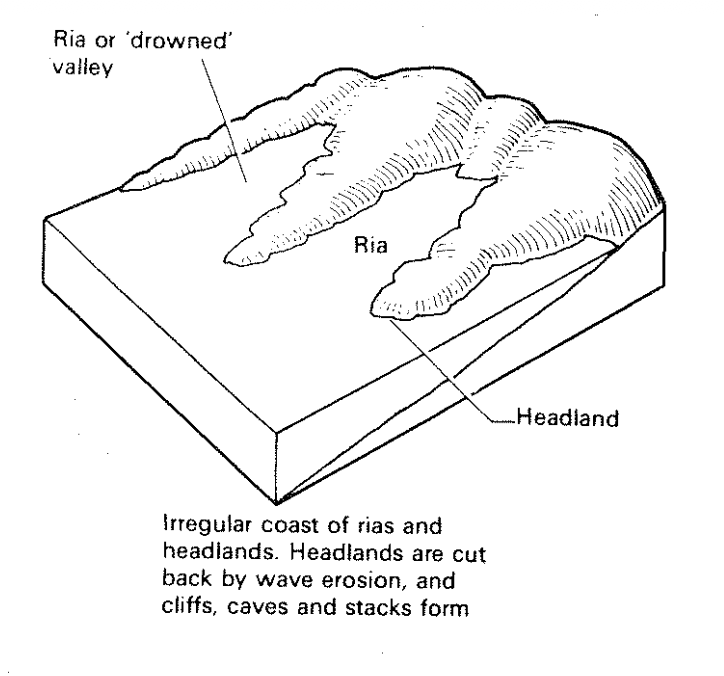
What is a Ria Coastline?
lower parts of river valleys underwater forming a submerged highland coast
What happens to the tips of headlands in a ria coast?
Due to submergence the coast becomes indented and the tips of headlands may be turned into islands.
What is a longitudinal coast?
When a highland coast whose
valleys are parallel to the coast is submerged, some
of the valleys are flooded and the separating moun-
tain ranges become chains of islands. These valleys
are sometimes called sounds, e.g. Puget Sound in
Washington (U.S.A.)
What is a fjord coast?
When glaciated highland coasts be-
come submerged the flooded lower parts of the
valleys are called fiords.
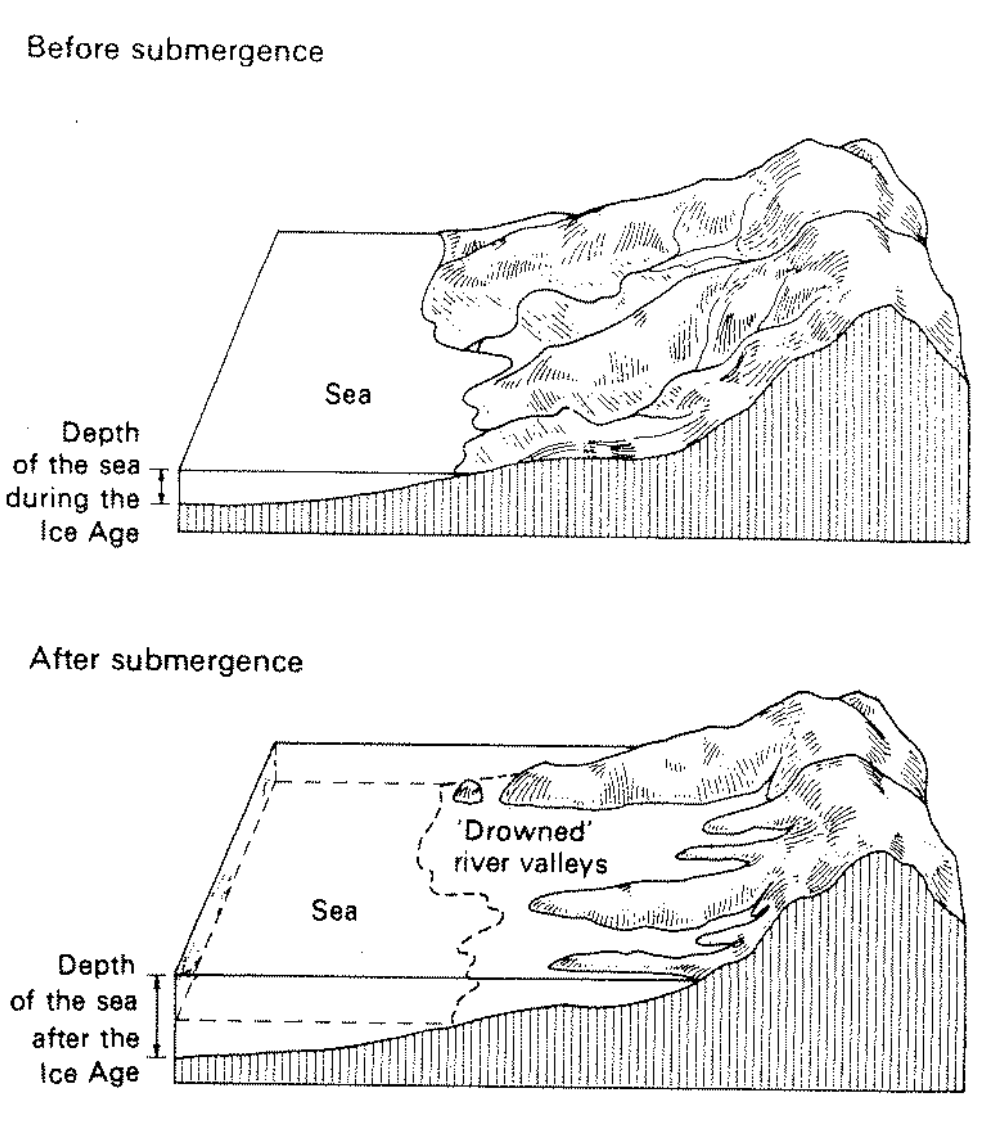
What coastline is shown here?
A ria coast
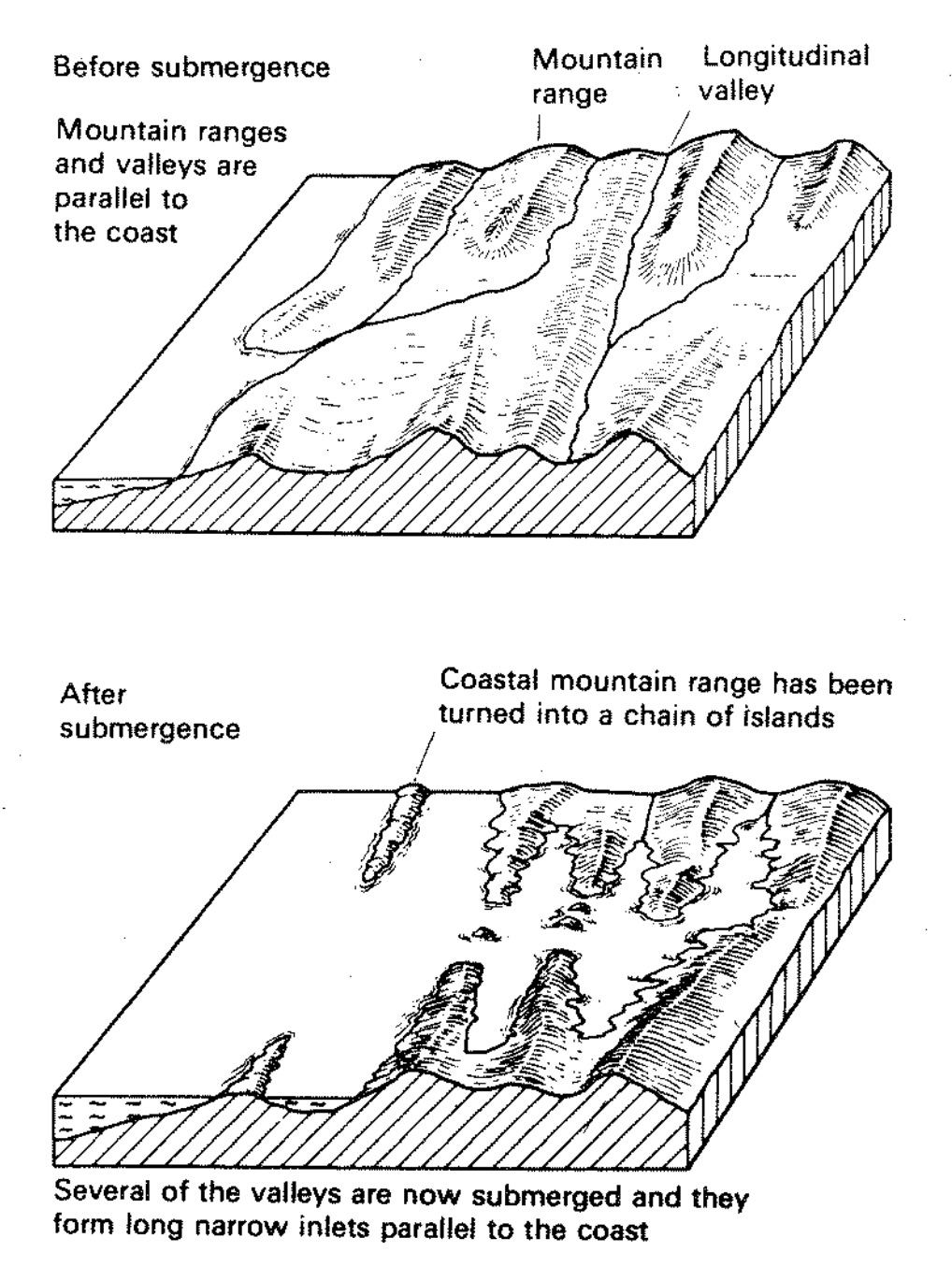
What coastline is shown here?
What _________ the fjord is much deeper than at the entrance of the fjord
inside
Is water deeper in a fjord or ria?
Fjord
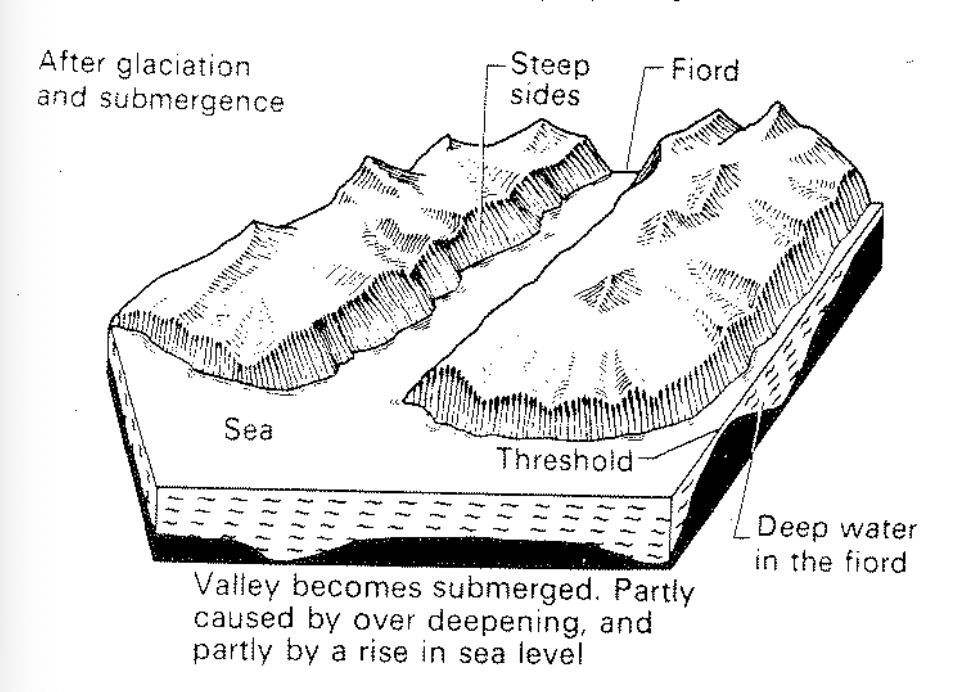
What two phases preceded this drowned fjord coastline?
Previously it was a river valley with interlocked spurs. After that it housed a valley glacier that deepened and widened it.
Both Rias and fjords provide natural ________
harbours
Why are fjords useless as ports?
mountainous country makes it difficult to get inland from the head of a fjord
Why are rias more suitable for ports?
typically easy to get inland from the head of a ria
Outline settlement patterns on a fjord
Settlement is difficult along the sides of a fiord
because there is little or no level land. Fiord
settlements occur at the head of a fiord where
there is level land.
What will this coastline look like in late maturity?
cut back beyond the heads of the bays and almost straight
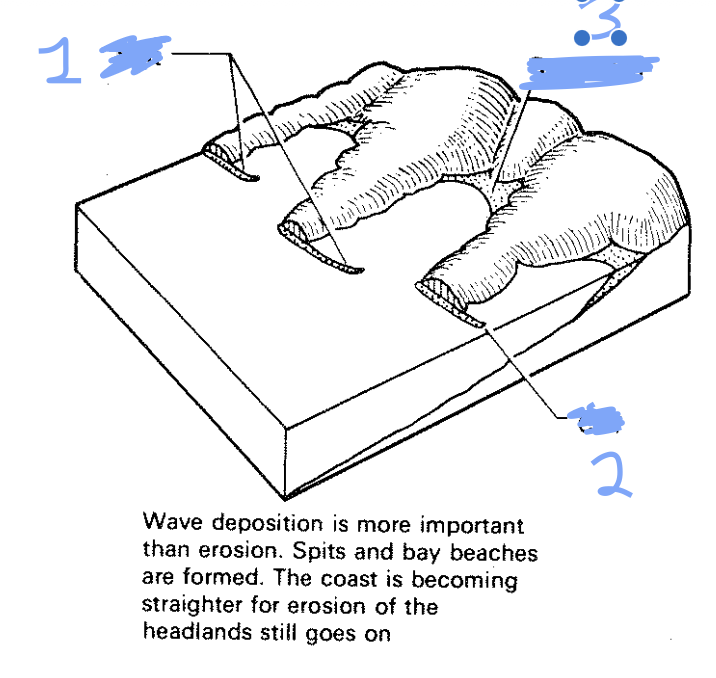
What are features 1,2 and 3 (in that order)?
Spits, cliff, bay beach.
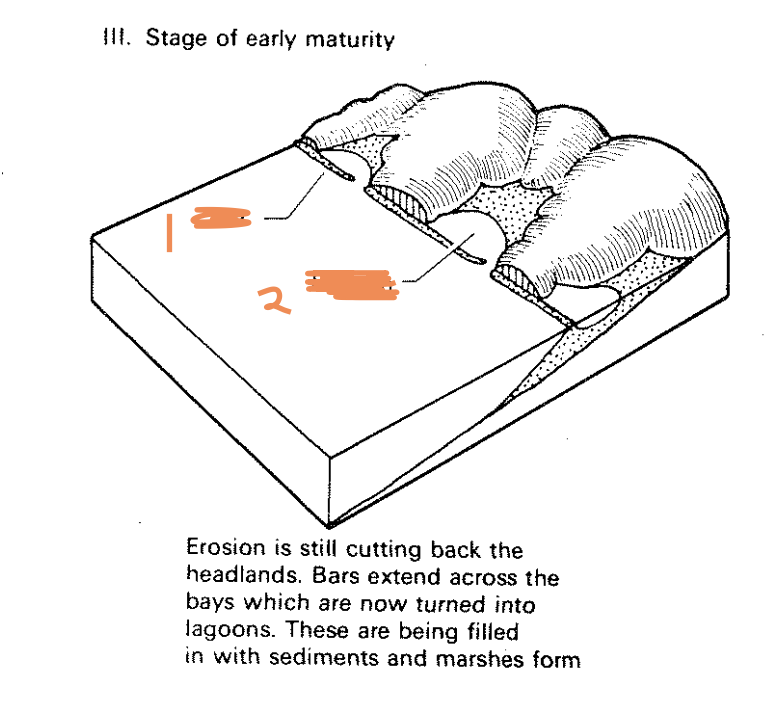
What are features 1 and 2?
A bar, a Lagoon (almost)
What’s an estuary?
Seawater and freshwater mix as a rise in sea level along a lowland coast
floods parts of a river valley forming an estuary
What is often found at low tide in estuaries?
marshes, swamps and mud flats
Where are some estuarine coasts commonly found?
The baltic coasts of Poland and Germany as well as the Dutch coast.
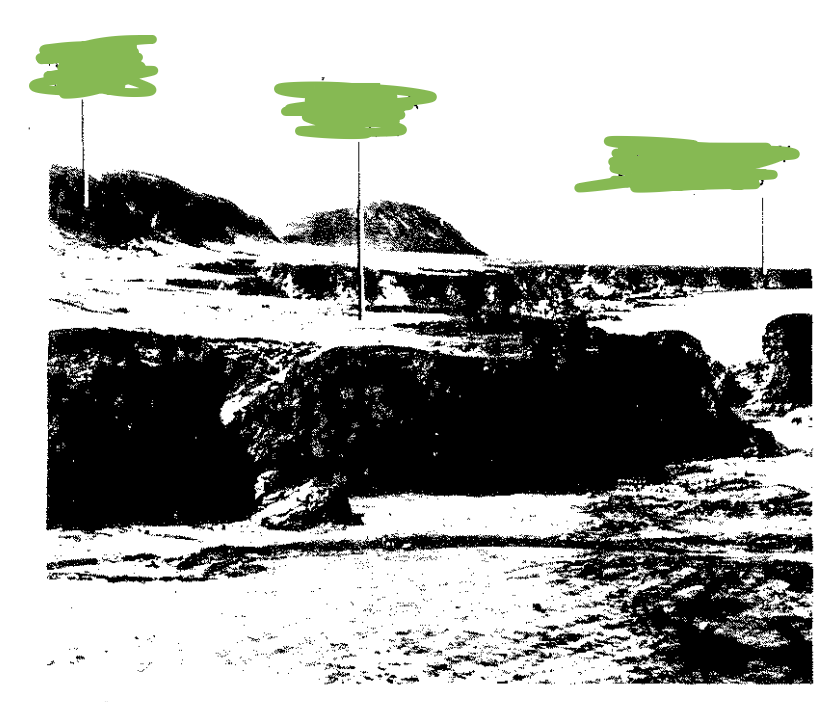
What are the green spots from left to right?
Old sea cliffs, Old sea beach, present day sea cliffs.
What feature do you often find at emerged highland coasts?
Raised beaches
When does an emerged lowland coast occur? What characterizes it?
when a part of the continental shelf emerges from the sea and forms a coastal plain.
The coast has no bays or headlands and deposition takes place in the shallow water off-shore, producing off-shore bars, lagoons, spits and beaches.
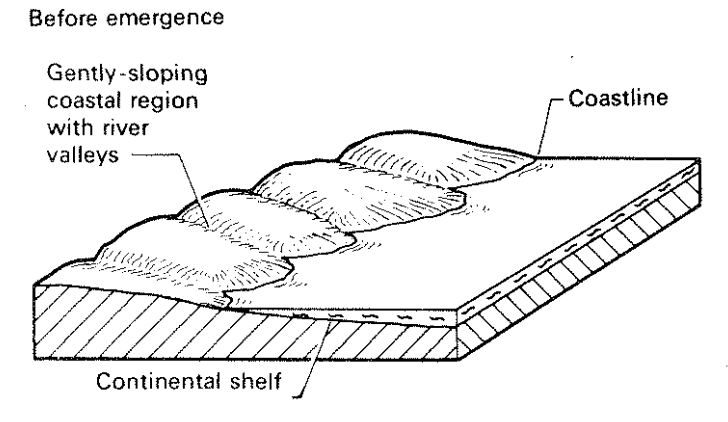
What coast is shown here?
lowland coast before emergence
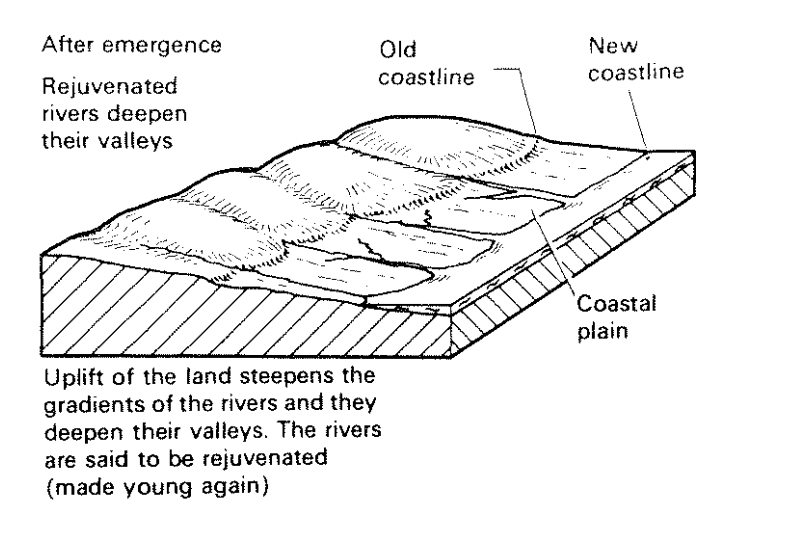
What coast is shown here?
A lowland coast after emergence