Social categorization
 Call Kai
 Learn
Learn Practice Test
 Spaced Repetition
 Match
Match Flashcards
 Knowt Play
1/34

There's no tags or description
Looks like no tags are added yet.
Name | Mastery | Learn | Test | Matching | Spaced | Call with Kai | Chat |
|---|
No analytics yet
Send a link to your students to track their progress
35 Terms
Categorization
The process of understanding what something is by knowing what other things it is equivalent to and what other things it is different from
What defines typicality is the WHAT of the category
What defines typicality is the PROTOTYPES of the category
What are prototypes
The most representative members of a category - they are the most available
Categorization of less typical members may be WHAT or prone to WHAT because they are less WHAT (making accommodations to our schemas)
Categorization of less typical members may be SLOWER or prone to ERROR because they are less AVAILABLE (making accommodations to our schemas)
When dealing with social categories we refer to prototypes as WHAT
When dealing with social categories, we refer to prototypes as STEREOTYPES
Illusory correlation
the belief that two variables are associated with one another when in fact there is little or no actual association
Category structure can be split into two things
WHAT
WHAT
Category structure can be split into two things
Homogenous
Heterogenous
Homogenous
Perceived to be made up of many different sorts of people
Heterogenous
Perceived to be made up of only a few types of people who are all very similar to each other
What is out group homogeneity effect
The general tendency that people have to perceive outgroup members to be more homogenous than ingroup members
Categorization does two things
WHAT
WHAT
Categorization does two things
Save us time in cognitive processing
Clarifies and refines our perception of the world (reduces uncertainty and predicts social behaviour) (meaning)
What are the three key factors that determine whether a category will be activated without awareness:
WHAT
WHAT
WHAT
What are the three key factors that determine whether a category will be activated without awareness:
Temporal primacy
Perceptual primacy
Chronic accessibility
Temporal primacy
we categorize on the basis of the features we encounter first
Perceptual salience
When difference becomes salient (male in a room of females)
Chronic accessibility
categorization in terms of some categories - race, age, gender- is so common that it can become automatized
The problem with trying to suppress a stereotype
When an individual is no longer trying to suppress their stereotype, and encountering a member of the stereotype category it can result in WHAT stereotyping and stereotype-WHAT behaviour than if no attempt was made to suppress the stereotype in the first place
The problem with trying to suppress a stereotype
When an individual is no longer trying to suppress their stereotype, and encountering a member of the stereotype category it can result in GREATER stereotyping and stereotype-CONSISTENT behaviour than if no attempt was made to suppress the stereotype in the first place
Consequences of categorization
Categorization leads to heightened accessibility of WHAT information
Stereotypes can influence our WHAT and what we WHAT about social scenes
Increase WHAT
Increase WHAT
Consequences of categorization
Categorization leads to heightened accessibility of STEREOTYPE-CONSISTENT information
Stereotypes can influence our ATTENTION and what we REMEMBER about social scenes
Increase ASSIMILATION
Increase CONTRAST
Assimilation
The cognitive tendency to perceive members of the same group as more similar to one another than they actually are
Contrast
the tendency to exaggerate the differences between different social groups.
prejudice
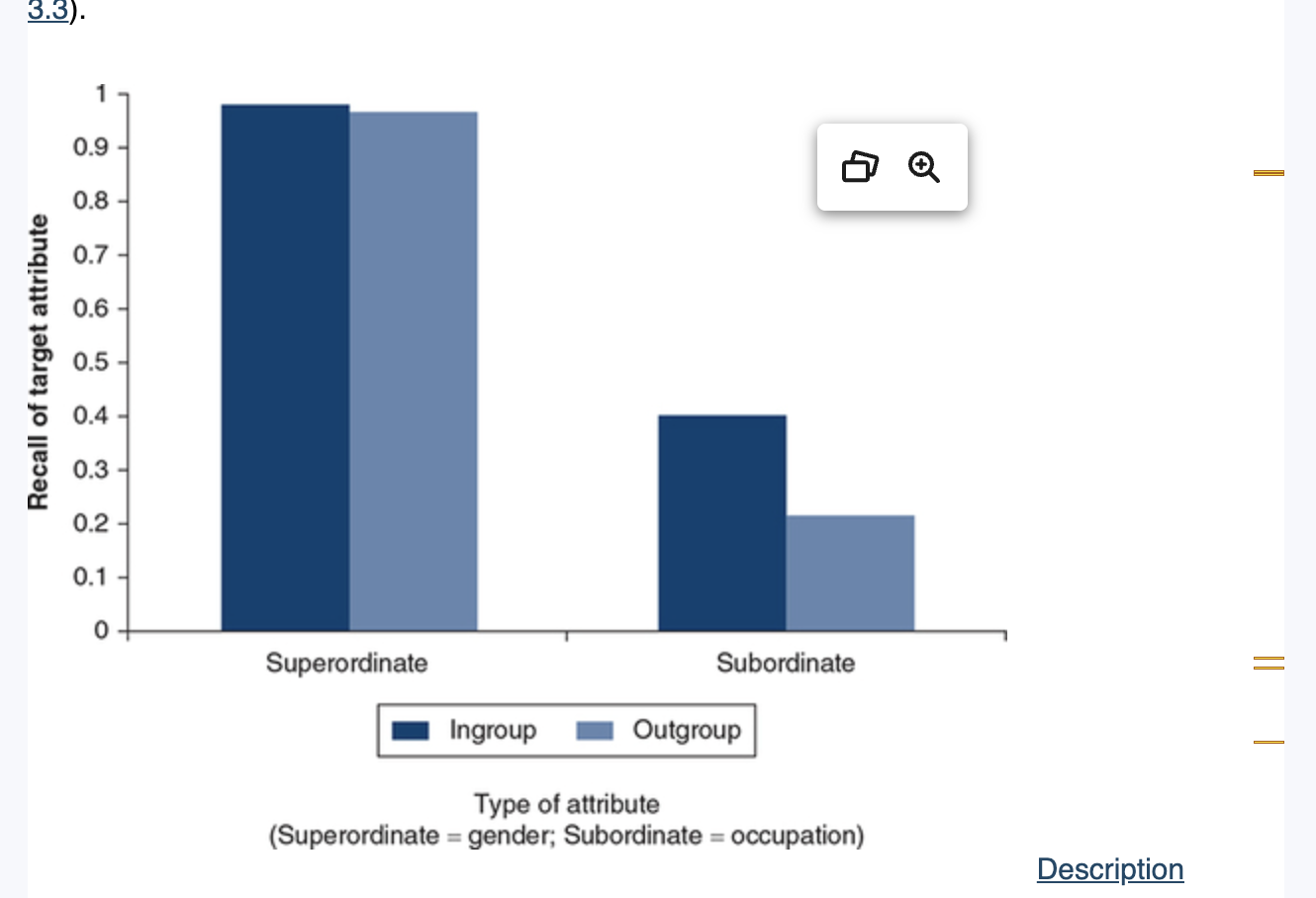
People recall more WHAT than WHAT information about someone in their group and more WHAT about someone in another group
prejudice
People recall more POSITIVE than NEGATIVE information about someone in their group and more NEGATIVE about someone in another group
Inconsistent information is WHAT - sometimes is better remembered but remembering inconsistent information requires WHAT effort
Inconsistent information is SALIENT - sometimes is better remembered but remembering inconsistent information requires COGNITIVE effort
cognitive overload
A condition that encourages the use of heuristics - leads people to use categories and stereotypes, therefore reducing memory of inconsistent information
Even when stereotype-inconsistent information is remembered its remembered as an WHAT to the rule or a WHAT
Even when stereotype-inconsistent information is remembered its remembered as an EXCEPTION to the rule or a SUBTYPE
behavioural assimilation
when thinking about categories people unconsciously begin to act in line with the stereotype associated with those categories
People who are WHAT with a category start to act like that category - Behavioural assimilation
People who are PRIMED with a category start to act like that category - Behavioural assimilation
Priming
Activating a specific attitude, for example a stereotype, can exert an influence on people’s subsequent behaviour
Stereotyping threat
predicament felt by people in situations where they could conform to negative stereotypes associated with their own group membership, do worse because they believe the stereotype,
Example
African Americans do worse on a test because they know the stereotype of them being dumb
Cognitive load can be a cause for WHAT - this is because the negative stereotype causes them to expend more WHAT when performing the task at hand
Cognitive load can be a cause for STEREOTYPING THREAT - this is because the negative stereotype causes them to expend more COGNITIVE EFFORT when performing the task at hand
Example:
Am i making mistakes
Those experiencing stereotyping threat become more motivated to identify and WHAT any indication that they might be conforming to the stereotype - but this causes WHAT results since you are expending WHAT energy on smth else
Those experiencing stereotyping threat become more motivated to identify and SUPPRESS any indication that they might be conforming to the stereotype - but this causes POORER results since you are expending MORE energy on smth else
Individuals conform more to their group norms when
WHAT
WHAT
Individuals conform more to their group norms when
Drawing on multiple social identities
Reframing a threat as a challenge
Drawing on multiple social identities
We have multiple WHAT (age, gender, ethnicity); therefore, it depends on which identity is WHAT at the time if a stereotype threat emerges
If given a good and bad stereotype simultaneously, the stereotype threat was WHAT (they believed they only focused on the good one)
Additionally, people who have successfully negotiated counter-sterotypic domain such as women who are successful in male-dominated fields, can deflect WHAT
Drawing on multiple social identities
We have multiple IDENTITIES (age, gender, ethnicity); therefore, it depends on which identity is SALIENT at the time if a stereotype threat emerges
If given a good and bad stereotype simultaneously, the stereotype threat was AVERTED (they believed they only focused on the good one)
Additionally, people who have successfully negotiated counter-sterotypic domain such as women who are successful in male-dominated fields, can deflect STEREOTYPE THREAT
Reappraising the threatening situation
WHAT
WHAT
Reappraising the threatening situation
Threat appraisal
Challenge appraisal
Threat appraisal
Generates physiological responses and impairs performance
Challenge appraisal
Facilitates performance by inducing an adaptive stress response
Reappraising the threatening situation
WHAT can have an impact on performance
Performance is WHAT when told about stereotype threat beforehand
Reappraising the threatening situation
FRAMING can have an impact on performance
Performance is EQUAL when told about stereotype threat beforehand