C1 - Exploration and Early Colonization
 Studied by 0 people
 Call Kai
 Learn
Learn Practice Test
 Spaced Repetition
 Match
Match Flashcards
 Knowt Play
1/25

Earn XP
Description and Tags
1. The Voyages of Columbus 2. Exploring the American Continent 3. The Motives for Colonization
Name | Mastery | Learn | Test | Matching | Spaced |
|---|
No study sessions yet.
26 Terms
who was Christopher Columbus and what was his greatest ambition ?
Italian sailor and mapmaker
reach Asia, hoping to find gold, spices and silks
who financially sponsored his first expedition in August 1492 ?
the Spanish monarchs Ferdinand of Aragon and Isabella of Castile
what Columbus, his ninety men and three ships had reached and mistook for the East Indies ?
the coast of America today known as the Bahamas and named it San Salvador
who where the natives of the island ? +
members of the Arawak tribe → friendly with remarkable hospitality (food, water, gifts), some wore tiny gold ornaments in their ears, leading Columbus to think there was gold to be found
what’s the recap of Columbus’ first expedition ?
looking for gold, him and his men sailed to other islands in the region and eventually built the fort La Navidad in Hispaniola, first European military base in the Western Hemisphere
left some men there with instructions to find and store gold while Columbus sailed back to Spain to report on his expedition
why and how did the monarchs of Spain accepted to sponsor his second expedition ?
Columbus’ report was extravagant (about ‘Asia’) and promised to bring as much gold as the monarchs needed
the second expedition was bigger with 17 ships and 1200 men
what’s the recap of Columbus’ second expedition ?
Columbus couldn’t find gold → number of Natives previously enslaved taken back to be sold in Spain
Arawaks resisted by fleeding towards other islands, fighting back but disadvantaged by weapons Europeans possessed, and even committed mass suicide to be saved from Columbus’ men’s hands
→ still, enslaved and forced to worked and eventually died as overworked
1650
none of the original Arawaks and descendants left on San Salvador
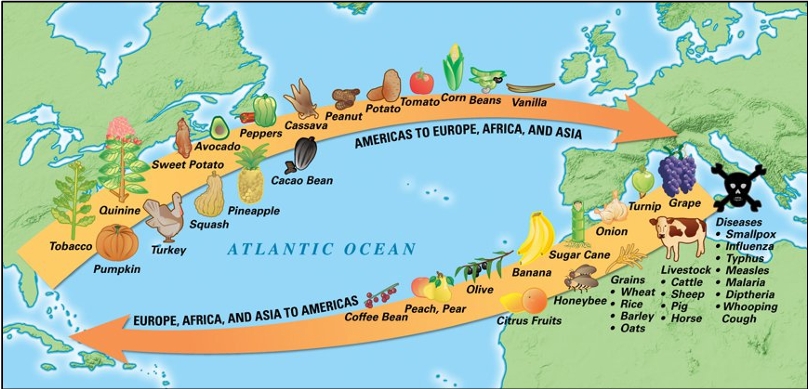
what was the Columbian Exchange ?
widespread transfer of plants, animals, and diseases between the New World in the Western Hemisphere, and the Old World in the Eastern Hemisphere,
who was Amerigo Vespucci ?
Italian explorer and navigator who demonstrated the newly discovered lands were a 'New World, not Asia
1507
German mapmaker Martin Waldseemüller refers to the fourth continent as “America” on his 1507 map, after Amerigo Vespucci
what happened for 16th Europe and how did it affect Europeans ?
many European nations launched voyages of exploration to America and soon claimed territories as their own, regardless of the ancient tribes living there
new products (tobacco, chocolate, etc.) found in North America where liked by people in Europe and the trade of these contributed to the expansion of European wealth
1518 to 1521 & 1531 to 1533
conquest of Central and South America
Hernando Cortés led a small army against the Aztec Empire of Mexico and took control of their gold and silver mines
Francisco Pizarro conquered the Incas and acquired the richest silver mines in the world
what reasons, other than gold, motivated the travelling of the Spanish settlers to America ? +
hopes of profiting from agriculture → helped establish elements of European civilization permanently in America
spread Catholicism (priests, friars, missionaries) → eventually extended the Catholic Church’s influence but sometimes evangelized forcing people to forsake their sacred beliefs and threatened them with physical punishments
who was Bartolomé de Las Casas ?
a friar who fought for the fair treatment of Native peoples by the Spanish
how did colonization impact the expansion Spanish empire ?
as the leaders of the exploration of the American continent, established an extensive empire and were mainly interested by the gold-rich South America → emerged as Europe’s wealthiest and most powerful nation in the 16th
late 16th Spanish Empire
included the Caribbean islands, Mexico, southern North America, spread to include nowadays Chile, Argentina, and Peru
1464
Treaty of Tordesillas → Spain and Portugal agreed to seperate spheres of influence in South America = Spain exclusive rights on all newly discovered lands to west of the line, Portuguese expeditions to keep east of the line
what country initiated slave trade ?
the Portuguese → first European colonists to resort to African slave to exploit their American territories
what was the extent of the consequences of Natives’ exposure to European diseases and what helped spread these ?
estimated millions of Native Americans died & in some areas, native populations were virtually wiped out within a few decaded post first contact with whites → some interpreted it as an evidence of God’s will for them to dominate the New World
natives’ cultures of caring for the very ill, surrounding the sick with companions hence helped spread the highly contagious diseases unknown to them yet (no post-plague notion of quarantine)
what role did France play in the exploration of America ?
mostly explored the northern part of the continent and really explored only from the 17th, establishing trading posts for the traffic of fur & fish
what role did the Netherlands play in the exploration of America ?
engaged in exploration of America in earlyy 17th, starting to colonize the territory on both side of now Hudson River and named it New Netherlands (today’s NYC was New Amsterdam)
what role did initially England play in the exploration of America ? -
real efforts to establish colonies in second half of 16th as Liz I encouraged colonization and granted financial support
1587
Sir Walter Raleigh sent 117 colonists (men, women, children) to establish the Roanoke settlement as the first English colony in America
what’s the story of the ‘Lost Colony’; England’s first failing attempt to plant a colony in North America ?
the leader of the Roanoke colony, John White wasn’t able to saild back to the colony after he returned to England for additional supply → returned and all colonists had disappeared and word ‘croatoan’ was carved into a tree
what were the motives for England’s colonization of North America ? +
political : competition between Spain and England fiercer in 16th and England wanted to prove superiority over Spain and prevent it’s empire’s expansion
economical : enrich the Crown and create a self-sufficient empire thanks to mercantilism
religious : as Reformation century, conquering territories in North America could reinforce Protestantism → religious dissenters, Puritans in particular, could seek refuge in the colonies