Bio 314 Chapter 12
 Studied by 0 people
 Call Kai
 Learn
Learn Practice Test
 Spaced Repetition
 Match
Match Flashcards
 Knowt Play
1/40

Earn XP
Description and Tags
transport across cell membrane
Name | Mastery | Learn | Test | Matching | Spaced | Call with Kai |
|---|
No analytics yet
Send a link to your students to track their progress
41 Terms
what molecule can cross the lipid bilayer without the help of membrane proteins?
protein-free, artificial lipid bilayer (liposome)
why do cells need to transport molecules across their membranes?
Maintain ion concentrations
Uptake nutrients
Release waste
Produce ATP
what are the two main types of transport proteins?
Channels — create pores in membrane for passive diffusion
Transporters — bind to molecule and change conformation
Channels vs Transporters
Channels: less specific, faster, size and charge
Transporters: more specific, slower
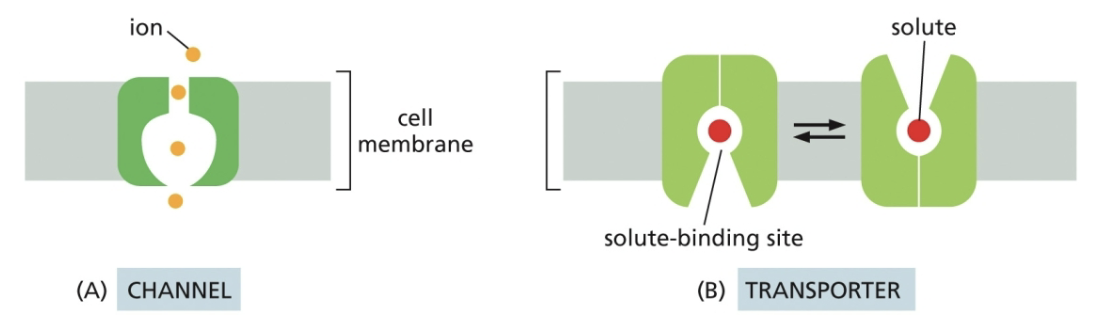
what controls the opening and closing of a channel?
external stimuli or conditions within the cell
what types of molecules can cross a cell membrane through either channels or transporters?
inorganic ions and small, polar organic molecules
what are the two components of an electrochemical gradient?
concentration gradient and membrane potential
How does water move through osmosis?
DOWN its concentration gradient from LOW to HIGH concentration.
what happens to a cell when the concentration of water is greater inside the cell than outside of it?
the cell will swell and burst as water rushes into the cell
what does an aquaporin-based water system do?
purifies water
what happens in a transporter to mediate the transport of a solute?
conformational changes
what are the 3 main ways that pumps carry out transport?
Gradient-driven pump
ATP-driven pump
Light-driven pump
what kind of pump is the Na+ - K+ pump (sodium potassium pump)?
ATP-driven
what does the Na+ - K+ pump do?
it helps keep the cytosolic conentration of Na+ low and K+ high (more Na+ out and more K+ in.)
what is the Ca2+ pump (ATPase pump) driven by?
phosphorylation
Gradient-driven pumps can be…
Symporters: move 2 diff molecules in same direction across membrane
Antiporters: move 2 diff molecules in opposite directions across membrane
Uniport: move one molecule in one direction across membrane
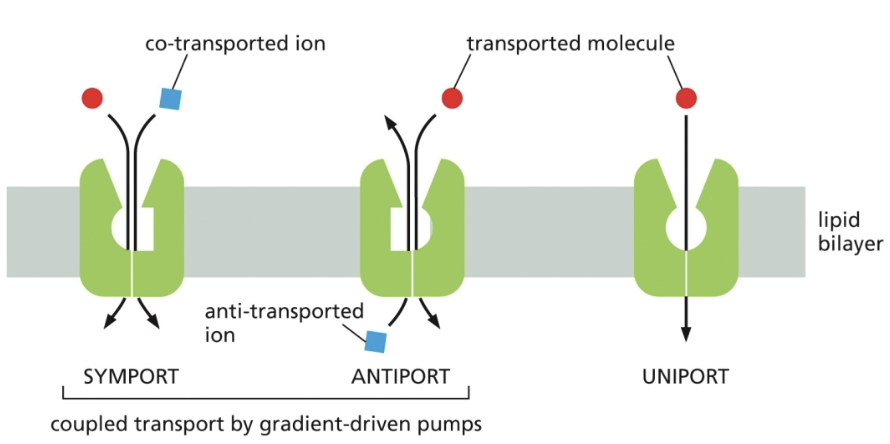
what is the glucose-Na+ symporter?
a transporter that uses the electrochemical Na+ gradient to drive active import of glucose against its gradient. (glucose and Na+ need to travel together..down the slide)
diagram of the alternate states of glucose-Na+ symporter
pump transitions between states
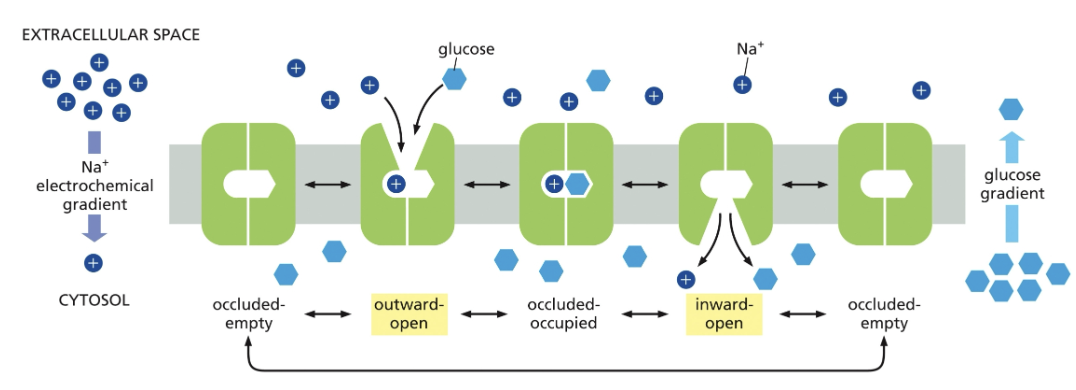
What is the uptake of glucose in the gut driven by?
the Na+ gradient (glucose is ACTIVELY taken up and PASSIVELY released for tissues)
what do plant cells use in replacement of an Na+ - K+ (ATPase) pump?
H+ - ATPase (electrochemical gradient of H+ is used for symports to import various solutes)
Ion channels are ___ and ____
ion-selective, gated
what type of functional groups help the pore select the ion in ion channels?
carbonyl groups
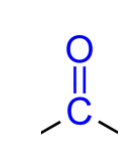
what is the main contribution to a cell’s membrane potential?
the distribution of ions on either side of the cell
What do K+ leak channels do?
when they open, K+ ions tend to leave the cell to go to lower concentration, which generates a membrane potential
what is patch-clamp recording used for?
it is used to monitor ion channel activity through measuring the current through a single ion channel
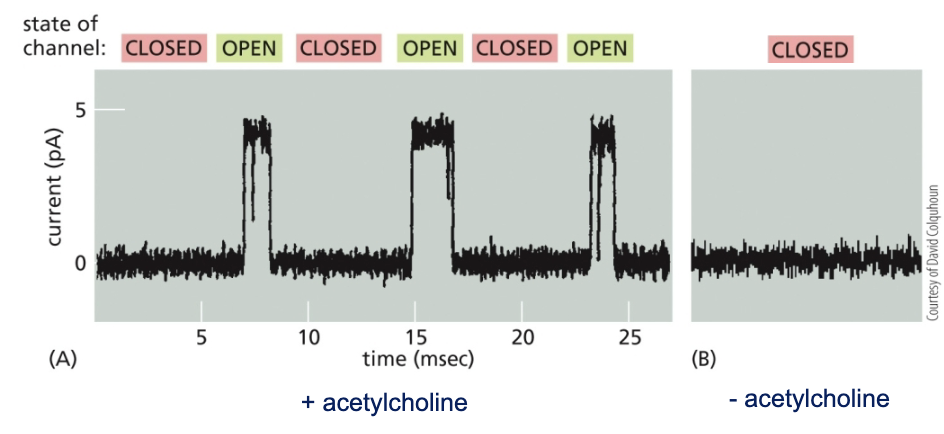
what do ion channels in patch-clamp recording respond to?
the ion channels open in response to the neurotransmitter acetylcholine
what type of cells are patch-clamp recordings tested on?
muscle cells
what are the four different types of ion channels based on their response to different stimuli?
voltage gated—open based on voltage nearby
ligand-gated — extracellular or intracellular: respond to specific neurotransmitter binding to receptor
mechanically-gated — physical pressure (e.g. allow us to hear through positioning of stereocilia)
always open
what does a typical neuron consist of?
dendrites, cell body, axon
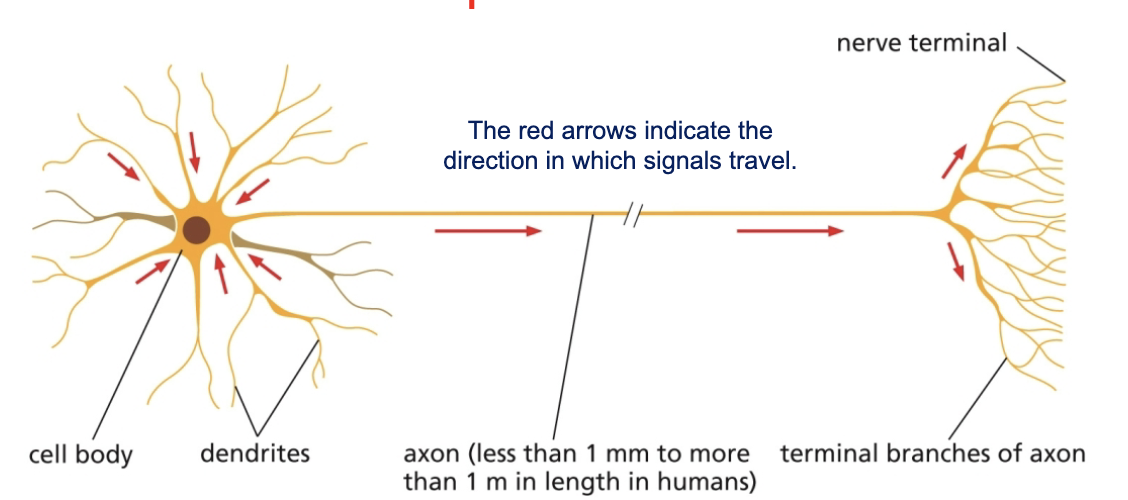
describe how neurons receive and transmit signals
neuron receives signal
signal changes membrane potential
membrane potential travels down axon
axon terminal relays signal to next cell
what is special about the squid’s nervous system?
it can respond rapidly to threats because its cytoplasm can be removed and replaced with an artificial solution of pure ion
how do we study nerve cell excitability in a squid?
we study an isolated axon with an electrode that we insert into the cytoplasm (axoplasm)
what type of ion channels are responsible for triggering an action potential?
voltage-gated ion channels (resting membrane potential is -60 mV, threshold potential is -40, which triggers action potential)
How do membrane potentials return to resting potential?
inactivation of Na+ channels and opening of K+ channels
how do neurons connect to their target cells?
through synapses
how are signals converted and transmitted across the synapse?
the electrical signal is converted to a chemical signal, which is then converted back to electrical signal in the postsynaptic cell
synapses can be either ___ or ____
excitatory, inhibitory
what makes a synapse excitatory?
influx of Na+ depolarizes membrane, which increases likelihood of firing an action potential
what makes a synapse inhibitory?
influx of Cl- keeps membrane more polarized and decreases likelihood of firing an action potential
what do psychoactive drugs do when exposed to ligand-gated ion channels?
they bind the ligand-gated ion channels
what are optogenetics?
biological technique that controls neuron activity through the use of light
 Note
Note  Flashcards (87)