Operant Conditioning Exam 3
 Studied by 0 people
 Call Kai
 Learn
Learn Practice Test
 Spaced Repetition
 Match
Match Flashcards
 Knowt Play
1/42

Earn XP
Description and Tags
made by Shakera_Jones6 on Quizlet
Name | Mastery | Learn | Test | Matching | Spaced |
|---|
No study sessions yet.
43 Terms
Operant Conditioning
Association between behaviors and their consequences. Behavior is influenced by consequences that follow it.
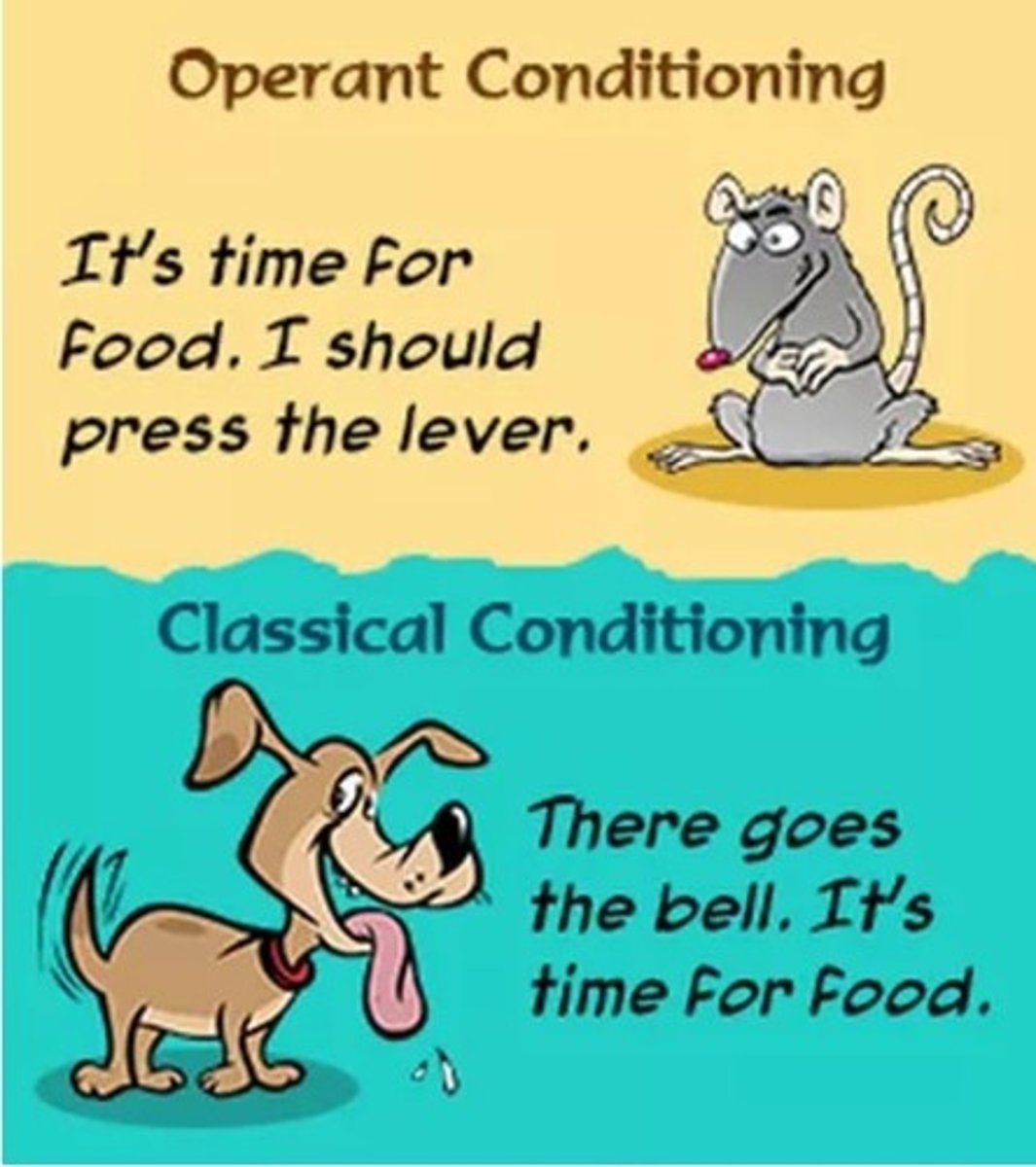
Operant vs. Classical Conditioning
in operant conditioning a behavior is learned; in classic conditioning a response to a stimuli is learned
Shaping
Reinforcers used to guide behavior toward closer and closer approximations of desired goal behavior.
Reinforcer
any consequence that strengthens behavior
Primary Reinforcer
stimulus that is naturally rewarding, such as food or water
Secondary Reinforcer
A neutral object that becomes associated with a primary reinforcer (e.g. money, praise)
Positive Reinforcement - Will always strengthen behavior
Occurs when a response is strengthened by the presentation of a stimulus. (e.g. a student studies for a test and gets an A)
Negative Reinforcement - (Will always strengthen behavior, negative reinforcement is not punishment.)
Increasing behaviors by removal (or avoidance) of an aversive stimulus
Continuous Reinforcement Schedule
The delivery of a reinforcer every single time that a desired behavior is emitted. Behaviors are learned rapidly and extinct rapidly.
Partial Reinforcement Schedule
Reinforcing a response only part of the time; results in slower learning of a response and greater persistence but results in slower extinction.
Partial Reinforcement Schedules-
Based on # of responses: Fixed Ratio
High rate of responding because of predictability
Partial Reinforcement Schedules-
Based on # of responses: Variable Ratio
High rate of responding because of unpredictability
Partial Reinforcement Schedules-
Based on time: Fixed Interval
Response rate slows after reinforcement then increases in frequency
Partial Reinforcement Schedules-
Based on time: Variable Interval
Steady rate of responding because of unpredictability of reinforcement
Instrumental Conditioning
an organism's behavior changes because of the consequences that follow the behavior.
Instrumental vs. Operant conditioning
Difference is degree of freedom organism has to respond.
Instrumental Conditioning Paradigms;
Straight Runway: Rats are placed in a start box of a straight-alley runway. If they run down the runway they will find a goal box that may contain food reinforcement. What does it measure?
Latency & speed as function of the number of training trials.
Instrumental Conditioning Paradigms;
Maze Learning: Two runways are perpendicular to one another (to form a T). Rats start at the bottom of the T and run to the choice point. The rats may always find food reinforcement on the right-hand side and no food on the left. Learning is assessed by monitoring the % of trials in a block of trials in which the rats chose correctly. What does it measure?
Latency, Speed, and error rate.
Instrumental Conditioning Paradigms;
Escape Learning
The aversive stimulus is already present and you have found a way to stop it by doing a certain behavior.
Instrumental Conditioning Paradigms;
Avoidance Learning
You have learned to behave in a way that prevents the aversive stimulus from even occurring.
Operant Conditioning Paradigms;
Skinner Box (operant chamber/free operant learning)
The organism is placed in an "operant" chamber (Skinner box) in which there is a response manipulandum (e.g., a lever) that the animal must contact in some way in order for reinforcement to be automatically delivered. What does it measure and what is required of the organism?
Measures: Response Rate
Requires the organism to learn an "arbitrary" response. The animal is to learn to make an operate response which itself is NOT part of the animal's natural behavioral habits.
Operant Conditioning Paradigms;
Key-peck response in pigeons: the response causes the positive event (e.g., the food pellet) NOT to occur (to be omitted). In the omission contingency, if the animal fails to respond, then food, for example, will be given, but food will be withheld if the animal makes the target response. What does it measure?
Response Rate
Variables that affect rate of Operant Conditioning (list)
-Amount (magnitude) of reinforcer
Quality (of reinforcer)
Time (delay between response and reinforcement)
-Previous experience.
Pre exposure to reinforcer inhibits conditioning (much like classical conditioning)
Contrast Effect
-Schedule of reinforcement
Operant Extinction
Stop reinforcing behavior, it will diminish
Aversive Punishment(Positive Punishment):
actively apply or present an aversive stimulus to decrease or extinguish a behavior (e.g. spanking)
Response Cost Punishment(Negative Punishment:
Weaken response by subsequent removal of a pleasurable stimulus after behavior. (e.g. no phone or car privileges)
Problems with punishment
-may increase aggressiveness in person being punished
-can create fear, anxiety, depression
-Punishment needs to be immediate and salient so the association is formed
-Punishment can be reinforcing to punisher. (negatively reinforcing)
-Can have generalized inhibiting effect - not just target behavior
-Learned helplessness
Biological Constraints on learning;
Instinctive Drift
A conditioned operant response "drifts back" toward instinctive behavior
Biological Constraints on learning;
Dopamine Reward Pathway
When exposed to a rewarding stimulus, the brain responds by increasing release of the neurotransmitter dopamine and thus the structures associated with the reward system are found along the major dopamine pathways in the brain.
Biological Constraints on learning;
Species-specific adaptive behavior
Animals have a hard time learning behaviors that counter their evolutionary adaptation
Cognitive Constraints on learning;
Latent learning
The subconscious retention of information without reinforcement or motivation. learning is not just reinforced action
Cognitive Constraints on learning;
Overjustification
The effect of reinforcing behavior one already likes to do
Cognitive Constraints on learning;
Intrinsic/extrinsic motivation
Intrinsic motivation comes from within, extrinsic motivation arises from external factors.
Hull’s Drive Reduction Hypothesis - theory of reinforcement
organism will engage in behaviors to reduce drives (internal tension)
cannot explain behavior when all drives are met and behavior that increases drives (smoking, drinking, etc.)
Optimal Arousal Theory - theory of reinforcement
organisms are motivated to achieve and maintain an optimal level of arousal
Premack Principle- theory of reinforcement
Any voluntary behavior can serve as a reinforcer for any voluntary behavior. less liked task can be enforced by promise of desired task to follow
Orbital Prefrontal Cortex (OPFC):
(Brain areas/neurotranmitters involved in reinforcement and punishment)
Evaluates consequences are reinforcing or not.
Projects this information to dorsal striatum.
Dorsal Striatum:
(Brain areas/neurotransmitters involved in reinforcement and punishment)
Gives us the motivation to engage in a behavior in order to get the reinforcer
Dopamine from (VTA) and Pars Compacta of Substantia Nigra is responsible for…
responsible for "wanting" a reinforcer. This motivates us to work (behave) to get reinforcers
Incentive Salience Hypothesis
Opioid system is likely the spot responsible for us “liking” and enjoying the reinforcer
Insula and dorsal Anterior Cingulate Gyrus (dACC) are involved in
punishment
Insula
evaluates whether a stimulus is punishing or not
dACC plays a role in
motivating us to engage in behavior that escapes or avoids the aversive stimulus