soc- w7 the psych of small groups + group leadership
 Call Kai
 Learn
Learn Practice Test
 Spaced Repetition
 Match
Match Flashcards
 Knowt Play
1/6

There's no tags or description
Looks like no tags are added yet.
Name | Mastery | Learn | Test | Matching | Spaced | Call with Kai | Chat |
|---|
No analytics yet
Send a link to your students to track their progress
7 Terms
what are the 2 major ways psychologists think about groups?
psychological individualism
social identity perspective
psychological individualism: “groups don’t exist”
Key figure: Floyd Allport (1924).
Core claim: Only individuals think, feel, and act.
Groups are not “real” psychological entities — they are just collections of individuals.
Any group behaviour can be reduced to the sum of individual behaviours.
social identity perspective: “groups are real because people believe they are”
Key theorists: Tajfel & Turner (1979).
Groups are not physical objects — they are shared social categories in people’s minds.
A group exists when:
People agree that it exists (consensus).
People identify with it.
Outsiders also recognise it.
Examples:
“Students”, “nurses”, “football fans”, “women”, “the working class”, “Gen Z”.
These are not physical groups, but they shape behaviour, norms, and identity.
social categories vs groups
social categories are broad labels whose members may not interact but still share the same social identity e.g “students”. groups are interacting units where members communicate, coordinate, and influence each other e.g “seminar group”
what size are small groups?
3-10/15
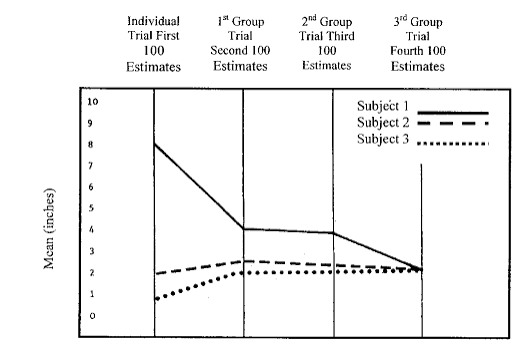
informational influence + norm formation
Informational social influence is when people conform because they believe others have better information or know the correct answer, especially in uncertain situations.
Norm formation is the process by which people in a group gradually develop a shared standard for behaviour, judgement, or belief — even when no one explicitly decides it.
example: sherif’s autokinetic effect(1935)
Sherif’s autokinetic effect(1935) study