Prostate Pathology
 Call Kai
 Learn
Learn Practice Test
 Spaced Repetition
 Match
Match Flashcards
 Knowt Play
1/27

Earn XP
Description and Tags
Page 466
Name | Mastery | Learn | Test | Matching | Spaced | Call with Kai | Chat |
|---|
No analytics yet
Send a link to your students to track their progress
28 Terms
Prostate-specific antigen (PSA) is a — produced by the prostate gland.
protein
An elevation in this protein can be indicative of some disease processes such as —
benign prostatic hypertrophy, prostatic cancer, prostatitis, and prostatic infarcts
It has been claimed that the higher the PSA level, the more likely the patient will have —
prostate cancer
a normal — can also be found in the presence of cancer.
PSA level
An elevated PSA is — for prostate cancer
not specific
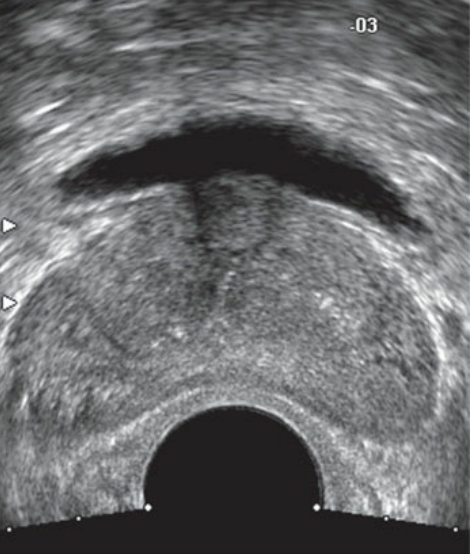
Transverse transrectal image of the normal prostate.
Prostate cancer, in the form of —, is the most common cancer in men
adenocarcinoma
the most common location for prostate cancer is within the
peripheral zone
the sonographic appearance of prostatic cancer can mimic —
normal anatomy, prostatitis, and benign prostatic hypertrophy (BPH)

Transrectal image of a seminal vesicle (arrows).
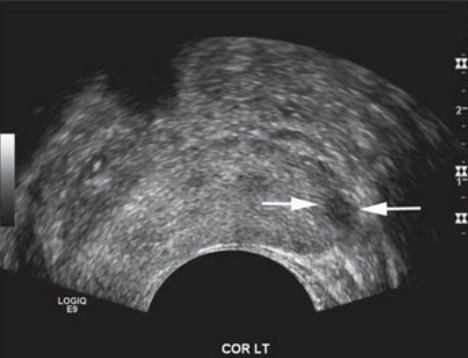
Prostate cancer. This image of the prostate reveals a small hypoechoic mass (between arrows) in the peripheral zone, which was eventually diagnosed as prostate carcinoma.
clinical findings of prostate cancer
elevated PSA
enlarged prostate
blood in urine (hematuria) or semen (hematospermia)
back pain, pelvic pain, hip or thigh pain
impotence
decreased in the amount of ejaculated fluid
sonographic findings of prostate cancer
varying sonographic appearances
hypoechoic mass
may be hypervascular
The benign enlargement of the prostate gland is termed—
benign prostatic hypertrophy (BPH)
BPH is most often located within the
transitional zone
An enlarged prostate can obstruct the flow of
urine through the urethra
Patients with BPH may undergo — of the prostate to remove some of the hypertrophic prostatic tissue causing urinary complications.
transurethral resection
clinical findings of benign prostatic hypertrophy
nocturia
increased urinary frequency
sense of urinary urgency
constant feeling of having a full bladder
elevated PSA
sonographic findings of benign prostatic hypertrophy
BHP will show enlargement of the inner gland
can lead to hypoechoic areas within the gland
calcifiactions within the gland
diffusely heterogeneous gland
cystic changes within the gland
— is inflammation of the prostate
Prostatitis
clinical findings of prostatitis
hematospermia
painful ejaculation
perineal pain
dysuria
sonographic findings of prostatitis
enlarged, hypoechoic prostate
hypermia evident with color doppler
Although seminal vesicle cysts are rare, they are said to be either —
congenital or acquired
Seminal vesicle cysts may be asymptomatic, but they can also be associated with
Zinner syndrome.
Zinner syndrome consists of
unilateral renal agenesis, ipsilateral seminal vesicle cyst, and ejaculatory duct obstruction.
Patients with Zinner syndrome present with
perineal pain, recurrent prostatitis, painful ejaculation, and infertility
clinical findings of seminal vesicle cysts
asymptomatic
may be associated with zinner syndrome (perineal pain, recurrent prostatitis, painful ejaculation, and infertility)
sonographic findings of seminal vesicle cysts
anechoic or complex cystic structures in the area of the seminal vesicles