Physics Paper 1 Mistakes
 Call Kai
 Learn
Learn Practice Test
 Spaced Repetition
 Match
Match Flashcards
 Knowt Play
1/27

There's no tags or description
Looks like no tags are added yet.
Name | Mastery | Learn | Test | Matching | Spaced | Call with Kai | Chat |
|---|
No analytics yet
Send a link to your students to track their progress
28 Terms
A student investigated how the current in a filament lamp varied with the potential difference across the filament lamp.
A second student did the same investigation. The ammeter used had a zero error.
What is meant by a zero error? [1 mark]
Ammeter displays a reading when not connected to a circuit.

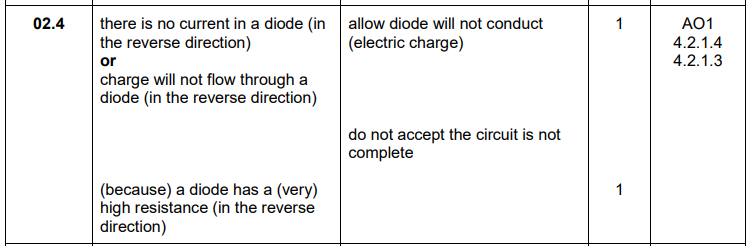
![<p>Figure 3 shows an <mark data-color="red" style="background-color: red; color: inherit;">LED</mark> torch.</p><p>The torch contains one <mark data-color="red" style="background-color: red; color: inherit;">LED</mark>, one switch and three cells.</p><p>When replaced, the cells were put into the torch the <mark data-color="red" style="background-color: red; color: inherit;">wrong way around</mark>.</p><p><strong><mark data-color="yellow" style="background-color: yellow; color: inherit;">Explain</mark> why the torch did not work. [2 marks]</strong></p>](https://assets.knowt.com/user-attachments/53defdec-e9aa-4039-921b-13a02abb702f.png)
Figure 3 shows an LED torch.
The torch contains one LED, one switch and three cells.
When replaced, the cells were put into the torch the wrong way around.
Explain why the torch did not work. [2 marks]
There is no current in a diode in the reverse direction
because a diode has a high resistance in the reverse direction
Write down the equation which links density (ρ), mass (m) and volume (V). [1 mark]
ρ=Vm
density = mass ÷ volume

Give two environmental advantages of using a gas-fired power station to generate electricity compared with using a coal-fired power station. [2 marks]
No sulfur dioxide so no acid rain
No particulates released so no global dimming

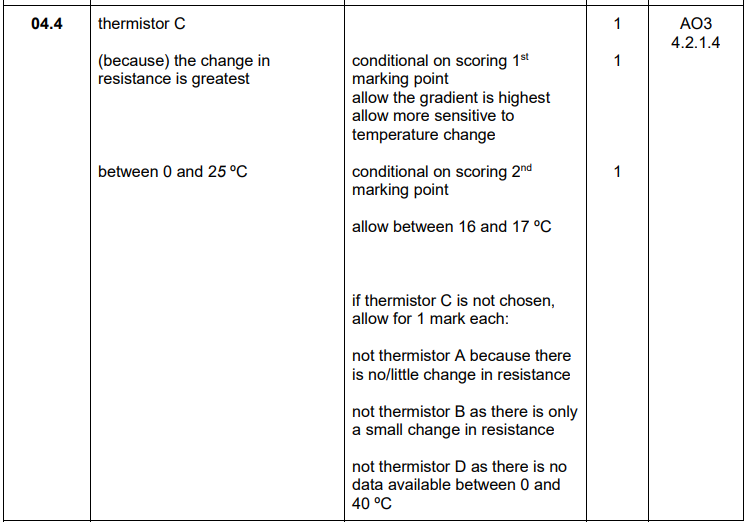
![<p>A thermistor can be used to measure temperature.</p><p>Figure 8 shows how the resistance of four different thermistors A, B, C and D, varies with temperature.</p><p><strong>Which of the four thermistors would be the most suitable to measure the <mark data-color="red" style="background-color: red; color: inherit;">surface temperature of the sea</mark>?</strong></p><p><strong><mark data-color="yellow" style="background-color: yellow; color: inherit;">Explain</mark> your answer. [3 marks]</strong></p>](https://assets.knowt.com/user-attachments/632a5b79-96c1-4544-9900-016152a33364.png)
A thermistor can be used to measure temperature.
Figure 8 shows how the resistance of four different thermistors A, B, C and D, varies with temperature.
Which of the four thermistors would be the most suitable to measure the surface temperature of the sea?
Explain your answer. [3 marks]
C
the change in resistance is greatest between 0 and 25ºC
Radioactive waste from nuclear power stations is a man-made source of background radiation.
Give one other man-made source of background radiation. [1 mark]
X-rays

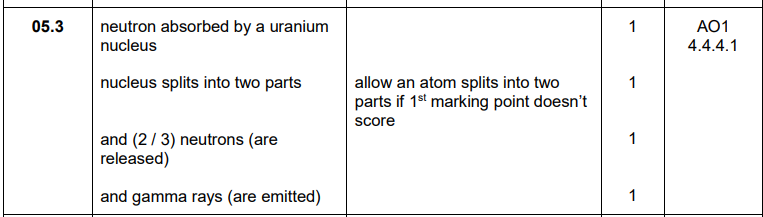
Nuclear fission releases energy.
Describe the process of nuclear fission inside a nuclear reactor. [4 marks]
Neutron absorbed by a uranium nucleus
Nucleus splits into two parts
2 - 3 neutrons are released
Gamma rays are emitted
Explain how the process of nuclear fusion leads to the release of energy. [2 marks]
Lighter nuclei join to form heavier nuclei
Some mass of the nuclei is converted to energy

Nuclear fusion power stations will produce radioactive waste.
This waste will have a much shorter half-life than the radioactive waste from a nuclear fission power station.
Explain the advantage of the radioactive waste having a shorter half-life. [2 marks]
Activity decreases quickly
so doesn’t need to be buried underground for as long

![<p>Figure 9 shows a theme park ride called AquaShute.</p><p>Riders of the AquaShute sit on a sled and move down a slide.</p><p>A <mark data-color="red" style="background-color: red; color: inherit;">light gate and data logger</mark> can be used to determine the speed of each rider and sled.</p><p><strong>What two measurements are needed to determine the speed of a rider and sled? [2 marks]</strong></p><ul data-type="taskList"><li data-checked="false" data-type="taskItem"><label><input type="checkbox"><span></span></label><div><p>Gravitational field strength</p></div></li><li data-checked="false" data-type="taskItem"><label><input type="checkbox"><span></span></label><div><p>Length of sled</p></div></li><li data-checked="false" data-type="taskItem"><label><input type="checkbox"><span></span></label><div><p>Mass of rider and sled</p></div></li><li data-checked="false" data-type="taskItem"><label><input type="checkbox"><span></span></label><div><p>Temperature of surroundings</p></div></li><li data-checked="false" data-type="taskItem"><label><input type="checkbox"><span></span></label><div><p>Time for sled to pass light gate</p></div></li></ul><p></p>](https://assets.knowt.com/user-attachments/523bed51-87da-44f2-bdc2-a9662014236e.png)
Figure 9 shows a theme park ride called AquaShute.
Riders of the AquaShute sit on a sled and move down a slide.
A light gate and data logger can be used to determine the speed of each rider and sled.
What two measurements are needed to determine the speed of a rider and sled? [2 marks]
Gravitational field strength
Length of sled
Mass of rider and sled
Temperature of surroundings
Time for sled to pass light gate
Length of sled
Time for sled to pass light gate
![<p>Figure 9 shows a theme park ride called AquaShute.</p><p>Riders of the AquaShute sit on a sled and move down a slide.</p><p><mark data-color="red" style="background-color: red; color: inherit;">At the bottom of the slide, all riders and their sleds have approximately the same speed.</mark></p><p><strong><mark data-color="yellow" style="background-color: yellow; color: inherit;">Explain</mark> why. [4 marks]</strong></p>](https://assets.knowt.com/user-attachments/b8a1ca76-0283-458e-8fba-8a4b02c31619.png)
Figure 9 shows a theme park ride called AquaShute.
Riders of the AquaShute sit on a sled and move down a slide.
At the bottom of the slide, all riders and their sleds have approximately the same speed.
Explain why. [4 marks]
½mv² = mgh
v² = 2gh
Final speed depends on vertical height and gravitational field strength
Variations will be due to friction
![<p>An electric kettle was switched on.</p><p>Figure 10 shows how the temperature of the water inside the kettle changed.</p><p>The <mark data-color="red" style="background-color: red; color: inherit;">straight section of the line</mark> in Figure 10 can be used to calculate the useful power output of the kettle.</p><p><strong><mark data-color="yellow" style="background-color: yellow; color: inherit;">Explain</mark> how. [3 marks]</strong></p>](https://assets.knowt.com/user-attachments/916f83cd-4251-422a-9fbe-e1708221c00f.png)
An electric kettle was switched on.
Figure 10 shows how the temperature of the water inside the kettle changed.
The straight section of the line in Figure 10 can be used to calculate the useful power output of the kettle.
Explain how. [3 marks]
gradient = ∆θ ÷ t
Pt = mc∆θ
P = gradient × mc

![<p>A student investigated how the total resistance of identical resistors connected in parallel varied with the number of resistors.</p><p>The student used an ohmmeter to measure the total resistance of the resistors.</p><p>Figure 11 shows the student’s circuit with 3 resistors.</p><p>The student repeated each reading of resistance three times.</p><p>Table 1 shows some of the results for 3 resistors in parallel.</p><table style="min-width: 125px;"><colgroup><col style="min-width: 25px;"><col style="min-width: 25px;"><col style="min-width: 25px;"><col style="min-width: 25px;"><col style="min-width: 25px;"></colgroup><tbody><tr><td colspan="1" rowspan="1" style="animation: auto ease 0s 1 normal none running none; appearance: none; background: none 0% 0% / auto repeat scroll padding-box border-box rgb(239, 239, 239); border: 1px solid rgb(196, 199, 197); inset: 0px; clear: none; clip: auto; columns: auto; contain: none; container: none; content: normal; cursor: auto; cx: 0px; cy: 0px; d: none; direction: ltr; display: table-cell; fill: rgb(0, 0, 0); filter: none; flex: 0 1 auto; float: none; gap: normal; hyphens: manual; interactivity: auto; isolation: auto; margin-right: 0px; margin-bottom: 0px; margin-left: 0px; marker: none; mask: none; offset: normal; opacity: 1; order: 0; orphans: 2; outline: rgb(31, 31, 31) none 3px; overlay: none; padding: 8px 12px; page: auto; perspective: none; position: relative; quotes: auto; r: 0px; resize: none; rotate: none; rx: auto; ry: auto; scale: none; speak: normal; stroke: none; transform: none; transition: all; translate: none; visibility: visible; widows: 2; x: 0px; y: 0px; zoom: 1; margin-top: 0px !important;"><p><span style="color: rgb(0, 0, 0);"><strong>Number of resistors</strong></span></p></td><td colspan="1" rowspan="1" style="animation: auto ease 0s 1 normal none running none; appearance: none; background: none 0% 0% / auto repeat scroll padding-box border-box rgb(239, 239, 239); border: 1px solid rgb(196, 199, 197); inset: 0px; clear: none; clip: auto; columns: auto; contain: none; container: none; content: normal; cursor: auto; cx: 0px; cy: 0px; d: none; direction: ltr; display: table-cell; fill: rgb(0, 0, 0); filter: none; flex: 0 1 auto; float: none; gap: normal; hyphens: manual; interactivity: auto; isolation: auto; margin-right: 0px; margin-bottom: 0px; margin-left: 0px; marker: none; mask: none; offset: normal; opacity: 1; order: 0; orphans: 2; outline: rgb(31, 31, 31) none 3px; overlay: none; padding: 8px 12px; page: auto; perspective: none; position: relative; quotes: auto; r: 0px; resize: none; rotate: none; rx: auto; ry: auto; scale: none; speak: normal; stroke: none; transform: none; transition: all; translate: none; visibility: visible; widows: 2; x: 0px; y: 0px; zoom: 1; margin-top: 0px !important;"><p><span style="color: rgb(0, 0, 0);"><strong>Reading 1 (ohms)</strong></span></p></td><td colspan="1" rowspan="1" style="animation: auto ease 0s 1 normal none running none; appearance: none; background: none 0% 0% / auto repeat scroll padding-box border-box rgb(239, 239, 239); border: 1px solid rgb(196, 199, 197); inset: 0px; clear: none; clip: auto; columns: auto; contain: none; container: none; content: normal; cursor: auto; cx: 0px; cy: 0px; d: none; direction: ltr; display: table-cell; fill: rgb(0, 0, 0); filter: none; flex: 0 1 auto; float: none; gap: normal; hyphens: manual; interactivity: auto; isolation: auto; margin-right: 0px; margin-bottom: 0px; margin-left: 0px; marker: none; mask: none; offset: normal; opacity: 1; order: 0; orphans: 2; outline: rgb(31, 31, 31) none 3px; overlay: none; padding: 8px 12px; page: auto; perspective: none; position: relative; quotes: auto; r: 0px; resize: none; rotate: none; rx: auto; ry: auto; scale: none; speak: normal; stroke: none; transform: none; transition: all; translate: none; visibility: visible; widows: 2; x: 0px; y: 0px; zoom: 1; margin-top: 0px !important;"><p><span style="color: rgb(0, 0, 0);"><strong>Reading 2 (ohms)</strong></span></p></td><td colspan="1" rowspan="1" style="animation: auto ease 0s 1 normal none running none; appearance: none; background: none 0% 0% / auto repeat scroll padding-box border-box rgb(239, 239, 239); border: 1px solid rgb(196, 199, 197); inset: 0px; clear: none; clip: auto; columns: auto; contain: none; container: none; content: normal; cursor: auto; cx: 0px; cy: 0px; d: none; direction: ltr; display: table-cell; fill: rgb(0, 0, 0); filter: none; flex: 0 1 auto; float: none; gap: normal; hyphens: manual; interactivity: auto; isolation: auto; margin-right: 0px; margin-bottom: 0px; margin-left: 0px; marker: none; mask: none; offset: normal; opacity: 1; order: 0; orphans: 2; outline: rgb(31, 31, 31) none 3px; overlay: none; padding: 8px 12px; page: auto; perspective: none; position: relative; quotes: auto; r: 0px; resize: none; rotate: none; rx: auto; ry: auto; scale: none; speak: normal; stroke: none; transform: none; transition: all; translate: none; visibility: visible; widows: 2; x: 0px; y: 0px; zoom: 1; margin-top: 0px !important;"><p><span style="color: rgb(0, 0, 0);"><strong>Reading 3 (ohms)</strong></span></p></td><td colspan="1" rowspan="1" style="animation: auto ease 0s 1 normal none running none; appearance: none; background: none 0% 0% / auto repeat scroll padding-box border-box rgb(239, 239, 239); border: 1px solid rgb(196, 199, 197); inset: 0px; clear: none; clip: auto; columns: auto; contain: none; container: none; content: normal; cursor: auto; cx: 0px; cy: 0px; d: none; direction: ltr; display: table-cell; fill: rgb(0, 0, 0); filter: none; flex: 0 1 auto; float: none; gap: normal; hyphens: manual; interactivity: auto; isolation: auto; margin-right: 0px; margin-bottom: 0px; margin-left: 0px; marker: none; mask: none; offset: normal; opacity: 1; order: 0; orphans: 2; outline: rgb(31, 31, 31) none 3px; overlay: none; padding: 8px 12px; page: auto; perspective: none; position: relative; quotes: auto; r: 0px; resize: none; rotate: none; rx: auto; ry: auto; scale: none; speak: normal; stroke: none; transform: none; transition: all; translate: none; visibility: visible; widows: 2; x: 0px; y: 0px; zoom: 1; margin-top: 0px !important;"><p><span style="color: rgb(0, 0, 0);"><strong>Mean (ohms)</strong></span></p></td></tr><tr><td colspan="1" rowspan="1" style="animation: auto ease 0s 1 normal none running none; appearance: none; background: none 0% 0% / auto repeat scroll padding-box border-box rgba(0, 0, 0, 0); border: 1px solid rgb(196, 199, 197); inset: 0px; clear: none; clip: auto; columns: auto; contain: none; container: none; content: normal; cursor: auto; cx: 0px; cy: 0px; d: none; direction: ltr; display: table-cell; fill: rgb(0, 0, 0); filter: none; flex: 0 1 auto; float: none; gap: normal; hyphens: manual; interactivity: auto; isolation: auto; margin-right: 0px; margin-bottom: 0px; margin-left: 0px; marker: none; mask: none; offset: normal; opacity: 1; order: 0; orphans: 2; outline: rgb(31, 31, 31) none 3px; overlay: none; padding: 8px 12px; page: auto; perspective: none; position: relative; quotes: auto; r: 0px; resize: none; rotate: none; rx: auto; ry: auto; scale: none; speak: normal; stroke: none; transform: none; transition: all; translate: none; visibility: visible; widows: 2; x: 0px; y: 0px; zoom: 1; margin-top: 0px !important;"><p><span style="background-color: rgba(0, 0, 0, 0);">3</span></p></td><td colspan="1" rowspan="1" style="animation: auto ease 0s 1 normal none running none; appearance: none; background: none 0% 0% / auto repeat scroll padding-box border-box rgba(0, 0, 0, 0); border: 1px solid rgb(196, 199, 197); inset: 0px; clear: none; clip: auto; columns: auto; contain: none; container: none; content: normal; cursor: auto; cx: 0px; cy: 0px; d: none; direction: ltr; display: table-cell; fill: rgb(0, 0, 0); filter: none; flex: 0 1 auto; float: none; gap: normal; hyphens: manual; interactivity: auto; isolation: auto; margin-right: 0px; margin-bottom: 0px; margin-left: 0px; marker: none; mask: none; offset: normal; opacity: 1; order: 0; orphans: 2; outline: rgb(31, 31, 31) none 3px; overlay: none; padding: 8px 12px; page: auto; perspective: none; position: relative; quotes: auto; r: 0px; resize: none; rotate: none; rx: auto; ry: auto; scale: none; speak: normal; stroke: none; transform: none; transition: all; translate: none; visibility: visible; widows: 2; x: 0px; y: 0px; zoom: 1; margin-top: 0px !important;"><p><span style="background-color: rgba(0, 0, 0, 0);">15.8</span></p></td><td colspan="1" rowspan="1" style="animation: auto ease 0s 1 normal none running none; appearance: none; background: none 0% 0% / auto repeat scroll padding-box border-box rgba(0, 0, 0, 0); border: 1px solid rgb(196, 199, 197); inset: 0px; clear: none; clip: auto; columns: auto; contain: none; container: none; content: normal; cursor: auto; cx: 0px; cy: 0px; d: none; direction: ltr; display: table-cell; fill: rgb(0, 0, 0); filter: none; flex: 0 1 auto; float: none; gap: normal; hyphens: manual; interactivity: auto; isolation: auto; margin-right: 0px; margin-bottom: 0px; margin-left: 0px; marker: none; mask: none; offset: normal; opacity: 1; order: 0; orphans: 2; outline: rgb(31, 31, 31) none 3px; overlay: none; padding: 8px 12px; page: auto; perspective: none; position: relative; quotes: auto; r: 0px; resize: none; rotate: none; rx: auto; ry: auto; scale: none; speak: normal; stroke: none; transform: none; transition: all; translate: none; visibility: visible; widows: 2; x: 0px; y: 0px; zoom: 1; margin-top: 0px !important;"><p><span style="background-color: rgba(0, 0, 0, 0);">15.3</span></p></td><td colspan="1" rowspan="1" style="animation: auto ease 0s 1 normal none running none; appearance: none; background: none 0% 0% / auto repeat scroll padding-box border-box rgba(0, 0, 0, 0); border: 1px solid rgb(196, 199, 197); inset: 0px; clear: none; clip: auto; columns: auto; contain: none; container: none; content: normal; cursor: auto; cx: 0px; cy: 0px; d: none; direction: ltr; display: table-cell; fill: rgb(0, 0, 0); filter: none; flex: 0 1 auto; float: none; gap: normal; hyphens: manual; interactivity: auto; isolation: auto; margin-right: 0px; margin-bottom: 0px; margin-left: 0px; marker: none; mask: none; offset: normal; opacity: 1; order: 0; orphans: 2; outline: rgb(31, 31, 31) none 3px; overlay: none; padding: 8px 12px; page: auto; perspective: none; position: relative; quotes: auto; r: 0px; resize: none; rotate: none; rx: auto; ry: auto; scale: none; speak: normal; stroke: none; transform: none; transition: all; translate: none; visibility: visible; widows: 2; x: 0px; y: 0px; zoom: 1; margin-top: 0px !important;"><p><span style="background-color: rgba(0, 0, 0, 0);"><strong>X</strong></span></p></td><td colspan="1" rowspan="1" style="animation: auto ease 0s 1 normal none running none; appearance: none; background: none 0% 0% / auto repeat scroll padding-box border-box rgba(0, 0, 0, 0); border: 1px solid rgb(196, 199, 197); inset: 0px; clear: none; clip: auto; columns: auto; contain: none; container: none; content: normal; cursor: auto; cx: 0px; cy: 0px; d: none; direction: ltr; display: table-cell; fill: rgb(0, 0, 0); filter: none; flex: 0 1 auto; float: none; gap: normal; hyphens: manual; interactivity: auto; isolation: auto; margin-right: 0px; margin-bottom: 0px; margin-left: 0px; marker: none; mask: none; offset: normal; opacity: 1; order: 0; orphans: 2; outline: rgb(31, 31, 31) none 3px; overlay: none; padding: 8px 12px; page: auto; perspective: none; position: relative; quotes: auto; r: 0px; resize: none; rotate: none; rx: auto; ry: auto; scale: none; speak: normal; stroke: none; transform: none; transition: all; translate: none; visibility: visible; widows: 2; x: 0px; y: 0px; zoom: 1; margin-top: 0px !important;"><p><span style="background-color: rgba(0, 0, 0, 0);">15.7</span></p></td></tr></tbody></table><p>The student thought that taking a fourth reading would improve the <mark data-color="red" style="background-color: red; color: inherit;">precision</mark> of the results.</p><p><mark data-color="red" style="background-color: red; color: inherit;">The fourth reading was 16.2 Ω.</mark></p><p><strong><mark data-color="yellow" style="background-color: yellow; color: inherit;">Explain</mark> why the student was wrong. [2 marks]</strong></p>](https://assets.knowt.com/user-attachments/0471ad61-c382-4b3e-a53e-08ecc82199a4.png)
A student investigated how the total resistance of identical resistors connected in parallel varied with the number of resistors.
The student used an ohmmeter to measure the total resistance of the resistors.
Figure 11 shows the student’s circuit with 3 resistors.
The student repeated each reading of resistance three times.
Table 1 shows some of the results for 3 resistors in parallel.
Number of resistors | Reading 1 (ohms) | Reading 2 (ohms) | Reading 3 (ohms) | Mean (ohms) |
3 | 15.8 | 15.3 | X | 15.7 |
The student thought that taking a fourth reading would improve the precision of the results.
The fourth reading was 16.2 Ω.
Explain why the student was wrong. [2 marks]
Precise results show little variation
The 4th result is further away from the mean than the other values
![<p>A student investigated how the total resistance of identical resistors connected in parallel varied with the number of resistors.</p><p>The student used an ohmmeter to measure the total resistance of the resistors.</p><p>Figure 12 shows the results from the investigation.</p><p>The student concluded that the <mark data-color="red" style="background-color: red; color: inherit;">number of resistors in parallel was inversely proportional to the mean total resistance.</mark></p><p><strong><mark data-color="yellow" style="background-color: yellow; color: inherit;">Explain</mark> why the student was correct. [3 marks]</strong></p><p><strong><mark data-color="yellow" style="background-color: yellow; color: inherit;">Use data</mark> from Figure 12 in your answer.</strong></p>](https://assets.knowt.com/user-attachments/1a21f173-417e-48ac-a483-c96c28ede06b.png)
A student investigated how the total resistance of identical resistors connected in parallel varied with the number of resistors.
The student used an ohmmeter to measure the total resistance of the resistors.
Figure 12 shows the results from the investigation.
The student concluded that the number of resistors in parallel was inversely proportional to the mean total resistance.
Explain why the student was correct. [3 marks]
Use data from Figure 12 in your answer.
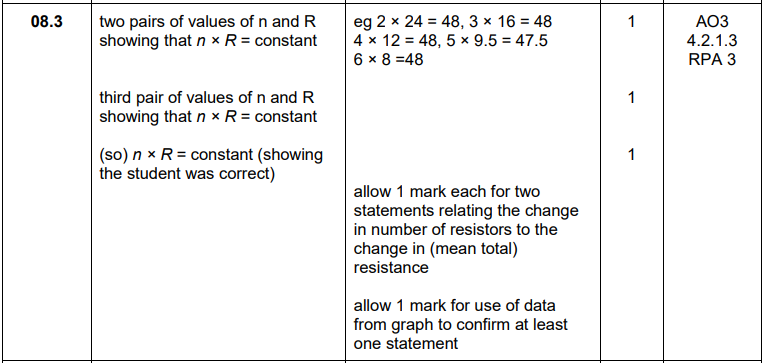
n × R = constant
2 × 24 = 48
3 × 16 = 48
4 × 12 = 48
Explain why adding resistors in parallel decreases the total resistance. [2 marks]
Multiple paths for electrons to flow
Total current is greater

![<p>Figure 13 shows part of a mains electricity lighting circuit in a house.</p><p>A fault in the switch caused a householder to receive a mild electric shock before a safety device switched the circuit off.</p><p>An electrician replaced the switch. </p><p>The electrician would have received an electric shock unless the circuit was disconnected from the mains supply. </p><p><strong><mark data-color="yellow" style="background-color: yellow; color: inherit;">Explain</mark> why. [3 marks]</strong></p>](https://assets.knowt.com/user-attachments/6d5d95a8-4779-4f6c-be2d-e0ae52e5fdf7.png)
Figure 13 shows part of a mains electricity lighting circuit in a house.
A fault in the switch caused a householder to receive a mild electric shock before a safety device switched the circuit off.
An electrician replaced the switch.
The electrician would have received an electric shock unless the circuit was disconnected from the mains supply.
Explain why. [3 marks]
One wire in the switch is live
The electrician is earthed
so there will be a large potential difference between the live wire and the electrician
![<p>The current from an electric shock causes a person’s muscles to contract. </p><p>The person cannot let go of the electrical circuit if the current is too high. Figure 14 shows how the maximum current at which a person can let go depends on the frequency of the electricity supply.</p><p>The UK mains frequency is 50 Hz. </p><p><strong><mark data-color="yellow" style="background-color: yellow; color: inherit;">Explain</mark> why it would be safer if the UK mains frequency was not 50 Hz. [2 marks]</strong></p>](https://assets.knowt.com/user-attachments/f63350b9-3e55-48ad-b0ab-86a0fb4e2218.png)
The current from an electric shock causes a person’s muscles to contract.
The person cannot let go of the electrical circuit if the current is too high. Figure 14 shows how the maximum current at which a person can let go depends on the frequency of the electricity supply.
The UK mains frequency is 50 Hz.
Explain why it would be safer if the UK mains frequency was not 50 Hz. [2 marks]
50Hz has the lowest maximum let-go current
Lower or higher mains frequency would allow a person to let go at higher currents

The temperature of the helium in a balloon was increased.
The mass and volume of helium in the balloon remained constant.
Explain why the pressure exerted by the helium inside the balloon would increase. [4 marks]
Particles would have a higher mean kinetic energy
so increased collisions with the walls of the balloon per second
Greater forces exerted in collisions
Greater force exerted on the same area
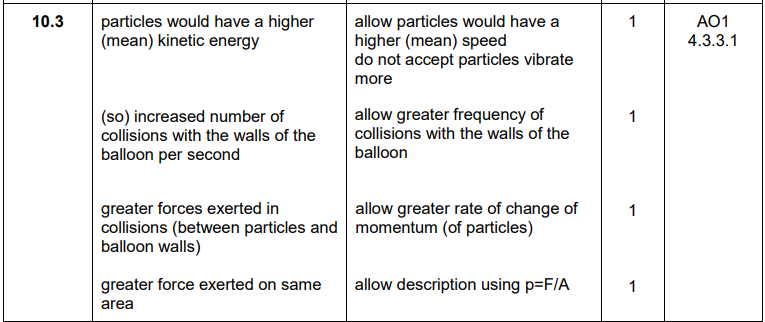
![<p><span style="background-color: transparent;">Figure 2 box shows the equipment a student used to determine the specific heat capacity of iron. </span></p><p><span style="background-color: transparent;">The iron block the student used has two holes, one for the heater and one for the thermometer.</span></p><p><span style="background-color: transparent;">Before the power supply was switched on, the thermometer was used to measure the temperature of the iron block. </span></p><p><span style="background-color: transparent;">The student left the thermometer in the iron block for a few minutes before recording the initial temperature. </span></p><p><span><strong><mark data-color="yellow" style="background-color: yellow; color: inherit;">Suggest</mark></strong></span><span style="background-color: transparent;"><strong> why. [1 mark]</strong></span></p>](https://assets.knowt.com/user-attachments/e4f47f85-05b5-4bd4-aaeb-f0ccaa6e0cdd.png)
Figure 2 box shows the equipment a student used to determine the specific heat capacity of iron.
The iron block the student used has two holes, one for the heater and one for the thermometer.
Before the power supply was switched on, the thermometer was used to measure the temperature of the iron block.
The student left the thermometer in the iron block for a few minutes before recording the initial temperature.
Suggest why. [1 mark]
So the thermometer temperature was the same as the temperature of the metal block
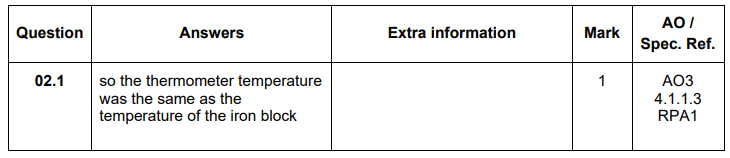
What is meant by ‘direct potential difference’? [1 mark]
Polarity of the potential difference doesn’t change

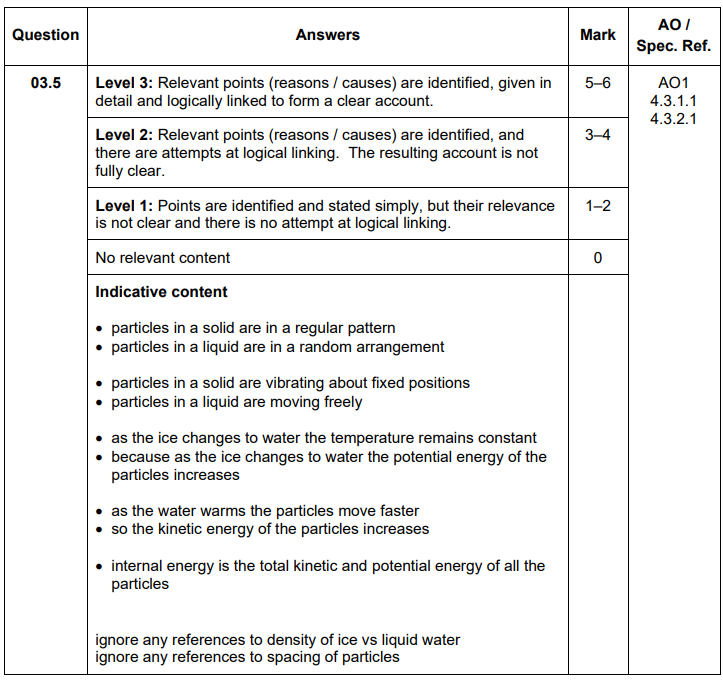
The electrical circuit was left switched on while the ice changed from a solid to a liquid and increased in temperature to 5 °C.
Explain the changes in the arrangement and movement of the particles as the ice melted and the temperature increased to 5 °C. [6 marks]
Particles in a solid are in a regular pattern
Particles in a liquid are in a random arrangement
Particles in a solid are vibrating about fixed positions
Particles in a liquid are moving freely
As ice changes state to water the temperature remains constant as the potential energy of the particles increases
As the temperature increases the particles move faster so the kinetic energy of the particles increases
![<p>Figure 5 shows how the power output of the generator varied during one year.</p><p>A solar power system is installed in the remote village in addition to the hydroelectric generator. </p><p><strong><mark data-color="yellow" style="background-color: yellow; color: inherit;">Explain</mark> why this improves the reliability of the electricity supply to the village. [2 marks]</strong></p><p>Use information from Figure 5.</p>](https://assets.knowt.com/user-attachments/fb907cf5-93cb-4562-b2d6-516170417cde.png)
Figure 5 shows how the power output of the generator varied during one year.
A solar power system is installed in the remote village in addition to the hydroelectric generator.
Explain why this improves the reliability of the electricity supply to the village. [2 marks]
Use information from Figure 5.
In the summer months the power output is lower but it would be higher with a solar power system
So there is less variation in total power output
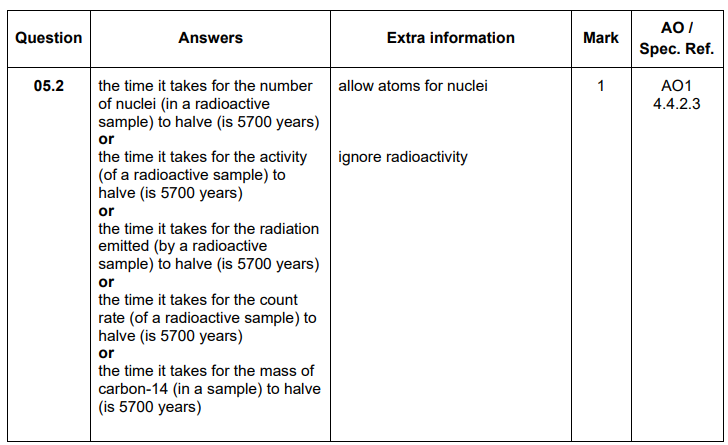
Carbon-14 is a radioactive isotope.
Carbon-14 has a half-life of 5700 years.
What does ‘a half-life of 5700 years’ mean? [1 mark]
Time it takes for the radiation emitted to halve
![<p>Table 1 gives the half-life of some other radioactive isotopes.</p><p>A sample of fluorine-17 has an activity that is one quarter of its original activity. </p><p><strong><mark data-color="yellow" style="background-color: yellow; color: inherit;">Calculate</mark> the age of the sample of fluorine-17. [2 marks]</strong></p>](https://assets.knowt.com/user-attachments/26117a42-8eab-4cd6-b680-718f4b094dcc.png)
Table 1 gives the half-life of some other radioactive isotopes.
A sample of fluorine-17 has an activity that is one quarter of its original activity.
Calculate the age of the sample of fluorine-17. [2 marks]
2 half lives
64.37 × 2 = 128.74

![<p>Table 1 gives the half-life of some other radioactive isotopes.</p><p>All of the isotopes in Table 1 emit beta radiation.</p><p><strong><mark data-color="yellow" style="background-color: yellow; color: inherit;">Explain</mark> which isotope would cause the biggest risk to a person’s health based only on the half-life of each isotope. [3 marks]</strong></p>](https://assets.knowt.com/user-attachments/796c1dce-25d3-457d-be94-9f730251b25f.png)
Table 1 gives the half-life of some other radioactive isotopes.
All of the isotopes in Table 1 emit beta radiation.
Explain which isotope would cause the biggest risk to a person’s health based only on the half-life of each isotope. [3 marks]
Nitrogen-18
Greatest activity
Greatest dose of radiation absorbed

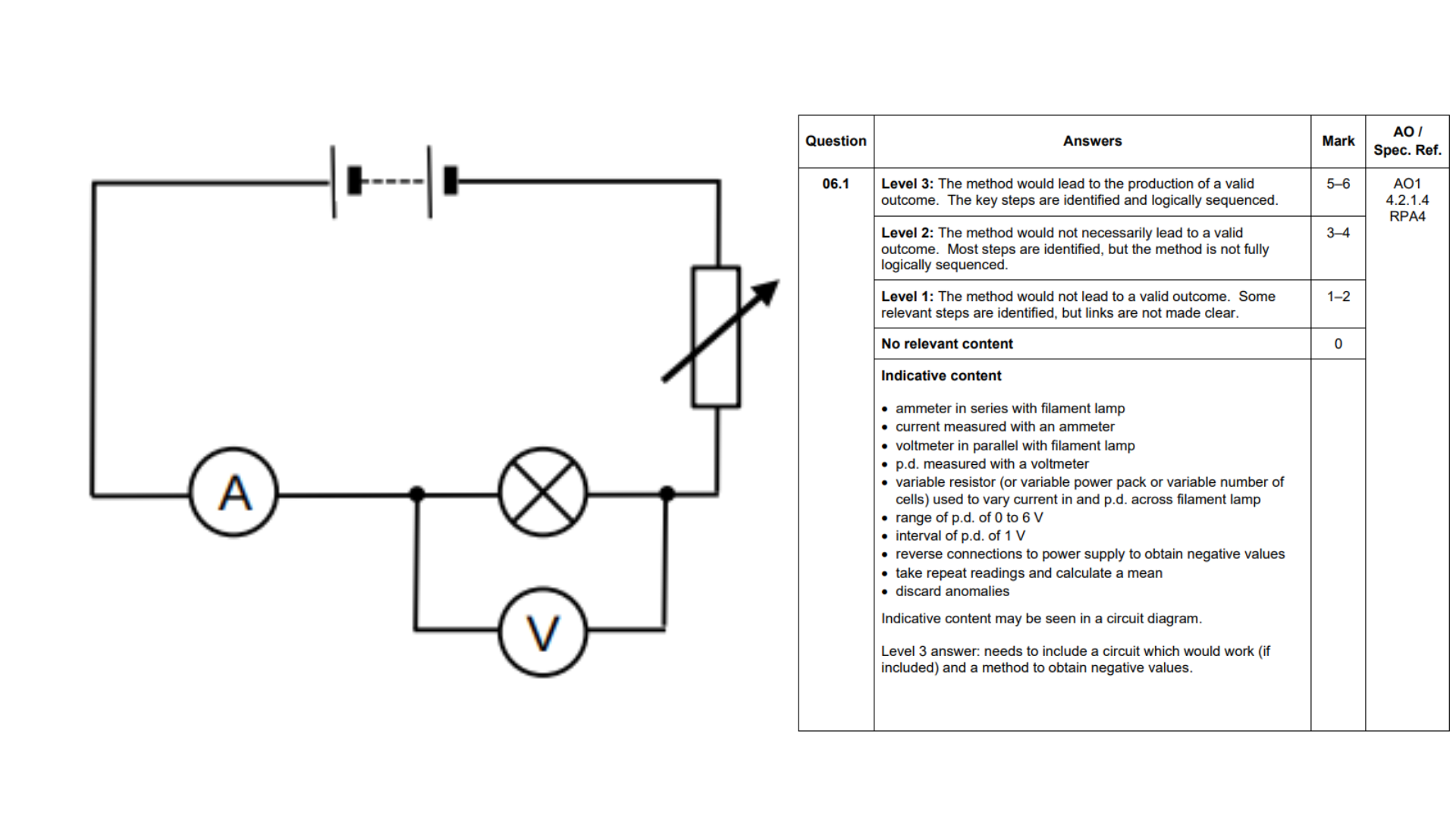
![<p>A student investigated how the current in a filament lamp varies with the potential box difference across the filament lamp. </p><p>Figure 6 shows the results</p><p><strong><mark data-color="yellow" style="background-color: yellow; color: inherit;">Describe</mark> a method the student could use to obtain these results. [6 marks]</strong></p><p>You should include a circuit diagram.</p>](https://assets.knowt.com/user-attachments/d741bbd0-d46d-46fc-ba6d-b360165854f8.png)
A student investigated how the current in a filament lamp varies with the potential box difference across the filament lamp.
Figure 6 shows the results
Describe a method the student could use to obtain these results. [6 marks]
You should include a circuit diagram.
Turn on the power supply and measure the current using an ammeter and the p.d. using a voltmeter
Adjust the variable resistor and record the readings again
range of p.d. 0 to 6V
in intervals of 1V
Repeat step 2 to get several readings
Swap the connections on the power supply to get negative values
Repeat steps 2 and 3
Calculate a mean and discard anomalies
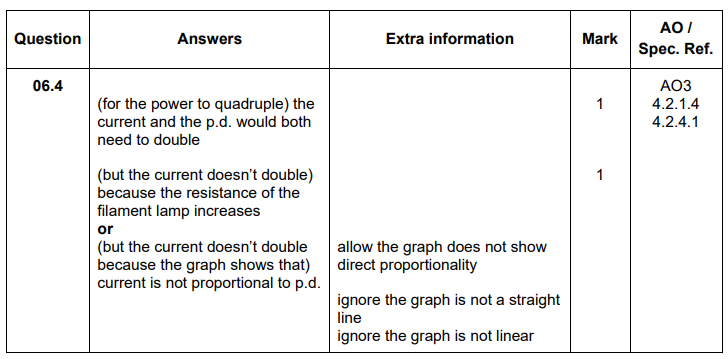
![<p><span style="background-color: transparent;">A student investigated how the current in a filament lamp varies with the potential box difference across the filament lamp.</span></p><p><span style="background-color: transparent;">Figure 6 shows the results</span></p><p>The power output of the lamp is 1.0 W when the potential difference across the lamp is 5.0 V. </p><p>A student predicts that the power output would be 4.0 W if the potential difference was doubled. </p><p><strong><mark data-color="yellow" style="background-color: yellow; color: inherit;">Explain</mark> why the student is not correct. [2 marks]</strong></p>](https://assets.knowt.com/user-attachments/d8898932-f0cb-4616-ae53-d613185851e9.png)
A student investigated how the current in a filament lamp varies with the potential box difference across the filament lamp.
Figure 6 shows the results
The power output of the lamp is 1.0 W when the potential difference across the lamp is 5.0 V.
A student predicts that the power output would be 4.0 W if the potential difference was doubled.
Explain why the student is not correct. [2 marks]
The current and the p.d. would both need to double
but the graph doesn’t show direct proportionality
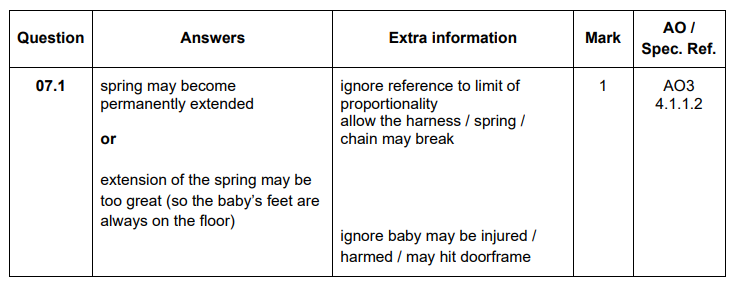
![<p>A baby bouncer is a harness attached to a spring that hangs from a door frame.</p><p>Figure 7 shows a baby in a baby bouncer in two positions.</p><p>The baby bouncer should not be used with babies that have a mass greater than 12 kg.</p><p><strong><mark data-color="yellow" style="background-color: yellow; color: inherit;">Suggest</mark> one reason why. [1 mark]</strong></p>](https://assets.knowt.com/user-attachments/5a9d24c2-6d07-437a-a9c0-a07965f127d6.png)
A baby bouncer is a harness attached to a spring that hangs from a door frame.
Figure 7 shows a baby in a baby bouncer in two positions.
The baby bouncer should not be used with babies that have a mass greater than 12 kg.
Suggest one reason why. [1 mark]
Spring may become permanently extended