4.1/4.2 - Definition of the Laplace Transform
 Call Kai
 Learn
Learn Practice Test
 Spaced Repetition
 Match
Match Flashcards
 Knowt Play
1/5

There's no tags or description
Looks like no tags are added yet.
Name | Mastery | Learn | Test | Matching | Spaced | Call with Kai | Chat |
|---|
No analytics yet
Send a link to your students to track their progress
6 Terms
Piecewise Continuous
A function is piecewise continuous if the function can be partitioned into a finite number of subintervals on which the function is continuous during each subinterval accordingly.
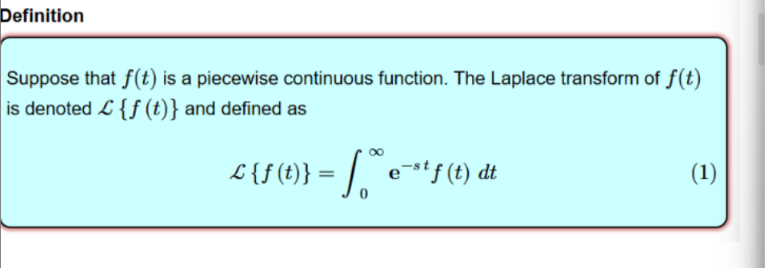
Definition of the Laplace Transform
The Laplace transform of a piecewise continuous function, f(t), is defined by the integral of the product of that function and the exponential; we essentially transform a function from the time-domain into the s-domain (frequency domain).
Notation for Laplace Transforms
Whenever taking the Laplace Transform of a function, we will always denote its final form as F(s)
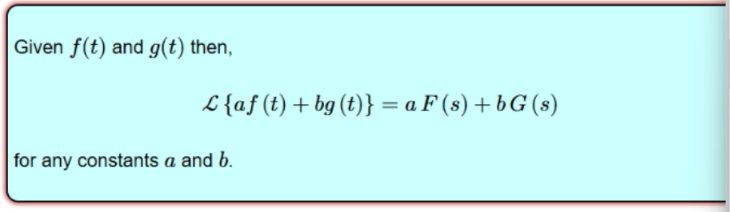
Linearity Property of Laplacian Operators
The Laplace operator is a linear operator, which means that if we take the Laplacian of the sum of the product of a constant and a function, we can break it up according to this rule:
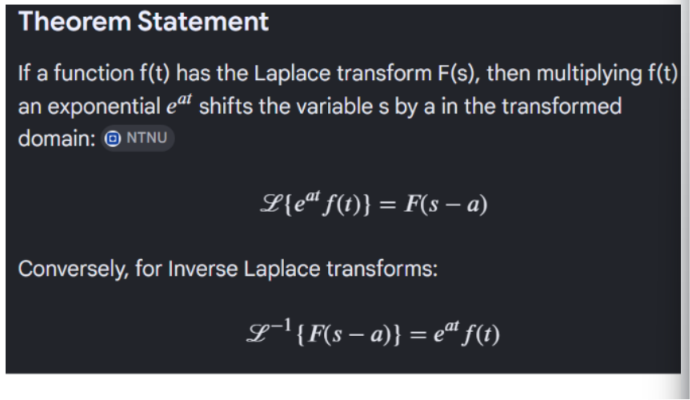
First Shifting Theorem for Laplace Transforms
If a function, f(t), is also being multiplied by an exponential of the form e^(at), then all that we have to do is find the Laplacian of f(t) and shift over each s variable by the same amount as the coefficient of the exponent.
Mathematically, this is proven by the fact that when we put the argument into the Laplace integral, we just add the exponents (st and at) to obtain a final form for the exponential and integrate as is usual.
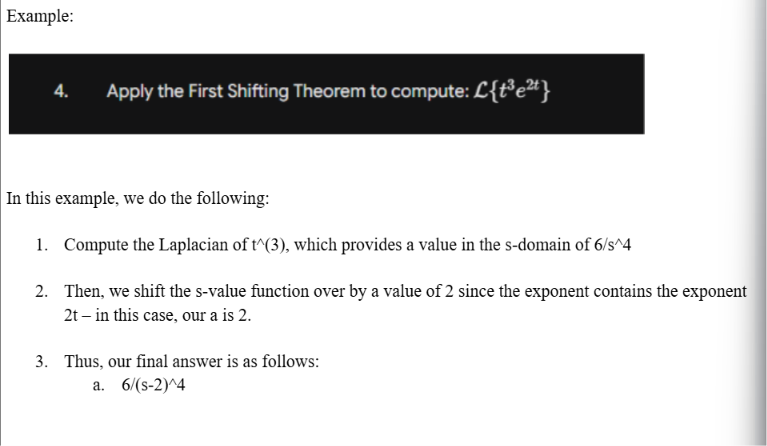
Application of the First Shifting Theorem