Prosthetics, Exoskeletons, and Assistive Robots
 Call Kai
 Learn
Learn Practice Test
 Spaced Repetition
 Match
Match Flashcards
 Knowt Play
1/8

There's no tags or description
Looks like no tags are added yet.
9 Terms
Why are sensors required in biomechatronics?
Sense variable in the human subject
Movement related
Physiological
Sense environmental variables
Sound (cochlear implant)
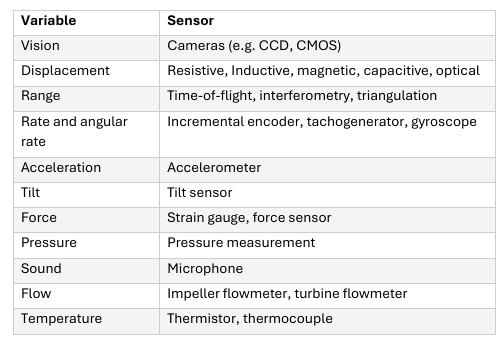
Common Sensors
Power Sources
Typically require power for the mechatronics devices
12V for motors
5V for analogue electronics
3.3V for signal processor
These systems may be:
Static - power should not present problems for design
Portable - require some form of battery power
Batteries
Battery power is one of the limiting factors due to their limited life.
Can be non-rechargeable (primary) or rechargable (secondary).
Primary batteries generally have a better power density, used for low power applications.
If access is difficult, secondary batteries should be used.
Measured in Watt-Hours
Energy Harvesting
The process of converting ambient sources of energy into electrical energy.
Can be harvested from a number of different sources:
Body motion
Vibration
Changes in shape or volume and pressure
Temperature gradient
Blood glucose
In current research the devices are not particularly efficient
Challenges in Exoskeletons
Portability
Ease of use
Metabolic cost
Lightweight actuators
Actuators that can supply high torque at slow speeds
Actuators that are soft and flexible
Intuitive control systems
Control systems that adapt to the changing dynamic of the human
Soft Exoskeleton Control
Layered control paradigm
Hierarchical control with 3 layers in cascade
High level controller
Understands user intention, converts to estimated joint torque / position using dynamic model of human arm
Mid level controller
Compensate for nonlinear backlash phenomenon
Low level controller
Sends input to DC motor to compensate for nonlinear friction
Models of Dynamic Systems
It is often the case that models are used that transform measured output variables into input variables that are used to drive actuators.
This is done with the inverse model of a system.
For models of physical systems the inverse often has more zeros than poles.
For this case the transfer function magnitude will be unbounded at high frequency (can be solved with a low pass filter)
Linear Dynamic Control
Control by negative feedback → reject disturbances
Control by positive feedback → sensitive to disturbances (i.e. BLEEK exoskeleton)
Controller designed close to inverse of exoskeleton dynamics
Subject to instability if the inverse model is inaccurate