LLB102 - Torts
 Call Kai
 Learn
Learn Practice Test
 Spaced Repetition
 Match
Match Flashcards
 Knowt Play
1/219

There's no tags or description
Looks like no tags are added yet.
Name | Mastery | Learn | Test | Matching | Spaced | Call with Kai | Chat |
|---|
No analytics yet
Send a link to your students to track their progress
220 Terms
Tort
A civil wrong where common law provides remedy for any incurred damages, typically monetary compensation.
Three general features of torts
An act or omission; an infringement of legally recognised rights; and an action for damages
Misfeasance
A positive act that causes harm
Nonfeasance
A failure or omission to act.
Absolute right
Actionable per se indicating the interference can initiate an action without need for further proof of damages.
Qualified right
The plaintiff must demonstrate the interference caused a legally recognised form of harm.
Tort Law
Protects a larger range of interested independent from contractual agreement including but not limited to personal safety, property and reputation.
Contract Law
Generally protects rights arising from agreements and promises.
Tort Law vs Criminal Law
Tort law primarily protects private rights and is generally pursued by an individual plaintiff, with the balance of probabilities as the standard of proof. Criminal law is generally enforced by the state, uses the beyond reasonable doubt standard, and focuses more heavily on punishment and deterrence.
Tort law primarily aims to protect private rights and is generally pursued by an individual plaintiff, with the balance of probabilities as the standard of proof. Conversely, criminal law is generally enforced by the state, operates with the beyond reasonable doubt standard and more heavily focuses on punishment and deterrence.
Donoghue vs Stevenson
Established the “neighbour principle” which posits a manufacturer is legally responsible for the final consumer of their products. Broadly, people must take reasonable care to avoid acts or omissions that they can reasonably foresee will cause harm or injury.
Insurance Role in Law
Protects defendants from financially devastating damages while simultaneously ensuring injured plaintiffs have ready access to funds to satisfy compensation awards.
Leading Question
A question that intrinsically suggests or presupposes an answer; avoid using when gathering facts or a story from a client.
Open Question
A question which opens up numerous response patterns and discussions; it should be used when gaining a chronological overview from a client.
Closed Question
A question with a more specific and shorter response; it should be used during theory development.
Value-laden Question
A question that may impact a client’s ability to recall a fact. A lawyer should start with an open question and then use narrowing or value-laden questions concerning more specific details or facts.
Reflecting
A statement or question which reflects back a client’s words. Should be used responsibly to avoid sounding patronising.
Reframing
A statement of question which acknowledges a client’s feelings or emotions and restates what they said in different words. Used to validate the client’s feelings and can also be used to defuse tension.
Non-verbal Cues
Leaning forward, consistent eye contact, nodding
Verbal Cues
Open questions, narrowing questions, acknowledgment
Gobbledygook
Excessive technical and legal jargon; it should be adjusted based on the client’s manner of speech.
Tortfeasor
The wrongdoer who committed the tort.
Legal Culpability
A person is under no legal obligation to aid another person if endangered from a source unconnected with that person.
Motive
The tortfeasor’s reason for acting.
Malice
Dishonest or improper motive
Infringement of Rights
Plaintiff must demonstrate how the act or omission infringed their legally recognised right(s). Otherwise, the plaintiff has no cause of action.
Damages
Monetary compensation awarded by the court to the plaintiff.
Basic Rule for Capacity to Sue or be Sued
Person must be of sound mind and 18+.
Minor and Disabled Persons
They may be sued if the criteria for tort law have been met.
Disabled Persons Liability
Disabled persons will not be liable if they are unable to reasonably control their bodily motions.
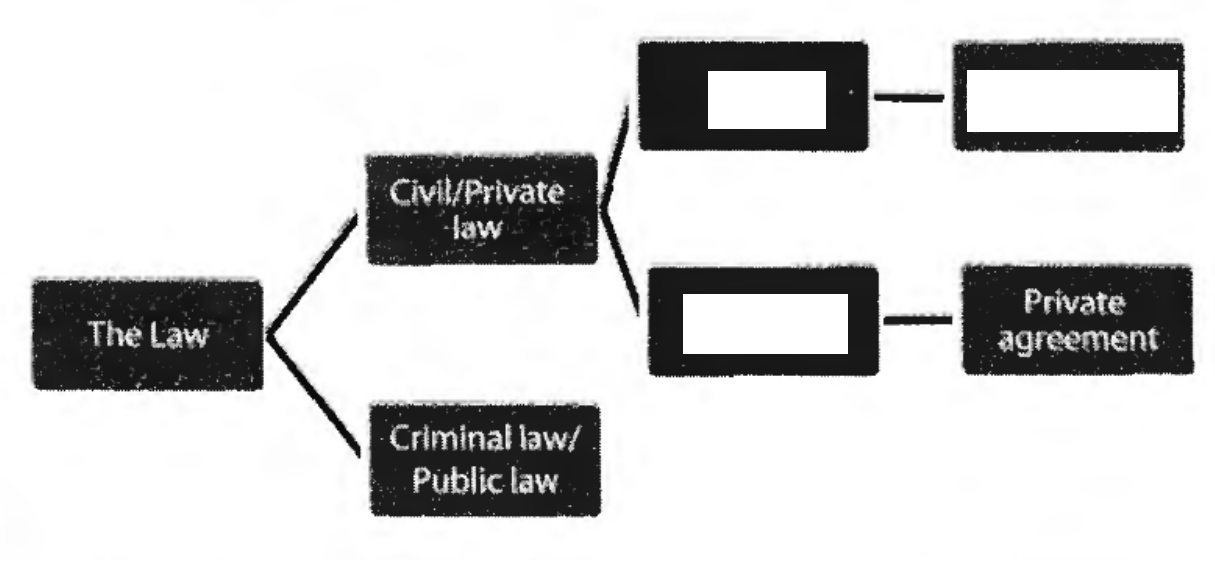
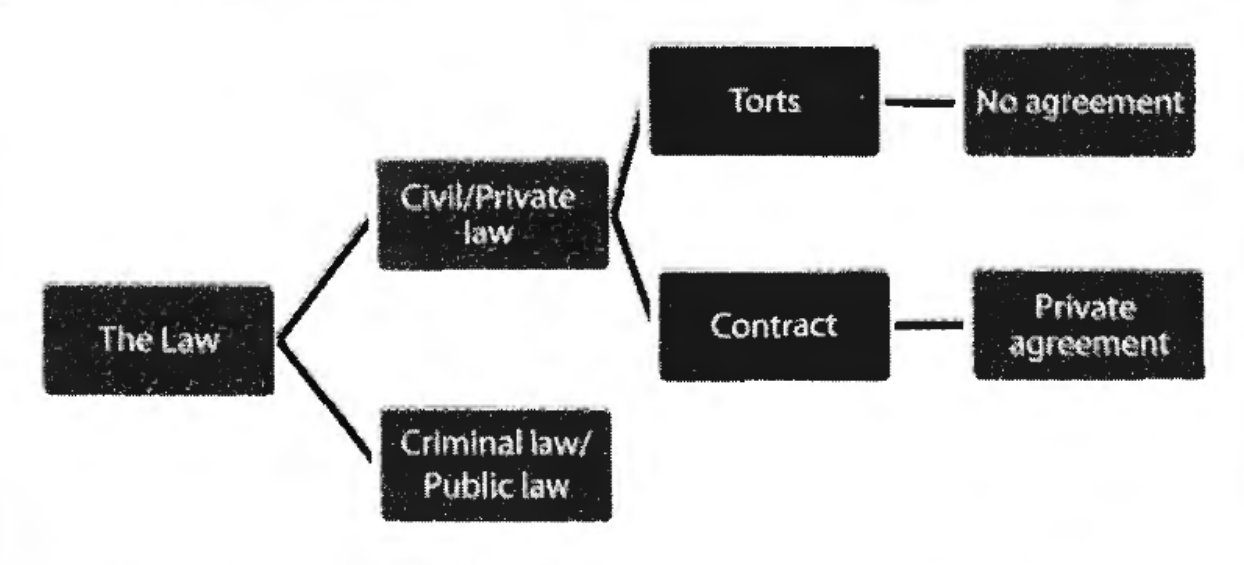
Contract vs Tort
Contract involves a voluntary agreement between involved parties whereas tort does not involve an agreement and are imposed by law to protect society from harm.
Determining Verdict in Criminal and Tort Law
Criminal law operates on the reasonable beyond doubt standard whereas tort law operates on the basis of probabilities.
Significance of Intention in Criminal vs Tort Law
Criminal law considers whether intent was involved when deciding the verdict whereas tort law does not consider intent provided the defendant’s act was voluntary.
Primary Remedy in Criminal vs Tort Law
Criminal Law is focused on enacting punishment top deter others whereas tort law is focused on compensatory damages. Criminal law also determines the punishment based on degree of culpability whereas tort law determines it on the basis of the degree of harm caused.
Initiators in Criminal vs Tort Law
Criminal law is primarily enforced by the state with the aim of punishment whereas tort law is initiated by individuals with the aim to vindicate private rights.
Injuries Arising from the Workplace
Generally, all that is required is proof there is a causal or temporal link between their injuries and employment.
No-fault compensation
An injured person receives financial compensation without needing to prove that anyone else was to blame for the injury; this is evident in workplace-related injuries.
Consumer Protection
Prohibits a person, in trade or commerce, from engaging in misleading or deceptive conduct.
Civil liability
Legal obligation of a person or business to financially compensate another party for causing them harm, loss or injury.
Indemnity
A legal promise where one party agrees to compensate another party for any loss, damage or legal liability they experience.
McNamara v Duncan (1971) 26 ALR 584
Frequently cited in battery causes related to sports; players provide implied consent to tackles and contact within the rules of the sports game but not to intentional violence or conduct outside these rules.
McHale v Watson (1964) 111 CLR 384
Established the child standard; children are judged against reasonable children of the same age, not against a reasonable adult.
Myer Stores Ltd v Soo [1991] 2 VR 597
Instrumental in Australian law to establishing false imprisonment. False imprisonment is unlawful confinement of a person against their will and does not require physical force.
Rixon v Star City Pty Ltd (2001) 53 NSWLR 98
Frequently cited in false imprisonment and battery cases; it concluded false imprisonment requires complete restraint and battery does not include everyday acts of contact.
Brady v Schatzel [1911] St R Qd 206
Frequently cited in assault cases; it posits assault requires reasonable apprehension of immediate, unlawful force and the feelings or fright of the victim is irrelevant to the verdict.
Narrowing vs Closed Question
Closed question involves a yes/no response whereas a narrowing question aims to minimise the scope of the task.
Action in trespass vs action in the case
Action in the trespass is a direct interference whereas an action in the case is an indirect interference.
Chay & Smith’s ‘Relational Approach’ to client interviewing
Taking a holistic view of the client’s concerns and addressing all legal and non-legal options and implications.
Chay & Smith’s ‘Instrumental Approach’ to client interviewing
Taking legally relevant facts only and applying them to the appropriate area of law.
Nominal Damages
A trivial sum of money awarded to a plaintiff to recognise their rights were violated even if they did not suffer any actual financial loss or physical injury. Commonly awarded in trespass cases.
Beyond reasonable doubt
Used in criminal law as a standard as the potential punishment in criminal law is severe and harsh.
Balance of probabilities
After reviewing the relevant stories and perspectives, which one is more likely. Used in tort law.
Direct vs Indirect Interference
Direct is an immediate result whereas indirect is consequential e.g. throwing a log on the road and causing an accident (direct) vs leaving a log on the road unattended and an accident occurs a couple hours later (indirect).
Fault
Mental element in tort law; it determines whether the tortfeasor was intentional or reckless in their acts. This must be proven in most tort cases to establish a case.
Non-highway vs Highway vs Indirect Interference
Onus on plaintiff to prove direct interference and on defendant to disprove fault; onus on plaintiff to prove both; and onus on plaintiff to prove all elements.
Non-highway vs Highway in Proving Fault
Defendant must disprove fault in non-highway scenarios whereas a plaintiff needs to prove fault in highway scenarios. This is because people provide implicit consent to the ordinary risks of public transit when travelling on roads.
Onus of Proof for Defendants
Onus of proof is always on the defendant when they raise a defense.
Immediate result in direct interference
Can be an unbroken chain of consequences like in Hillier v Leitch (1936)
Voluntary
Person was in control of their bodily motions.
Cause of action
Legal basis causing someone to act; the name of the tort (e.g. negligence, assault, etc).
Damage
Loss, injury or harm
Compensatory Damages
Awarded if plaintiff suffered damage.
Battery conditions - Contact
Regardless of it being direct or indirect, unconsented bodily contact is required as seen in Carter v Walker (2010).
Battery conditions - Object
Battery can arise from contact with objects; it does not need to be contact via a person-to-person basis.
Battery conditions - Everyday Life
Physical contact within the ordinary incidents of everyday social interactions is not grounds for battery as seen in Rixon v Star City (2001).
Battery conditions - Consent
Consent may be express like in medical procedures or implied like in sporting events. Consent is not provided for acts of excessive violence outside of the general rules of the situation like in McNamara v Duncan (1971).
Battery conditions - Knowledge
Knowledge of the interference is not necessary to enable battery like in Law v Visser (1961).
Assault conditions - Verbal
Assault can be enabled by a combination of gestures and words like in Stephens v Myers (1830) or just with words like in Barton v Armstrong (1969). The primary criterion for assault is an apprehension of imminent contact.
Assault conditions - Time
There can be a delay in assault cases but not a threat of force at some distant indeterminate time. This was approved in Zanker v Vartzokas (1988) and denied in Balven v Thurston (2013).
Assault conditions - Fright
Plaintiff does not need to be afraid or experience fright for assault to occur as observed in Brady v Schatzel (1911).
Assault conditions - Ability
The defendant’s inherent ability to carry out the threat is irrelevant; the only requirement for assault is the apparent ability to carry out the threat. This is observed in Brady v Schatzel (1911).
Assault conditions - Conditional
Conditional threats can constitute assault as seen in Tuberville v Savage (1699).
Assault conditions - Intention
Intention to carry out the threat is not relevant in assault cases; the only requirement is the apprehension of imminent contact.
False Imprisonment conditions - Duration
Duration of imprisonment is not required or considered initially when establishing action; it is only considered once remedy is being determined.
False Imprisonment conditions - Interference
False imprisonment can only occur in direct interference scenarios as it does not full under the Criminal Code 245.
False Imprisonment conditions - Restraint
Restraint must be in all directions and there must be no reasonable means of escape. Restraint does not necessarily have to be physical; it can also be psychological like in Myer Stores Ltd v Soo.
False Imprisonment conditions - Consent
Must be against the plaintiff’s will; false imprisonment cannot occur if the plaintiff consents or does not want to leave.
TCN Channel Nine Pty Ltd v Anning (2002)
Established the grounds for trespass to land; it occurs if there is a direct interference with someone’s land without proper consent and without proper legal or social justification.
Title to sue in Trespass to Land Cases
Having possession of the land in question (does not require legal ownership).
Newington v Windeyer (1985) 3 NSWLR 555
Established possession of land gives title to sue and not necessarily legal ownership of the land. Fundamentally used and referenced in trespass to land cases.
Halliday v Nevill (1984) 155 CLR 1
There is implied licence or consent for people who enter private property for legitimate purposes e.g. to apprehend a person for suspicious activity. Breach of this implied consent can provide grounds to sue for trespass to land.
Roy v O’Neil [2020] HCA 45
An implied licence exists in the case of a dual purpose for police; if the police are present for a purpose not involving exercising coercive powers, they have an implied licence to conduct further tests like breath tests. Moreover, if the breath test is conditional and not premeditated, there is sufficient evidence for an implied licence.
Implied Licence
Permission that is not expressly stated but is inferred from the circumstances or the occupier’s conduct e.g. entering someone’s land to ask a question is considered an implied licence.
Exemplary Damages
Compensation allocated to prevent or deter future cases of a similar nature from arising.
Aggravated Damages
Compensation allocated when increased emotional distress has occurred.
Three Elements of Trespass to Land
Title to sue (exclusive possession of land); direct interference; and fault.
Time Limitations
6 years if no person injury or harm occurred; 6 years if harm occurred but no personal injury (e.g. property damage); and 3 years if person injury occurred.
Ownership in Trespass to Land Cases
Does not require legal ownership, only exclusive possession needs to be demonstrated like in
Implied Licence Revocation
Implied licence can be revoked if verbally expressed or defendant enters on invalid grounds e.g. without legal justification or outside regular social interactions.
Interference Conditions in Trespass to Land Cases
Must be direct; on the land; and unauthorised.
Direct
Immediately or within an unbroken chain of events.
Rights to airspace in Trespass to Land Cases
Must be within a reasonable height fundamental in the ordinary use and enjoyment of the land.
Land
Surface, subsoil and airspace
Continued Trespass
Separate trespass action each day and a new time limitation each new day.
Objects Signalling Revocation of Implied Licence
Notice, locked gate and prior communication
Conditions of Self Defence
Defendant must prove threat of imminent harm and demonstrate the action was reasonable and proportionate to the threat.
Conditions of Defence to Another
Defendant must prove a threat of imminent harm and demonstrate their actions were reasonable and proportionate to the plaintiff’s actions.
Conditions of Provocation
Only a defence in QLD; the defendant must demonstrate plaintiff initiated a provocation; defendant’s actions were in the heat of the moment, not disproportionate and not inflicted to cause severe harm.
Necessity
Legal defence that enables a person to enter or use another person’s property.
Conditions of Necessity
Defendant must prove an imminent threat of grave harm; a reasonable apparent necessity; and the original interference was not fault of the defendant.