Topic 1: States of Matter
 Call Kai
 Learn
Learn Practice Test
 Spaced Repetition
 Match
Match Flashcards
 Knowt Play
1/24

There's no tags or description
Looks like no tags are added yet.
Name | Mastery | Learn | Test | Matching | Spaced | Call with Kai | Chat |
|---|
No analytics yet
Send a link to your students to track their progress
25 Terms
What are the distinguishing properties of solids?
They have a fixed volume and shape and they have a high density, the particles are packed very closely together in a fixed and regular pattern, and they vibrate in position but can’t change location.
What are the distinguishing properties of liquids?
They have a fixed volume but adopt the shape of the container. They are generally less dense than solids, but much denser than gases. The particles are still close together but are arranged randomly. The particles move and slide past each other which is why liquids adopt the shape of the container and are able to flow freely.
What are the distinguishing properties of gases?
They do not have a fixed volume, but are able to take the shape of their container. Gases have a very low density. Their particles are far apart and move randomly and quickly (around 500 m/s) in all directions. They collide with each other and with the sides of the container (this is how pressure is created inside a can of gas).
Describe the structure of solids in terms of particle separation?
Very close
Describe the structure of solids in terms of particle arrangement?
Regular Arrangement
Describe the structure of solids in terms of particle motion?
Vibrate about in a fixed position
Describe the structures of liquids in particle separation?
Close
Describe the structures of liquids in particle arrangement?
Randomly Arranged.
Describe the structures of liquids in particle motion?
Move around each other.
Describe the structures of gases in particle seperation?
Far apart.
Describe the structures of gases in particle arrangement?
Randomly Arranged
Describe the structures of gases in particle motion?
Move quickly in all directions.
What are the changes of state in terms of melting?
It is the change from a solid to a liquid. When a solid is heated, its particles gain kinetic energy and start moving faster. At a specific temperature called the melting point, the solid turns into a liquid.
What are the changes of state in terms of boiling?
The change from a liquid to a gas. As you continue to heat a liquid, its particles gain more kinetic energy. At a specific temperature called the boiling point, the liquid turns into a gas.
What are the changes of state in terms of evaporation?
It occurs when a liquid changes into a gas and occurs over a range of temperatures. It occurs only at the surface of liquids where high energy particles can escape from the liquid's surface at low temperatures, below the b.p. of the liquid. So, the larger the surface area and the warmer the liquid surface, the more quickly a liquid can evaporate.
What are the changes of state in terms of freezing?
The change from a liquid to a solid. When a liquid loses heat, its particles lose kinetic energy and slow down. At the freezing point, the liquid turns into a solid.
What are the changes of state in terms of condensing?
The change from a gas to a liquid. When a gas loses heat, its particles lose kinetic energy and slow down and come closer together. It can occur at a range of temperatures.
How does temperature and pressure affect the volume of a gas?
The volume of a gas is affected by changes in temperature and pressure.
What are the effects of temperature on the volume of a gas, in terms of kinetic particle theory?
When you increase the temperature of a gas, its particles start moving faster and have more kinetic energy. This increased kinetic energy causes the gas particles to collide more frequently and with greater force, pushing them further apart, and pushing them against their container walls. This makes the gas expand and take up more space. So, higher temperature leads to increased volume.
What are the effects of pressure on the volume of a gas, in terms of kinetic particle theory?
When you increase the pressure on a gas, you’re basically squeezing it. This makes the gas particles come together, reducing the space they occupy. So, higher pressure leads to decreased volume.
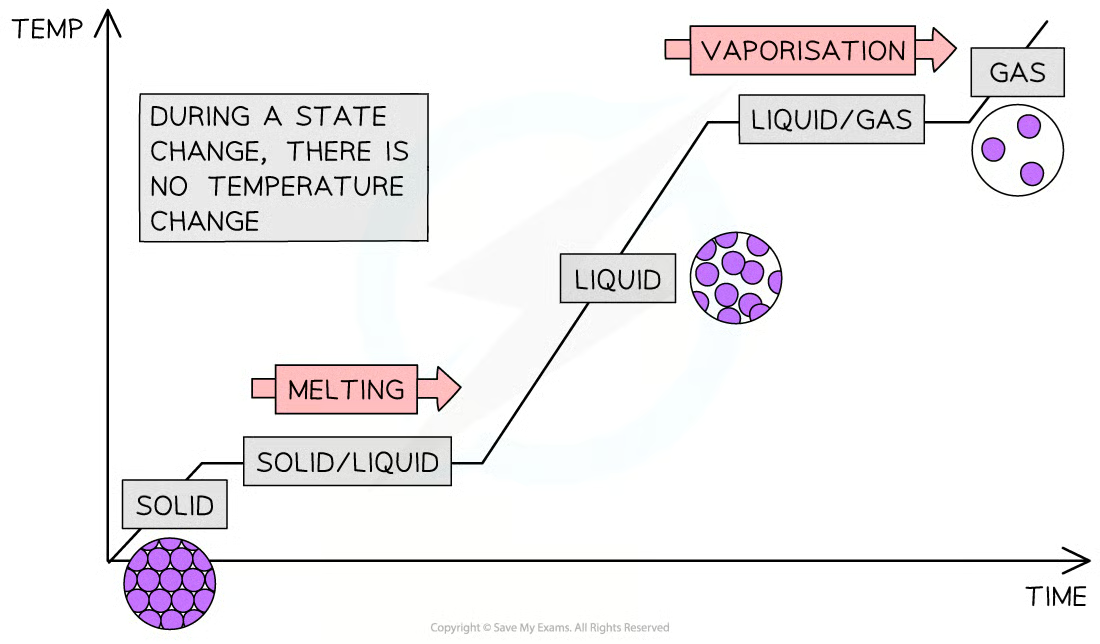
What is a heating curve?
It shows how the temperature changes as a substance is heated.
Sloping sections: Temperature increases because the particles gain kinetic energy.
Flat sections: A change of state is occurring.
At the melting point, solid → liquid.
At the boiling point, liquid → gas.
During a flat section, the temperature stays constant because the energy supplied is being used to overcome intermolecular forces, rather than increasing the particles' kinetic energy.
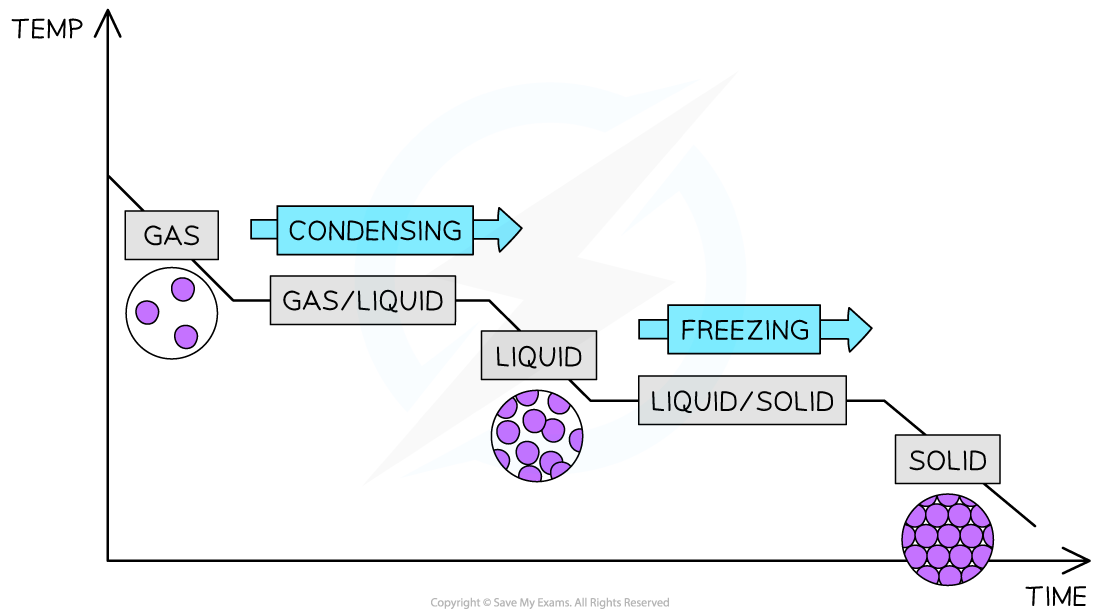
What is the cooling curve?
It shows how the temperature changes as a substance is cooled. During cooling, particles lose thermal energy, so their kinetic energy decreases and the temperature falls. During a change of state, the particles form stronger attractive forces and energy is released. Therefore, the temperature remains constant during the horizontal section until the change of state is complete.
What is diffusion?
The process where particles, typically gas or a liquid molecules, spread out from an area of high concentration to an area of low concentration due to the random motion of their particles.
What is the effect of relative molecular mass on the rate of diffusion of gases?
At the same temperature, different gases don’t diffuse at the same rate due to the difference in their relative molecular mass.
Gases with a lower relative molecular mass are “lighter”, meaning that they can travel faster and further in the same amount of time.
Gases with a higher relative molecular mass, they can travel slower and are unable to travel as far in the same amount of time due to them being “heavier.”
What is an example of the effect of relative molecular mass on the rate of diffusion of gases?
Helium has a lower relative molecular mass, meaning they can move faster over a long distance. While oxygen has a higher relative molecular mass, meaning that it moves much slower compared to helium.