Ch 09 The Integumentary System
 Call Kai
 Learn
Learn Practice Test
 Spaced Repetition
 Match
Match Flashcards
 Knowt Play
1/50

There's no tags or description
Looks like no tags are added yet.
Name | Mastery | Learn | Test | Matching | Spaced | Call with Kai | Chat |
|---|
No analytics yet
Send a link to your students to track their progress
51 Terms
Three layers of the skin
Epidermis
Outer layer of the skin
Protects underlying structures, sheds its superficial cells, and renews them continually throughout life, and provides a waterproof barrier
Dermis
Inner layer of the skin
Composed of dense connective tissue with collagen fibers, which gives the skin strength and elasticity.
It is well supplied with blood vessels and nerves.
Contains the other skin organs: sweat glands, oil glands, hair follicles, and nail roots.
Subcutaneous layer
Located below the other layers of skin
Helps to anchor the skin to the underlying structures
Within the subcutaneous fatty layer is a superficial fascia layer, which binds the skin to the parts beneath.
This layer guards against heat loss and provides insulation.
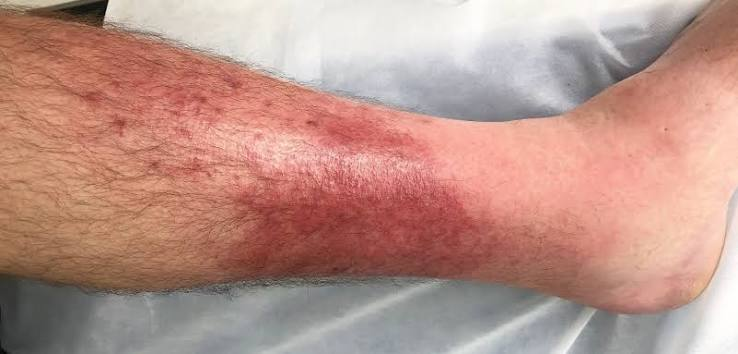
Cellulitis
An acute, spreading bacterial infection of the deep layers of the skin and subcutaneous tissue.
Dermatitis
A general term for inflammation of the skin, often causing redness, swelling, and itching.
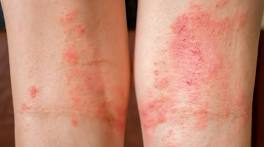
Eczema
A chronic, inflammatory skin condition characterized by itchy, red, dry, and scaly patches.
Dermatophytosis - Ringworm (tinea corporis)
A highly contagious fungal infection of the skin or scalp, characterized by a ring-shaped rash.
Melanocytes
Produce melanin that gives color to the skin
Sweat glands
Help lower body temperature
Blood vessels
The dilation and constriction of blood vessels regulate body temperature
Sebaceous glands
Produce sebum to lubricate the skin and inhibit the growth of bacteria on the skin
Abscess
A skin abscess occurs when a bacterial infection causes pus to collect in a localized area of the skin. Treatment involves draining the abscess and obtaining a culture to determine the causative pathogen.
Actinic keratosis (AK)
Very common, crusty skin lesion that results from years of sun exposure.
If left untreated, it may develop into skin cancer.
Either cryotherapy (liquid nitrogen) or a topical chemotherapy drug is used to destroy the lesion.
Herpes zoster (shingles)
a viral infection that causes a painful, blistering rash. It is caused by the reactivation of the varicella-zoster virus—the same virus that causes chickenpox. Anyone who has had chickenpox can develop shingles, usually appearing as a band on one side of the body.
Macule
A flat, distinct, and discolored area of skin that is usually less than one cm in diameter.
A freckle is a macule.
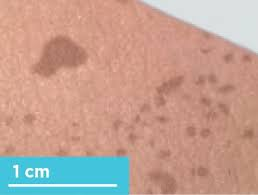
Papule
Small, raised bump on the skin that is less than one cm in diameter.
Insect bites and chickenpox are examples.
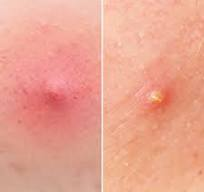
Pustule
A small elevation on the skin that exudates liquid.
Also known as a pimple.
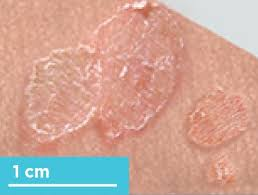
Scales
Flakes or dry patches of skin made up of excess dead epidermal cells. These are associated with psoriasis.
Verruca
Small, hard skin lesion caused by the human papillomavirus. Also known as a wart.
Vesicle
A small fluid-filled, blister -like lesion.
A poison ivy rash consists of vesicles.
Wheal
A small bump that itches. Also known as a welt.
Pressure ulcer
(bedsores or decubitus ulcers) are localized skin and tissue injuries caused by prolonged, unrelieved pressure, friction, or shear.
They frequently develop over bony prominences (e.g., tailbone, heels, hips) in individuals with limited mobility, restricting blood flow and causing tissue damage
A complex biological pigment responsible for the natural color of human skin, hair, and eyes.
Beyond pigmentation, it acts as a crucial photoprotectant by absorbing harmful ultraviolet (UV) radiation and neutralizing free radicals to prevent DNA damage in cells.
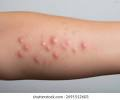
Raised, itchy, or stinging areas of skin that are often redder or paler than the surrounding skin.
They are a classic sign of an allergic reaction, insect bite, or inflammatory response
A common fingerprint pattern where the central papillary ridges make at least one complete circle or spiral
Whorl
Impetigo
a common, highly contagious bacterial skin infection, usually caused by Staphylococcus aureus or Streptococcus pyogenes
A small red macule becomes a vesicle and then changes into a pustule with yellow crust and outer rim
Keloid
An overgrown, thick, and raised scar that extends beyond the borders of an original skin injury.
Caused by an excess of collagen production during healing, they can be itchy, tender, or painful.
They are common on the chest, shoulders, earlobes, and face, and frequently appear in individuals with darker skin tones.
The ABCDE Rules of Melanoma
Asymmetry
One half does not match the other half.
Border irregularity
The edges are ragged, notched, or blurred.
Color
The pigment is not uniform. Shades of tan, brown, and black are present. Red, white, and blue may add to the mottled appearance.
Diameter
It is greater than 6 millimeters. Any sudden or continuing increase in size is a sign.
Evolving
The surface of a mole may change to be scaly, oozing, or bleeding. A bump may appear, pigment may spread, or redness/swelling/pain may occur.