Chapter 11: Project Planning and Project Management
 Call Kai
 Learn
Learn Practice Test
 Spaced Repetition
 Match
Match Flashcards
 Knowt Play
1/64

There's no tags or description
Looks like no tags are added yet.
Name | Mastery | Learn | Test | Matching | Spaced | Call with Kai | Chat |
|---|
No analytics yet
Send a link to your students to track their progress
65 Terms
why do we need PMs?
Needed bc lots of projects fail!
⅓ - ½ of projects are challenged or fail in the recent years
3 categories of project success
Successful projects – on time, within budget, on scope
Challenged projects – failure in one area
Failed projects – cancelled or not used
“triple constraint” concept used by PMs
Time, Budget, Scope
common reasons for project faliure
Undefined project management practices
Poor IT management and poor IT procedures
Inadequate executive support for the project
You need buy in from the top!
Inexperienced project managers
Affects communication of what is being done properly and things
Unclear business needs and project objectives
Inadequate user involvement
Ensures the client or users actually USE what you made (ensures intuitive, easy to use, etc)
what is project management
Organizing and directing other people to achieve a planned result within a predetermined schedule and budget
The processes used to plan the project and then to monitor and control it.
what is a project manager
Great need for effective project managers
Internally managing people and resources
Externally conducting public relations
what makes the role of PM especially difficutl
PM is Difficult role bc u have to get people to do work for you! Often outside of their normal scope
PM internal responsibilities
Developing the project schedule
Recruiting and training team members
Assigning work to teams and team members
Assessing project risks
Monitoring and controlling project deliverables and milestones
“Checks and balances” of project management
PM external responsibilities
Reporting the project’s status and progress
Working directly with the client (the project’s sponsor) and other stakeholders
Both internal and external stakeholders
Identifying resource needs and obtaining resource
what is a stakeholder
anyone who is involved, as a vested interest, or is affected by the project
client, oversight committee, and users
Client
the person or group that funds the project
Oversight Committee
clients and key managers who review the progress and direct the project
Users
the person or group of people who will use the new system once deployed
THEY ALL REPORT/COMMUNICATE WITH THE PM!
what is level of formality or ceremony
a measure of the amount of documentation generated, the tracebility of specifications, and the formality of the project;s decision making processes
small projects usually have low ceremony (ex. meet at the water cooler and little written documentation)
larger or more complex ones have high ceremony (ex. predefined meetings schedule, specifications documented, meeting agendas)
10 parts of PMBOK
Project Integration Management
Project Scope Management
Project Time Management
Project Cost Management
Project Quality Management
Project Human Resource Management
Project Communications Management
Project Risk Management
Project Procurement Management
Project Stakeholder Management
Project Integration Management—
Integrating all the other knowledge areas into one seamless whole
How do you integrate all the other knowledge areas?
Glue that holds the project together
Ensures that all other knowledge areas get equal weight
agile project management diagram

Project Scope Management
Defining and controlling the functions that are to be included in the system as well as the scope of the work to be done by the project team
Project Time Management
Creating a detailed schedule of all project tasks and then monitoring the progress of the project against defined milestones
Project Cost Management
Calculating the initial cost/benefit analysis and its later updates and monitoring expenditures as the project progresses
Initial baseline budget
Project Quality Management
Establishing a comprehensive plan for ensuring quality, which includes quality control activities for every phase of a project
Are you putting out a quality piece of software?
Project Human Resource Management
Recruiting and hiring project team members; training, motivating, and team building; and implementing related activities to ensure a happy, productive team
How do we get people to work on the project? The right talent?
Project Communications Management
Identifying all stakeholders and the key communications to each; also establishing all communications mechanisms and schedules
Communicating effectively, right model, technical form, printing vs emailing reports etc
Project Risk Management
Identifying and reviewing throughout the project all potential risks for failure and developing plans to reduce these risks
Identify what could go wrong and how to then mitigate
Project Procurement Management
Developing requests for proposals, evaluating bids, writing contracts, and then monitoring vendor performance
Happens when you have to go outside the firm for resources
Ex. if you need to procure a consultant for software development of a project bc ur team doesnt have one
Project Stakeholder Management
Identifying and communicating with the stakeholders of the new system
Ensures communication and transparency between PM and stakeholders
PM vs VA
“Project Manager (PM) oversees strategy, timelines, and overall project outcomes
Virtual Assistant (VA) executes day-to-day administrative and operational tasks“
Activities of Core Process 1
Identify the problem and obtain approval
also quantify approval factors,
feasibility/risk analysis,
review and approve w/client
Activities of Core Process 1 - How to identify the problem
IS projects usually
Projects are often a response to a problem, data, or popularity of a service
Some projects may respond to an external directive
Ex. in response to a new tax law
Respond to an opportunity
Strategic initiative
Something that provides competitive advantage
Resolve a problem
Operational issues keep coming up
User needs aren’t being met
Respond to an external directive
Legislation requires new form of reporting
Changes in tax laws or regulations
Activities of Core Process 1 - How to identify the problem w/ a systems vision document + its 3 parts
Problem Description
What is the problem and idea for the solution?
System Capabilities
What are the capabilities the new system will have?
Helps define the scope
Business Benefits
The benefits that accrue to the organization
Tangible (in dollars) and intangible benefits
Activities of Core Process 1 - quantifying estimated time for completion

3 key project approval factors
est. time for project completion
est. cost for project and system
anticipated benefits from deloyment of the system
Activities of Core Process 1 - quantifying estimated cost for development

Activities of Core Process 1 - estimated cost for support

quantify project approval factors - anticpated benefits from new system
Opening up new markets with new services, products, or locations
Increasing market share in existing markets
Enhancing cross-sales capabilities with existing customers
Reducing staff by automating manual functions or increasing efficiency
Decreasing operating expenses, such as shipping charges for “emergency shipments”
Reducing error rates through automated editing or validation
Reducing bad accounts or bad credit losses
Reducing inventory or merchandise losses through tighter controls
Collecting receivables (accounts receivable) more rapidly
quantify project approval factors - tangible “dollar” benefits and what are they used for
used for Cost/Benefit Analysis--process of comparing costs and benefits to see whether investing in a new system will be beneficial--
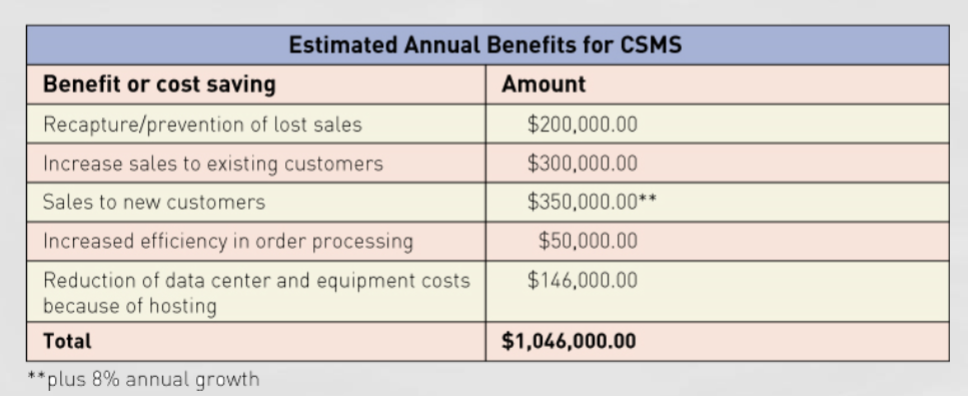
what is a cost benefit analysis
Cost/benefit analysis, your returns on investment or ROI
comparing costs and benefits to see if the net result is plus or minus
If I give you X, what do i get in return, is it positive, and how positive?
what is Net Present Value (NPV)
NPV discusses time value of money
So is it better to invest the money for a 10% return, or invest it in your project?
The goal is to get a better return overall, so your project should give a better investment return than the current investment strategy for that money
Companies pick the project with the highest NPV
the present value of dollar benefits and dollar costs of a particular investment
what is the break-even point
point in time at which benefits and costs are equal
what is the payback period
When do we get paid back from the project?
The sooner the better!
When the dollar benefits have offset dollar costs in time
cost benefit analysis types- what is a tangible benefit
a benefit that can be measured or estimated in terms of dollars
The NPV after 5 years is $1,713,097
Payback Period is 2 years and 128 days

cost benefit analysis types- what is an intangible benefit
A benefit that accrues to an organization but that can’t be measured quantitatively or estimated accurately
Increased levels of service (in ways that can’t be measured in dollars)
Increased customer satisfaction (not measurable in dollars)
Survival—need to do it to compete
Need to develop in-house expertise (such as a pilot program with new technology)
GENERAL CONCEPT- what does determining project risk and feasibility include?
What can go wrong and how can we mitigate?
Determine the organizational risks and feasibility
How well does the new system fit the organizational culture? Risk of negative impacts?
Evaluate the technological risks and feasibility
Can we do this? Do we have the talent or a true understanding of it?
Can the system be built by the team using technology needed? Training available?
Assess the resource risks and feasibility
Are the needed resources available? Skilled people?
Identify the schedule risks and feasibility
Can the system be built in the amount of time available? Fixed Deadline?
people risks
Ex. we need 10 devs, but we only have 3 → risk = we dont have enough talent
We mitigate it by hiring consultants, but consultants have a cost!
GENERAL CONCEPT- what does review with client and obtain approval include?
Executive committee reviews and approves
Board must review and approve for very large projects
Involved stakeholders need to understand what is expected of them
IS department needs to know what to do for staffing and support
Whole organization should be made aware of the project and its importance
Activities of core process 2:
plan and monitor the project
establish the project environement
schedule the work
staff and allocate resources
evaluate work processes
monitor progress and make connections

What does it mean to establish the project parameters and work environment
tailor and operationalize the methodology being used
Recording and communicating—internal and external
Who, what, when, and how
Work environment - support/facilities/tools
Workstations, software development tools (IDE), servers and repositories, office and meeting space, support staff
Process and procedures followed
Reporting and documentation, programming approach, testing, deliverables, code and version control

example of digital repository of information in a project environment

electronic digital repository diagram example from establish the project environment
info stored in repositories for team member use

establish the project environment - work environment tools
Pm should establish the who what when and hows
How are we doing this (computers, softwares, systems)
Milestones, reporting, documentation
Should always be consistent (same set of parameters and standardization between projects to ensure efficiency)
Key table parameters: Info captured, electronic tools, who can update/view
Personal computer(s) and/or workstation(s)
Personal development software and tools
Development server with repositories, sandboxes, and communication tools
Office space, conference rooms, and equipment, including printers, scanners, and projectors
Support staff
establish the project environment - processes and procedures
Reporting and documentation—What is done? How is it done? Who does it?
Programming—Single or pair programming? How is work assigned? By whom?
Testing—Programmer tests or user tests? How do you mark items ready for testing?
Deliverables—What are they? How and when are they handed over to users? How are they accepted?
Code and version control—How is the code controlled to prevent conflicts? How do you coordinate bug fixing with new development? How and when are deliverables released?
schedule the work - project iteration schedule and detailed work schedule
these must be constantly adjusting:
Project Iteration Schedule
The list of iterations and use cases or user stories assigned to each iteration
Detailed Work Schedule
Within an iteration, the schedule that lists, organizes, and describes the dependencies of the detailed work tasks
As each iteration is finished, a detailed work schedule is prepared for the next iteration
The next detailed work schedule takes into account the changes necessary based on feedback/progress
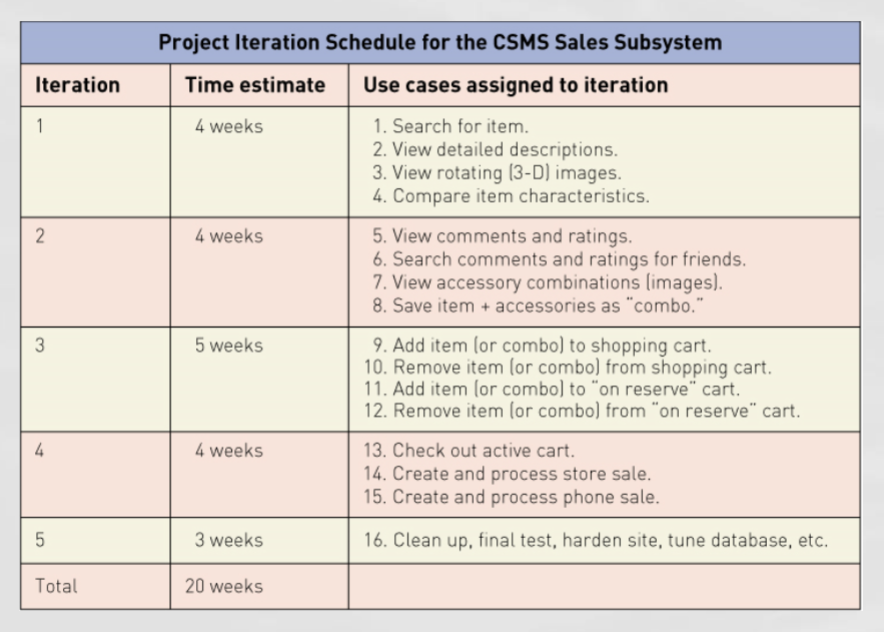
schedule the work - three steps of developing a detailed work schedule
Develop a Work Breakdown Structure (WBS)
The list or hierarchy of activities and tasks used to estimate the work to be done in a project or iteration
Estimate effort and identify dependencies
Task times
Tasks that must be completed before another task begins
Critical path--a sequence of tasks that can’t be delayed without causing the entire project to be delayed
Create a schedule using a Gantt chart
Bar chart that portrays the schedule by the length of horizontal bars superimposed on a calendar

Critical path
Critical path--a sequence of tasks that can’t be delayed without causing the entire project to be delayed
tasks for the work breakdown schedule - 3 key guidelines of how detailed individual tasks should be
There should be a way to recognize when the task is complete.
The definition of the task should be clear enough so you can estimate the amount of effort required.
As a general rule for software projects, the effort should take one to five working days.
staff and allocate resources
5 tasks of staffing activity
Developing a resource plan for the project
Identifying and requesting specific technical staff
Identifying and requesting specific user staff
Organizing the project team into work groups
Conducting preliminary training and team-building exercises
what does it mean to monitor project progress and make corrections
process to monitor and control project execution

sample issues tracking log
(monitor project progress and make corrections)

retrospective
after each iteration, team member evaluate how well they worked together and how they can improve their effectivmness and performance as a team
discuss deadlines, communication method/quality, relationship with user, major issues and future accordances bc of it, what went well, bottlenecks
what is a gnatt chart?
a visual project management tool that maps out a project schedule along a horizontal timeline
Vertical Axis: Lists project tasks, subtasks, or phases in order.
Horizontal Axis: Shows the project timeline broken down into days, weeks, or months.
Horizontal Bars: Represent each task's start date, duration, and end date. The length of the bar shows how long the task takes.
Dependencies: Lines or links showing which tasks must be finished before others can start.
Milestones: Markers for major deadlines, meetings, or key deliverables. [1, 2, 3, 4, 5, 6]
![<p><strong><em>a visual project management tool that maps out a project schedule along a horizontal timeline</em></strong></p><ul><li><p><span><strong>Vertical Axis:</strong> Lists project tasks, subtasks, or phases in order.</span></p></li><li><p><span><strong>Horizontal Axis:</strong> Shows the project timeline broken down into days, weeks, or months.</span></p></li><li><p><span><strong>Horizontal Bars:</strong> Represent each task's start date, duration, and end date. The length of the bar shows how long the task takes.</span></p></li><li><p><span><strong>Dependencies:</strong> Lines or links showing which tasks must be finished before others can start.</span></p></li><li><p><span><strong>Milestones:</strong> Markers for major deadlines, meetings, or key deliverables. [1, 2, 3, 4, 5, 6]</span></p></li></ul><p></p>](https://assets.knowt.com/user-attachments/cfe1a469-afc6-488e-ae9d-a0781461f74b.png)
Portfolio
Portfolio is a collection of programs
Program
Program is a collection of projects
project approval factors - time estimate table items
Time estimate table items: Subsystem, fundamental requirements, iterations required, estimated time, at the bottom have total project time!
^^^ in a table
Also can include whos involved, and how much the project will cost
This is a very high level thing
Estimated cost for support table - in quantify project approval factors
Include totals for costs/money stuff!
Estimated cost for development table items: Expense category → amount
Estimated cost for support table items: Recurring expense → amount
Tangible dollar benefits → benefit or cost saving → amount
Purpose:
Give stakeholders enough info to make good decisions
Some companies use formulas to calculate this, and it also depends how far we are into the project life cycle
tangible benefits
things we can see and count!
intangible benefits
based on intuition, experience, survey data, increased level of service, things that are not counted numerically or measured