Dyslipidemia Cardiology REM
 Call Kai
 Learn
Learn Practice Test
 Spaced Repetition
 Match
Match Flashcards
 Knowt Play
1/87

There's no tags or description
Looks like no tags are added yet.
Name | Mastery | Learn | Test | Matching | Spaced | Call with Kai |
|---|
No analytics yet
Send a link to your students to track their progress
88 Terms
Lipids
Organic compounds, poorly soluble in water (i.e., lipophilic)
Transported in blood as large complexes of liquids + proteins, known as lipoproteins
Triglycerides Primary Functions
Energy supply, energy storage, insulation, organ protection
Phospholipids Primary Functions
Cell membrane structure, lipid transport, signaling molecule precursors
Cholesterol
Cell membrane integrity, precursor for steroid hormones, bile acids, and vitamin D production
Endogenous generation
Liver is primary site for synthesis, closely tied to glucose/carb metabolism
Cholesterol synthesis regulated by HMG-CoA reductase (rate- limiting enzyme)
Diurnal variation: synthesis rates greater at night
Feedback regulation: high intracellular cholesterol inhibits HMG-CoA reductase
Stored or packaged (into VLDL lipoproteins) for transport
Lipoproteins
Mechanism for transporting lipids in the blood
Includes High density lipoproteins (HDL), low density lipoproteins (LDL), Intermediate density lipoproteins (IDL), very low density lipoproteins (VLDL)
Lipid transportation
The liver synthesizes and secretes VLDL, primarily composed of triglycerides, with smaller amounts of cholesterol and phospholipids
In the bloodstream, VLDL loses triglycerides through enzymatic transformations, converting into IDL and then LDL, which is cholesterol-rich (Hence, you will see LDL often written as LDL-C)
Chylomicrons
Large, triglyceride-rich lipoproteins
Transports lipids from dietary intake
Not present ~12 hours after fasting
VLDL
Lipoprotein that is released by the liver
Similar in structure to chylomicrons, but carries high levels of endogenous TG (followed by cholesterol)
LDL
Major cholesterol transporter (hence, often written LDL-C)
IDL is modified form of LDL
Cleared by uptake by LDL receptors
HDL
Synthesized by a distinct process of the liver
Responsible for removing excess cholesterol and taking it back to the liver for catabolism or to the gut for excretion
Causes of dyslipidemia
Often multifactorial with environmental factors and genetic abnormalities involved
Mostly secondary causes – the “4 Ds” of diet (western diets = strong contributor), disorders, disease, and drugs
Primary or Familial dyslipidemia is fairly rare
Secondary causes or contributors of High Total Cholesterol and LDL
Atypical antipsychotics
Glucocorticoids
Immunosuppressants (e.g., cyclosporine, sirolimus)
Progestins
Isotretinoin
Thiazide diuretics
Beta-blockers
Protease inhibitors
Mirtazapine
Gemfibrozil
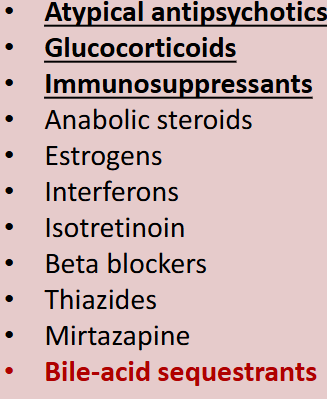
Secondary causes or contributors of High TG
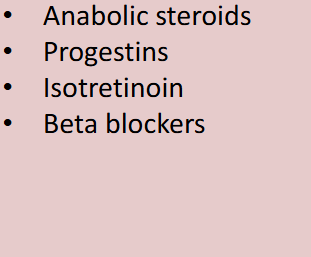
Secondary causes or contributors of Low HDL
Clinical presentation
Most patients are asymptomatic
May present with multiple signs of metabolic syndrome
May present with cardiovascular events if have had underlying dyslipidemia for sufficient time period
Eruptive xanthomas can develop in childhood/early adulthood in aggressive forms of dyslipidemia (i.e. familial)
Pancreatitis in patients with TG > 500 mg/dL
Patient evaluation (Required lab for diagnostics)
Fasting lipid profile (FLP) (12-hour fast, preferred) - Includes total cholesterol, LDL, HDL, and TG
Total cholesterol, HDL and TG can be measured directly with assays, whereas LDL cholesterol is calculated
TG > 400 mg/dL → can mislead calculation, so LDL cannot be calculated; A direct-LDL (assay) can be obtained in this case; direct-LDL is also preferred if calculated LDL is < 70 mg/dL (due to limitations of accuracy)
FLP lab recommended in all > 20 years old, at least every 5 years
In nonfasted state, only total cholesterol and HDL will be usable; If total cholesterol > 200 mg/dL or HDL < 40 mg/dL, obtain a follow-up fasting panel
Cholesterol calculations
LDL = Total cholesterol – HDL – (TG ÷ 5); TG ÷ 5 estimates the VLDL
Non-HDL cholesterol = total cholesterol – HDL
Total Cholesterol Values (mg/dl)
<200 = desirable
200-239 = Borderline high
> 240 is high
LDL Values (mg/dl)
< 70-100 = Optimal
100-129 = Near or above optimal
130-159 = Borderline high
160-189 = High
> 190 = Very high
TG Values (mg/dl)
< 150 = Normal
150-174 = Borderline high
175-499 = Moderately high
>500 = High – at risk for acute pancreatitis
HDL Values (mg/dl)
< 50 (female) ; < 40 (male) = Low
> 60 = High – good
> 90-100 (FYI) = Extremely high (FYI)– paradoxically negative effects*
Primary prevention
Assess risk of developing ASCVD
Screen FLP every 5 years starting at age 20 to determine if lipid abnormalities exist
Often abnormalities are a mixture of elevated LDL, elevated TG and low HDL
Elevated LDL: if >190 mg/dL, more likely to be genetic (HeFH or HoFH) but would require genetic testing to confirm (not often done), often requires combination treatment
Elevated TG: when > 500 mg/dL becomes an acute risk (pancreatitis), often requires TG-targeted drug
If lipid abnormity is identified, gather patient data
1) age, 2) gender, 3) family history, 4) cardiovascular risk factors (e.g., age, smoking, BP, lipids, A1c), 5) medication history, 6) potential secondary causes of lipid abnormalities 7) other pertinent history (e.g., history of pancreatitis)
Physical exam by provider
Secondary prevention: what constitutes very high-risk?
History of multiple major ASCVD events or 1 major ASCVD event + multiple high-risk conditions
Major ASCVD Events
Recent ACS (within past 12 months)
History of MI
History of ischemic stroke
Symptomatic PAD
High-risk conditions
Age > 65 years
Heterozygous familial hypercholesterolemia
History of prior CABG or PCI outside of major ASCVD events
Diabetes
Hypertension
Chronic kidney disease
Heart failure
Persistently elevated LDL (> 100) despite maximally tolerated statin therapy + ezetimibe
“Statin” Benefit Groups
Severe hypercholesterolemia (LDL > 190)
Age 40-75 years, with diabetes, and LDL > 70
Age 40-75 years, without diabetes, LDL > 70 to < 190, and 10-yr ASCVD risk > 7.5%
Clinical ASCVD
Severe hypercholesterolemia (baseline LDL > 190)
Initial therapy: High-intensity statin or maximally tolerated statin
Subsequent therapy: Consider ezetimibe if LDL ≥ 100 mg/dL on maximally tolerated statin; consider PSCK9i if LDL is still ≥ 100 mg/dL (despite statin + ezetimibe) with HeFH diagnosed patients
Age 40-75 years, with diabetes, and LDL > 70
Moderate-intensity statin at least (if pt agreeable); if has multiple risk factors and/or > 50 yrs of age, consider high-intensity statin
Age 40-75 years, without diabetes, LDL > 70, and 10-yr ASCVD risk
> 7.5% = Moderate intensity statin if shared decision favors statin (i.e., risk enhancers present or check CAC)
> 20% = High-intensity statin or maximally tolerated statin
Clinical ASCVD
Initial therapy: High-intensity statin or maximally tolerated statin
For those > 75 years of age and not at very-high risk, a moderate-or high-intensity
Subsequent Therapy: If very high-risk ASCVD + LDL > 70 mg/dL on maximally tolerated statin, there is the highest level of evidence to consider adding non-statins (consider ezetimibe first; if goal not achieved on statin plus ezetimibe, then consider PCSK9 inhibitor)
LDL-C = > 190 mg/dL
Primary severe hypercholesterolemia
LDL-C < 70 mg/dL
Very high risk ASCVD
> 50% reduction in LDL-C from baseline measurement
All others indicated for a high-intensity statin, including: Age 40 – 75 years, without diabetes, LDL-C > 70 mg/dL, and ASCVD risk > 20%
Age 40 – 75 years, with diabetes, LDL-C > 70 mg/dL, and multiple risk factors
30-49% reduction in LDL-C from baseline measurement
Those indicated for a moderate-intensity statin, including: Age 40 – 75 years, without diabetes, LDL-C > 70 mg/dL, and ASCVD risk 7.5 – 19.9%
Age 40 – 75 years, with diabetes and LDL-C > 70 mg/dL
Therapeutic Lifestyle Changes (TLC) diet
Emphasize intake of vegetables, fruits, legumes (lentils, beans, peas, chickpeas, whole grains, nuts, healthy protein sources (fish, well-sourced dairy or poultry)
Limit refined carbohydrates, sweets, sweetened beverages, and processed meats (ex. bacon, deli meat)
Achieve ideal body weight
Modify to meet personal and cultural food preferences and nutritional needs for concomitant diseases
TLC Ideal Diet Goals
Calories from saturated fat: 5-6%; Avoid trans fat
Cholesterol intake < 200 mg/day
Sodium intake < 1500 mg/day to 2400 mg/day
Other diet interventions/supplements
Fiber - Found in vegetables, fruits, legumes, chia seeds, whole grains (whole/rolled oats, oat bran, barley), Soluble fiber especially beneficial (25% or 6g/d of total dietary fiber)
When assessing Nutrition Facts, ideally there should be > 1 gm of fiber for ever 10 gm of carb
10-15 g/d of psyllium seed reduced total and LDL cholesterol by 5-20%
MOA: binds cholesterol in the gut and reduces hepatic production and clearance
Other diet interventions/supplements 2
Plant sterols (whole foods have enough) & stanols (isolated/added to fortified food)
Sterols are available in high enough levels of whole foods (nuts, seeds, whole grains); whereas stanols are isolated from soybean and tall pine-tree oils to then be added to fortified foods
2-3 g/day reduced LDL by 6-15%
MOA: resemble cholesterol → compete for gut absorption; may also have anti-inflammatory effects
Atorvastatin
Lipitor
Dosage Range: 10-80 mg daily
Fluvastatin
Lescol
Dosage Range: 20-80 mg in evening or bedtime
Lovastatin
Mevacor
20-80 mg in evening or bedtime
Pitavastatin
Livalo
1-4 mg daily
Pravastatin
Pravachol
10-40 mg in evening or bedtime
Rosuvastatin
Crestor
5-40 mg daily
Simvastatin
Zocor
5-40 mg in evening or bedtime (80 mg should no longer be used)
High intensity statin
Daily dose lowers LDL by > 50%
Atorvastatin (Lipitor) 40-80mg
Rosuvastatin (Crestor) 20-40mg - Has greatest lowering potential (up to 63%)
Moderate intensity statin
Atorvastatin 10-20mg
Rosuvastatin 5-10mg
Simvastatin (Zocor) 20-40mg
Pravastatin (Pravachol) 40-80mg
Lovastatin (Mevacor) 40-80 mg
Fluvastin XL (Lescol XL) 80mg
Fluvastatin (Lescol) 40 mg BID
Pitavastatin (Livalo) 1-4mg
Low intensity statin
Daily dose lowers LDL < 30%
Simvastatin 10 mg
Pravastatin 10-20mg
Lovastatin 20mg
Fluvastatin 20-40mg
Statins Tolerability
ADE – overall one of the best tolerated lipid agents
Myalgias (1-10%): muscle pain without elevated CK (benign), Subjective pain/aches are more likely to be drug-related if bilateral, involves proximal muscles, onset weeks to months after initiation, resolves after discontinuation
Myositis: muscle pain plus increased CK
Rhabdomyolysis (<0.6%): muscle breakdown/severe pain, CK > 10x ULN, increased SCr, brown urine
Pravastatin (followed by rosuvastatin): least likely to cause myopathies, less muscle penetration (more lipophilic)
Elevations in LFTs > 3x ULN: Statin hepatotoxicity is rare (< 0.1%), Rule out other causes (e.g., fatty liver disease, hepatitis, heavy alcohol use)
Small increases in glucose level, but not a reason to stop therapy
Statins Drug Interactions
CYP 3A4 substrate– simvastatin, lovastatin, atorvastatin - Contraindicated to give simvastatin or lovastatin with azole antifungals, macrolides, HIV protease inhibitors, cyclosporine, grapefruit juice (> 1 qt/day)
Do not exceed 10 mg of simvastatin when taking: verapamil, diltiazem, dronedarone
Do not exceed 20 mg of simvastatin when taking: amlodipine, amiodarone, ranolazine
CYP 2C9 substrate – fluvastatin, rosuvastatin
None – pravastatin
Avoid gemfibrozil with ALL statin drugs
Statins Monitoring
Efficacy: follow-up lipid panel 4 – 12 weeks after initiation of therapy, then 3-12 months thereafter
Safety: LFTs: likely done at baseline; no need for routine checks; repeat if develop s/sx of liver disease
Creatinine kinase (CK): only checked if develops symptoms of myopathy
Statins Contraindications
Acute liver disease/decompensated cirrhosis or unexplained elevated LFTs
Statins Precautions
Pregnancy
Prior myopathy with statin use - Appropriate to use statins, when indicated, as long as monitoring LFTs
Chronic liver disease
Renal insufficiency - Recommended to continue statins in CKD/if progresses to dialysis, but do NOT first initiate a statin after dialysis
Statins Primary Prevention
Always 1st line therapy
Moderate intensity Statins in Primary Prevention
DM age 40 – 75 y
Age 40 – 75 y and LDL-C 70 – 189 and ASCVD borderline risk + risk enhancers OR intermediate risk (higher/stronger evidence)
High intensity Statins in Primary Prevention
Severe hypercholesterolemia (LDL-C > 190 mg/dl)
DM and age 40 – 75 y with higher risk assessment
Age 40 -75 y and LDL-C 70 – 189 and ASCVD high risk
Borderline Risk
5% - <7.5%
Intermediate Risk
>7.5 - <20%
High Risk
>20%
Statins: Clinical ASCVD
Always 1st line therapy
Moderate or high intensity indicated in: Not very high-risk ASCVD > 75 y old
High intensity indicated in: Not very high-risk ASCVD < 75 y old, Very high risk ASCVD regardless of age
Addressing statin intolerance concerns
Rule out other causes (e.g., injury, exercise-induced soreness, rheum disorders)
Check for drug interactions that may be 1) increasing statin levels or 2) having additive effects
Consider adjustment strategies: Choose alternate statin (less lipophilic if possible), reduce the dose or frequency, hold statin and re-challenge in 2-4 weeks
Provide detailed patient education
Optimize diet + consider non-statin if completely intolerant to statin or unwilling to use
Notably, there is insufficient evidence that Co-enzyme Q-10 supplementation helps
Ezetimibe
Decreases LDL 15-20%
Decreases TG 5-10%
Increases HDL 0-5%
IMPROVE-IT trial was shown to additionally reduce ASCVD risk when added to a statin in post ACS patients
Ezetimibe ADEs
Generally well tolerated
GI upset, fatigue, myalgias/arthralgias
No major drug interactions
No major contraindications
Monitor similar LFT and CK readings as with statins
Ezetimibe in Clinical ASCVD
Typically, 2nd line add-on therapy
For use in patients meeting the following criteria:
Clinical ASCVD on maximally tolerated statin with LDL-C still > 70 mg/dL
Very high risk ASCVD (regardless of age) or Not very high-risk ASCVD < 75 y old
OR
Severe hypercholesterolemia on maximally tolerated statin with LDL-C still > 100 mg/dL
PCSK9 Inhibitors
Decreased LDL 50-70%
Decreased TG 10%
Increased HDL 5-10%
FOURIER and ODYSSEY OUTCOMES trial - when added to statin therapy, PCSK9 inhibitors reduced risk of ASVCD in high-risk patients
Requires patient education for self-administered injection
Significant cost reduction in 2018-19, however still relatively high cost
PCSK9 Inhibitors ADEs
Injection site pain
Nasopharyngitis
Allergic reactions (non-anaphylactic): rash, eczema, erythema, urticarial
Myalgia
Excess LDL reduction (?)
No drug interactions
Precautions for hypersensitivity reactions
PCSK9 Inhibitors in Clinical ASCVD
Typically, 3rd line add-on therapy
For use in patients meeting the following criteria:
Very high risk ASCVD
On maximal LDL-C lowering therapy
LDL-C still > 70 mg/dL
OR
Severe hypercholesterolemia, diagnosed with HeFH
On maximal LDL-C lowering therapy
LDL-C > 100 mg/dLc
Bile acid sequestrants (BAS)
Available in tablets and powders (can be refrigerated or mixed with drinks to help with taste/texture)
Often multiple daily doses and cannot be administered at same time as many common medications
Take with meals since mechanism is to bind intestinal bile acids
LRC-CPPT trial showed reduced CV events as monotherapy; but have not shown to reduce CV-events when alongside statins
40% discontinue in first year due to complex administration and ADEs
Not systemically absorbed so advantageous with pregnancy, renal, or hepatic disease
Bile acid sequestrants (BAS) ADEs
Common: constipation, obstruction, bloating, nausea, and flatulence, Minimize by increased fluid intake and increase fiber
Other: impaired ADEK absorption possible
Bile acid sequestrants Drug interactions and Safety
Binds many co-administered drugs in gut
Reduced bioavailability of acidic drugs (e.g., ezetimibe, niacin, warfarin, thyroxine, acetaminophen, hydrocortisone, HCTZ, loperamide, iron)
In general, avoid administering other oral drugs at least 1 hour before or 4 hours after
Contraindication in complete biliary obstruction
Precaution - Avoid if TG > 300 mg/dL. Constipation
Niacin (nicotinic acid, vitamin B3)
not shown to reduce CV-events (when alongside statins); some trials have suggested harm, Latest guidelines do NOT recommend use
Niacin ADEs
Cutaneous flushing and itching (prostaglandin mediated): expected ADE with regular release formulations
Manage by taking aspirin 325 mg 30 minutes before medication, taking medication with meals, slowing dose titrating, use of sustained release formulation
Lab abnormalities: Elevated LFTs (hepatotoxicity), Hyperuricemia, Hyperglycemia
GI upset
Myalgias
Niacin Safety and Drug interactions
Statins: increase risk of myopathy, close monitoring is important
Bile acid sequestrants: bind niacin, must separate administration
Contraindications: Active (acute or chronic?) liver disease, Active peptic ulcer disease, Active bleeding, Uncontrolled diabetes and gout
Safety monitoring: LFTs, uric acid, and glucose at baseline and repeated in 6-12 weeks if on 1000 mg/day or more
CK at baseline and if clinically indicated based on signs and symptoms
Bempidoic Acid
Nexletol
Adjunct to maximally tolerated statin therapy for the treatment of adults with primary or secondary ASCVD prevention or heterozygous FH if requiring additional lowering of LDL-C
Inclisiran
Leqvio
Adjunct to maximally tolerated statin therapy for the treatment of adults with established ASCVD, heterozygous FH, or homozygous FH if requiring additional lowering of LDL-C
Evinacumab
Evkeeza
monoclonal antibody
As an adjunct to other LDL-C lowering therapies for the treatment of adult and pediatric patients, aged 12 years and older, with homozygous FH
Omega-3 fatty acids
Ingestion of large amounts of cold water, oily fish is associated with reduction in CHD risk
Studies of omega-3 dietary supplements have showed inconsistent results
The REDUCE-IT trial led to Vasepa FDA approval for CV risk reduction – it showed a reduction in ASCVD events for statin-treated patients with TG > 135 mg/dL
Primary treatment of hypertriglyceridemia (TG > 500)
Vascepa (specifically): patients with established CV disease or diabetes who have TG > 150
Omega-3 fatty acids ADE
Dyspepsia, belching, fishy after-taste (can freeze OTC omega 3s to reduce this, not recommend for Rx versions)
Thrombocytopenia and increased bleeding risk (especially in high doses)
Contraindication in allergy to fish or shellfish
Omega-3 fatty acids Drug Interactions
Caution with agents that can increase bleeding risk due to additive bleeding (e.g., anticoagulants, antiplatelets, SSRIs)
Fibrates (fibric acid derivatives)
Primary treatment of hypertriglyceridemia (TG > 500)
Fenofibrate
Gemfibrozil (Lopid) - not commonly seen due to drug interaction concerns
Fibrates ADEs and Drug interactions
Not shown to reduce CV-events when alongside statins
GI upsets, gallstones, increases in SCr, more severe (but rare) elevation of LFTs, myopathies
Monitor closely if combined with statins; gemfibrozil (specifically) is CI with statins
Moderate inhibitor of CYP2C9: warfarin (↑ INR)
Fibrates Contraindications and Safety
Active (acute or chronic?) liver disease
Severe renal disease (CrCl < 30 ml/min)
Gallbladder disease
Safety monitoring: Renal function at baseline and periodically – dose adjustments when CrCl < 80 ml/min; CrCl >30 to 80 mL/minute: use lowest available strength (if a formulation is not available in a strength that is ≤67 mg, then an alternate formulation should be used)
Similar LFT and CK monitoring as with statins
Moderate hypertriglyceridemia management
(175-499 mg/dL) – ensure FLP was obtained fasting
Address and treat lifestyle factors, secondary factors (e.g., diabetes), and medications that increase TG
Quite responsive to therapeutic lifestyle changes
Remember, endogenous lipid synthesis is closely tied to glucose metabolism; those with uncontrolled blood glucose may also present with hypertriglyceridemia
If 40-75 years of age + ASCVD risk > 7.5%, consider persistently elevated TG as a factor favoring statin initiation/intensifying of statin
Severe hypertriglyceridemia management
(> 500 mg/dL) – ensure FLP was obtained fasting
Must prioritize treatment of TGs due to added risk of pancreatitis in addition to CV risk
Identify and address secondary causes (e.g., uncontrolled diabetes, alcohol use)
Diet change (reduced cholesterol/saturated fat, avoid refined carbs and sugar, abstain from alcohol, increase consumption of fatty fish)
Consider initiation either: Fenofibrate, An RX omega-3 fatty acids
Low HDL
No specified goal for raising HDL – has not been the focus of research
Often associated with insulin resistance, diabetes, physical inactivity, high carbohydrate intake, and cigarette smoking
Quite responsive to therapeutic lifestyle changes
Drug therapy not usually prescribed – no RCTs have shown reduction in ASCVD