Lecture 2: Clinical manifestations of Diagnostic tests for joint disorders
 Call Kai
 Learn
Learn Practice Test
 Spaced Repetition
 Match
Match Flashcards
 Knowt Play
1/59

There's no tags or description
Looks like no tags are added yet.
Name | Mastery | Learn | Test | Matching | Spaced | Call with Kai | Chat |
|---|
No analytics yet
Send a link to your students to track their progress
60 Terms
Lameness or gait abnormalities
Animals with joint disease commonly present with/ hx of ....
Yes! (one= trauma/ developmental or multiple= degenerative/ inflammatory)
can lameness involve one or multiple joints
cells found in joint fluid
How are joint diseases characterized?
non-inflammatory
What do monocytes indicate?
inflammatory
What do neutrophils indicate?
Developmental, Degenerative, Neoplastic, Traumatic processes
What are the types of non-inflammatory joint diseases?
UAP (Ununited Anconeal Process)
What is an example of a developmental non-inflammatory joint disease?
Hip dysplasia
What is an example of a degenerative non-inflammatory joint disease?
Low-grade chronic discomfort and fluctuating/intermittent lameness
What are the signs of degenerative non-inflammatory joint disease?
Reluctance to exercise without systemic illness
What is a common sign of illness in non-inflammatory joint disease?
Multiple joints may be affected, but signs are usually consistent from day to day
How many joints may be affected in non-inflammatory joint disease?
Patients often 'warm' out of lameness
What is a characteristic behavior of patients with non-inflammatory joint disease?
Borrelia burgdorferi
What is an example of an infectious cause of inflammatory joint disease?
Staphylococcus spp.
What is another infectious cause of inflammatory joint disease?
Rheumatoid-like arthritis
What is a noninfectious, immune-mediated cause of inflammatory joint disease that is erosive?
IMPA (Immune-Mediated Polyarthritis)
What is a noninfectious, immune-mediated cause of inflammatory joint disease that is non-erosive?
Very painful joints, shifting leg lameness, reluctance to exercise or move
What are common signs of inflammatory joint disease in dogs?
Fever, lethargy, inappetence, weakness, stiffness, exercise intolerance
What systemic signs may accompany inflammatory joint disease in dogs?
Multiple joints
How many joints are usually affected in cases of inflammatory joint disease?
25%
What percentage of dogs with immune-mediated polyarthritis may not show obvious joint pain or swelling?
To localize the region of pain or inflammation.
What is the purpose of conducting a physical exam?
Posture, gait, spine, muscles, bones, and joints of each limb.
What should be examined during a physical exam?
Systemic examination.
What should be considered alongside the physical exam?
Trauma, panosteitis, hypertrophic osteodystrophy, osteomyelitis, bone neoplasia.
What are some differential diagnoses for pain upon palpation of bones?
Myositis, strain/sprain injuries.
What are some differential diagnoses for pain upon palpation of muscles?
Spinal cord or vertebral abnormalities (IVDD, diskospondylitis, intervertebral facet joint inflammation)
What spinal issues can cause pain upon palpation in the spine?
Articular damage and wear, osteophytes, peri-articular changes, tendon/ligament damage.
What does decreased range of motion, crepitation, and joint instability suggest?
When only one joint is affected, or joint palpation reveals crepitation, instability, or a restricted range of motion.
When is radiography used for initial diagnostic evaluation?
Lateral and anterior/posterior views.
What views are recommended for radiography of affected joints?
abnormalities of the joints and peri-articular region.
What radiographic abnormalities are expected in animals with DJD, chronic septic arthritis, and erosive immune-mediated arthritis?
No
Are radiographs recommended for presumed IMPA if the response to treatment is rapid and complete?
Soft tissue swelling and effusion.
What do radiographs from patients with infectious polyarthritis typically demonstrate?
UAP
what is this?›
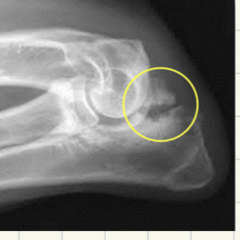
OA
What is this?
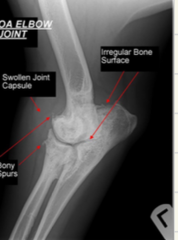
extensive bone formation around the joint, irregular joint surfaces and advanced degenerative change
CT helps us view what?
Minimal risk, high diagnostic yield
What is the risk level and diagnostic yield of arthrocentesis?
General anesthesia
What type of anesthesia is recommended for cats during arthrocentesis?
3-4 joints
How many joints should be analyzed if polyarthritis is suspected?
one carpus, one hock, and one stifle
Which specific joints should be included in the analysis for polyarthritis?
Sterile procedure
What is the procedure type for arthrocentesis?
Always aseptically prep and wear gloves
What is required for aseptic preparation during arthrocentesis?
1-3 drops
How much joint fluid is needed for viscosity determination and cell count?
cell count
What do you need a larger amount to test for during arthrocentesis?
Thick, viscous fluid secreted by the synovium.
What is normal synovial fluid?
Clear to slightly yellow.
What is the color of normal synovial fluid?
To lubricate articular surfaces and facilitate movement within the joint.
What is the primary function of normal synovial fluid?
No more than 3 WBCs.
What is the maximum number of WBCs per high-dry power (40x) field in normal synovial fluid?
A mix of large & small mononuclear cells.
What types of cells are present in normal synovial fluid?
Less than 10% neutrophils.
What percentage of neutrophils is found in normal synovial fluid?
1 neutrophil per 500 RBCs.
What does blood contamination indicate in terms of neutrophils in synovial fluid?
Hyaluronic acid and lubricin.
What molecules contribute to the composition of normal synovial fluid?
synovial fluid
What am I looking at ??
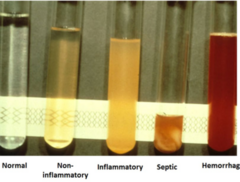
immediately
When should synovial fluid smears be prepared?
culture and sensitivity
what should additional drops of synovial fluid be submitted for?
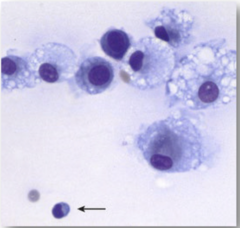
macrophages
what are these cells?
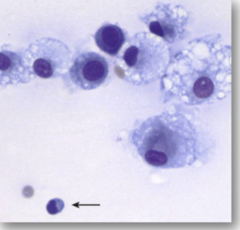
noninflammatory
Is this cytology consistent with normal, inflammatory, or noninflammatory joint disease?
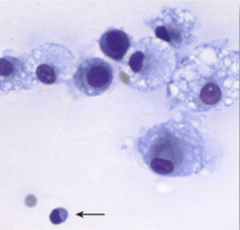
CCL tear
a common joint disease that is consistent with this cytology
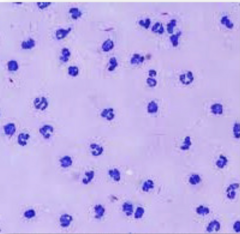
Neutrophils
what are these cells?
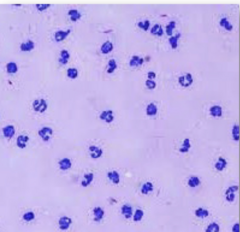
inflammatory
Is this cytology consistent with normal, inflammatory, or noninflammatory joint disease?
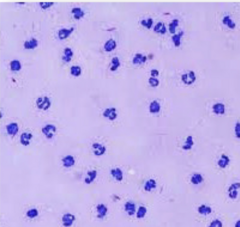
infectious disease or immune mediated
a common joint disease that is consistent with this cytology